igcse model questions vol1 2024 physics | Essay

Prepare for your exams with igcse model questions vol1 questions? Reviewing past/model questions is one of the most effective ways to guarantee a high score. This practice hub features authentic 2024 physics (Essay) questions designed to simulate the real exam environment.

Practice these randomly selected questions to test your readiness.
Question 1 View Details
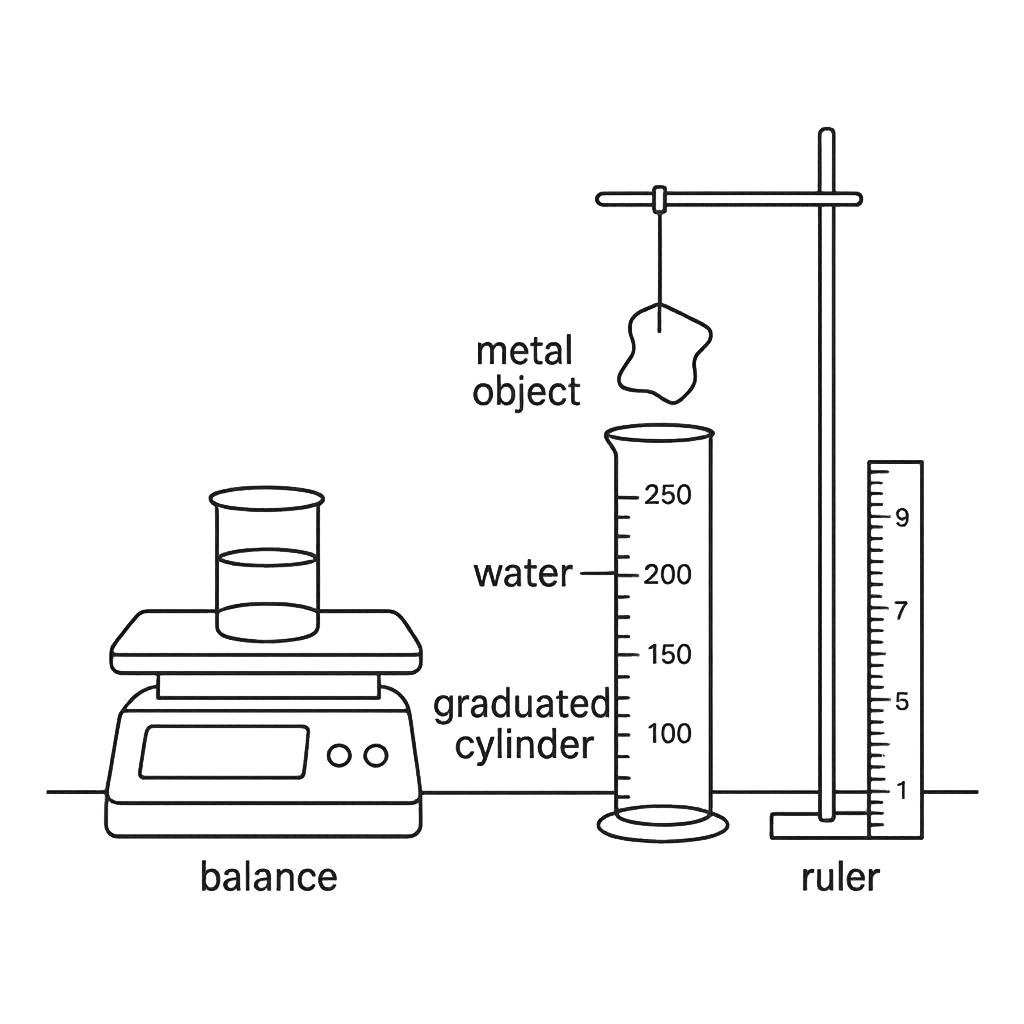
A student is required to determine the density of an irregular metal object using the experimental arrangement shown in the diagram.
Question Parts
(a)
Explain how the mass of the metal object should be measured with the balance, including any steps required to ensure accuracy.
(b)
Describe how the volume of the object can be obtained by the water‑displacement method using the graduated cylinder, and show how the volume is calculated from the readings provided.
(c)
Using the mass and volume obtained, calculate the density of the metal object. Then, compare the calculated density with typical densities of common metals (aluminium ≈ 2.7 g cm⁻³, copper ≈ 8.9 g cm⁻³, iron ≈ 7.9 g cm⁻³) and suggest the most likely material.
Detailed Essay Solution & Marking Scheme Available

Get the step-by-step mathematical proofs, key points required by examiners, and a comprehensive breakdown from our AI Tutor.
Question 2 View Details
A boat is attempting to cross a river that is 200 m wide. The speed of the river current is 2.0 m s⁻¹ downstream. The boat can travel at a speed of 5.0 m s⁻¹ relative to the still water and is aimed directly across the river.
Question Parts
(a)
Determine the magnitude of the boat’s resultant velocity relative to the ground and the angle it makes downstream from the straight‑across direction.
(b)
Calculate the time taken for the boat to reach the opposite bank.
(c)
Find how far downstream the boat will be when it reaches the opposite bank.
Detailed Essay Solution & Marking Scheme Available

Get the step-by-step mathematical proofs, key points required by examiners, and a comprehensive breakdown from our AI Tutor.
Question 3 View Details
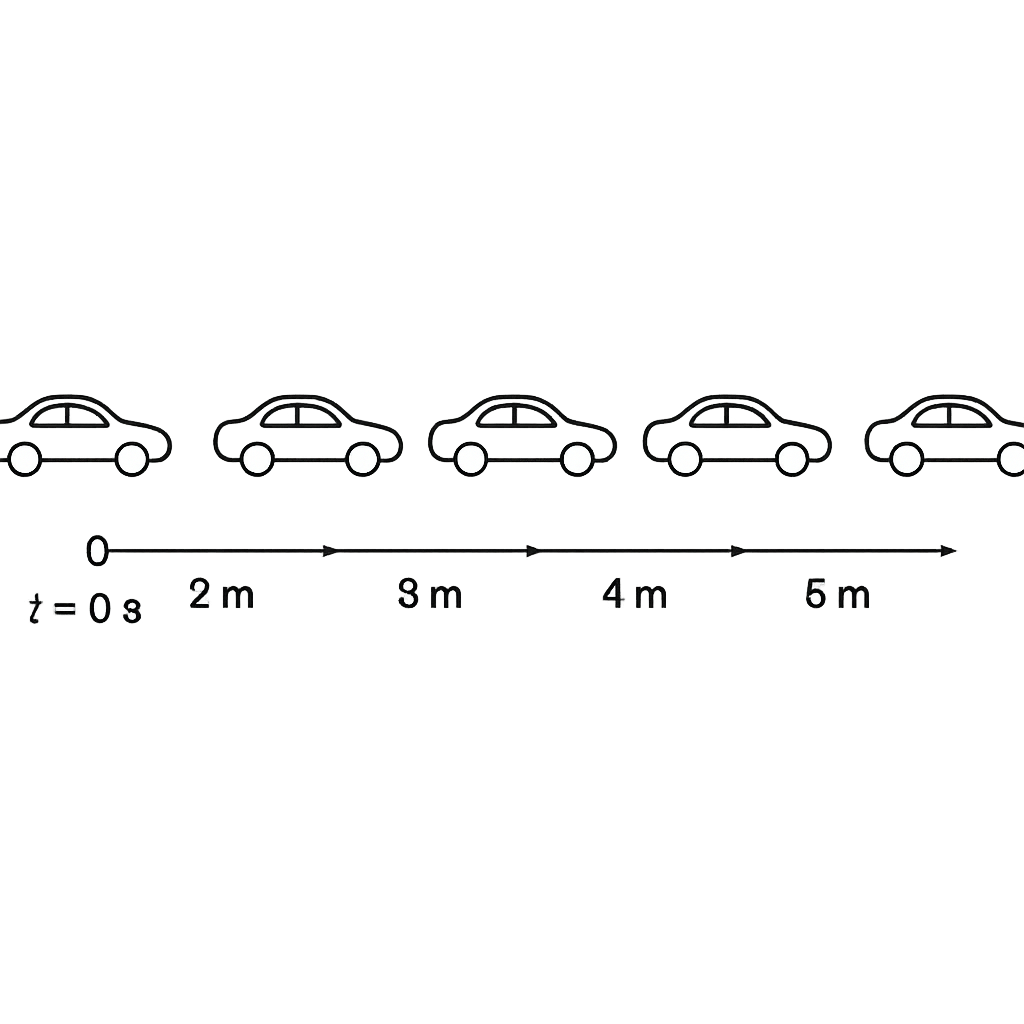
A motion diagram for a car moving in a straight line is shown. The diagram records the position of the car at successive 1‑second intervals. The distances between successive positions are 2 m, 3 m, 4 m and 5 m respectively.
Question Parts
(a)
State the type of motion exhibited by the car and give a brief justification.
(b)
Calculate the average speed of the car over the whole 4‑second interval.
(c)
Assuming the time interval between each recorded position is exactly 1 s, determine the magnitude of the car’s acceleration.
(d)
If the car started from rest and has a mass of 800 kg, calculate the net force that must have acted on it during the motion.
Detailed Essay Solution & Marking Scheme Available

Get the step-by-step mathematical proofs, key points required by examiners, and a comprehensive breakdown from our AI Tutor.

Question 4 View Details
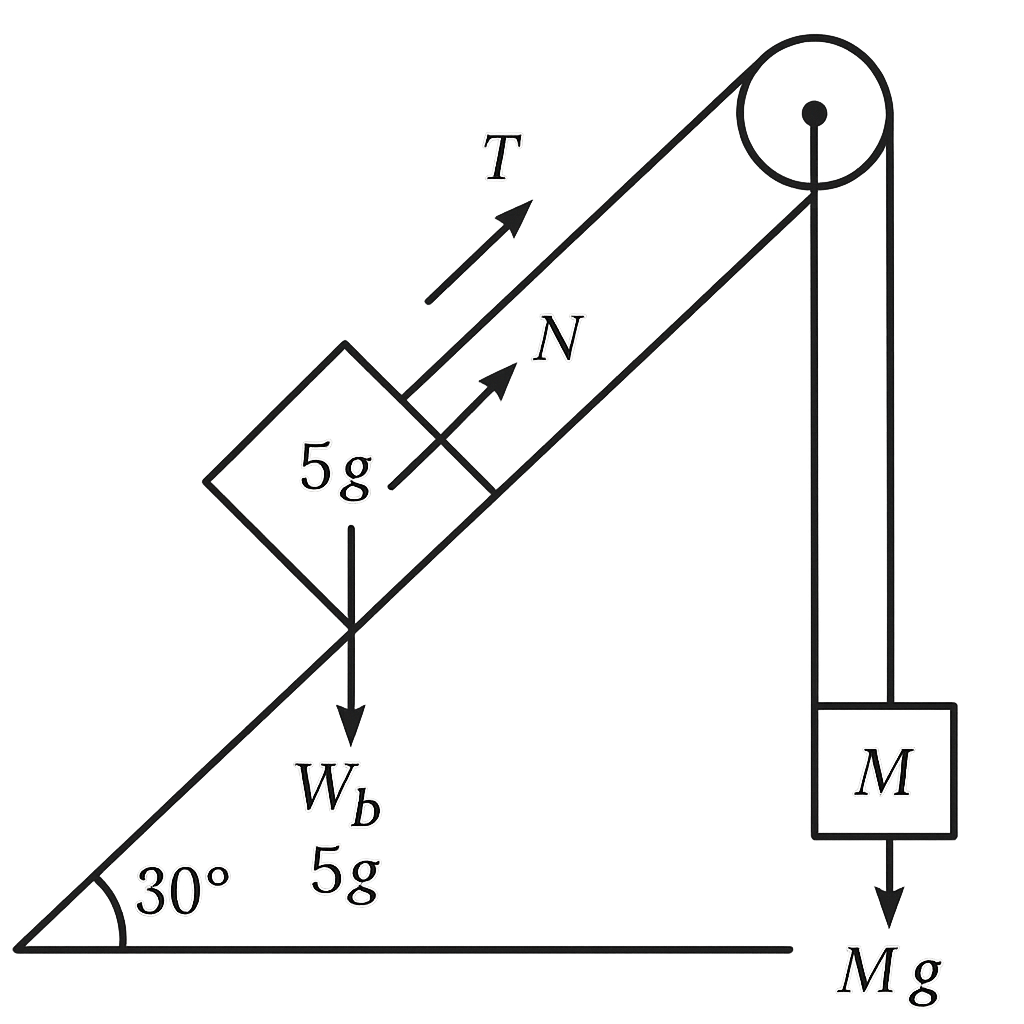
A 5.0 kg block rests on a smooth inclined plane that makes an angle of 30° with the horizontal. The block is attached to a light inextensible rope that passes over a frictionless pulley at the top of the incline and is connected to a hanging mass M. The rope is parallel to the plane. The kinetic coefficient of friction between the block and the plane is unknown. When the system is released the block moves up the plane with constant speed and the tension in the rope is measured to be 30 N. Using the force diagram provided, answer the following:
Question Parts
(a)
Determine the coefficient of kinetic friction (µₖ) between the block and the plane.
(b)
Find the mass M of the hanging weight.
(c)
If the hanging mass is increased to 8.0 kg, determine the acceleration of the block up the plane (assume the coefficient of kinetic friction found in part a remains unchanged).
Detailed Essay Solution & Marking Scheme Available

Get the step-by-step mathematical proofs, key points required by examiners, and a comprehensive breakdown from our AI Tutor.

Question 5 View Details
A 12 kg crate is pulled up a smooth 5.0 m long incline that makes an angle of 30° with the horizontal by a constant horizontal force of 150 N. The crate starts from rest at the bottom of the incline.
Question Parts
(a)
Calculate the work done by the horizontal pulling force.
(b)
Determine the increase in gravitational potential energy of the crate when it reaches the top of the incline.
(c)
Assuming the only forces doing work are the pulling force and gravity, find the speed of the crate at the top of the incline.
(d)
If the crate takes 4.0 s to travel from the bottom to the top, calculate the average power delivered by the pulling force.
Detailed Essay Solution & Marking Scheme Available

Get the step-by-step mathematical proofs, key points required by examiners, and a comprehensive breakdown from our AI Tutor.

Question 6 View Details
A system of pulleys is used to lift a load of 200 N. The effort applied to the rope is 80 N. While the load rises 2.0 m, the free end of the rope moves through 6.0 m.
Question Parts
(a)
Calculate the ideal mechanical advantage (IMA) of the pulley system.
(b)
Determine the actual mechanical advantage (AMA) of the system.
(c)
Find the efficiency of the pulley system expressed as a percentage.
(d)
If the load is raised through a vertical height of 3.0 m, calculate (i) the work done on the load, (ii) the work done by the effort, and (iii) comment on the energy loss in the system.
Detailed Essay Solution & Marking Scheme Available

Get the step-by-step mathematical proofs, key points required by examiners, and a comprehensive breakdown from our AI Tutor.

Question 7 View Details
A rectangular steel tank of internal dimensions 2.0 m (length) × 1.0 m (width) × 1.5 m (height) is filled with water. The tank has a small opening at the bottom that leads to a vertical pipe of length 0.8 m which discharges water to the atmosphere. The water temperature is 20 °C and the density of water is 1000 kg m⁻³. Atmospheric pressure is 1.01 × 10⁵ Pa.
Question Parts
(a)
Calculate the gauge pressure exerted by the water at the bottom of the tank (i.e. at the opening).
(b)
Assuming the flow is steady and neglecting losses, determine the speed of the water as it leaves the pipe using Bernoulli’s equation between the water surface in the tank and the pipe exit.
(c)
The tank is now fitted with a pressure gauge that reads absolute pressure at the bottom. If the gauge reading is 2.30 × 10⁵ Pa, determine whether any air is trapped above the water, and if so, calculate the pressure of the trapped air assuming it behaves as an ideal gas at constant temperature.
(d)
Discuss two practical reasons why the actual discharge speed might be lower than the theoretical speed calculated in part (b).
Detailed Essay Solution & Marking Scheme Available

Get the step-by-step mathematical proofs, key points required by examiners, and a comprehensive breakdown from our AI Tutor.

Question 8 View Details
A 0.250 kg block of aluminium (specific heat capacity 900 J kg⁻¹ K⁻¹) at 150 °C is placed in a well‑insulated copper calorimeter containing 0.500 kg of water at 25 °C. The specific heat capacity of water is 4180 J kg⁻¹ K⁻¹ and that of copper is 385 J kg⁻¹ K⁻¹. Assume no heat loss to the surroundings.
Question Parts
(a)
Write the energy‑balance equation for the system when thermal equilibrium is reached, clearly stating the terms representing heat lost and gained.
(b)
Calculate the final equilibrium temperature of the system.
(c)
After equilibrium is reached, the water is allowed to evaporate until 20 g of water has turned into steam at 100 °C. The latent heat of vaporisation of water is 2.26 × 10⁶ J kg⁻¹. Assuming the calorimeter and aluminium block remain at the temperature found in part (b), determine (i) the amount of heat removed from the system during this evaporation, and (ii) the new temperature of the aluminium block and copper calorimeter after the evaporation, assuming they lose heat only to the evaporating water.
Detailed Essay Solution & Marking Scheme Available

Get the step-by-step mathematical proofs, key points required by examiners, and a comprehensive breakdown from our AI Tutor.

Question 9 View Details
A sealed metal cylinder contains 0.150 mol of an ideal gas at a temperature of 300 K and a pressure of 1.00 × 10^5 Pa. The cylinder is placed in a water bath whose temperature is gradually increased. After heating, the pressure of the gas rises to 2.20 × 10^5 Pa and the volume of the cylinder (which can expand) is measured to be 2.5 times its original volume. The gas continues to behave ideally throughout the experiment.
Question Parts
(a)
Determine the final temperature of the gas in Kelvin and in degrees Celsius.
(b)
The temperature of the water bath is recorded with a thermometer that has a systematic error of +2.0 °C and a random error of ±0.5 °C. Using the temperature obtained in part (a), calculate the range of possible true temperatures of the water bath and state the maximum possible absolute error in the temperature measurement.
(c)
The metal cylinder has a coefficient of linear expansion α = 1.2 × 10⁻⁵ K⁻¹ and an original length of 0.200 m. Calculate the change in length of the cylinder caused by the temperature rise found in part (a). Comment on whether this dimensional change could significantly affect the pressure reading.
Detailed Essay Solution & Marking Scheme Available

Get the step-by-step mathematical proofs, key points required by examiners, and a comprehensive breakdown from our AI Tutor.

Question 10 View Details
A transverse sinusoidal wave travels to the right along a stretched string. The wave speed is 6.0 m s⁻¹, the wavelength is 0.30 m and the amplitude is 0.04 m. In the accompanying wave diagram two points, X and Y, are marked on the string such that the distance XY is 0.09 m, with X ahead of Y in the direction of propagation. The string is driven by a vertical oscillator that moves the string upward by 0.02 m from its equilibrium position. The tension in the string is 30 N and a 0.15 kg segment of the string is considered for part (d).
Question Parts
(a)
Calculate the period of the wave.
(b)
Determine the phase difference between points X and Y in degrees and in radians.
(c)
At the instant when point X is at its maximum upward displacement:
() State the phase angle of point Y relative to the reference phase of point X.
() Calculate the displacement of point Y, giving its magnitude and direction (upward or downward).
(d)
The string is driven by a vertical oscillator that moves the string upward by 0.02 m from its equilibrium position. Assuming the motion of the string is simple harmonic, calculate the maximum transverse force exerted on the 0.15 kg segment of the string. The tension in the string is 30 N.
Detailed Essay Solution & Marking Scheme Available

Get the step-by-step mathematical proofs, key points required by examiners, and a comprehensive breakdown from our AI Tutor.

Master the Exam!

You've seen a preview, but there are thousands more questions plus AI tutor to break down complex solutions.

Unlock Full Access Available for Android & Windows
Help others prepare! Share this practice hub:
Chat with Support