igcse model questions vol1 2024 chemistry | Objective

Prepare for your exams with igcse model questions vol1 questions? Reviewing past/model questions is one of the most effective ways to guarantee a high score. This practice hub features authentic 2024 chemistry (Objective) questions designed to simulate the real exam environment.

Practice these randomly selected questions to test your readiness.

Question 1 View Details
A 1.00 g sample of an unknown primary alcohol with the general formula \(C_{n}H_{2n+2}O\) is completely combusted. The combustion produces 1.20 g of water. Determine the value of \(n\) and write the molecular formula of the alcohol.
Correct A. C3H8O
B. C2H6O
C. C5H12O
D. C4H10O

Correct Answer: A

Want to see the full step-by-step solution? Unlock AI Explanation & Analytics
Question 2 View Details
A volatile compound contains by mass 52.14 % carbon, 13.13 % hydrogen and 34.73 % oxygen. Its molar mass is 184 g mol⁻¹. Determine its molecular formula.
A. C9H28O3
B. C7H20O5
C. C6H16O6
Correct D. C8H24O4

Correct Answer: D

Want to see the full step-by-step solution? Unlock AI Explanation & Analytics
Question 3 View Details
Arrange the following elements in order of increasing electronegativity: silicon (Si), phosphorus (P) and sulphur (S).
A. Si, S, P
B. P, S, Si
Correct C. Si, P, S
D. P, Si, S

Correct Answer: C

Want to see the full step-by-step solution? Unlock AI Explanation & Analytics
Question 4 View Details
A solution is prepared by dissolving 80.0 g of NaCl in 250 mL of water at 20 °C. The solubility of NaCl at 20 °C is 35.7 g per 100 mL, and at 0 °C it is 28.1 g per 100 mL. When the solution is cooled to 0 °C, how many grams of NaCl will precipitate?
Correct A. 9.75
B. 8.25
C. 10.5
D. 12.0

Correct Answer: A

Want to see the full step-by-step solution? Unlock AI Explanation & Analytics
Question 5 View Details
Chlorine gas reacts with excess sodium hydroxide solution to give sodium chloride, sodium chlorate and water according to the disproportionation reaction.\n\n(a) Write the balanced chemical equation.\n(b) If 10.0 g of \(Cl_{2}\) reacts with excess \(NaOH\), calculate the mass of sodium chloride produced.
A. 15.3
B. 12.5
Correct C. 13.7
D. 9.8

Correct Answer: C

Want to see the full step-by-step solution? Unlock AI Explanation & Analytics
Question 6 View Details
A 100.0 g sample of an ore consisting solely of a metal oxide with formula \(M_{2}O_{5}\) is reduced with carbon at high temperature. The reaction produces 56.0 g of the pure metal \(M\) and carbon dioxide gas. (a) Determine the atomic mass of the metal \(M\) (to one decimal place) and identify the metal from the periodic table. (b) If the theoretical mass of metal that could be obtained from 100.0 g of the ore is 60.0 g, calculate the percent yield of the actual reduction.
A. Atomic mass ≈ 50.9 g·mol⁻¹; metal = chromium; percent yield = 85.0 %
Correct B. Atomic mass ≈ 50.9 g·mol⁻¹; metal = vanadium; percent yield = 93.3 %
C. Atomic mass ≈ 48.0 g·mol⁻¹; metal = titanium; percent yield = 93.3 %
D. Atomic mass ≈ 55.8 g·mol⁻¹; metal = manganese; percent yield = 90.0 %

Correct Answer: B

Want to see the full step-by-step solution? Unlock AI Explanation & Analytics
Question 7 View Details
A buffer solution is prepared by dissolving 0.250 mol of acetic acid (\(K_{a}=1.8\times10^{-5}\)) and 0.150 mol of sodium acetate in enough water to make 1.00 L of solution. (a) Calculate the pH of the buffer. (b) How many moles of NaOH must be added (volume change negligible) to raise the pH to 5.00?
Correct A. pH = 4.52; NaOH required = 0.107 mol
B. pH = 4.30; NaOH required = 0.080 mol
C. pH = 4.70; NaOH required = 0.150 mol
D. pH = 4.52; NaOH required = 0.050 mol

Correct Answer: A

Want to see the full step-by-step solution? Unlock AI Explanation & Analytics
Question 8 View Details
Isobutylene (\((CH_{3})_{2}C=CH_{2}\)) is reacted with excess hydrogen bromide in the presence of peroxides at 25 °C. (a) Write the structural formula of the major product and give its IUPAC name. (b) If 10.0 g of isobutylene (M = 56.11 g·mol⁻¹) are used and the reaction is carried out with an 80 % isolated yield, what mass of product is obtained?
A. Product = 1‑bromo‑2‑methylpropane; mass obtained = 21.0 g
Correct B. Product = 1‑bromo‑2‑methylpropane; mass obtained = 19.5 g
C. Product = 2‑bromo‑2‑methylpropane; mass obtained = 19.5 g
D. Product = 1‑bromo‑2‑methylpropane; mass obtained = 17.3 g

Correct Answer: B

Want to see the full step-by-step solution? Unlock AI Explanation & Analytics
Question 9 View Details
A 0.250 g sample of an unknown organic compound containing only C, H and O is combusted completely. The combustion yields 0.366 g of carbon dioxide and 0.150 g of water. (a) Determine the empirical formula of the compound. (b) If the molar mass of the compound is known to be 180 g·mol⁻¹, calculate the number of moles present in the original sample.
A. Empirical formula = CH₃O; moles in sample = 1.39×10⁻³ mol
B. Empirical formula = C₂H₄O; moles in sample = 2.78×10⁻³ mol
Correct C. Empirical formula = CH₂O; moles in sample = 1.39×10⁻³ mol
D. Empirical formula = CH₂O; moles in sample = 2.00×10⁻³ mol

Correct Answer: C

Want to see the full step-by-step solution? Unlock AI Explanation & Analytics
Question 10 View Details
5.00 g of propan‑1‑ol (\(C_{3}H_{8}O\)) is oxidised with acidified potassium dichromate solution. After work‑up, 5.80 g of propanoic acid (\(C_{3}H_{6}O_{2}\)) is isolated. (a) Calculate the theoretical mass of propanoic acid that could be formed and the percent yield of the reaction. (b) If the same amount of propan‑1‑ol were oxidised with pyridinium chlorochromate (PCC) under anhydrous conditions, what would be the major product? State its IUPAC name.
A. Theoretical mass = 6.16 g; percent yield = 94.2 %; product with PCC = acetaldehyde
Correct B. Theoretical mass = 6.16 g; percent yield = 94.2 %; product with PCC = propanal
C. Theoretical mass = 5.80 g; percent yield = 94.2 %; product with PCC = propanal
D. Theoretical mass = 6.16 g; percent yield = 88.5 %; product with PCC = propanal

Correct Answer: B

Want to see the full step-by-step solution? Unlock AI Explanation & Analytics
Question 11 View Details
A \(0.20\) mol sample of ammonium chloride (NH\(_4\)Cl) is dissolved in \(250\) mL of water. The base dissociation constant of ammonia is \(K_b = 1.8 \times 10^{-5}\) and the ion‑product constant of water at 25 °C is \(K_w = 1.0 \times 10^{-14}\). Calculate the pH of the resulting solution.
A. 4.12
Correct B. 4.68
C. 5.03
D. 3.95

Correct Answer: B

Want to see the full step-by-step solution? Unlock AI Explanation & Analytics
Question 12 View Details
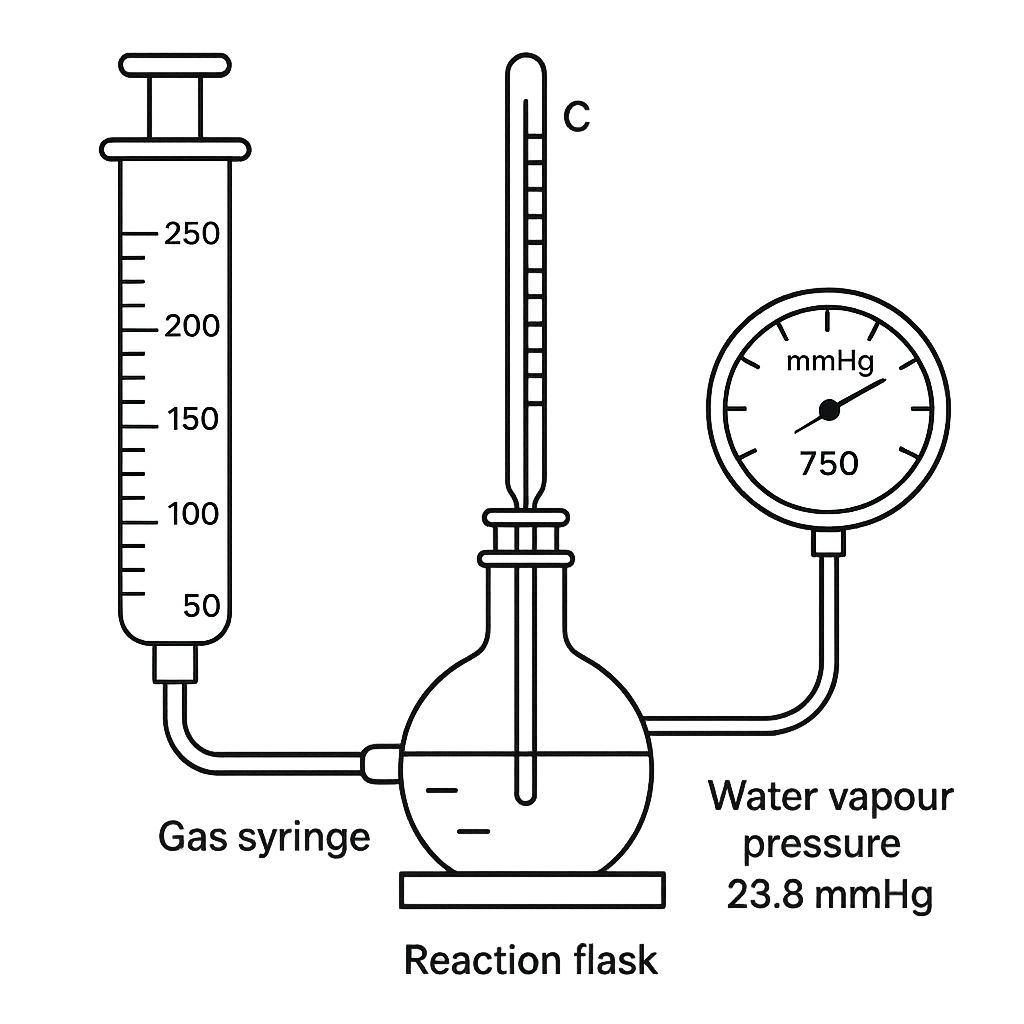
In the laboratory apparatus shown, hydrogen gas is collected over water. The gas syringe indicates a volume of \(120\) mL. The temperature reading on the thermometer is \(25\) °C and the pressure gauge reads \(750\) mmHg. The water vapour pressure at this temperature is \(23.8\) mmHg. Assuming the gas behaves ideally, calculate the number of moles of hydrogen collected. Give your answer in scientific notation to three significant figures.
A. 3.87×10⁻³ mol
B. 5.12×10⁻³ mol
Correct C. 4.69×10⁻³ mol
D. 4.69×10⁻⁴ mol

Correct Answer: C

Want to see the full step-by-step solution? Unlock AI Explanation & Analytics
Question 13 View Details
A \(2.00\) L sealed container at \(298\) K initially contains oxygen gas at a pressure of \(1.00\) atm. A sample of white phosphorus (P\(_4\)) is then introduced and allowed to react completely with the oxygen according to the equation \(\mathrm{P_4 + 5\,O_2 \rightarrow P_4O_{10}}\). After the reaction the total pressure in the container is measured to be \(0.65\) atm (temperature unchanged). Assuming no side reactions and that the volume of the container remains constant, calculate the mass of phosphorus that was originally placed in the container. Give your answer to three significant figures.
A. 1.12 g
B. 0.456 g
C. 0.754 g
Correct D. 0.886 g

Correct Answer: D

Want to see the full step-by-step solution? Unlock AI Explanation & Analytics
Question 14 View Details
An element is a metal located in period 4 and group 1 of the periodic table. It reacts vigorously with water to give a hydroxide and hydrogen gas. Identify the element and write its balanced reaction with water.
A. Calcium; \(\text{Ca} + 2\ \text{H}_2\text{O} \rightarrow \text{Ca(OH)}_2 + \text{H}_2\)
B. Potassium; \(2\ \text{K} + 2\ \text{H}_2\text{O} \rightarrow 2\ \text{KOH} + \text{H}_2\)
C. Lithium; \(2\ \text{Li} + 2\ \text{H}_2\text{O} \rightarrow 2\ \text{LiOH} + \text{H}_2\)
Correct D. Sodium; \(2\ \text{Na} + 2\ \text{H}_2\text{O} \rightarrow 2\ \text{NaOH} + \text{H}_2\)

Correct Answer: D

Want to see the full step-by-step solution? Unlock AI Explanation & Analytics
Question 15 View Details
A \(0.500\) g sample of a metal M is reacted with excess hydrochloric acid. The hydrogen gas produced is collected over water at \(298\) K and a total pressure of \(750\) mmHg. The water vapour pressure at this temperature is \(23.8\) mmHg and the volume of gas collected is \(85.0\) mL. The experiment is later found to have a \(78\)% yield of hydrogen relative to the theoretical amount. (M reacts according to \(\mathrm{M + 2\,HCl \rightarrow MCl_2 + H_2}\).) Determine the mass of metal M that actually took part in the reaction.
A. 0.150 g
Correct B. 0.115 g
C. 0.095 g
D. 0.130 g

Correct Answer: B

Want to see the full step-by-step solution? Unlock AI Explanation & Analytics
Question 16 View Details
Propanoic acid ((C_3H_6O_2), molar mass 74.08 g mol(^{-1})) is reacted with excess ethanol in the presence of (H_2SO_4) to form ethyl propanoate. During the reaction 10 % of the acid is lost to a side polymerisation, and the isolated product is only 70 % pure by mass. If 5.00 g of propanoic acid is mixed with 8.0 g of ethanol (molar mass 46.07 g mol(^{-1})), calculate the mass of pure ethyl propanoate obtained. (Molar mass of ethyl propanoate = 102.13 g mol(^{-1})).
A. 3.70 g
B. 4.02 g
C. 5.12 g
Correct D. 4.34 g

Correct Answer: D

Want to see the full step-by-step solution? Unlock AI Explanation & Analytics
Question 17 View Details
A galvanic cell consists of a zinc electrode in 1.0 M ZnSO₄ and a copper electrode in 0.10 M CuSO₄. Standard reduction potentials are \(E^{\circ}_{\text{Zn}^{2+}/\text{Zn}} = -0.76\) V and \(E^{\circ}_{\text{Cu}^{2+}/\text{Cu}} = +0.34\) V.\n(a) Calculate the cell EMF at 25 °C using the Nernst equation (assume \(n = 2\)).\n(b) If a current of 0.50 A is passed for 2.00 h and the current efficiency for copper deposition is 85 %, what mass of copper is actually deposited on the copper electrode? (Molar mass Cu = 63.55 g mol(^{-1})).
A. 0.88 g
Correct B. 1.01 g
C. 0.95 g
D. 1.15 g

Correct Answer: B

Want to see the full step-by-step solution? Unlock AI Explanation & Analytics
Question 18 View Details
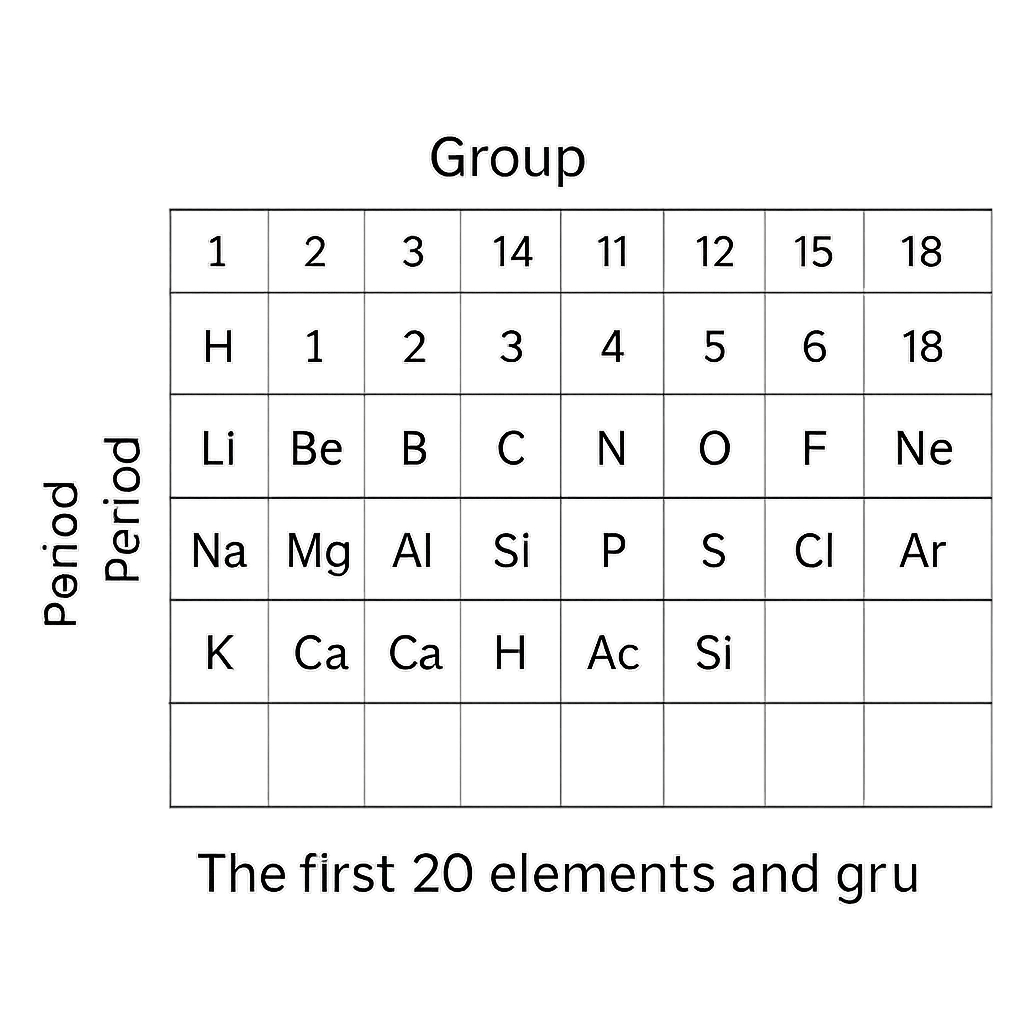
The diagram shows the first 20 elements of the periodic table with their symbols, atomic numbers, groups and periods. Which element in the diagram has the highest first ionisation energy?
A. Ne
Correct B. He
C. Be
D. Li

Correct Answer: B

Want to see the full step-by-step solution? Unlock AI Explanation & Analytics
Question 19 View Details
Aluminium reacts with hydrochloric acid according to \(2\,Al + 6\,HCl \rightarrow 2\,AlCl_{3} + 3\,H_{2}\). If 5.0 g of aluminium are used with excess HCl and only 85 % of the theoretical volume of hydrogen gas is collected at STP, what volume of \(H_{2}\) is actually collected? (Molar mass Al = 26.98 g mol(^{-1}); 1 mol gas at STP = 22.414 L).
A. 6.00 L
B. 4.50 L
Correct C. 5.29 L
D. 5.00 L

Correct Answer: C

Want to see the full step-by-step solution? Unlock AI Explanation & Analytics
Question 20 View Details
An isotope of chlorine has mass number 37 and atomic number 17. How many neutrons are present in this isotope?
A. 16
B. 23
C. 21
Correct D. 20

Correct Answer: D

Want to see the full step-by-step solution? Unlock AI Explanation & Analytics
Question 21 View Details
A sample of 2‑methyl‑1‑propanol (molecular formula \( \mathrm{C_4H_{10}O} \)) is first oxidised with PCC to give the corresponding aldehyde, and the aldehyde is then reacted with excess ethanol in the presence of sulphuric acid to form an acetal. Determine the molecular formula of the final acetal product.
A. C8H16O2
B. C8H18O3
Correct C. C8H18O2
D. C9H18O2

Correct Answer: C

Want to see the full step-by-step solution? Unlock AI Explanation & Analytics
Question 22 View Details
A rigid sealed container of fixed volume holds 0.5 mol of nitrogen gas at \(298 \text{ K}\) and a pressure of \(1.0 \text{ atm}\). Water is then added and the temperature is raised to \(350 \text{ K}\). At this temperature the vapour pressure of water is \(0.50 \text{ atm}\). Assuming ideal‑gas behaviour and that the water vapour reaches equilibrium, calculate the total pressure in the container at \(350 \text{ K}\).
A. 1.75 atm
B. 1.50 atm
C. 2.00 atm
Correct D. 1.67 atm

Correct Answer: D

Want to see the full step-by-step solution? Unlock AI Explanation & Analytics
Question 23 View Details
In the reaction \(2\mathrm{Al} + 6\mathrm{HCl} \rightarrow 2\mathrm{AlCl_3} + 3\mathrm{H_2}\), 5.0 g of aluminium are mixed with 10.0 g of hydrochloric acid. Calculate the mass of hydrogen gas produced.
A. 0.22 g
Correct B. 0.28 g
C. 0.40 g
D. 0.31 g

Correct Answer: B

Want to see the full step-by-step solution? Unlock AI Explanation & Analytics
Question 24 View Details
A hydrocarbon containing only carbon and hydrogen is burnt completely in excess oxygen. The combustion yields \(44.8 \text{ g}\) of carbon dioxide and \(18.0 \text{ g}\) of water. Determine the empirical formula of the hydrocarbon.
Correct A. CH2
B. CH3
C. C2H2
D. C2H4

Correct Answer: A

Want to see the full step-by-step solution? Unlock AI Explanation & Analytics
Question 25 View Details
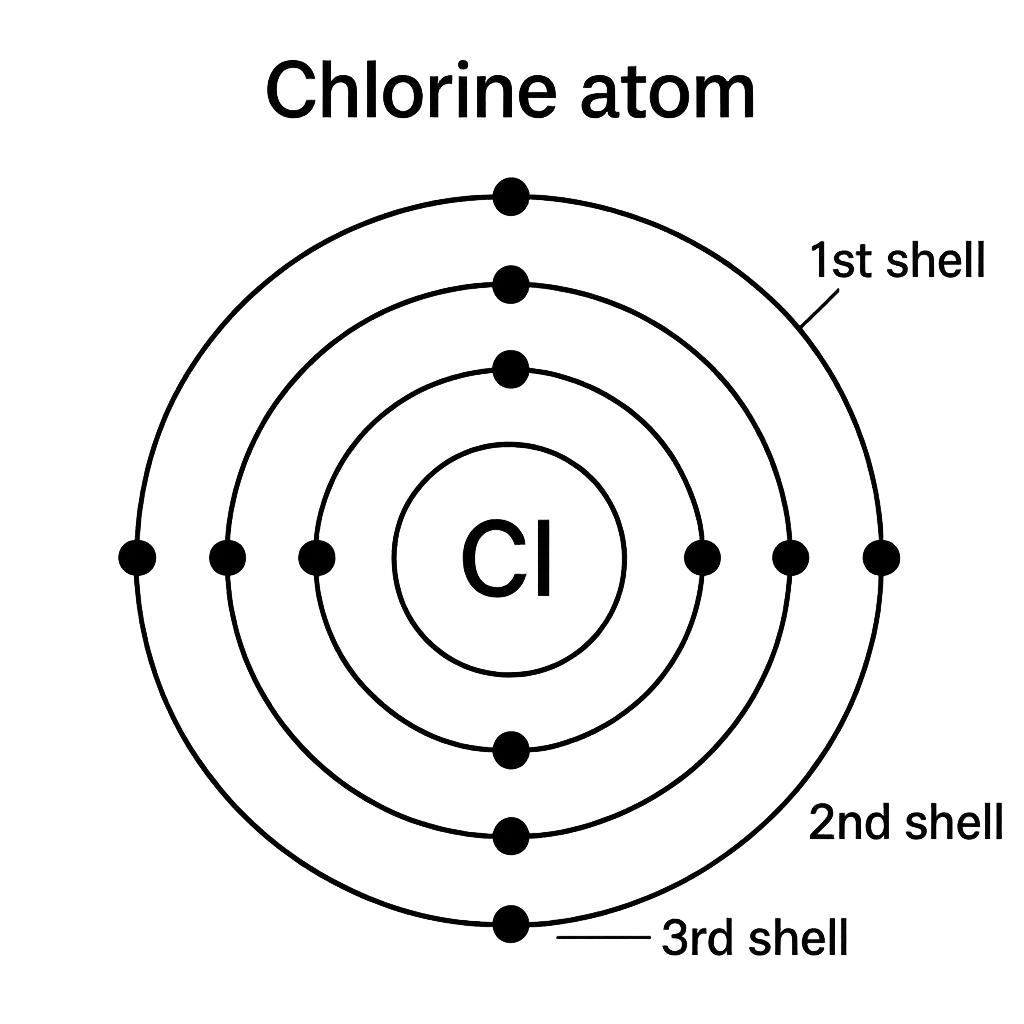
The diagram shows a Bohr model of a chlorine atom. How many valence electrons does this atom have?
A. 5
B. 8
C. 6
Correct D. 7

Correct Answer: D

Want to see the full step-by-step solution? Unlock AI Explanation & Analytics

Master the Exam!

You've seen a preview, but there are thousands more questions plus AI tutor to break down complex solutions.

Unlock Full Access Available for Android & Windows
Help others prepare! Share this practice hub:
Chat with Support