igcse model questions vol1 2024 biology | Objective

Prepare for your exams with igcse model questions vol1 questions? Reviewing past/model questions is one of the most effective ways to guarantee a high score. This practice hub features authentic 2024 biology (Objective) questions designed to simulate the real exam environment.

Practice these randomly selected questions to test your readiness.

Question 1 View Details
An adult at rest has a tidal volume of \(500\) mL and a respiratory rate of \(12\) breaths per minute. The anatomical dead‑space volume is \(150\) mL per breath. The fraction of oxygen in inhaled air is \(0.21\) and in exhaled air is \(0.16\). Calculate the volume of oxygen taken up per minute (in mL).
A. 180 mL/min
B. 195 mL/min
C. 240 mL/min
Correct D. 210 mL/min

Correct Answer: D

Want to see the full step-by-step solution? Unlock AI Explanation & Analytics
Question 2 View Details
In a community, 5 % of bacterial strains are resistant to a certain antibiotic. Respiratory infections are bacterial in 80 % of cases; the remaining 20 % are viral and do not respond to antibiotics. Antibiotic A cures 90 % of infections caused by non‑resistant bacteria and is ineffective against resistant strains. Antibiotic B cures 70 % of non‑resistant infections and 50 % of resistant infections. Assuming each patient receives only one antibiotic, calculate the overall cure rate (as a percentage) for each antibiotic and state which antibiotic gives the higher expected cure rate.
A. Antibiotic A: 68.4 %; Antibiotic B: 55.2 %; Antibiotic B gives the higher cure rate
Correct B. Antibiotic A: 68.4 %; Antibiotic B: 55.2 %; Antibiotic A gives the higher cure rate
C. Antibiotic A: 65.0 %; Antibiotic B: 60.0 %; Antibiotic A gives the higher cure rate
D. Antibiotic A: 70.2 %; Antibiotic B: 58.0 %; Antibiotic A gives the higher cure rate

Correct Answer: B

Want to see the full step-by-step solution? Unlock AI Explanation & Analytics
Question 3 View Details
The nerve impulse that triggers a withdrawal reflex travels at a speed of \(60\ \text{m s}^{-1}\) over a distance of \(1.2\ \text{m}\) from the spinal cord to the foot muscle. The pathway includes two synapses, each introducing a delay of \(0.5\ \text{ms}\). After the impulse reaches the muscle, the muscle takes \(30\ \text{ms}\) to contract. Determine the total time from the initial stimulus to the start of muscle contraction, expressed in milliseconds.
Correct A. 51 ms
B. 50 ms
C. 55 ms
D. 21 ms

Correct Answer: A

Want to see the full step-by-step solution? Unlock AI Explanation & Analytics
Question 4 View Details
Two desert plant species differ in leaf morphology. Species A has a leaf area of \(200\ \text{cm}^2\) and a stomatal density of \(300\) stomata per \(\text{mm}^2\). Each stomata loses \(0.05\ \mu\text{L}\) of water per hour. Species B has a leaf area of \(150\ \text{cm}^2\) and a stomatal density of \(200\) stomata per \(\text{mm}^2\). Each stomata loses \(0.07\ \mu\text{L}\) of water per hour. Calculate the total water loss per hour for each species (in millilitres) and indicate which species loses less water.
A. Species A: 3 mL h⁻¹; Species B: 2.1 mL h⁻¹; Species B loses less water
B. Species A: 200 mL h⁻¹; Species B: 315 mL h⁻¹; Species A loses less water
C. Species A: 300000 mL h⁻¹; Species B: 210000 mL h⁻¹; Species B loses less water
Correct D. Species A: 300 mL h⁻¹; Species B: 210 mL h⁻¹; Species B loses less water

Correct Answer: D

Want to see the full step-by-step solution? Unlock AI Explanation & Analytics
Question 5 View Details
In a certain artery (Artery A) the radius is \(2.0\ \text{mm}\) and the blood flow rate is \(500\ \text{mL min}^{-1}\). Assuming the pressure gradient and blood viscosity are the same, what is the expected flow rate in a second artery (Artery B) whose radius is \(1.5\ \text{mm}\)? Give your answer to the nearest whole millilitre per minute.
A. 212 mL/min
B. 281 mL/min
Correct C. 158 mL/min
D. 119 mL/min

Correct Answer: C

Want to see the full step-by-step solution? Unlock AI Explanation & Analytics
Question 6 View Details
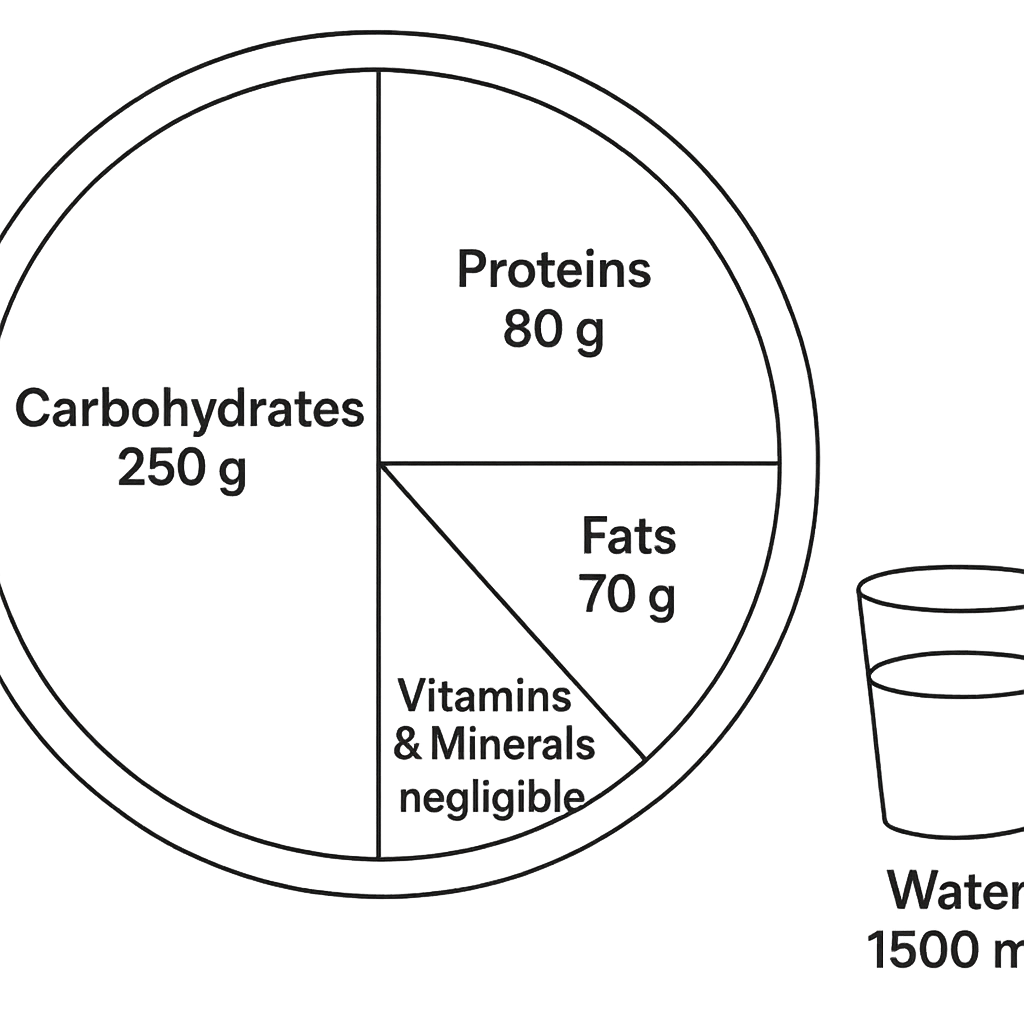
The labelled diagram of a balanced diet plate shows the following amounts of each food group: Carbohydrates \(250\ \text{g}\), Proteins \(80\ \text{g}\), Fats \(70\ \text{g}\), Vitamins & Minerals (negligible energy), and Water \(1500\ \text{ml}\). The energy values are \(4\ \text{kcal\,g}^{-1}\) for carbohydrates and proteins and \(9\ \text{kcal\,g}^{-1}\) for fats. Calculate the percentage of the total caloric intake that is supplied by proteins. Give your answer to one decimal place.
A. 12.5
B. 14.2
C. 18.7
Correct D. 16.4

Correct Answer: D

Want to see the full step-by-step solution? Unlock AI Explanation & Analytics
Question 7 View Details
In a bacterial culture the population was \(1.2 \times 10^{6}\) cells after 2 h and \(9.6 \times 10^{6}\) cells after 5 h. Assuming exponential growth during this interval, determine the generation time in minutes and state how many generations would occur in a 10‑hour period.
A. 75 minutes; 12 generations
Correct B. 60 minutes; 10 generations
C. 45 minutes; 8 generations
D. 30 minutes; 5 generations

Correct Answer: B

Want to see the full step-by-step solution? Unlock AI Explanation & Analytics
Question 8 View Details
The following characteristics are observed for three unknown organisms. Identify the kingdom (Monera, Protista, Fungi, Plantae, or Animalia) to which each organism belongs. - Organism X: eukaryotic cells, cell wall composed of chitin, heterotrophic, absorbs nutrients, reproduces by spores. - Organism Y: prokaryotic cells, cell wall of peptidoglycan, heterotrophic, reproduces by binary fission. - Organism Z: eukaryotic cells, cell wall of cellulose, contains chloroplasts, autotrophic, reproduces by seeds.
A. X: Protista; Y: Monera; Z: Plantae
B. X: Fungi; Y: Monera; Z: Animalia
Correct C. X: Fungi; Y: Monera; Z: Plantae
D. X: Fungi; Y: Protista; Z: Plantae

Correct Answer: C

Want to see the full step-by-step solution? Unlock AI Explanation & Analytics
Question 9 View Details
A phylogenetic analysis of four species (A, B, C, D) is based on the presence (✓) or absence (✗) of four traits: | Trait | A | B | C | D | |-------|---|---|---|---| | 1 (fur) | ✓ | ✓ | ✗ | ✗ | | 2 (lays eggs) | ✗ | ✗ | ✓ | ✓ | | 3 (gills) | ✗ | ✓ | ✓ | ✗ | | 4 (backbone) | ✓ | ✓ | ✗ | ✗ | Using the principle of maximum parsimony, which two species are most likely to be sister taxa, and list the synapomorphic traits that support this relationship.
A. C and D; traits: lays eggs (Trait 2) and gills (Trait 3)
B. A and B; traits: lays eggs (Trait 2) and gills (Trait 3)
C. A and C; traits: fur (Trait 1) and backbone (Trait 4)
Correct D. A and B; traits: fur (Trait 1) and backbone (Trait 4)

Correct Answer: D

Want to see the full step-by-step solution? Unlock AI Explanation & Analytics
Question 10 View Details
In an experiment a hormone is released into the bloodstream after a stimulus. Its concentration rises linearly from 0 to \(0.8\ \mu\text{g\,ml}^{-1}\) during the first 30 s and then declines exponentially with a half‑life of 45 s. The hormone increases heart rate proportionally: at a concentration of \(0.8\ \mu\text{g\,ml}^{-1}\) the rate rises from 70 bpm to 110 bpm. Calculate the heart rate 90 s after the stimulus.
A. 92
B. 81
C. 78
Correct D. 86

Correct Answer: D

Want to see the full step-by-step solution? Unlock AI Explanation & Analytics
Question 11 View Details
A resting adult consumes \(250\ \text{mL O}_2\) per minute and produces \(200\ \text{mL CO}_2\) per minute. Assuming that carbohydrate metabolism gives a respiratory quotient (RQ) of \(1.0\) and fat metabolism gives an RQ of \(0.7\), determine the approximate percentage of the energy that is derived from carbohydrate and from fat.
A. ≈50 % carbohydrate and 50 % fat
Correct B. ≈33 % carbohydrate and 67 % fat
C. ≈25 % carbohydrate and 75 % fat
D. ≈40 % carbohydrate and 60 % fat

Correct Answer: B

Want to see the full step-by-step solution? Unlock AI Explanation & Analytics
Question 12 View Details
In a beetle population the allele \(A\) (dominant, green colour) and allele \(a\) (recessive, brown colour) have initial frequencies \(p = 0.6\) and \(q = 0.4\). The relative fitnesses of the three genotypes are: \(w(AA)=0.5\), \(w(Aa)=0.8\), \(w(aa)=1.0\).\n(i) Calculate the allele frequency of \(A\) after one generation of selection.\n(ii) Assuming random mating in the next generation, what proportion of the offspring are expected to be green (genotypes \(AA\) or \(Aa\))?
A. p' ≈ 0.60; about 70 % of offspring will be green
Correct B. p' ≈ 0.514; about 76 % of offspring will be green
C. p' ≈ 0.48; about 82 % of offspring will be green
D. p' ≈ 0.55; about 68 % of offspring will be green

Correct Answer: B

Want to see the full step-by-step solution? Unlock AI Explanation & Analytics
Question 13 View Details
The following table shows average concentrations of estrogen (E₂) and progesterone (P₄) in a woman's menstrual cycle.\n\n| Day | E₂ (ng mL⁻¹) | P₄ (ng mL⁻¹) |\n|-----|--------------|--------------|\n| 1 | 30 | 1 |\n| 7 | 120 | 2 |\n| 14 | 350 | 5 |\n| 21 | 150 | 20 |\n| 28 | 40 | 10 |\n\nBased on these data, (i) on which day is ovulation most likely to occur, and (ii) which hormone is primarily responsible for the surge that triggers ovulation?
A. Day 7; estrogen
B. Day 21; estrogen
C. Day 14; progesterone
Correct D. Day 14; estrogen

Correct Answer: D

Want to see the full step-by-step solution? Unlock AI Explanation & Analytics
Question 14 View Details
A kidney filters plasma at a glomerular filtration rate (GFR) of \(180\ \text{mL min}^{-1}\). The plasma glucose concentration is \(7\ \text{mmol L}^{-1}\), and \(99\%\) of the filtered glucose is re‑absorbed in the proximal tubule. Calculate the amount of glucose excreted in the urine per hour (in mmol).
A. ≈0.07 mmol h⁻¹
Correct B. ≈0.76 mmol h⁻¹
C. ≈7.6 mmol h⁻¹
D. ≈0.8 mmol h⁻¹

Correct Answer: B

Want to see the full step-by-step solution? Unlock AI Explanation & Analytics
Question 15 View Details
Two parallel capillary networks (A and B) have the same length of \(1\ \text{mm}\) and carry blood of viscosity \(\eta = 3.5 \times 10^{-3}\ \text{Pa·s}\). Network A has a radius of \(5\ \mu\text{m}\), while network B has a radius of \(3\ \mu\text{m}\). Assuming laminar flow and that the pressure drop across each network is the same, use Poiseuille's law (flow \(Q \propto r^{4}\)) to determine the ratio of the volumetric flow in network A to that in network B.
A. ≈9.8 : 1
B. ≈6.3 : 1
Correct C. ≈7.7 : 1
D. ≈5.2 : 1

Correct Answer: C

Want to see the full step-by-step solution? Unlock AI Explanation & Analytics
Question 16 View Details
In a typical 28‑day menstrual cycle, the concentration of estrogen rises linearly from \(120\ \text{pg\ mL}^{-1}\) on day 5 to \(200\ \text{pg\ mL}^{-1}\) on day 9. The luteinising hormone (LH) surge that triggers ovulation begins as soon as the estrogen concentration exceeds \(175\ \text{pg\ mL}^{-1}\). Ovulation occurs 24-36 h after the start of the LH surge. On which day of the cycle is ovulation most likely to occur?
Correct A. 9
B. 11
C. 8
D. 10

Correct Answer: A

Want to see the full step-by-step solution? Unlock AI Explanation & Analytics
Question 17 View Details
A plant cell originally has a vacuole volume of \(120\ \mu\text{m}^3\). After being placed in a hypertonic solution for 30 minutes, the vacuole loses 40 % of its water content. What is the final volume of the vacuole (in \(\mu\text{m}^3\))?
A. 84
B. 68
Correct C. 72
D. 90

Correct Answer: C

Want to see the full step-by-step solution? Unlock AI Explanation & Analytics
Question 18 View Details
During a 30‑minute run, a person generates metabolic heat at a rate of \(800\ \text{W}\). The runner sweats at a rate of \(0.5\ \text{L\ h}^{-1}\). The latent heat of vapourisation of water is \(2.43\ \text{MJ\ kg}^{-1}\). Assuming the density of sweat is \(1.0\ \text{kg\ L}^{-1}\), calculate the amount of heat removed by evaporation during the run and state whether this evaporative cooling is sufficient to dissipate all the metabolic heat produced. If it is not sufficient, indicate how much heat (in MJ) remains to be dissipated by other mechanisms.
A. 0.40
B. 1.02
C. 0.65
Correct D. 0.83

Correct Answer: D

Want to see the full step-by-step solution? Unlock AI Explanation & Analytics
Question 19 View Details
Three organisms have the following characteristics: *Organism A*: unicellular, prokaryotic, cell wall contains peptidoglycan, reproduces by binary fission, obtains energy by photosynthesis using chlorophyll a. *Organism B*: multicellular, eukaryotic, cell walls contain cellulose, reproduces via seeds, possesses chloroplasts with thylakoids, stores starch. *Organism C*: multicellular, eukaryotic, cell walls contain chitin, reproduces by spores, obtains nutrients by absorption, has hyphae. Identify the kingdom (Monera, Plantae, or Fungi) to which each organism belongs and give one key piece of evidence that justifies each classification.
A. A: Plantae; B: Monera; C: Fungi
B. A: Monera; B: Fungi; C: Plantae
Correct C. A: Monera; B: Plantae; C: Fungi
D. A: Fungi; B: Plantae; C: Monera

Correct Answer: C

Want to see the full step-by-step solution? Unlock AI Explanation & Analytics
Question 20 View Details
After a meal, a person's blood glucose concentration rises to \(9\ \text{mmol\ L}^{-1}\). At that moment, insulin concentration is \(5\ \mu\text{U\ mL}^{-1}\) and glucagon concentration is \(2\ \text{pg\ mL}^{-1}\). Each \(\mu\text{U\ mL}^{-1}\) of insulin lowers blood glucose by \(0.4\ \text{mmol\ L}^{-1}\) per hour, while each \(\text{pg\ mL}^{-1}\) of glucagon raises blood glucose by \(0.1\ \text{mmol\ L}^{-1}\) per hour. Assuming no further food intake, what will the blood glucose concentration be after 2 hours?
Correct A. 5.4
B. 5.0
C. 7.2
D. 4.6

Correct Answer: A

Want to see the full step-by-step solution? Unlock AI Explanation & Analytics
Question 21 View Details
A man with an X‑linked recessive disorder (genotype \(X^{h}Y\)) marries a woman who is a carrier (genotype \(X^{H}X^{h}\)). They have three children: two sons and one daughter. Assuming independent segregation of sex chromosomes, calculate the probability that (i) exactly one of the sons is affected by the disorder, and (ii) the daughter is a carrier. Give the combined probability that both events occur.
A. 1/8
Correct B. 1/4
C. 3/4
D. 1/2

Correct Answer: B

Want to see the full step-by-step solution? Unlock AI Explanation & Analytics
Question 22 View Details
The kidneys filter plasma at a rate of \(180\ \text{mL min}^{-1}\). The plasma glucose concentration is \(7\ \text{mmol L}^{-1}\). The proximal tubule can reabsorb glucose up to a maximum of \(0.5\ \text{mmol min}^{-1}\); any glucose beyond this amount is excreted in the urine. Calculate the rate at which glucose is excreted (in \(\text{mmol min}^{-1}\)).
A. 0.86
B. 0.5
Correct C. 0.76
D. 1.2

Correct Answer: C

Want to see the full step-by-step solution? Unlock AI Explanation & Analytics
Question 23 View Details
A fish population in a lake follows logistic growth described by \(\frac{dN}{dt}=rN\left(1-\frac{N}{K}\right)\). The intrinsic growth rate is \(r = 0.4\ \text{month}^{-1}\) and the carrying capacity is \(K = 10\,000\) fish. (a) Determine the maximum sustainable harvest rate \(H_{\max}\) (in fish per month) that can be removed constantly while keeping the population at equilibrium, and state the corresponding equilibrium population size. (b) If a drought reduces the carrying capacity to \(K' = 8\,000\) fish while \(r\) remains unchanged, calculate the new maximum sustainable harvest \(H'_{\max}\) and the percentage change in the sustainable harvest compared with the original value.
A. (a) \(H_{\max}=1000\) fish\/month, equilibrium \(N=4000\) fish; (b) \(H'_{\max}=800\) fish\/month, a 10 % decrease
B. (a) \(H_{\max}=1200\) fish\/month, equilibrium \(N=6000\) fish; (b) \(H'_{\max}=960\) fish\/month, a 20 % increase
C. (a) \(H_{\max}=800\) fish\/month, equilibrium \(N=4000\) fish; (b) \(H'_{\max}=640\) fish\/month, a 20 % decrease
Correct D. (a) \(H_{\max}=1000\) fish/month, equilibrium \(N=5000\) fish; (b) \(H'_{\max}=800\) fish/month, a 20 % decrease

Correct Answer: D

Want to see the full step-by-step solution? Unlock AI Explanation & Analytics
Question 24 View Details
The kidneys filter \(180\ \text{L}\) of plasma per day. Plasma osmolality is \(300\ \text{mOsm kg}^{-1}\). The renal tubules reabsorb \(95\%\) of the filtered solutes. The person produces \(1.2\ \text{L}\) of urine per day. Assuming that the urine osmolality equals the amount of solute excreted divided by urine volume, calculate the urine osmolality (in \(\text{mOsm L}^{-1}\)).
A. 2000
B. 2700
Correct C. 2250
D. 2500

Correct Answer: C

Want to see the full step-by-step solution? Unlock AI Explanation & Analytics
Question 25 View Details
Which organelle is described as having a double membrane, containing inner folds called cristae, and is the site of aerobic respiration in eukaryotic cells?
A. chloroplast
B. nucleus
C. ribosome
Correct D. mitochondrion

Correct Answer: D

Want to see the full step-by-step solution? Unlock AI Explanation & Analytics

Master the Exam!

You've seen a preview, but there are thousands more questions plus AI tutor to break down complex solutions.

Unlock Full Access Available for Android & Windows
Help others prepare! Share this practice hub:
Chat with Support