igcse model questions vol1 2024 biology | Essay

Prepare for your exams with igcse model questions vol1 questions? Reviewing past/model questions is one of the most effective ways to guarantee a high score. This practice hub features authentic 2024 biology (Essay) questions designed to simulate the real exam environment.

Practice these randomly selected questions to test your readiness.
Question 1 View Details
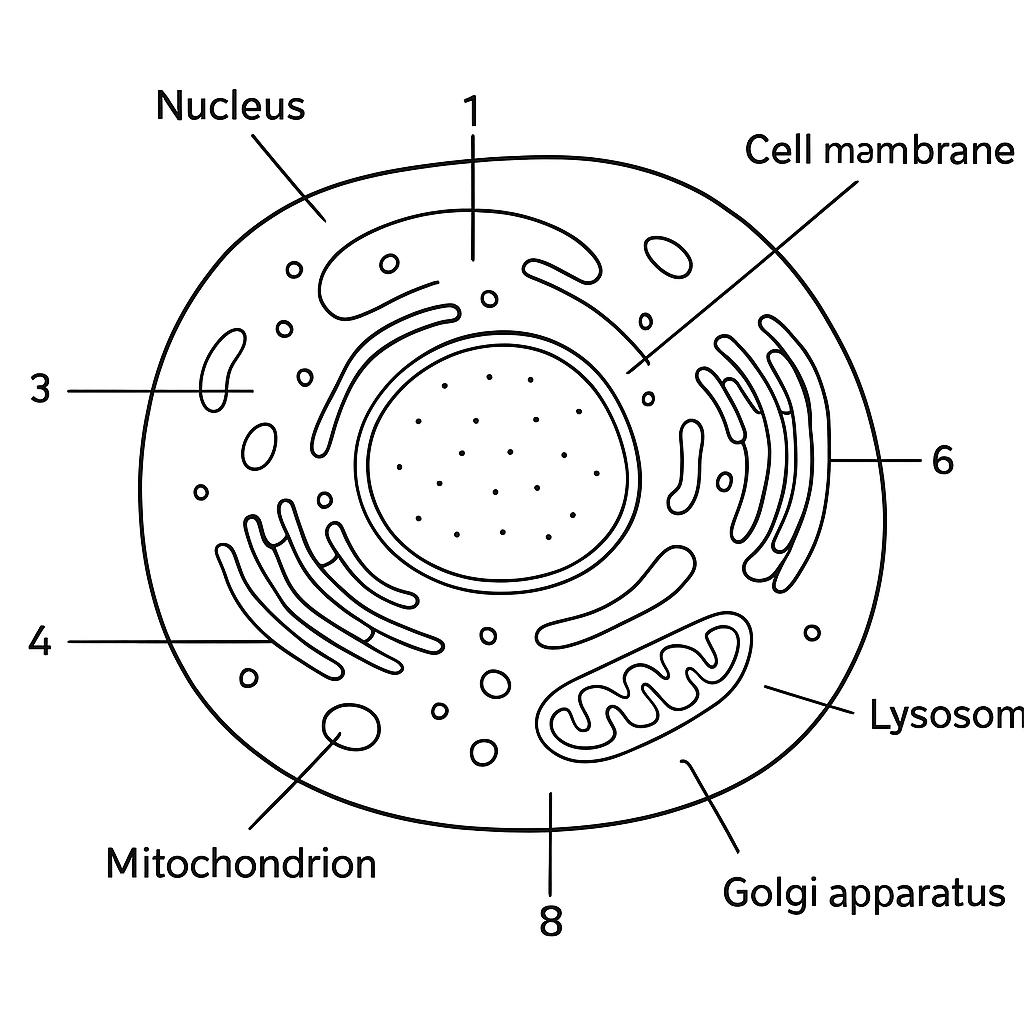
The diagram shows a typical animal cell with its major organelles labelled.
Question Parts
(a)
Identify the organelles labelled 1–8 in the diagram.
(b)
For each organelle listed in part (a), give one essential function.
(c)
Explain how the structure of the mitochondrion enables its function of ATP production.
(d)
Compare the cell shown with a typical plant cell, mentioning at least three structural differences and the functional significance of each difference.
Detailed Essay Solution & Marking Scheme Available

Get the step-by-step mathematical proofs, key points required by examiners, and a comprehensive breakdown from our AI Tutor.
Question 2 View Details
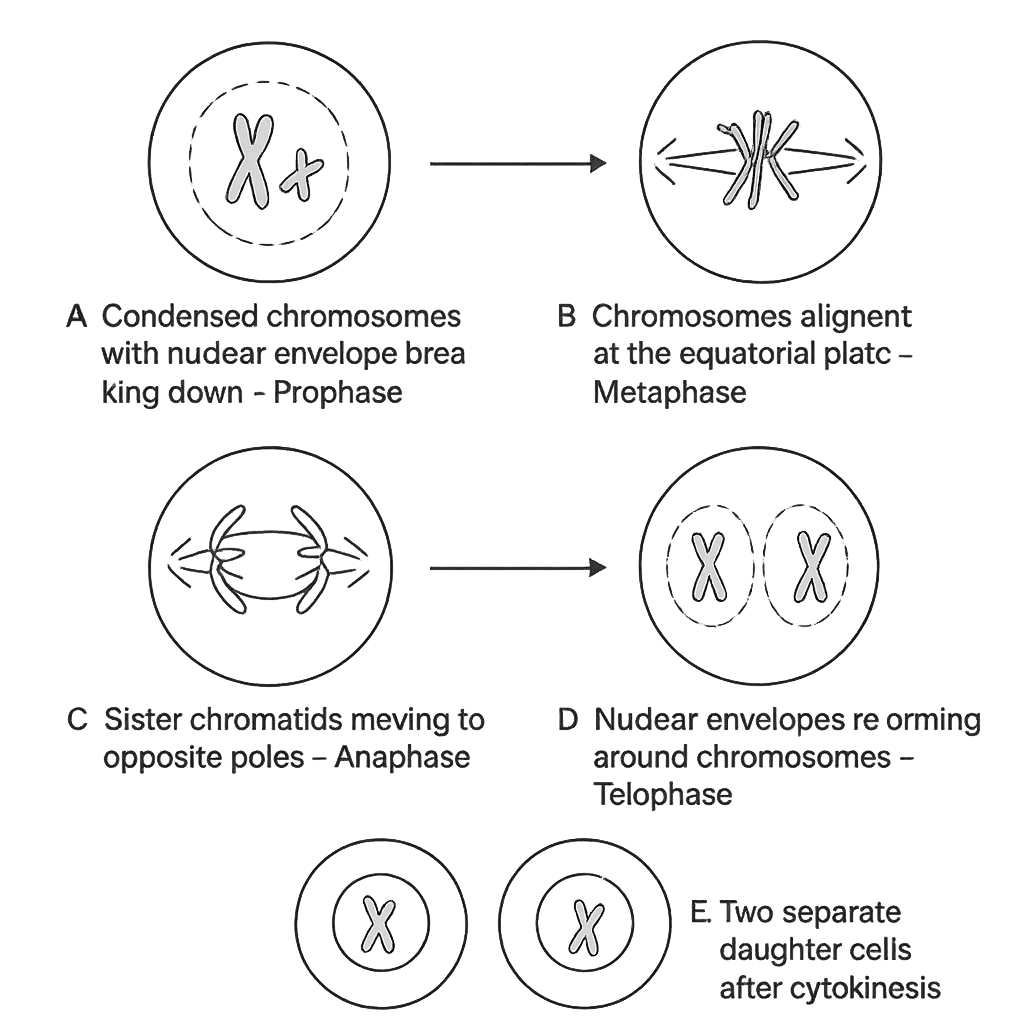
The labelled diagram shows the sequential stages of mitosis in a typical animal cell. Each part (A–E) highlights a characteristic feature of the stage shown.
Question Parts
(a)
State the name of the mitotic stage shown at each of the labelled parts A, B, C and D in the diagram.
(b)
For the stage identified in part a for label A (Prophase), describe the main events that occur, including changes to the chromosomes, spindle fibres and the nuclear envelope.
(c)
At the end of mitosis (as shown in part E), what is the chromosome number in each daughter cell compared with the original parent cell? Explain why this result is important for organismal growth.
(d)
Two ways in which meiosis I differs from mitosis are:
Detailed Essay Solution & Marking Scheme Available

Get the step-by-step mathematical proofs, key points required by examiners, and a comprehensive breakdown from our AI Tutor.
Question 3 View Details
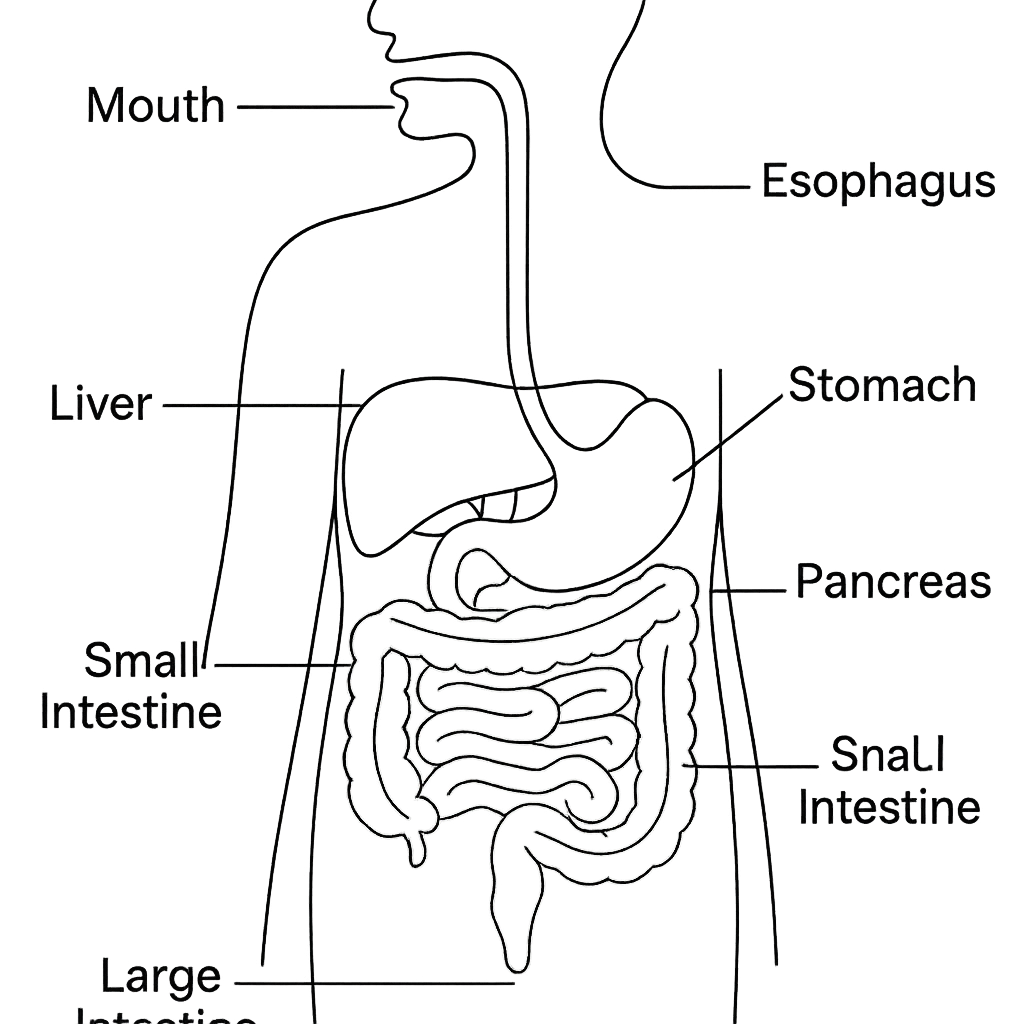
The labelled diagram shows the major organs of the human digestive system.
Question Parts
(a)
Describe the role of the pancreas in digestion, including the enzymes it secretes and the specific actions of those enzymes.
(b)
Explain how the structure of the small intestine enhances its function in nutrient absorption.
(c)
A person has a deficiency of the enzyme lactase. Using the diagram, identify where lactase would normally be secreted and discuss the likely symptoms after consuming dairy products.
Detailed Essay Solution & Marking Scheme Available

Get the step-by-step mathematical proofs, key points required by examiners, and a comprehensive breakdown from our AI Tutor.
Question 4 View Details
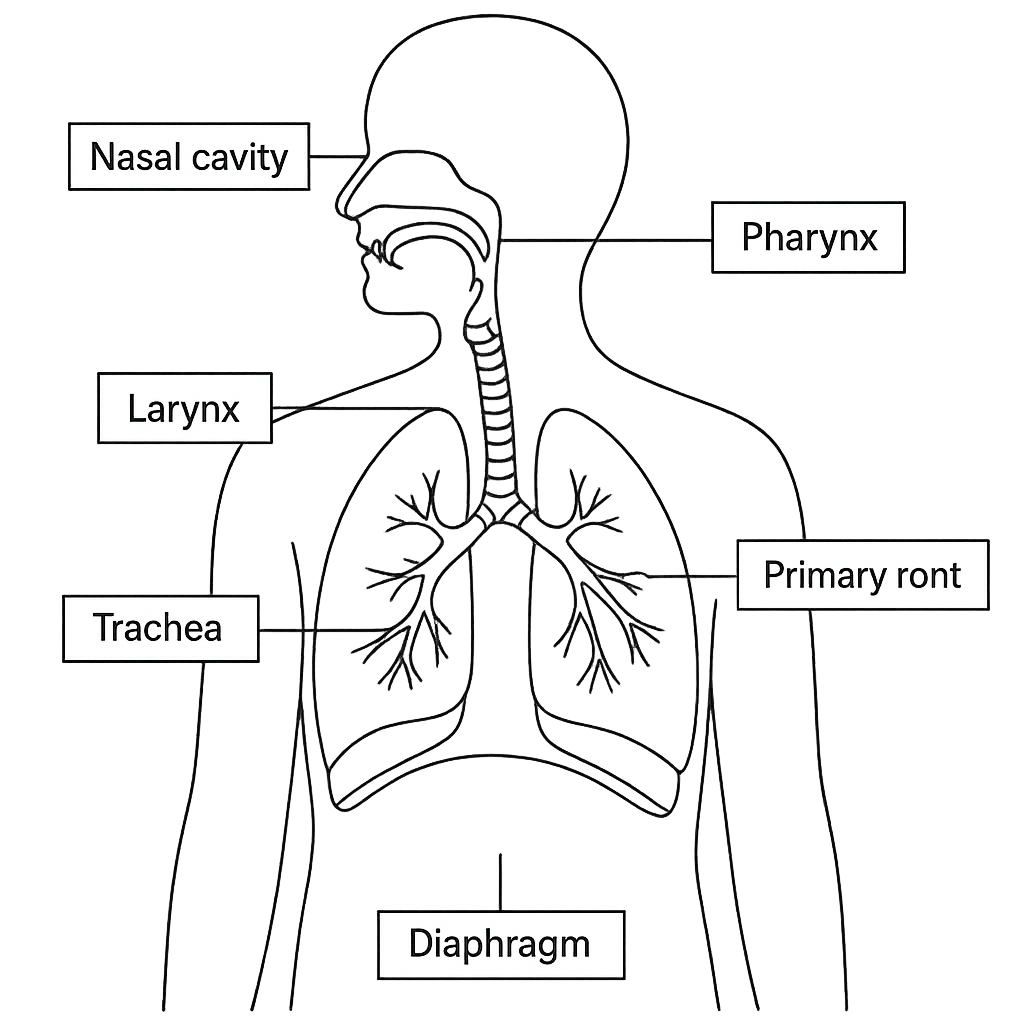
The diagram shows the major structures of the human respiratory system.
Question Parts
(a)
Write the correct name of each labelled part (1‑7) shown in the diagram.
(b)
Explain the pathway of air from the external environment to the site of gas exchange, mentioning at least four structures in the correct order.
(c)
Using the alveolar gas equation, calculate the alveolar partial pressure of oxygen (PAO₂) at sea level and at an altitude of 3000 m. Use the following data: - Fraction of inspired oxygen (FIO₂) = 0.21 - Water vapour pressure in the alveoli (PH₂O) = 47 mmHg - Arterial carbon dioxide pressure (PaCO₂) = 40 mmHg - Respiratory quotient (R) = 0.8 - Atmospheric pressure at sea level = 760 mmHg - Atmospheric pressure at 3000 m = 523 mmHg Show all steps and state any assumptions.
(d)
Briefly describe two physiological mechanisms that help maintain oxygen uptake when a person moves from sea level to high altitude.
Detailed Essay Solution & Marking Scheme Available

Get the step-by-step mathematical proofs, key points required by examiners, and a comprehensive breakdown from our AI Tutor.

Question 5 View Details
A tall tree relies on its vascular system to transport water from the roots to the leaves.
Question Parts
(a)
Explain how water moves from the roots to the leaves in a tall tree, describing the roles of cohesion, adhesion and transpiration pull.
(b)
A tree 15 m tall has a leaf water potential of –1.5 MPa and a root water potential of –0.4 MPa. The hydraulic conductivity of its xylem is 4 × 10⁻⁹ m³·MPa⁻¹·s⁻¹ per metre of length. Assuming water moves through a single continuous column of xylem equal to the tree height, calculate the volumetric flow rate of water in µL·s⁻¹. Show all steps of your reasoning.
(c)
Discuss two environmental factors that could reduce the rate of water transport in the tree and explain the physiological consequences for the plant.
Detailed Essay Solution & Marking Scheme Available

Get the step-by-step mathematical proofs, key points required by examiners, and a comprehensive breakdown from our AI Tutor.

Question 6 View Details
A student is studying the processes involved in the formation of urine in the human kidney.
Question Parts
(a)
Describe the pathway of filtrate through the nephron, naming each major segment and stating its primary function in urine formation.
Detailed Essay Solution & Marking Scheme Available

Get the step-by-step mathematical proofs, key points required by examiners, and a comprehensive breakdown from our AI Tutor.

Question 7 View Details
Explain how the human body maintains internal stability (homeostasis) in the following situations.
Question Parts
(a)
Describe the negative‑feedback mechanisms that control blood‑glucose concentration after a meal.
(b)
If the pancreas fails to secrete sufficient insulin, predict the short‑term and long‑term effects on blood‑glucose level and list two clinical symptoms that may arise.
(c)
Outline two physiological responses that help lower core body temperature when ambient temperature rises above 30 °C.
Detailed Essay Solution & Marking Scheme Available

Get the step-by-step mathematical proofs, key points required by examiners, and a comprehensive breakdown from our AI Tutor.

Question 8 View Details
Discuss the coordination of the nervous and endocrine systems in controlling rapid and sustained physiological responses.
Question Parts
(a)
Explain the complete pathway of the knee‑jerk (patellar) stretch reflex, naming the type of receptor, the sensory neuron, the integration centre, the motor neuron and the resulting muscle action.
(b)
A patient suffers a complete transection of the spinal cord at the T12 level. Predict which reflexes below the lesion will be affected and justify your answer.
(c)
Describe how the nervous system and endocrine system cooperate during the ‘fight‑or‑flight’ response, specifying the role of the hypothalamus, sympathetic nerves, adrenal medulla and the hormones released.
Detailed Essay Solution & Marking Scheme Available

Get the step-by-step mathematical proofs, key points required by examiners, and a comprehensive breakdown from our AI Tutor.

Question 9 View Details
A 28‑year‑old woman attends the clinic because she has experienced irregular menstrual cycles for the past six months and has been trying to conceive for one year without success. Her medical history is unremarkable and she does not take any regular medication. She reports occasional stress at work and a diet low in iron. The clinician suspects a reproductive problem and asks you to discuss the case.
Question Parts
(a)
Describe the normal hormonal regulation of the menstrual cycle, clearly indicating the role of the hypothalamus, pituitary gland and ovaries, and the feedback mechanisms that operate during the follicular and luteal phases.
(b)
Identify two possible causes of infertility that could explain the woman's irregular cycles and discuss how each would disrupt the normal hormonal regulation described in part (a).
(c)
Discuss two methods of contraception, comparing their mechanisms of action, advantages and typical effectiveness rates.
(d)
Propose a concise management plan for this patient, including at least two investigations and two possible treatment options, and justify why each is appropriate for her presentation.
Detailed Essay Solution & Marking Scheme Available

Get the step-by-step mathematical proofs, key points required by examiners, and a comprehensive breakdown from our AI Tutor.

Question 10 View Details
In a small community, a rare autosomal recessive disorder called X‑linked‑like Cystic Fibrosis (CF) has been reported. The disorder is characterised by thick mucus production, recurrent lung infections and pancreatic insufficiency. The pedigree below shows three generations of a family in which the disorder is present. The proband (individual III‑2) is affected. The parents of the proband are both clinically healthy. [The pedigree is described in the stem; no visual is required for the question.]
Question Parts
(a)
Using the information given, determine the most likely mode of inheritance of the disorder and justify your answer with reference to the pedigree pattern.
(b)
If both parents of the proband are heterozygous carriers, calculate the probability that a future child of theirs will be affected, will be a carrier, and will be completely unaffected.
(c)
Explain the molecular basis of cystic fibrosis, specifying the type of mutation most commonly involved and how this mutation affects the CFTR protein function.
Detailed Essay Solution & Marking Scheme Available

Get the step-by-step mathematical proofs, key points required by examiners, and a comprehensive breakdown from our AI Tutor.

Master the Exam!

You've seen a preview, but there are thousands more questions plus AI tutor to break down complex solutions.

Unlock Full Access Available for Android & Windows
Help others prepare! Share this practice hub:
Chat with Support