igcse model questions vol1 2023 chemistry | Objective

Prepare for your exams with igcse model questions vol1 questions? Reviewing past/model questions is one of the most effective ways to guarantee a high score. This practice hub features authentic 2023 chemistry (Objective) questions designed to simulate the real exam environment.

Practice these randomly selected questions to test your readiness.

Question 1 View Details
Elements X, Y and Z have electronegativities of 1.0, 2.5 and 3.0 respectively. Three binary compounds are formed: XY, XZ and YZ. (i) Using the rule that a bond is ionic when the electronegativity difference \(\Delta EN \ge 1.7\) and covalent otherwise, state the type of bond (ionic or covalent) in each compound. (ii) For an ionic bond, the lattice energy (in kJ mol\(^{-1}\)) can be estimated as \(U = 500 \times \Delta EN\). For a covalent bond, the bond enthalpy (in kJ mol\(^{-1}\)) is approximated by \(E = 350 - 20\Delta EN\). Calculate the estimated bond energy for each compound and rank the three compounds from highest to lowest bond energy.
Correct A. XZ is ionic, XY and YZ are covalent; ranking by bond energy: XZ > YZ > XY
B. XY is ionic, XZ and YZ are covalent; ranking by bond energy: XY > XZ > YZ
C. YZ is ionic, XY and XZ are covalent; ranking by bond energy: YZ > XY > XZ
D. All three bonds are covalent; ranking by bond energy: XY > YZ > XZ

Correct Answer: A

Want to see the full step-by-step solution? Unlock AI Explanation & Analytics
Question 2 View Details
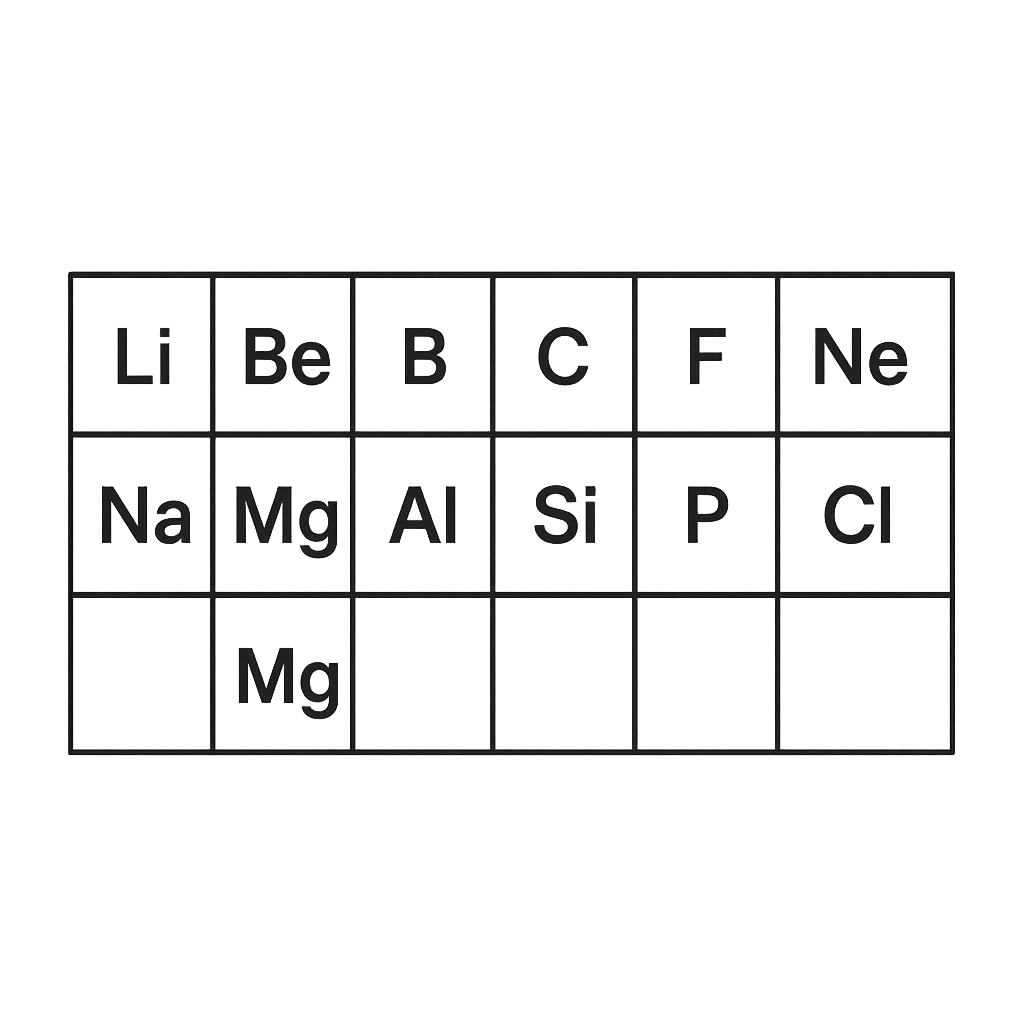
The diagram shows a portion of the periodic table containing the elements Li, Be, B, C, N, O, F, Ne in period 2 and Na, Mg, Al, Si, P, S, Cl, Ar in period 3. Four of these elements are highlighted: O, F, Ne and Mg. Which highlighted element has the highest first ionisation energy? Give the symbol of the element and briefly justify your answer using periodic trends.
A. O
B. Mg
Correct C. Ne
D. F

Correct Answer: C

Want to see the full step-by-step solution? Unlock AI Explanation & Analytics
Question 3 View Details
The molecular formula \(\mathrm{C_5H_{12}}\) can represent three structural isomers: n‑pentane, 2‑methylbutane and 2,2‑dimethylpropane. Their standard heats of combustion are 3500 kJ mol\(^{-1}\) for n‑pentane, 3520 kJ mol\(^{-1}\) for 2‑methylbutane and 3550 kJ mol\(^{-1}\) for 2,2‑dimethylpropane. (i) State how many structural isomers \(\mathrm{C_5H_{12}}\) has. (ii) Which isomer releases the greatest amount of energy on complete combustion? Using the data, calculate the total energy released when 2.0 mol of this isomer is burnt completely.
Correct A. 3 isomers; 2,2‑dimethylpropane releases the most energy; total energy = 7100 kJ
B. 3 isomers; 2‑methylbutane releases the most energy; total energy = 7200 kJ
C. 3 isomers; n‑pentane releases the most energy; total energy = 7000 kJ
D. 2 isomers; 2,2‑dimethylpropane releases the most energy; total energy = 7100 kJ

Correct Answer: A

Want to see the full step-by-step solution? Unlock AI Explanation & Analytics
Question 4 View Details
In acidic solution the following redox reaction occurs: \(\mathrm{MnO_4^- + Fe^{2+} \rightarrow Mn^{2+} + Fe^{3+}}\) A solution containing 0.050 mol of \(\mathrm{KMnO_4}\) is electrolysed with a constant current of 0.75 A for 30 minutes. Assume the current is 100 % efficient and excess \(\mathrm{Fe^{2+}}\) is present. Calculate the mass of \(\mathrm{Mn^{2+}}\) formed (in grams) to three significant figures.
Correct A. 0.154 g
B. 0.145 g
C. 0.158 g
D. 0.162 g

Correct Answer: A

Want to see the full step-by-step solution? Unlock AI Explanation & Analytics
Question 5 View Details
The reaction between aluminium and chlorine gas is: \(2\,\mathrm{Al} + 3\,\mathrm{Cl_2} \rightarrow 2\,\mathrm{AlCl_3}\) A sample of aluminium weighing 5.0 g is only 90 % pure, and 4.0 g of chlorine gas is used. (i) Determine the limiting reagent. (ii) Calculate the theoretical mass of aluminium chloride (\(\mathrm{AlCl_3}\)) that could be produced. (iii) If the actual mass of \(\mathrm{AlCl_3}\) obtained after the reaction is 4.0 g, calculate the percent yield.
A. Limiting reagent: Al; theoretical yield ≈ 4.5 g AlCl₃; percent yield ≈ 89 %
B. Limiting reagent: Al; theoretical yield ≈ 5.5 g AlCl₃; percent yield ≈ 73 %
C. Limiting reagent: Cl₂; theoretical yield ≈ 6.0 g AlCl₃; percent yield ≈ 67 %
Correct D. Limiting reagent: Cl₂; theoretical yield ≈ 5.0 g AlCl₃; percent yield ≈ 80 %

Correct Answer: D

Want to see the full step-by-step solution? Unlock AI Explanation & Analytics
Question 6 View Details
A 0.90 g sample of glucose (\(\mathrm{C_6H_{12}O_6}\)) is analysed. Using atomic masses C = 12.01 g mol\(^{-1}\), H = 1.008 g mol\(^{-1}\), O = 16.00 g mol\(^{-1}\), calculate the number of molecules present in the sample. Give your answer in scientific notation to two significant figures.
A. 4.2×10^21
B. 2.5×10^21
C. 3.0×10^20
Correct D. 3.0×10^21

Correct Answer: D

Want to see the full step-by-step solution? Unlock AI Explanation & Analytics
Question 7 View Details
Glacial acetic acid (CH\(_3\)COOH, molar mass 60.05 g mol\(^{-1}\)) reacts with ethanol (C\(_2\)H\(_5\)OH, molar mass 46.07 g mol\(^{-1}\)) according to the equation \(\mathrm{CH_3COOH + C_2H_5OH \rightarrow CH_3COOC_2H_5 + H_2O}\). If 5.0 g of acetic acid are mixed with 6.0 g of ethanol and the reaction yields 6.5 g of ethyl acetate, determine: (a) the limiting reagent, (b) the theoretical mass of ethyl acetate, (c) the percent yield, and (d) the mass of excess ethanol remaining unreacted.
Correct A. Limiting reagent: acetic acid; Theoretical mass: 7.34 g; Percent yield: 89%; Excess ethanol: 2.16 g
B. Limiting reagent: ethanol; Theoretical mass: 7.34 g; Percent yield: 89%; Excess ethanol: 0.00 g
C. Limiting reagent: acetic acid; Theoretical mass: 8.10 g; Percent yield: 95%; Excess ethanol: 0.90 g
D. Limiting reagent: ethanol; Theoretical mass: 6.80 g; Percent yield: 78%; Excess ethanol: 1.20 g

Correct Answer: A

Want to see the full step-by-step solution? Unlock AI Explanation & Analytics
Question 8 View Details
When potassium chlorate (\(\mathrm{KClO_3}\), molar mass 122.55 g mol\(^{-1}\)) decomposes on heating according to \(2\,\mathrm{KClO_3 \rightarrow 2\,KCl + 3\,O_2}\), 10.0 g of \(\mathrm{KClO_3}\) are heated completely. Calculate (a) the volume of oxygen gas produced at STP (22.4 L mol\(^{-1}\)), and (b) the mass of potassium chloride formed.
A. O2 volume: 2.20 L; KCl mass: 6.50 g
B. O2 volume: 2.74 L; KCl mass: 5.00 g
Correct C. O2 volume: 2.74 L; KCl mass: 6.08 g
D. O2 volume: 3.30 L; KCl mass: 5.50 g

Correct Answer: C

Want to see the full step-by-step solution? Unlock AI Explanation & Analytics
Question 9 View Details
A 0.500 g sample of an unknown gas occupies a volume of 0.44 L at a temperature of 298 K and a pressure of 1.00 atm. Using the ideal gas equation, determine the molar mass of the gas in g mol\(^{-1}\).
A. 30.2
B. 26.0
C. 24.5
Correct D. 28.0

Correct Answer: D

Want to see the full step-by-step solution? Unlock AI Explanation & Analytics
Question 10 View Details
A buffer solution is prepared by dissolving 0.20 mol of acetic acid (\(\mathrm{CH_3COOH}\), \(K_a = 1.8 \times 10^{-5}\)) and 0.10 mol of sodium acetate (\(\mathrm{CH_3COONa}\)) in enough water to make 1.0 L of solution. (a) Calculate the initial pH of the solution. (b) After adding 0.05 mol of hydrochloric acid (\(\mathrm{HCl}\)), calculate the new pH of the solution.
A. 4.30
B. 3.85
Correct C. 4.05
D. 4.50

Correct Answer: C

Want to see the full step-by-step solution? Unlock AI Explanation & Analytics
Question 11 View Details
A 1.13 g mixture of ethanol \(C_{2}H_{5}OH\) and propan-1-ol \(C_{3}H_{7}OH\) reacts with excess sodium metal according to \(2R\!{-}OH + 2Na \rightarrow 2R\!{-}ONa + H_{2}\). The mixture contains twice as many moles of ethanol as propan-1-ol and the reaction produces \(0.250\) L of hydrogen gas at STP. Calculate the mass of each alcohol present in the mixture (give your answers to three significant figures).
A. Ethanol: 0.730 g; Propan-1-ol: 0.400 g
B. Ethanol: 0.658 g; Propan-1-ol: 0.472 g
Correct C. Ethanol: 0.685 g; Propan-1-ol: 0.447 g
D. Ethanol: 0.712 g; Propan-1-ol: 0.418 g

Correct Answer: C

Want to see the full step-by-step solution? Unlock AI Explanation & Analytics
Question 12 View Details
The intrinsic viscosity of a solution of poly(ethylene) is measured as \([\eta]=0.85\) dL·g⁻¹. For this polymer the Mark-Houwink relationship is \([\eta]=K\,M^{a}\) with \(K=1.2\times10^{-4}\) dL·g⁻¹·(g·mol⁻¹)⁻ᵃ and \(a=0.75\). Using these data, calculate the number‑average degree of polymerisation \(DP_{n}\) of the sample. (Molar mass of the ethene monomer = 28 g·mol⁻¹.) Give your answer to two significant figures.
A. 4.2×10³
Correct B. 5.0×10³
C. 6.1×10³
D. 3.8×10³

Correct Answer: B

Want to see the full step-by-step solution? Unlock AI Explanation & Analytics
Question 13 View Details
A metal X reacts with excess dilute hydrochloric acid according to \(X + 2HCl \rightarrow XCl_{2} + H_{2}\). When 0.654 g of the metal is used, \(0.225\) L of hydrogen gas is collected at STP. The metal forms a divalent chloride. Identify the metal X from the following possibilities: magnesium (24.3 g·mol⁻¹), zinc (65.4 g·mol⁻¹), iron (55.8 g·mol⁻¹), copper (63.5 g·mol⁻¹).
A. Copper
B. Iron
Correct C. Zinc
D. Magnesium

Correct Answer: C

Want to see the full step-by-step solution? Unlock AI Explanation & Analytics
Question 14 View Details
A primary alcohol A with molecular formula \(C_{5}H_{12}O\) is oxidised with pyridinium chlorochromate (PCC) to give aldehyde B. Aldehyde B, which contains no \(\alpha\)-hydrogen, undergoes a Cannizzaro reaction to produce a primary alcohol C and a carboxylic acid D. The molecular formulas of C and D are \(C_{5}H_{12}O\) and \(C_{5}H_{10}O_{2}\) respectively. Determine the IUPAC name of the original alcohol A.
A. 3-methylbutan-1-ol
B. 2-methylbutan-1-ol
Correct C. 2,2-dimethylpropan-1-ol
D. 2,3-dimethylpropan-1-ol

Correct Answer: C

Want to see the full step-by-step solution? Unlock AI Explanation & Analytics
Question 15 View Details
A 2.00 g sample of a substance (molar mass = 100 g·mol⁻¹) is heated at constant pressure from \(-20\)°C (solid) to \(80\)°C (gas). The substance melts at \(-5\)°C and boils at \(60\)°C. Its specific heat capacities are: solid 0.50 J·g⁻¹·K⁻¹, liquid 0.80 J·g⁻¹·K⁻¹, gas 0.60 J·g⁻¹·K⁻¹. The enthalpy of fusion is 25 kJ·mol⁻¹ and the enthalpy of vaporisation is 40 kJ·mol⁻¹. Calculate the total energy required for the whole heating process. Give your answer in kJ to three significant figures.
A. 1.64 kJ
Correct B. 1.44 kJ
C. 1.24 kJ
D. 2.04 kJ

Correct Answer: B

Want to see the full step-by-step solution? Unlock AI Explanation & Analytics
Question 16 View Details
A water treatment plant processes 5000 L of river water that contains 0.12 mg L^{-1} of phosphate ions (\(\text{PO}_4^{3-}\)). To remove the phosphate, 2.0 g of calcium hydroxide, Ca(OH)_{2}, is added and the mixture is allowed to reach equilibrium at 25 °C. The solubility product of calcium phosphate, Ca_{3}(PO_{4})_{2}, is \(K_{sp}=2.07\times10^{-33}\). Calculate the final concentration of phosphate ions in the water, expressed in mg L^{-1}, after precipitation has taken place.
Correct A. 0.00066 mg L^{-1}
B. 0.0066 mg L^{-1}
C. 0.000066 mg L^{-1}
D. 0.066 mg L^{-1}

Correct Answer: A

Want to see the full step-by-step solution? Unlock AI Explanation & Analytics
Question 17 View Details
Using the following bond dissociation energies (kJ mol^{-1}):\n\(\text{H-H}=436\), \(\text{Cl-Cl}=243\), \(\text{F-F}=158\), \(\text{H-Cl}=431\), \(\text{H-F}=565\).\n\n(a) Calculate the enthalpy change (\(\Delta H\)) for the reactions:\n(i) \(\text{H}_2(g)+\text{Cl}_2(g)\rightarrow 2\text{HCl}(g)\)\n(ii) \(\text{H}_2(g)+\text{F}_2(g)\rightarrow 2\text{HF}(g)\)\n\n(b) For each reaction, determine the amount of energy released per gram of halogen (Cl_{2} or F_{2}) consumed. Which halogen releases more energy per gram when reacting with hydrogen?
A. Fluorine releases more energy per gram (≈10 kJ g^{-1} vs 2.8 kJ g^{-1})
B. Fluorine releases more energy per gram (≈12 kJ g^{-1} vs 3.0 kJ g^{-1})
Correct C. Fluorine releases more energy per gram (≈14 kJ g^{-1} vs 2.6 kJ g^{-1})
D. Chlorine releases more energy per gram (≈14 kJ g^{-1} vs 2.6 kJ g^{-1})

Correct Answer: C

Want to see the full step-by-step solution? Unlock AI Explanation & Analytics
Question 18 View Details
In a hydrogen atom an electron falls from the \(n=3\) level to the \(n=2\) level. Using the Rydberg constant \(R=1.097\times10^{7}\ \text{m}^{-1}\), calculate the wavelength of the emitted photon in nanometres.
Correct A. 656 nm
B. 486 nm
C. 410 nm
D. 434 nm

Correct Answer: A

Want to see the full step-by-step solution? Unlock AI Explanation & Analytics
Question 19 View Details
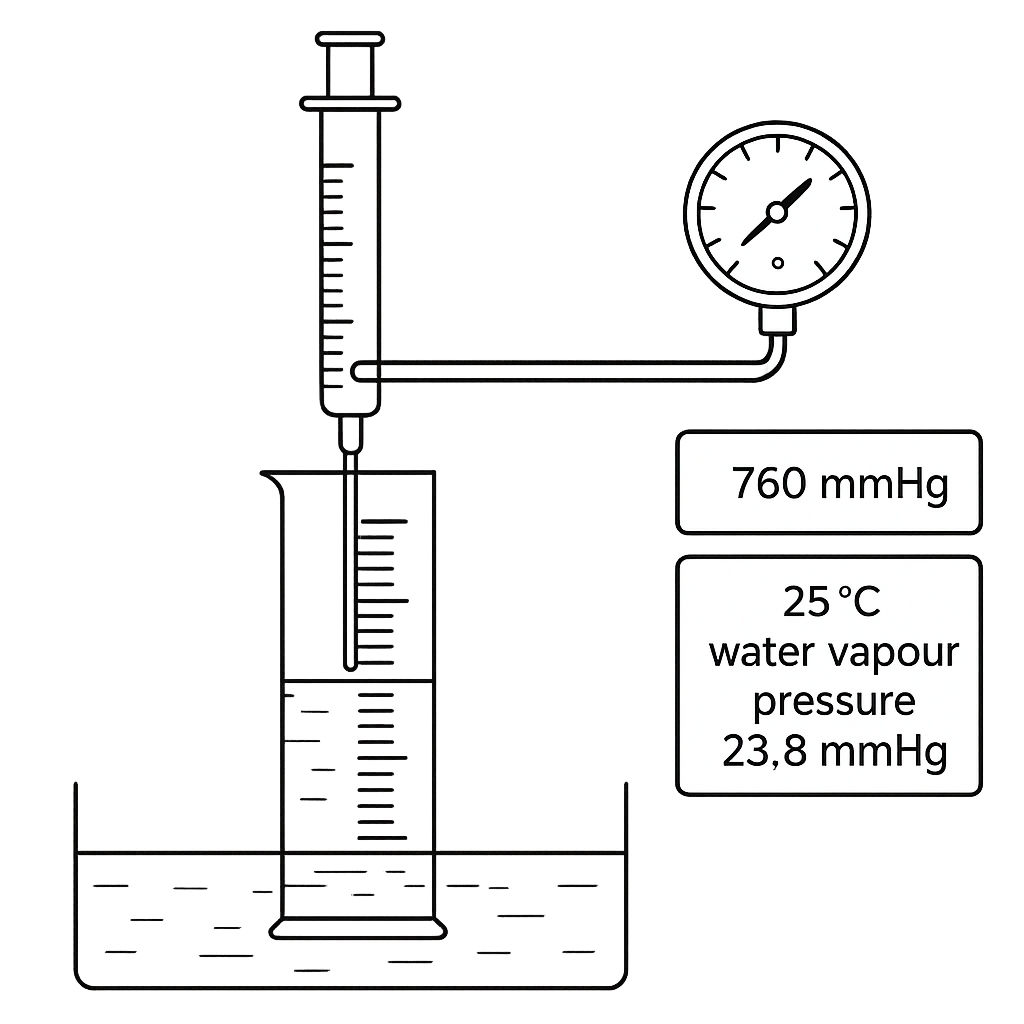
A gas‑collection‑over‑water apparatus is used to collect hydrogen gas produced from the reaction of excess zinc with excess hydrochloric acid. The apparatus is at 25 °C. The total pressure inside the collection tube is 760 mmHg and the water‑vapour pressure at this temperature is 23.8 mmHg. The volume of gas collected is 0.850 dm³. Calculate the number of moles of hydrogen gas collected, correcting for the water vapour.
A. 5.0×10^{-2} mol
Correct B. 3.4×10^{-2} mol
C. 2.8×10^{-2} mol
D. 4.1×10^{-2} mol

Correct Answer: B

Want to see the full step-by-step solution? Unlock AI Explanation & Analytics
Question 20 View Details
Propanoic acid (\(\text{C}_3\text{H}_6\text{O}_2\)) combusts according to\n\(\text{C}_3\text{H}_6\text{O}_2(l) + 5\text{O}_2(g) \rightarrow 3\text{CO}_2(g) + 3\text{H}_2\text{O}(l)\).\nThe standard enthalpy change of combustion is \(\Delta_c H^{\circ} = -2215\ \text{kJ mol}^{-1}\). The standard enthalpy of formation of liquid water is \(\Delta_f H^{\circ}(\text{H}_2\text{O},l) = -285.8\ \text{kJ mol}^{-1}\) and that of propanoic acid is \(\Delta_f H^{\circ}(\text{C}_3\text{H}_6\text{O}_2,l) = -613\ \text{kJ mol}^{-1}\). Using these data, calculate the standard enthalpy of formation of carbon dioxide, \(\Delta_f H^{\circ}(\text{CO}_2,g)\).
A. -680 kJ mol^{-1}
Correct B. -657 kJ mol^{-1}
C. -700 kJ mol^{-1}
D. -630 kJ mol^{-1}

Correct Answer: B

Want to see the full step-by-step solution? Unlock AI Explanation & Analytics
Question 21 View Details
A galvanic cell is constructed as follows: Fe(s) | Fe^{2+} (unknown) || Cu^{2+} (0.10 M) | Cu(s). The standard reduction potentials are E°(Cu^{2+}/Cu) = +0.34 V and E°(Fe^{2+}/Fe) = -0.44 V. At 25 °C the measured cell emf is 0.75 V. (a) Calculate the concentration of Fe^{2+} in the cell. (b) Using the standard cell potential, calculate the equilibrium constant K for the overall cell reaction at 25 °C.
A. Fe^{2+}=0.85 M; K=3.3×10^{25}
B. Fe^{2+}=2.15 M; K=1.1×10^{27}
C. Fe^{2+}=0.31 M; K=5.0×10^{24}
Correct D. Fe^{2+}=1.03 M; K=2.2×10^{26}

Correct Answer: D

Want to see the full step-by-step solution? Unlock AI Explanation & Analytics
Question 22 View Details
In acidic solution the redox reaction between potassium permanganate and oxalic acid is: \(\mathrm{KMnO_4}\) + \(\mathrm{C_2O_4^{2-}}\) → \(\mathrm{Mn^{2+}}\) + \(\mathrm{CO_2}\). A sample of 0.50 g \(\mathrm{KMnO_4}\) is mixed with excess oxalic acid and enough 0.10 M \(\mathrm{H_2SO_4}\) to provide the required acidity. (a) Calculate the volume of \(\mathrm{H_2SO_4}\) solution needed. (b) Calculate the mass of \(\mathrm{CO_2}\) produced.
A. 1.10×10^2 mL H_2SO_4; 0.630 g CO_2
B. 9.8×10^1 mL H_2SO_4; 0.542 g CO_2
C. 1.45×10^2 mL H_2SO_4; 0.812 g CO_2
Correct D. 1.27×10^2 mL H_2SO_4; 0.696 g CO_2

Correct Answer: D

Want to see the full step-by-step solution? Unlock AI Explanation & Analytics
Question 23 View Details
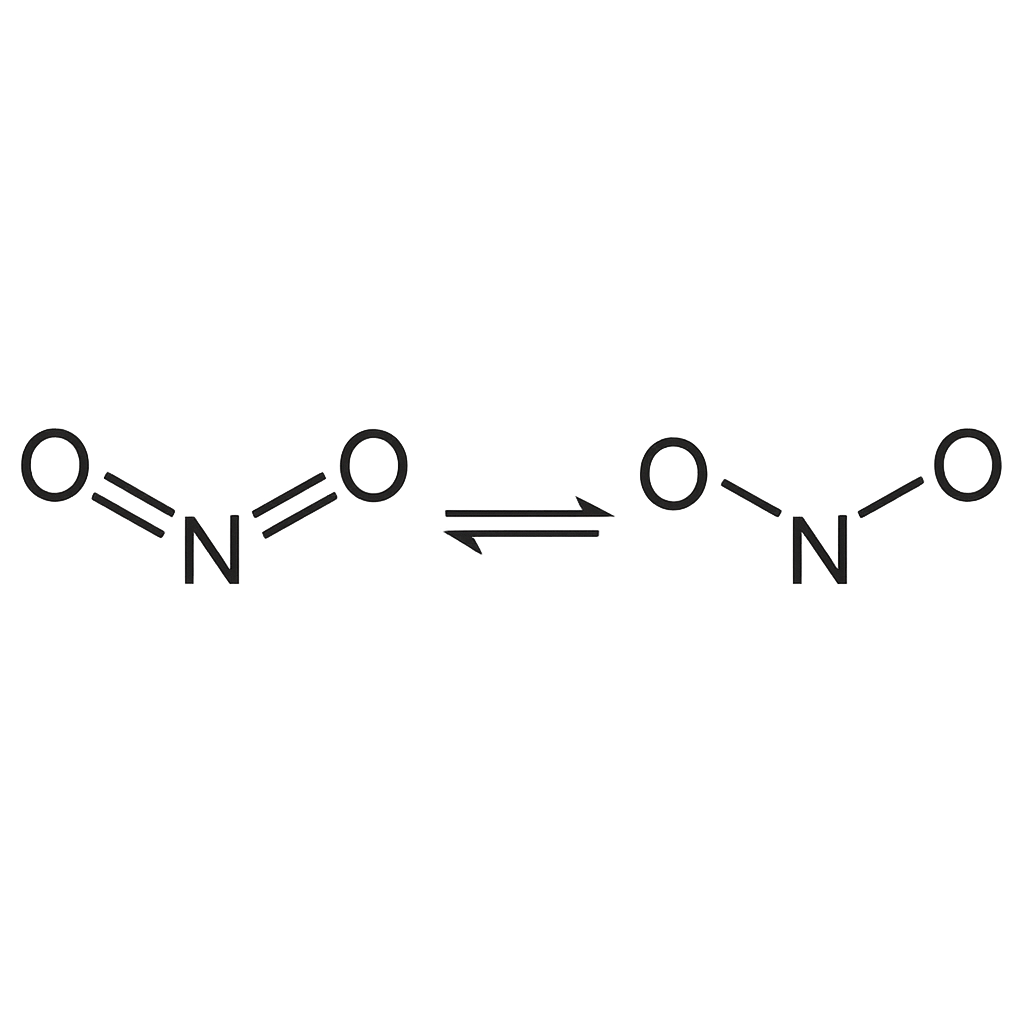
The diagram shows the nitrite ion \(\mathrm{NO_2^-}\) with resonance structures indicated. Determine the hybridisation of the nitrogen atom and give the approximate O-N-O bond angle.
Correct A. sp^2; ≈115°
B. sp^3; ≈109.5°
C. sp; ≈180°
D. sp^2; ≈120°

Correct Answer: A

Want to see the full step-by-step solution? Unlock AI Explanation & Analytics
Question 24 View Details
When 2‑bromo‑2‑methylpropane is treated sequentially with aqueous NaOH and then with excess \(\mathrm{H_2SO_4}\), a single organic product is obtained. Identify this product and write its IUPAC name.
A. 2-methylprop-1-yne (isobutyn)
Correct B. 2‑methylprop‑1‑ene (isobutene)
C. 2-methylpropane (isobutane)
D. 2-methylprop-1-ol (isobutanol)

Correct Answer: B

Want to see the full step-by-step solution? Unlock AI Explanation & Analytics
Question 25 View Details
An isotope of element X has an atomic number of 20 and a mass number of 45. How many neutrons are present in the nucleus of this isotope?
A. 65
Correct B. 25
C. 45
D. 20

Correct Answer: B

Want to see the full step-by-step solution? Unlock AI Explanation & Analytics

Master the Exam!

You've seen a preview, but there are thousands more questions plus AI tutor to break down complex solutions.

Unlock Full Access Available for Android & Windows
Help others prepare! Share this practice hub:
Chat with Support