igcse model questions vol1 2022 physics | Objective

Prepare for your exams with igcse model questions vol1 questions? Reviewing past/model questions is one of the most effective ways to guarantee a high score. This practice hub features authentic 2022 physics (Objective) questions designed to simulate the real exam environment.

Practice these randomly selected questions to test your readiness.

Question 1 View Details
A car starts from rest, accelerates uniformly for \(t_{1}\) seconds, then travels at constant speed for \(t_{2}\) seconds, and finally decelerates uniformly to rest in \(t_{3}\) seconds. The magnitude of the acceleration during speeding up equals the magnitude of the deceleration during slowing down. The distance covered while accelerating is one‑fifth of the total distance of \(500\) m, and the total time taken is \(40\) s. Find the maximum speed reached by the car (in m s(^{-1}\)).
A. 12.5 m s⁻¹
B. 20.0 m s⁻¹
C. 15.0 m s⁻¹
Correct D. 17.5 m s⁻¹

Correct Answer: D

Want to see the full step-by-step solution? Unlock AI Explanation & Analytics
Question 2 View Details
A motor supplies \(2.0\) kW at \(1500\) rpm to a gearbox consisting of two gear pairs in series. The first pair has a gear ratio of \(3:1\) (driving : driven) and an efficiency of \(90\%\). The second pair has a gear ratio of \(4:1\) and an efficiency of \(85\%\). Determine the angular speed (in rpm) and torque (in N·m) of the final output shaft, and calculate the total power loss in the gearbox (in watts).
Correct A. Output speed = 125 rpm, output torque ≈ 117 N·m, total power loss ≈ 471 W
B. Output speed = 150 rpm, output torque ≈ 105 N·m, total power loss ≈ 520 W
C. Output speed = 125 rpm, output torque ≈ 130 N·m, total power loss ≈ 400 W
D. Output speed = 100 rpm, output torque ≈ 130 N·m, total power loss ≈ 450 W

Correct Answer: A

Want to see the full step-by-step solution? Unlock AI Explanation & Analytics
Question 3 View Details
A radioactive sample contains two isotopes, A and B, that decay independently. Isotope A has a half‑life of \(30\) min and an initial activity of \(800\) Bq. Isotope B has a half‑life of \(2\) h and an unknown initial activity. After exactly \(1\) h the total activity of the sample is measured to be \(500\) Bq.\n\n(a) Determine the initial activity of isotope B (in Bq).\n(b) Using the decay constant of B, calculate the number of atoms of B present initially. (Take \(\lambda =\ln 2 / t_{1/2}\) and \(A = \lambda N\).)
A. Initial activity of B ≈ 500 Bq; initial number of atoms of B ≈ 5.2×10⁶
B. Initial activity of B ≈ 600 Bq; initial number of atoms of B ≈ 6.3×10⁶
Correct C. Initial activity of B ≈ 424 Bq; initial number of atoms of B ≈ 4.4×10⁶
D. Initial activity of B ≈ 350 Bq; initial number of atoms of B ≈ 3.6×10⁶

Correct Answer: C

Want to see the full step-by-step solution? Unlock AI Explanation & Analytics
Question 4 View Details
A force of \(10\) N acts due east and a second force of \(6\) N acts due north on the same point. Find the magnitude of the resultant force (in newtons).
Correct A. 11.66 N
B. 9.21 N
C. 15.48 N
D. 13.00 N

Correct Answer: A

Want to see the full step-by-step solution? Unlock AI Explanation & Analytics
Question 5 View Details
A pipe that is open at one end and closed at the other has a length of \(1.20\) m. The speed of sound in air at the experimental temperature is \(340\) m s(^{-1}\). The pipe resonates at its third harmonic (first overtone).\n\n(a) Calculate the frequency of this resonance.\n(b) If the pipe is heated so that the speed of sound increases by \(5\)% while the length remains unchanged, what is the new frequency of the same harmonic? Give both frequencies to the nearest hertz.
A. 360 Hz and 378 Hz
B. 340 Hz and 357 Hz
C. 350 Hz and 368 Hz
Correct D. 354 Hz and 372 Hz

Correct Answer: D

Want to see the full step-by-step solution? Unlock AI Explanation & Analytics
Question 6 View Details
An air column closed at one end has length \(0.33\ \text{m}\) and produces a fundamental frequency of \(256\ \text{Hz}\). (a) Calculate the speed of sound in the air at this temperature. (b) If the temperature rises so that the speed of sound increases by \(0.6\%\), what is the new fundamental frequency? Give your answer to the nearest hertz.
Correct A. Speed of sound \(\approx 338\ \text{m s}^{-1}\); new frequency \(258\ \text{Hz}\)
B. Speed of sound \(\approx 330\ \text{m s}^{-1}\); new frequency \(256\ \text{Hz}\)
C. Speed of sound \(\approx 345\ \text{m s}^{-1}\); new frequency \(260\ \text{Hz}\)
D. Speed of sound \(\approx 350\ \text{m s}^{-1}\); new frequency \(262\ \text{Hz}\)

Correct Answer: A

Want to see the full step-by-step solution? Unlock AI Explanation & Analytics
Question 7 View Details
Two radioactive isotopes A and B are mixed in a sealed source. Isotope A decays by \(\alpha\)-emission with a half‑life of \(30\ \text{min}\) and releases \(5.0\ \text{MeV}\) per decay. Isotope B decays by \(\beta\)-emission with a half‑life of \(2\ \text{h}\) and releases \(1.2\ \text{MeV}\) per decay. Initially the source contains \(2.0\times10^{12}\) atoms of A and \(5.0\times10^{12}\) atoms of B. After an elapsed time \(t\) the total power emitted by the source is measured to be \(1.2\times10^{-6}\ \text{W}\). Determine \(t\) (in hours, to two significant figures).
A. 12 h
B. 10 h
Correct C. 13 h
D. 15 h

Correct Answer: C

Want to see the full step-by-step solution? Unlock AI Explanation & Analytics
Question 8 View Details
A circular coil of \(200\) turns and radius \(5.0\ \text{cm}\) rotates uniformly in a uniform magnetic field of magnitude \(0.80\ \text{T}\). The coil is connected to a resistor of \(10\ \Omega\). (a) If the average power dissipated in the resistor is \(2.5\ \text{W}\), find the rotation frequency in revolutions per second. (b) The coil radius is then increased by \(20\%\) while the number of turns and the power remain the same. What magnetic‑field strength is now required? Give your answers to two significant figures.
A. f = 1.10 Hz; B' = 0.62 T
B. f = 0.75 Hz; B' = 0.56 T
Correct C. f = 0.90 Hz; B' = 0.56 T
D. f = 0.90 Hz; B' = 0.48 T

Correct Answer: C

Want to see the full step-by-step solution? Unlock AI Explanation & Analytics
Question 9 View Details
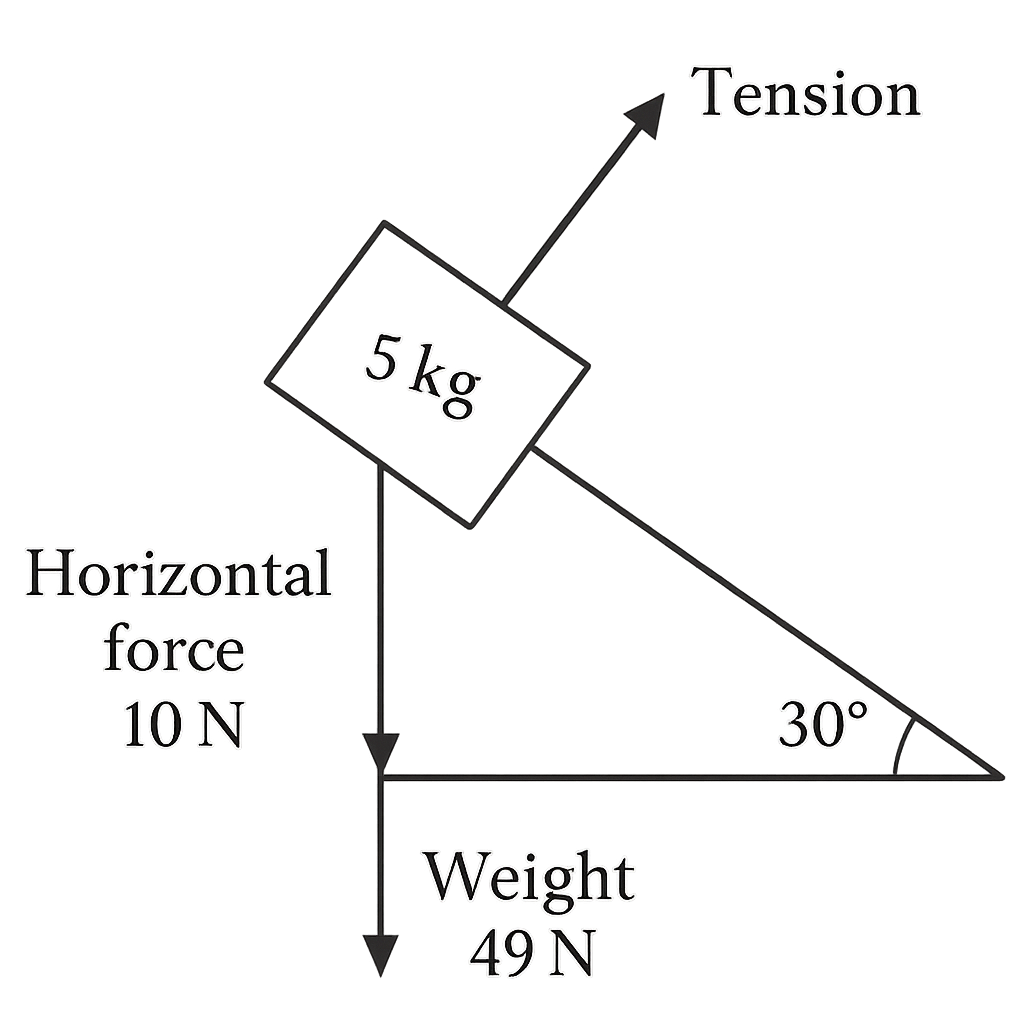
The diagram shows a \(5\ \text{kg}\) block resting on a smooth incline that makes an angle of \(30^{\circ}\) with the horizontal. A horizontal force of \(10\ \text{N}\) pushes the block to the right, and a rope pulls the block up the incline with tension \(T\). The weight, normal reaction, horizontal force and tension are drawn as vectors. Determine the magnitude of the tension \(T\) required to keep the block in equilibrium.
Correct A. 15.8 N
B. 18.5 N
C. 12.3 N
D. 10.0 N

Correct Answer: A

Want to see the full step-by-step solution? Unlock AI Explanation & Analytics
Question 10 View Details
Two identical loudspeakers are placed \(1.0\ \text{m}\) apart. A point P lies on the perpendicular bisector of the line joining the speakers at a distance \(d\) from the midpoint. The speakers emit sound of equal power and are in phase, so the intensities at P add constructively. At a point Q that is \(2.0\ \text{m}\) directly in front of one speaker, the intensity is measured to be \(I_Q\). Find the distance \(d\) (in metres, to two decimal places) at which the resultant intensity at P is exactly twice \(I_Q\).
Correct A. 2.78 m
B. 3.12 m
C. 1.88 m
D. 2.45 m

Correct Answer: A

Want to see the full step-by-step solution? Unlock AI Explanation & Analytics
Question 11 View Details
A sealed container holds a gas at an initial pressure of \(150\ \text{kPa}\), volume \(2.0\ \text{L}\) and temperature \(300\ \text{K}\). The gas is heated at constant volume until its pressure doubles. The container is then allowed to expand isothermally to a volume of \(3.0\ \text{L}\). What is the final pressure of the gas in kPa?
A. 300
B. 150
C. 250
Correct D. 200

Correct Answer: D

Want to see the full step-by-step solution? Unlock AI Explanation & Analytics
Question 12 View Details
Two point charges are placed on the x‑axis. Charge \(Q_{1}=+8.0\ \mu\text{C}\) is at the origin and charge \(Q_{2}=-2.0\ \mu\text{C}\) is at \(x=0.12\ \text{m}\). (i) Find the position \(x\) (in metres, measured from the origin) where the net electric field on the axis is zero. (ii) If \(Q_{2}\) is moved to \(x=0.20\ \text{m}\) while \(Q_{1}\) remains at the origin, find the new position where the net electric field is zero. Give your answers to three significant figures.
A. 0.0900 m, 0.150 m
B. 0.0850 m, 0.120 m
Correct C. 0.0800 m, 0.133 m
D. 0.0750 m, 0.140 m

Correct Answer: C

Want to see the full step-by-step solution? Unlock AI Explanation & Analytics
Question 13 View Details
A converging lens L1 has focal length \(f_{1}=10\ \text{cm}\). An object is placed \(30\ \text{cm}\) to the left of L1. A second lens L2 is positioned \(15\ \text{cm}\) to the right of L1. The final image formed by L2 is \(40\ \text{cm}\) to the right of L2. Assuming thin lenses and using the sign convention that distances measured to the right of a lens are positive, calculate the focal length \(f_{2}\) of L2 in centimetres. Give your answer to two decimal places.
Correct A. -9.23 cm
B. -10.12 cm
C. -8.45 cm
D. -7.80 cm

Correct Answer: A

Want to see the full step-by-step solution? Unlock AI Explanation & Analytics
Question 14 View Details
State whether each of the following quantities is a scalar (S) or a vector (V): (i) speed, (ii) displacement, (iii) mass, (iv) force, (v) temperature.
A. V, S, S, V, S
B. S, V, V, V, S
Correct C. S, V, S, V, S
D. S, S, S, V, V

Correct Answer: C

Want to see the full step-by-step solution? Unlock AI Explanation & Analytics
Question 15 View Details
A string of length \(0.80\ \text{m}\) is fixed at both ends. When the tension in the string is \(40\ \text{N}\) its fundamental frequency is \(120\ \text{Hz}\). If the tension is increased to \(90\ \text{N}\) and the linear mass density of the string remains unchanged, what is the new fundamental frequency? Give your answer in hertz, rounded to the nearest whole number.
A. 150
B. 270
Correct C. 180
D. 80

Correct Answer: C

Want to see the full step-by-step solution? Unlock AI Explanation & Analytics
Question 16 View Details
A calorimeter of heat capacity \(50\ \text{J/°C}\) contains \(150\ \text{g}\) of water at \(20^{\circ}\text{C}\). An unknown mass of water at \(80^{\circ}\text{C}\) is added, and the final equilibrium temperature of the mixture is \(40^{\circ}\text{C}\). Assuming the specific heat capacity of water is \(4.18\ \text{J/g°C}\), calculate the mass of the hot water added (in grams, correct to the nearest gram).
A. 95
B. 70
Correct C. 81
D. 120

Correct Answer: C

Want to see the full step-by-step solution? Unlock AI Explanation & Analytics
Question 17 View Details
A sealed container holds a fixed amount of ideal gas. Initially the gas is at a temperature of \(27^{\circ}\text{C}\), a pressure of \(1.0\ \text{atm}\) and occupies a volume of \(10.0\ \text{L}\). The gas is heated while the volume is allowed to expand to \(12.0\ \text{L}\) and the pressure rises to \(2.5\ \text{atm}\). Determine the final temperature of the gas in degrees Celsius (to the nearest degree).
A. 550
B. 480
Correct C. 627
D. 700

Correct Answer: C

Want to see the full step-by-step solution? Unlock AI Explanation & Analytics
Question 18 View Details
A \(5.0\ \text{kg}\) block rests on an inclined plane that makes an angle of \(30^{\circ}\) with the horizontal. The coefficient of kinetic friction between the block and the plane is unknown. When a force of \(10\ \text{N}\) is applied parallel to the plane upward, the block moves down the plane at constant speed.\n(a) Find the coefficient of kinetic friction.\n(b) Using this coefficient, calculate the magnitude of a force parallel to the plane required to accelerate the block up the plane at \(2.0\ \text{m s}^{-2}\). Give your answer in newtons, correct to the nearest newton.
A. 45
B. 60
C. 52
Correct D. 49

Correct Answer: D

Want to see the full step-by-step solution? Unlock AI Explanation & Analytics
Question 19 View Details
A converging lens of focal length \(5\ \text{cm}\) is used to form a real image of an object on a screen. The distance between the object and the screen is fixed at \(30\ \text{cm}\).\n(a) Determine the two possible positions of the object relative to the lens (give the object distances in centimetres, correct to two decimal places).\n(b) For each position, calculate the magnification of the image. State the larger magnification value (to two decimal places).
A. 4.20
B. 5.00
C. 2.85
Correct D. 3.73

Correct Answer: D

Want to see the full step-by-step solution? Unlock AI Explanation & Analytics
Question 20 View Details
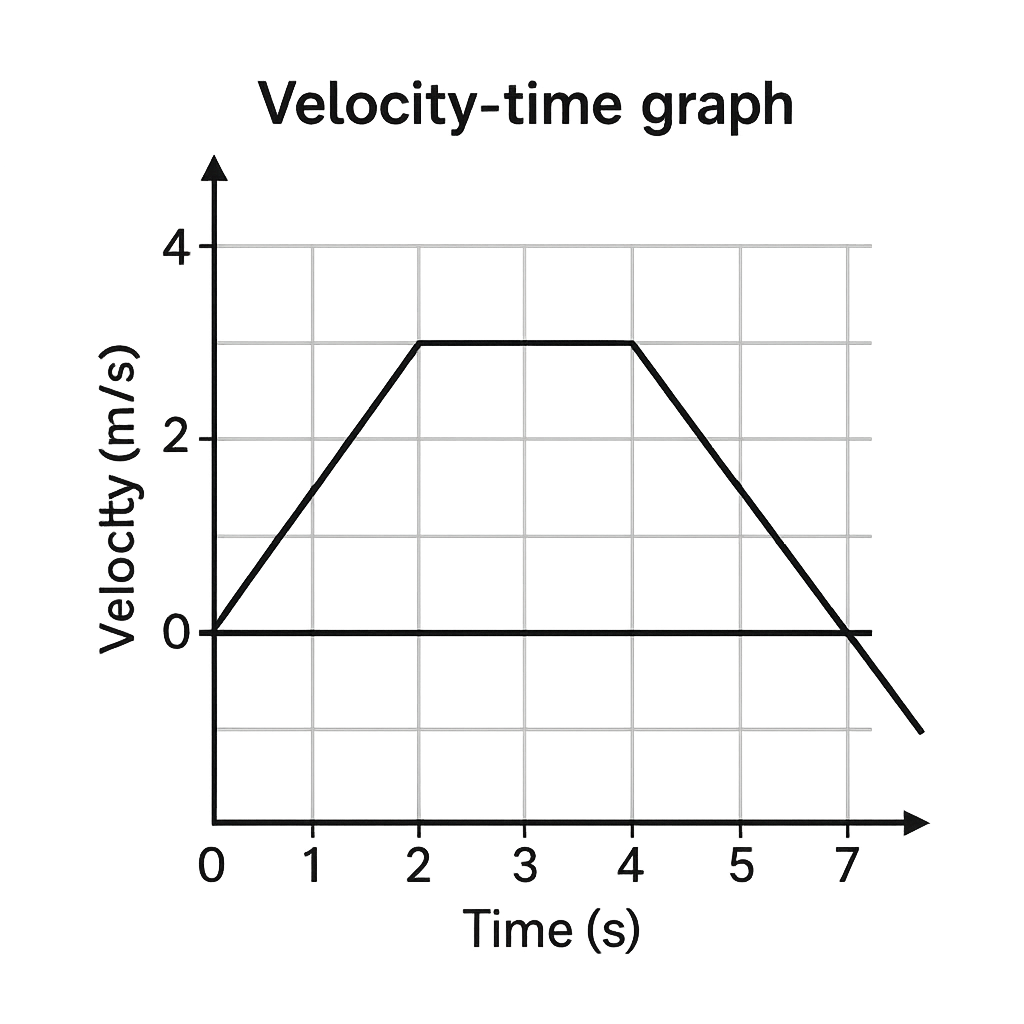
The diagram shows a velocity‑time graph for a car. From \(t = 0\) to \(t = 2\ \text{s}\) the velocity increases uniformly from \(0\) to \(4\ \text{m s}^{-1}\). From \(t = 2\) to \(t = 5\ \text{s}\) the velocity remains constant at \(4\ \text{m s}^{-1}\). From \(t = 5\) to \(t = 7\ \text{s}\) the velocity decreases uniformly back to \(0\ \text{m s}^{-1}\). Using the diagram, calculate the total displacement of the car during the 7‑second interval (in metres, to the nearest metre).
A. 12
B. 16
C. 24
Correct D. 20

Correct Answer: D

Want to see the full step-by-step solution? Unlock AI Explanation & Analytics
Question 21 View Details
A 0.50 kg metal block is heated to 150 °C and then quickly transferred into 2.00 kg of water at 20 °C contained in an insulated vessel. The final equilibrium temperature of the water‑metal system is 45 °C. During the transfer 5 % of the heat released by the metal is lost to the surroundings. Given the specific heat capacity of water is \(4180\ \text{J\,kg}^{-1}\text{K}^{-1}\), calculate the specific heat capacity of the metal in \(\text{J\,kg}^{-1}\text{K}^{-1}\).
Correct A. 4.19×10^3 J kg⁻¹ K⁻¹
B. 5.10×10^3 J kg⁻¹ K⁻¹
C. 4.19×10^2 J kg⁻¹ K⁻¹
D. 3.80×10^3 J kg⁻¹ K⁻¹

Correct Answer: A

Want to see the full step-by-step solution? Unlock AI Explanation & Analytics
Question 22 View Details
A 5.0 kg block rests on a rough inclined plane. The coefficient of static friction between the block and the plane is 0.40. A horizontal force of magnitude 30 N is applied to the block, and the block is just about to move up the plane. Determine the angle of inclination \(\theta\) (in degrees) of the plane.
A. 12.5°
Correct B. 9.7°
C. 15.0°
D. 7.3°

Correct Answer: B

Want to see the full step-by-step solution? Unlock AI Explanation & Analytics
Question 23 View Details
A rectangular coil of 50 turns, each side 0.10 m, rotates in a uniform magnetic field of magnitude \(0.20\ \text{T}\). The coil's axis of rotation is perpendicular to the field. The coil is pulled by a force that causes its speed to increase uniformly from rest to \(4.0\ \text{m\,s}^{-1}\) over a distance of \(0.80\ \text{m}\), then moves at constant speed \(4.0\ \text{m\,s}^{-1}\) for a further \(0.80\ \text{m}\), after which it decelerates uniformly to rest over a distance of \(0.40\ \text{m}\). The coil is connected across a resistor of \(10\ \Omega\). (a) Find the total electrical energy dissipated in the resistor during the whole motion. (b) Find the average power dissipated while the coil moves at constant speed.
A. Energy = 1.85×10⁻³ J; Power = 4.60×10⁻³ W
B. Energy = 2.30×10⁻³ J; Power = 6.50×10⁻³ W
Correct C. Energy = 2.30×10⁻³ J; Power = 5.76×10⁻³ W
D. Energy = 3.00×10⁻³ J; Power = 5.76×10⁻³ W

Correct Answer: C

Want to see the full step-by-step solution? Unlock AI Explanation & Analytics
Question 24 View Details
A 2.0 kg block is pulled along a horizontal surface by a force that varies with distance as \(F(x)=10-2x\) N, where \(x\) is measured in metres from the starting point. The block moves from \(x=0\) to \(x=3\ \text{m}\). The coefficient of kinetic friction between the block and the surface is 0.20. (a) Calculate the net work done on the block. (b) Determine the speed of the block after it has traveled 3 m, assuming it starts from rest.
Correct A. Net work = 9.24 J; Speed = 3.04 m s⁻¹
B. Net work = 7.50 J; Speed = 2.80 m s⁻¹
C. Net work = 10.5 J; Speed = 3.04 m s⁻¹
D. Net work = 9.24 J; Speed = 2.50 m s⁻¹

Correct Answer: A

Want to see the full step-by-step solution? Unlock AI Explanation & Analytics
Question 25 View Details
A uniform lever 4.00 m long is supported on a fulcrum that is not at its centre. A weight of 30 N is hung 0.80 m from the left end, and a weight of 45 N is hung 0.50 m from the right end. (a) Find the distance of the fulcrum from the left end so that the lever is in equilibrium. (b) Calculate the mechanical advantage of the lever, defined as the ratio of load force to effort force.
A. Fulcrum at 3.10 m from left; MA = 0.9
B. Fulcrum at 2.00 m from left; MA = 2.0
Correct C. Fulcrum at 2.42 m from left; MA = 1.5
D. Fulcrum at 1.80 m from left; MA = 1.2

Correct Answer: C

Want to see the full step-by-step solution? Unlock AI Explanation & Analytics

Master the Exam!

You've seen a preview, but there are thousands more questions plus AI tutor to break down complex solutions.

Unlock Full Access Available for Android & Windows
Help others prepare! Share this practice hub:
Chat with Support