igcse model questions vol1 2022 chemistry | Objective

Prepare for your exams with igcse model questions vol1 questions? Reviewing past/model questions is one of the most effective ways to guarantee a high score. This practice hub features authentic 2022 chemistry (Objective) questions designed to simulate the real exam environment.

Practice these randomly selected questions to test your readiness.

Question 1 View Details
A 2.00 g sample of oxalic acid dihydrate (\(\ce{C2H2O4·2H2O}\)) is to be completely oxidised by potassium permanganate (\(\ce{KMnO4}\)) in acidic solution. The balanced redox equation is \(\ce{2 MnO4^- + 5 C2O4^{2-} + 16 H+ -> 2 Mn^{2+} + 10 CO2 + 8 H2O}\). Calculate the mass of \(\ce{KMnO4}\) required to react completely with the oxalic acid.
A. 0.75 g
B. 2.00 g
C. 1.25 g
Correct D. 1.00 g

Correct Answer: D

Want to see the full step-by-step solution? Unlock AI Explanation & Analytics
Question 2 View Details
A 8.00 g mixture of 1‑propanol (\(\ce{CH3CH2CH2OH}\)) and 2‑propanol (\(\ce{CH3CHOHCH3}\)) is oxidised with potassium permanganate in acidic medium until all the alcohols are consumed. In this oxidation, each mole of 1‑propanol loses four electrons (to give propanoic acid) and each mole of 2‑propanol loses two electrons (to give acetone). One mole of \(\ce{KMnO4}\) accepts five electrons. The experiment uses 10.0 g of \(\ce{KMnO4}\). Determine the mass of 2‑propanol present in the original mixture.
Correct A. 6.49 g
B. 5.00 g
C. 7.00 g
D. 8.00 g

Correct Answer: A

Want to see the full step-by-step solution? Unlock AI Explanation & Analytics
Question 3 View Details
When 5.00 g of solid sodium carbonate (\(\ce{Na2CO3}\)) is mixed with 250 cm³ of 0.200 M calcium chloride solution, calcium carbonate precipitates according to \(\ce{Na2CO3 + CaCl2 -> CaCO3(s) + 2 NaCl}\). Only 60 % of the theoretical amount of \(\ce{CaCO3}\) actually precipitates. Calculate the mass of calcium carbonate that is obtained.
A. 3.58 g
B. 4.73 g
Correct C. 2.84 g
D. 1.70 g

Correct Answer: C

Want to see the full step-by-step solution? Unlock AI Explanation & Analytics
Question 4 View Details
A batch contains 10.0 g of ethene (\(\ce{C2H4}\)) and 5.0 g of propene (\(\ce{C3H6}\)). Under catalytic polymerisation, 80 % of the ethene is converted to polyethylene and 70 % of the propene is converted to polypropylene. The average degree of polymerisation is 5000 for polyethylene and 3000 for polypropylene. Assuming each polymer chain contains the same number of monomer units, calculate the total number of polymer molecules formed (both polymers combined). Give your answer in scientific notation to two significant figures.
A. 4.2×10¹⁹
Correct B. 5.1×10¹⁹
C. 6.3×10¹⁹
D. 3.8×10¹⁸

Correct Answer: B

Want to see the full step-by-step solution? Unlock AI Explanation & Analytics
Question 5 View Details
The solubility of potassium nitrate (\(\ce{KNO3}\)) in water is 31.6 g per 100 g water at 20 °C and 56.0 g per 100 g water at 60 °C. Assuming the enthalpy of solution is constant over this temperature range, estimate the solubility at 80 °C. Express your answer as grams of \(\ce{KNO3}\) per 100 g water (to three significant figures).
A. 52.0 g
Correct B. 71.0 g
C. 65.0 g
D. 78.0 g

Correct Answer: B

Want to see the full step-by-step solution? Unlock AI Explanation & Analytics
Question 6 View Details
Element A has electronegativity 2.1 and element B has electronegativity 3.5. In a binary compound AB the measured bond length is 180 pm. Using Pauling's equation \(\%\,\text{ionic} = \bigl(1 - e^{-0.25(\Delta EN)^2}\bigr)\times100\) calculate the percent ionic character of the bond (to the nearest whole percent). Then, given that the sum of the ionic radii of A and B is 170 pm and the sum of their covalent radii is 190 pm, decide whether the bond is best described as ionic or covalent.
A. 32 % ionic character; the bond is covalent
Correct B. 39 % ionic character; the bond is covalent
C. 45 % ionic character; the bond is ionic
D. 55 % ionic character; the bond is ionic

Correct Answer: B

Want to see the full step-by-step solution? Unlock AI Explanation & Analytics
Question 7 View Details
A pure solid oxide of an unknown non‑metal X has the formula \(X_2O_3\). When 1.10 g of this oxide is heated, it decomposes according to \(2X_2O_3 \rightarrow 4X + 3O_2\) and 0.48 g of \(O_2\) gas is collected. Determine the atomic mass of X (in g mol\(^{-1}\)) and identify the element from the list: sulfur (S), phosphorus (P), silicon (Si), chlorine (Cl).
A. 34 g mol⁻¹; the element is chlorine
Correct B. 31 g mol⁻¹; the element is phosphorus
C. 28 g mol⁻¹; the element is silicon
D. 35 g mol⁻¹; the element is sulfur

Correct Answer: B

Want to see the full step-by-step solution? Unlock AI Explanation & Analytics
Question 8 View Details
A student prepares 250 mL of a buffer by mixing 0.20 mol of acetic acid (\(K_a = 1.8\times10^{-5}\)) with solid sodium acetate (molar mass 82.0 g mol\(^{-1}\)). The resulting pH is 4.75. Calculate the mass of sodium acetate that must have been added.
A. 20.0 g
B. 14.2 g
Correct C. 16.6 g
D. 18.5 g

Correct Answer: C

Want to see the full step-by-step solution? Unlock AI Explanation & Analytics
Question 9 View Details
A polymer is formed by condensation of a monomer M (molar mass 180 g mol\(^{-1}\)). The intrinsic viscosity \([η]\) of a polymer solution obeys the Mark-Houwink equation \([η] = K\,DP^{a}\) with \(K = 1.2\times10^{-4}\,\text{dL g}^{-1}\) and \(a = 0.75\). An experiment measures \([η] = 0.018\) dL g\(^{-1}\). (a) Calculate the degree of polymerisation (DP). (b) Determine the number‑average molecular weight \(M_n\). (c) If the theoretical maximum \(M_n\) (complete conversion) would be \(1.80\times10^{5}\) g mol\(^{-1}\), calculate the percentage yield of the polymerisation.
A. DP ≈ 7.5 × 10²; Mn ≈ 1.35 × 10⁵ g mol⁻¹; yield ≈ 75 %
B. DP ≈ 8.0 × 10²; Mn ≈ 1.44 × 10⁵ g mol⁻¹; yield ≈ 70 %
C. DP ≈ 9.0 × 10²; Mn ≈ 1.62 × 10⁵ g mol⁻¹; yield ≈ 90 %
Correct D. DP ≈ 8.0 × 10²; Mn ≈ 1.44 × 10⁵ g mol⁻¹; yield ≈ 80 %

Correct Answer: D

Want to see the full step-by-step solution? Unlock AI Explanation & Analytics
Question 10 View Details
Magnesium metal reacts with excess hydrochloric acid according to \(Mg + 2HCl \rightarrow MgCl_2 + H_2\). A sample of 5.00 g Mg is used and the hydrogen gas produced is collected over water at 25 °C and 750 mmHg. The gas volume measured is 0.850 L. (a) Calculate the theoretical volume of \(H_2\) at STP. (b) Determine the percent yield of hydrogen obtained. (Assume the vapour pressure of water at 25 °C is 23 mmHg and 1 atm = 760 mmHg.)
A. Theoretical volume = 4.61 L; percent yield ≈ 25 %
Correct B. Theoretical volume = 4.61 L; percent yield ≈ 16 %
C. Theoretical volume = 5.12 L; percent yield ≈ 20 %
D. Theoretical volume = 3.90 L; percent yield ≈ 16 %

Correct Answer: B

Want to see the full step-by-step solution? Unlock AI Explanation & Analytics
Question 11 View Details
A galvanic cell is constructed using a zinc electrode immersed in a ZnSO\(_4\) solution of unknown concentration \(c\) mol L\(^{-1}\) and a copper electrode immersed in a CuSO\(_4\) solution of concentration \(0.10\) mol L\(^{-1}\). At \(25^{\circ}\)C the cell EMF is measured as \(1.05\) V. Given the standard reduction potentials \(E^{\circ}_{\text{Cu}^{2+}/\text{Cu}} = +0.34\) V and \(E^{\circ}_{\text{Zn}^{2+}/\text{Zn}} = -0.76\) V, calculate the concentration \(c\) of \(\text{Zn}^{2+}\) in the solution.
A. 6.1 mol/L
B. 0.98 mol/L
C. 2.3 mol/L
Correct D. 4.9 mol/L

Correct Answer: D

Want to see the full step-by-step solution? Unlock AI Explanation & Analytics
Question 12 View Details
A student electrolyses an aqueous solution of metal XCl\(_2\) using a constant current of \(0.50\) A for \(1.00\) h. The cathode deposits \(0.52\) g of metal X. The same current is then passed through a solution of metal YCl\(_3\) for the same time, depositing \(1.66\) g of metal Y. The atomic masses are \(M_{\text{X}} = 55.8\) g mol\(^{-1}\) and \(M_{\text{Y}} = 88.9\) g mol\(^{-1}\). (a) Determine the number of electrons transferred per ion of each metal (i.e., the valency). (b) Given the standard reduction potentials \(E^{\circ}_{\text{X}^{n+}/\text{X}} = -0.76\) V and \(E^{\circ}_{\text{Y}^{m+}/\text{Y}} = -0.34\) V, state which metal is the more reactive.
A. X:1, Y:1; X is more reactive
B. X:1, Y:2; Y is more reactive
Correct C. X:2, Y:1; X is more reactive
D. X:2, Y:1; Y is more reactive

Correct Answer: C

Want to see the full step-by-step solution? Unlock AI Explanation & Analytics
Question 13 View Details
An element A is located in period 3 and group 16 of the periodic table. Its atomic radius is \(99\) pm and its first ionisation energy is \(1012\) kJ mol\(^{-1}\). Identify element A and give its chemical symbol.
Correct A. S
B. Se
C. Cl
D. P

Correct Answer: A

Want to see the full step-by-step solution? Unlock AI Explanation & Analytics
Question 14 View Details
A \(25.0\) cm³ sample of \(0.20\) M \(\mathrm{H_2SO_4}\) is diluted to \(250.0\) cm³ with water. (a) Calculate the pH of the diluted solution before any base is added, assuming the second dissociation constant of \(\mathrm{HSO_4^-}\) is \(K_a = 1.2\times10^{-2}\). (b) How many millilitres of \(0.10\) M NaOH are required to reach the equivalence point? (c) If phenolphthalein is used as the indicator, will it change colour at the equivalence point? Justify your answer.
A. (a) pH ≈ 1.30; (b) 90.0 mL; (c) Yes, because phenolphthalein changes colour in the pH range 8-10.
B. (a) pH ≈ 1.70; (b) 75.0 mL; (c) Yes, because the pH at equivalence is about 8, within phenolphthalein's range.
C. (a) pH ≈ 2.00; (b) 85.0 mL; (c) No, because the pH at equivalence is about 9, outside phenolphthalein's range.
Correct D. (a) pH ≈ 1.49; (b) 80.0 mL; (c) No, because the pH at equivalence is about 7, outside phenolphthalein's range.

Correct Answer: D

Want to see the full step-by-step solution? Unlock AI Explanation & Analytics
Question 15 View Details
A piece of metal Z reacts with dilute hydrochloric acid according to \( \mathrm{Z + 2\,HCl \rightarrow ZCl_2 + H_2} \). When \(0.500\) g of Z is placed in excess HCl, \(0.225\) L of hydrogen gas is collected at \(25^{\circ}\)C and \(1.00\) atm. (a) Determine the molar mass of metal Z. (b) From the following options, identify Z: (i) Mg (24.3 g mol\(^{-1}\)), (ii) Zn (65.4 g mol\(^{-1}\)), (iii) Fe (55.8 g mol\(^{-1}\)), (iv) Al (27.0 g mol\(^{-1}\)). (c) Using the standard reduction potentials \(E^{\circ}_{\text{Mg}^{2+}/\text{Mg}} = -2.37\) V, \(E^{\circ}_{\text{Zn}^{2+}/\text{Zn}} = -0.76\) V, \(E^{\circ}_{\text{Fe}^{2+}/\text{Fe}} = -0.44\) V, \(E^{\circ}_{\text{Al}^{3+}/\text{Al}} = -1.66\) V, which metal would produce the greatest volume of hydrogen under the same conditions (0.500 g, same acid excess)? Explain.
A. (a) 48.6 g mol⁻¹; (b) Zn; (c) Magnesium would produce the greatest volume of H₂ because each mole of Mg yields 1 mol H₂ and its low molar mass gives the highest number of moles per 0.500 g.
B. (a) 58.2 g mol⁻¹; (b) Mg; (c) Zinc would produce the greatest volume of H₂ because each mole of Zn yields 1 mol H₂ and its moderate molar mass provides more moles per 0.500 g than Fe.
C. (a) 62.5 g mol⁻¹; (b) Al; (c) Iron would produce the greatest volume of H₂ because Fe has the lowest standard reduction potential among the listed metals.
Correct D. (a) 54.4 g mol⁻¹; (b) Fe; (c) Aluminium would produce the greatest volume of H₂ because each mole of Al yields 1.5 mol H₂ and its low molar mass gives the highest number of moles per 0.500 g.

Correct Answer: D

Want to see the full step-by-step solution? Unlock AI Explanation & Analytics
Question 16 View Details
A galvanic cell is constructed with a zinc electrode immersed in a \(0.010\ \text{M}\) Zn²⁺ solution and a copper electrode immersed in an unknown concentration of Cu²⁺ solution. The standard reduction potentials are \(E^{\circ}(\text{Cu}^{2+}/\text{Cu})=+0.34\ \text{V}\) and \(E^{\circ}(\text{Zn}^{2+}/\text{Zn})=-0.76\ \text{V}\). At \(25\ ^{\circ}\text{C}\) the cell emf is measured as \(1.05\ \text{V}\). Calculate the concentration of Cu²⁺ in the solution (express your answer in scientific notation to two significant figures).
A. 1.5\times10^{-4}\ \text{M}
Correct B. 2.0\times10^{-4}\ \text{M}
C. 3.0\times10^{-4}\ \text{M}
D. 2.0\times10^{-5}\ \text{M}

Correct Answer: B

Want to see the full step-by-step solution? Unlock AI Explanation & Analytics
Question 17 View Details
A piece of magnesium weighing \(0.500\ \text{g}\) is placed in excess hydrochloric acid. The hydrogen gas produced is collected over water at \(25\ ^{\circ}\text{C}\), where the total pressure is \(760\ \text{mm\,Hg}\) and the vapour pressure of water is \(23.8\ \text{mm\,Hg}\). The volume of gas collected is \(0.250\ \text{L}\). Determine the percentage of the magnesium that actually reacted.
Correct A. 48
B. 60
C. 52
D. 35

Correct Answer: A

Want to see the full step-by-step solution? Unlock AI Explanation & Analytics
Question 18 View Details
Potassium permanganate reacts with oxalic acid in acidic solution according to the redox reaction. If \(0.200\ \text{g}\) of \(\text{KMnO}_{4}\) reacts completely with excess oxalic acid, calculate the mass of carbon dioxide produced (give your answer to three significant figures).
A. 0.250
B. 0.322
C. 0.227
Correct D. 0.278

Correct Answer: D

Want to see the full step-by-step solution? Unlock AI Explanation & Analytics
Question 19 View Details
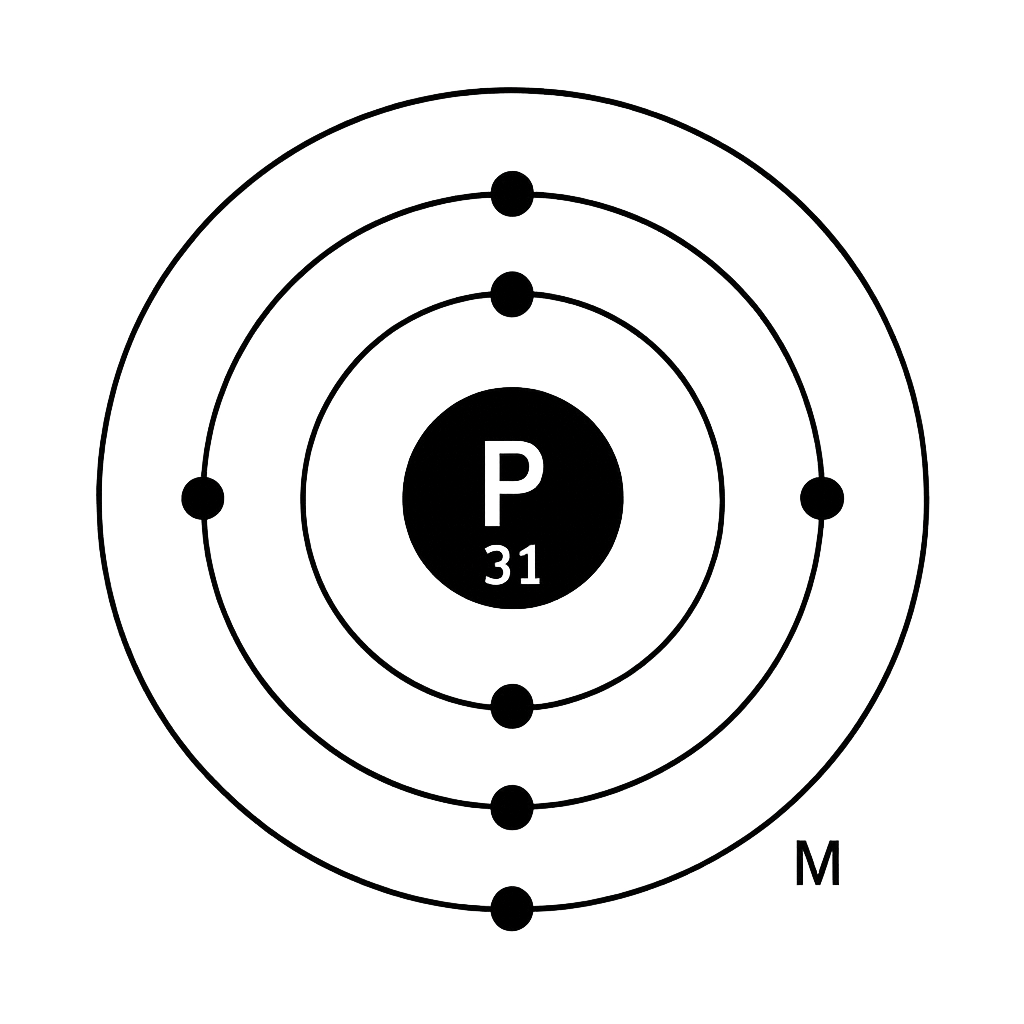
The diagram shows a Bohr model of an atom labelled with its mass number 31 and the electrons distributed as 2, 8, 5 in the successive shells. Identify the element (give its symbol), state its atomic number, and state the number of valence electrons.
A. Si, 14, 4
Correct B. P, 15, 5
C. S, 16, 6
D. Cl, 17, 7

Correct Answer: B

Want to see the full step-by-step solution? Unlock AI Explanation & Analytics
Question 20 View Details
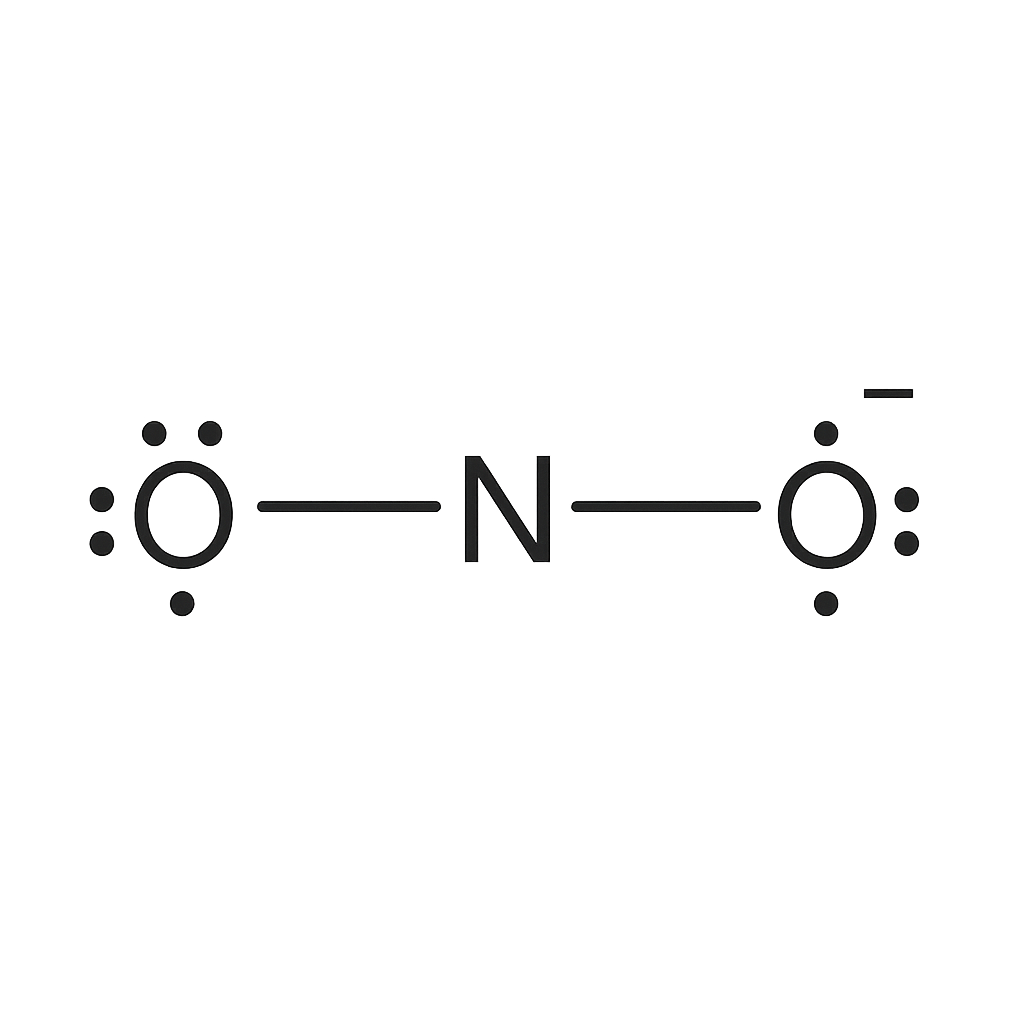
The diagram shows the Lewis structure of the nitrite ion (NO₂⁻). Nitrogen is central, double‑bonded to one oxygen atom and single‑bonded to the other oxygen atom, which carries a negative formal charge. All lone pairs are shown. Using the diagram, calculate the formal charge on the nitrogen atom.
A. 1
B. 2
C. -1
Correct D. 0

Correct Answer: D

Want to see the full step-by-step solution? Unlock AI Explanation & Analytics
Question 21 View Details
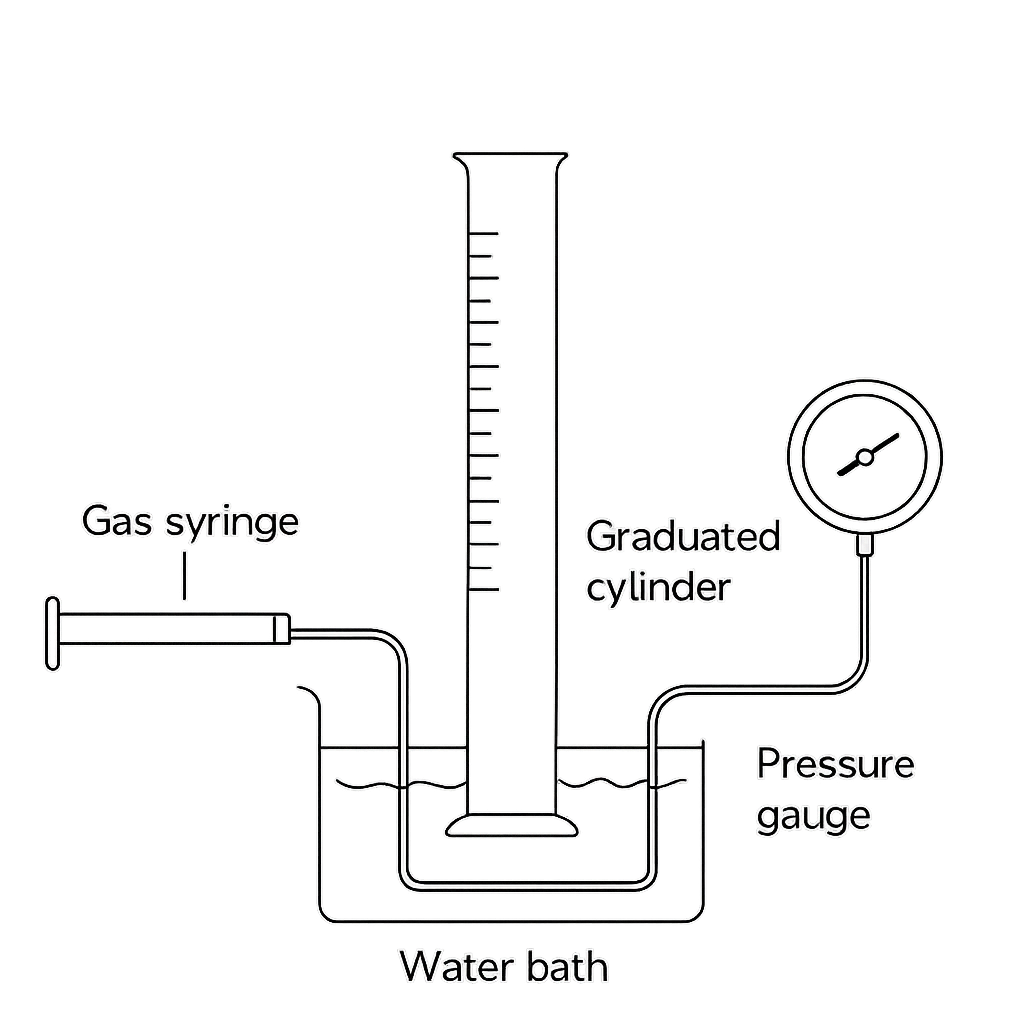
In the laboratory apparatus shown, hydrogen gas is collected over water at 25 °C. The volume of gas collected is 125 mL and the total pressure measured is 760 mmHg. The vapour pressure of water at 25 °C is 23.8 mmHg. Given the molar mass of H₂ is 2.016 g mol⁻¹, calculate the mass of hydrogen collected. Use the ideal‑gas equation (PV=nRT) with (R=0.0821\,\text{L·atm·mol}^{-1}\text{·K}^{-1}).
Correct A. 0.010 g
B. 0.012 g
C. 0.015 g
D. 0.008 g

Correct Answer: A

Want to see the full step-by-step solution? Unlock AI Explanation & Analytics
Question 22 View Details
Calcium (Ca) has an atomic radius of 197 pm. Assuming that moving down a group increases the atomic radius by 20 % per period, estimate the atomic radius of strontium (Sr), which is in the same group one period below calcium.
Correct A. 236 pm
B. 197 pm
C. 250 pm
D. 210 pm

Correct Answer: A

Want to see the full step-by-step solution? Unlock AI Explanation & Analytics
Question 23 View Details
A student carries out the esterification reaction between acetic acid and ethanol: \[\text{CH}_3\text{COOH} + \text{C}_2\text{H}_5\text{OH} \rightarrow \text{CH}_3\text{COO}\text{C}_2\text{H}_5 + \text{H}_2\text{O}\] The student uses 5.0 g of acetic acid and 4.0 g of ethanol. The reaction is 80 % efficient (actual yield). Given molar masses: acetic acid 60.05 g mol⁻¹, ethanol 46.07 g mol⁻¹, ethyl acetate 88.11 g mol⁻¹. Calculate the mass of ethyl acetate obtained.
A. 7.12 g
B. 6.45 g
C. 4.23 g
Correct D. 5.87 g

Correct Answer: D

Want to see the full step-by-step solution? Unlock AI Explanation & Analytics
Question 24 View Details
Carbon dioxide (CO₂) contains two C=O double bonds with a bond length of 116 pm. In the carbonate ion (CO₃²⁻) each C-O bond is equivalent due to resonance. Predict whether the C-O bond length in CO₃²⁻ is longer, shorter, or the same as in CO₂, and give a brief justification based on bond order.
A. the same as in CO₂
B. shorter than in CO₂
Correct C. longer than in CO₂
D. shorter than in CO₂ (due to resonance)

Correct Answer: C

Want to see the full step-by-step solution? Unlock AI Explanation & Analytics
Question 25 View Details
The vapour pressure of solid iodine at 300 K is 0.30 Pa. Its enthalpy of sublimation is 62 kJ mol⁻¹. Using the Clausius-Clapeyron equation \(\ln(P_2/P_1) = -\dfrac{\Delta H_{sub}}{R}\left(\dfrac{1}{T_2}-\dfrac{1}{T_1}\right)\) (with \(R = 8.314\) J mol⁻¹ K⁻¹), estimate the vapour pressure at 350 K. Give your answer to two significant figures.
A. 9.8 Pa
B. 12.3 Pa
Correct C. 10.5 Pa
D. 8.6 Pa

Correct Answer: C

Want to see the full step-by-step solution? Unlock AI Explanation & Analytics

Master the Exam!

You've seen a preview, but there are thousands more questions plus AI tutor to break down complex solutions.

Unlock Full Access Available for Android & Windows
Help others prepare! Share this practice hub:
Chat with Support