igcse model questions vol1 2022 biology | Objective

Prepare for your exams with igcse model questions vol1 questions? Reviewing past/model questions is one of the most effective ways to guarantee a high score. This practice hub features authentic 2022 biology (Objective) questions designed to simulate the real exam environment.

Practice these randomly selected questions to test your readiness.

Question 1 View Details
Ecosystem A receives 2000 MJ m⁻² yr⁻¹ of solar radiation and converts 1 % of it into chemical energy in its primary producers. Herbivores obtain 10 % of the producer energy, secondary consumers obtain 20 % of the herbivore energy and tertiary consumers obtain 15 % of the secondary‑consumer energy. Ecosystem B receives 2500 MJ m⁻² yr⁻¹ and converts 0.8 % of it into producer energy. Its herbivores obtain 12 % of the producer energy, secondary consumers obtain 18 % of the herbivore energy and tertiary consumers obtain 10 % of the secondary‑consumer energy. Which ecosystem supports the greater amount of energy at the tertiary‑consumer level? State the ecosystem (A or B) and the amount of energy (MJ m⁻² yr⁻¹) available to tertiary consumers in that ecosystem.
A. Ecosystem B, 0.07 MJ m⁻² yr⁻¹
B. Ecosystem B, 0.06 MJ m⁻² yr⁻¹
Correct C. Ecosystem A, 0.06 MJ m⁻² yr⁻¹
D. Ecosystem A, 0.05 MJ m⁻² yr⁻¹

Correct Answer: C

Want to see the full step-by-step solution? Unlock AI Explanation & Analytics
Question 2 View Details
A kidney filters blood at a glomerular filtration rate of 120 mL min⁻¹. The filtrate initially contains 0.9 g L⁻¹ of glucose and 140 mmol L⁻¹ of Na⁺. During tubular processing, 99 % of the glucose, 85 % of the Na⁺ and 70 % of the water are re‑absorbed. Calculate (a) the volume of urine produced each minute, (b) the concentration of glucose (g L⁻¹) in the urine, and (c) the concentration of Na⁺ (mmol L⁻¹) in the urine.
Correct A. Urine volume 0.036 L min⁻¹; glucose 0.03 g L⁻¹; Na⁺ 70 mmol L⁻¹
B. Urine volume 0.030 L min⁻¹; glucose 0.01 g L⁻¹; Na⁺ 70 mmol L⁻¹
C. Urine volume 0.042 L min⁻¹; glucose 0.09 g L⁻¹; Na⁺ 85 mmol L⁻¹
D. Urine volume 0.036 L min⁻¹; glucose 0.03 g L⁻¹; Na⁺ 60 mmol L⁻¹

Correct Answer: A

Want to see the full step-by-step solution? Unlock AI Explanation & Analytics
Question 3 View Details
A beetle population initially has allele frequencies p = 0.6 and q = 0.4 (two alleles). The original effective population size is large, so the initial heterozygosity is H₀ = 2pq. A severe bottleneck reduces the effective size to Ne = 50 for five successive generations, after which the population expands again to a large size where drift is negligible. Assuming no mutation, migration or selection, calculate (a) the heterozygosity after the five‑generation bottleneck, and (b) the percentage loss of heterozygosity relative to the original value.
A. H after bottleneck ≈0.400; loss ≈10.0 % of the original heterozygosity
B. H after bottleneck ≈0.480; loss ≈2.5 % of the original heterozygosity
C. H after bottleneck ≈0.432; loss ≈6.2 % of the original heterozygosity
Correct D. H after bottleneck ≈0.457; loss ≈4.9 % of the original heterozygosity

Correct Answer: D

Want to see the full step-by-step solution? Unlock AI Explanation & Analytics
Question 4 View Details
A desert reptile excretes uric acid as a paste containing 0.5 g of uric acid per 10 mL of water. A mammal excretes urea containing 0.5 g of urea per 200 mL of water. Both animals must eliminate 30 g of nitrogen (as elemental N). The molecular formulae are C₅H₄N₄O₃ for uric acid (4 N atoms per molecule, molar mass 168 g mol⁻¹) and CH₄N₂O for urea (2 N atoms per molecule, molar mass 60 g mol⁻¹). Which animal uses less water to excrete the same amount of nitrogen, and how much water (in litres) is saved compared with the other animal?
A. The desert reptile uses less water; it saves about 15 L compared with the mammal
Correct B. The desert reptile uses less water; it saves about 24 L compared with the mammal
C. The mammal uses less water; it saves about 5 L compared with the reptile
D. The mammal uses less water; it saves about 12 L compared with the reptile

Correct Answer: B

Want to see the full step-by-step solution? Unlock AI Explanation & Analytics
Question 5 View Details
At sea level atmospheric pressure is 760 mmHg and the fraction of inspired O₂ is 0.21. Water vapour pressure in the alveoli is 47 mmHg, alveolar CO₂ partial pressure is 40 mmHg and the respiratory quotient R is 0.8. Using the alveolar gas equation \(PAO₂ = FiO₂(P_{atm} - P_{H₂O}) - \frac{PaCO₂}{R}\), calculate (a) the alveolar partial pressure of O₂ (PAO₂) in mmHg, (b) the O₂ gradient between alveolar air and arterial blood if arterial PO₂ is 95 mmHg, and (c) the percentage of alveolar O₂ that is transferred to the blood.
A. PAO₂ ≈110 mmHg; gradient 15 mmHg; 85 % of alveolar O₂ transferred
B. PAO₂ ≈105 mmHg; gradient 10 mmHg; 90 % of alveolar O₂ transferred
C. PAO₂ ≈95 mmHg; gradient 0 mmHg; 100 % of alveolar O₂ transferred
Correct D. PAO₂ ≈100 mmHg; gradient 5 mmHg; 95 % of alveolar O₂ transferred

Correct Answer: D

Want to see the full step-by-step solution? Unlock AI Explanation & Analytics
Question 6 View Details
A person at rest has a tidal volume of \(0.5\) L and a respiratory rate of \(12\) breaths per minute. During moderate exercise the tidal volume rises to \(1.2\) L and the respiratory rate to \(20\) breaths per minute. The fraction of inhaled oxygen removed from the air is \(5\%\) at rest and \(15\%\) during exercise. Atmospheric air contains \(21\%\) oxygen. Calculate the increase in the volume of oxygen consumed per minute when the person moves from rest to exercise. Give your answer in litres of O₂ per minute, correct to two decimal places.
Correct A. 0.69 L/min
B. 0.85 L/min
C. 0.45 L/min
D. 1.02 L/min

Correct Answer: A

Want to see the full step-by-step solution? Unlock AI Explanation & Analytics
Question 7 View Details
At rest a person loses heat by radiation (\(100\) W), convection (\(50\) W) and evaporation (\(30\) W). These losses exactly balance the metabolic heat production at rest. During vigorous exercise the metabolic heat production rises to \(500\) W while the rates of heat loss by radiation and convection remain unchanged. Assuming the latent heat of vapourisation of water is \(2.43\) kJ g⁻¹, determine (a) the additional rate of evaporative heat loss required to maintain constant body temperature, and (b) the corresponding increase in sweat loss in millilitres per minute. Give your answer for (b) to one decimal place.
A. 300 W; 7.2 mL/min
B. 350 W; 8.5 mL/min
Correct C. 320 W; 7.9 mL/min
D. 280 W; 6.8 mL/min

Correct Answer: C

Want to see the full step-by-step solution? Unlock AI Explanation & Analytics
Question 8 View Details
A spherical animal cell has a diameter of \(20\ \mu\text{m}\). Using \(\pi = 3.14\), calculate the surface‑area‑to‑volume ratio of the cell in \(\mu\text{m}^{-1}\). Give your answer to two significant figures.
Correct A. 0.30 µm⁻¹
B. 0.35 µm⁻¹
C. 0.25 µm⁻¹
D. 0.28 µm⁻¹

Correct Answer: A

Want to see the full step-by-step solution? Unlock AI Explanation & Analytics
Question 9 View Details
A bacterial culture contains \(1 \times 10^{9}\) cells. The mutation rate that confers resistance to antibiotic X is \(2 \times 10^{-8}\) per cell per generation, and each generation lasts 20 minutes. After five generations, a plasmid that carries an additional resistance gene can be acquired by any mutant cell with probability \(1 \times 10^{-4}\). (a) Calculate the expected number of cells that have acquired both resistances after the five generations. (b) Assuming the number of fully resistant cells follows a Poisson distribution, calculate the probability that at least one fully resistant cell is present. Give your answer for (b) as a decimal to three significant figures.
Correct A. 0.01 cells; 0.010
B. 0.015 cells; 0.015
C. 0.02 cells; 0.020
D. 0.005 cells; 0.005

Correct Answer: A

Want to see the full step-by-step solution? Unlock AI Explanation & Analytics
Question 10 View Details
In pea plants two genes are linked on the same chromosome: gene A controls plant height (A = tall, a = dwarf) and gene B controls pod colour (B = yellow, b = green). The recombination frequency between the genes is \(10\%\). A plant heterozygous for both genes in coupling phase (genotype A B / a b) is self‑fertilised. What proportion of the offspring are expected to display the dwarf, green‑pod phenotype (a b)? Express your answer as a percentage to one decimal place.
A. 18.5 %
B. 22.0 %
C. 25.1 %
Correct D. 20.3 %

Correct Answer: D

Want to see the full step-by-step solution? Unlock AI Explanation & Analytics
Question 11 View Details
A student feels light‑headed when standing up quickly. Identify the primary type of receptor that detects the sudden fall in blood pressure and describe the immediate physiological response that restores normal pressure.
A. Juxtaglomerular cells; the kidneys increase renin secretion leading to angiotensin II‑mediated vasoconstriction over several hours.
B. Carotid body chemoreceptors; the medulla decreases parasympathetic activity causing a reduced heart rate and vasodilation to lower blood pressure.
Correct C. Carotid sinus (and aortic arch) baroreceptors; the medulla increases sympathetic activity causing an increased heart rate and peripheral vasoconstriction to raise blood pressure.
D. Aortic stretch receptors; the hypothalamus releases antidiuretic hormone causing water retention and increased blood volume to raise pressure.

Correct Answer: C

Want to see the full step-by-step solution? Unlock AI Explanation & Analytics
Question 12 View Details
A contagious disease has a basic reproduction number of \(R_0 = 3\). A vaccine available for this disease is 70\% effective.\n(a) Calculate the minimum proportion of the population that must be vaccinated to achieve herd immunity.\n(b) If only 85\% of the population is vaccinated, can an outbreak still occur? Justify your answer.
Correct A. At least about 95 % of the population must be vaccinated; with 85 % coverage the disease could still spread.
B. At least about 70 % of the population must be vaccinated; with 85 % coverage the disease could still spread.
C. At least about 95 % of the population must be vaccinated; with 85 % coverage the disease would not spread.
D. At least about 85 % of the population must be vaccinated; with 85 % coverage the disease would be eliminated.

Correct Answer: A

Want to see the full step-by-step solution? Unlock AI Explanation & Analytics
Question 13 View Details
When a skeletal muscle fibre receives a single action potential, outline the sequence of events that leads to contraction, highlighting the role of the sarcoplasmic reticulum and troponin.
A. Action potential → T‑tubule depolarisation → Ca²⁺ release from sarcoplasmic reticulum → Ca²⁺ binds troponin, moving tropomyosin → actin binds myosin and the cross‑bridge cycle ends.
B. Action potential → T‑tubule depolarisation → Ca²⁺ release from sarcoplasmic reticulum → Ca²⁺ binds tropomyosin, moving troponin → myosin binds actin and the cross‑bridge cycle begins.
Correct C. Action potential → T‑tubule depolarisation → Ca²⁺ release from sarcoplasmic reticulum → Ca²⁺ binds troponin, moving tropomyosin → myosin binds actin and the cross‑bridge cycle begins.
D. Action potential → T‑tubule depolarisation → Na⁺ release from sarcoplasmic reticulum → Na⁺ binds troponin, moving tropomyosin → myosin binds actin and the cross‑bridge cycle begins.

Correct Answer: C

Want to see the full step-by-step solution? Unlock AI Explanation & Analytics
Question 14 View Details
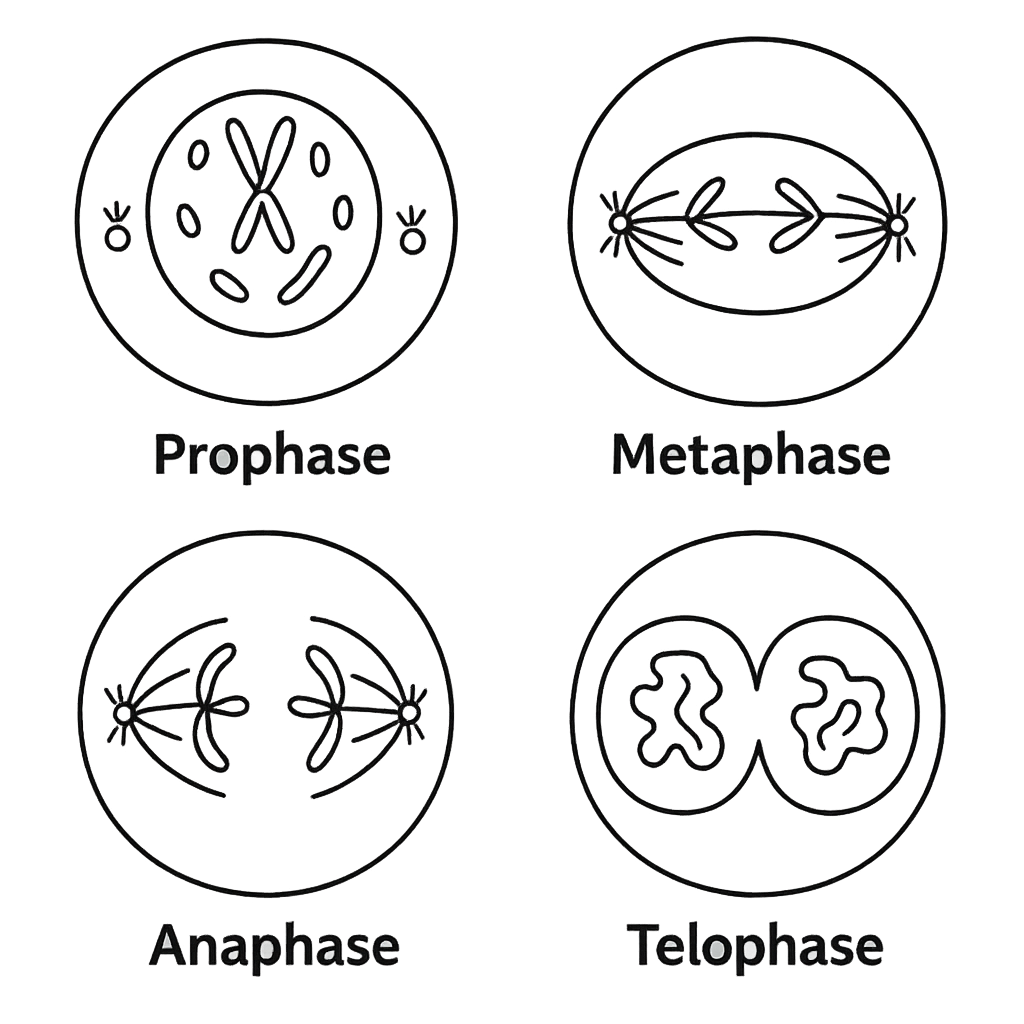
In the diagram of mitosis, a cell shows chromosomes lined up along the middle of the cell, forming a clear equatorial plate. Identify the stage of mitosis depicted.
A. Telophase
B. Anaphase
Correct C. Metaphase
D. Prophase

Correct Answer: C

Want to see the full step-by-step solution? Unlock AI Explanation & Analytics
Question 15 View Details
Five plants are described as follows:\n1. Fern - non‑vascular, reproduces by spores, frond leaves.\n2. Moss - non‑vascular, small, rhizoids, reproduces by spores.\n3. Pine - vascular, seed plant, needle‑like leaves, produces cones.\n4. Oak - vascular, seed plant, broad leaves, produces fruit.\n5. Liverwort - non‑vascular, thallus body, reproduces by spores.\nConstruct a dichotomous key to separate these five plants. Then, using your key, identify a plant that is vascular, reproduces by seeds in cones, and has needle‑like leaves.
Correct A. Pine
B. Moss
C. Oak
D. Fern

Correct Answer: A

Want to see the full step-by-step solution? Unlock AI Explanation & Analytics
Question 16 View Details
In a 28‑day menstrual cycle, the concentration of estrogen (E) rises linearly from 20 pg mL⁻¹ on day 1 to a peak of 200 pg mL⁻¹ on day 12, then falls linearly to 150 pg mL⁻¹ on day 14. An LH surge occurs as soon as the estrogen concentration exceeds 180 pg mL⁻¹. On which day does the LH surge first begin?
A. 10
B. 13
Correct C. 11
D. 12

Correct Answer: C

Want to see the full step-by-step solution? Unlock AI Explanation & Analytics
Question 17 View Details
A herbivore population follows logistic growth \(\frac{dN}{dt}=rN\left(1-\frac{N}{K}\right)\). In a stable environment \(r=0.4\) month⁻¹ and \(K=800\). After a drought, the carrying capacity falls by 25 % and the intrinsic rate falls by 10 %. The population was at the original equilibrium (\(N=K\)) when the drought began. Using the new parameters, calculate the expected number of individuals after 3 months (round to the nearest whole individual).
Correct A. 656
B. 800
C. 600
D. 720

Correct Answer: A

Want to see the full step-by-step solution? Unlock AI Explanation & Analytics
Question 18 View Details
Blood glucose concentration \(G\) (mg dL⁻¹) in a simplified model changes as \(\frac{dG}{dt}=R_{in}-R_{out}\), where \(R_{in}=0.5+0.02\,(200-G)\) mg dL⁻¹ min⁻¹ (liver input plus intestinal absorption) and \(R_{out}=0.03\,G\) mg dL⁻¹ min⁻¹ (insulin‑mediated uptake).\n\n(a) Determine the fasting equilibrium glucose concentration (where \(dG/dt=0\)).\n(b) Immediately after a meal, the intestinal absorption term changes to \(0.04\,(250-G)\) for the next 30 minutes, while the other terms remain unchanged. Assuming the glucose concentration does not change appreciably during this short interval, calculate the glucose concentration at the end of the 30‑minute period.
A. 190
Correct B. 216
C. 200
D. 240

Correct Answer: B

Want to see the full step-by-step solution? Unlock AI Explanation & Analytics
Question 19 View Details
In a community of 30 000 people, a vaccine trial recorded 300 cases of disease X among 15 000 unvaccinated individuals and 75 cases among 15 000 vaccinated individuals over one year.\n\n(a) Calculate the vaccine efficacy as a percentage reduction in incidence.\n(b) How many people must be vaccinated to prevent at least 200 cases per year, assuming the same efficacy and that the disease incidence in the unvaccinated population remains as observed? Round up to the nearest whole person.
Correct A. 13334
B. 15000
C. 12000
D. 10000

Correct Answer: A

Want to see the full step-by-step solution? Unlock AI Explanation & Analytics
Question 20 View Details
A bacterial culture shows the following viable counts (CFU ×10⁶) at 30‑minute intervals: \nTime (min): 0 30 60 90 120 CFU (×10⁶): 2 8 32 128 512\n\n(a) Assuming exponential growth, determine the generation time in minutes.\n(b) After 120 min an antibiotic is added that reduces the specific growth rate by 40 % (the new rate is 0.6 of the original). Predict the CFU count after a further 60 minutes (i.e., at 180 min). Give your answer in scientific notation to two significant figures.
A. 2.0×10^9
Correct B. 2.7×10^9
C. 3.2×10^9
D. 1.6×10^9

Correct Answer: B

Want to see the full step-by-step solution? Unlock AI Explanation & Analytics
Question 21 View Details
A plant cell has a total volume of \(5000\) \(\mu m^{3}\). The central vacuole occupies \(80\%\) of this volume. What is the volume of the cytoplasm (excluding the vacuole) in \(\mu m^{3}\)?
A. 2000
B. 4000
C. 1500
Correct D. 1000

Correct Answer: D

Want to see the full step-by-step solution? Unlock AI Explanation & Analytics
Question 22 View Details
A desert mammal dissipates heat through its large ears. The ear surface area is \(150\) cm\(^2\) and the temperature difference between the blood in the ears and the ambient air is \(20^{\circ}C\). The heat transfer coefficient is \(15\) W·m\(^{-2}\)·K\(^{-1}\).\n\nAnother desert animal loses water through respiration at a rate of \(0.1\) g·min\(^{-1}\). The latent heat of vaporisation of water is \(2400\) J·g\(^{-1}\).\n\nCalculate the rate of heat loss (in J·s\(^{-1}\)) from the ears and from respiration, and state which adaptation dissipates more heat.
A. Ear heat loss = 3.0 J·s⁻¹; respiration heat loss = 4 J·s⁻¹; respiration dissipates more heat.
B. Ear heat loss = 4.5 J·s⁻¹; respiration heat loss = 5 J·s⁻¹; respiration dissipates more heat.
Correct C. Ear heat loss = 4.5 J·s⁻¹; respiration heat loss = 4 J·s⁻¹; ears dissipate more heat.
D. Ear heat loss = 6.0 J·s⁻¹; respiration heat loss = 4 J·s⁻¹; ears dissipate more heat.

Correct Answer: C

Want to see the full step-by-step solution? Unlock AI Explanation & Analytics
Question 23 View Details
Both parents are heterozygous for cystic fibrosis (genotype \(C c\)) and also heterozygous for sickle‑cell trait (genotype \(S s\)). Assuming the two genes assort independently, what is the probability that their child will be a carrier for cystic fibrosis (genotype \(C c\)) but will not have sickle‑cell disease (i.e. genotype \(S S\) or \(S s\))?
A. 1/4
B. 1/2
Correct C. 3/8
D. 5/8

Correct Answer: C

Want to see the full step-by-step solution? Unlock AI Explanation & Analytics
Question 24 View Details
A small gas diffuses across a cell membrane that is \(5\) µm thick. The diffusion coefficient for the gas in the cytoplasm is \(2.5 \times 10^{-5}\) cm\(^2\)·s\(^{-1}\). Using the approximation \(t = \frac{x^{2}}{2D}\), where \(x\) is the diffusion distance and \(D\) the diffusion coefficient, calculate the time required for the gas to cross the membrane (in seconds).\n\nAn active transport protein can move the same amount of this gas at a rate of \(1 \times 10^{-8}\) mol·s\(^{-1}\). If the cell needs to transport \(1 \times 10^{-9}\) mol of the gas, how long will active transport take (in seconds)?\n\nWhich mechanism delivers the required amount of gas faster?
A. Diffusion ≈ 0.005 s; active transport ≈ 0.01 s; active transport is faster.
B. Diffusion ≈ 0.02 s; active transport ≈ 0.05 s; active transport is faster.
Correct C. Diffusion ≈ 0.005 s; active transport ≈ 0.1 s; diffusion is faster.
D. Diffusion ≈ 0.01 s; active transport ≈ 0.1 s; diffusion is faster.

Correct Answer: C

Want to see the full step-by-step solution? Unlock AI Explanation & Analytics
Question 25 View Details
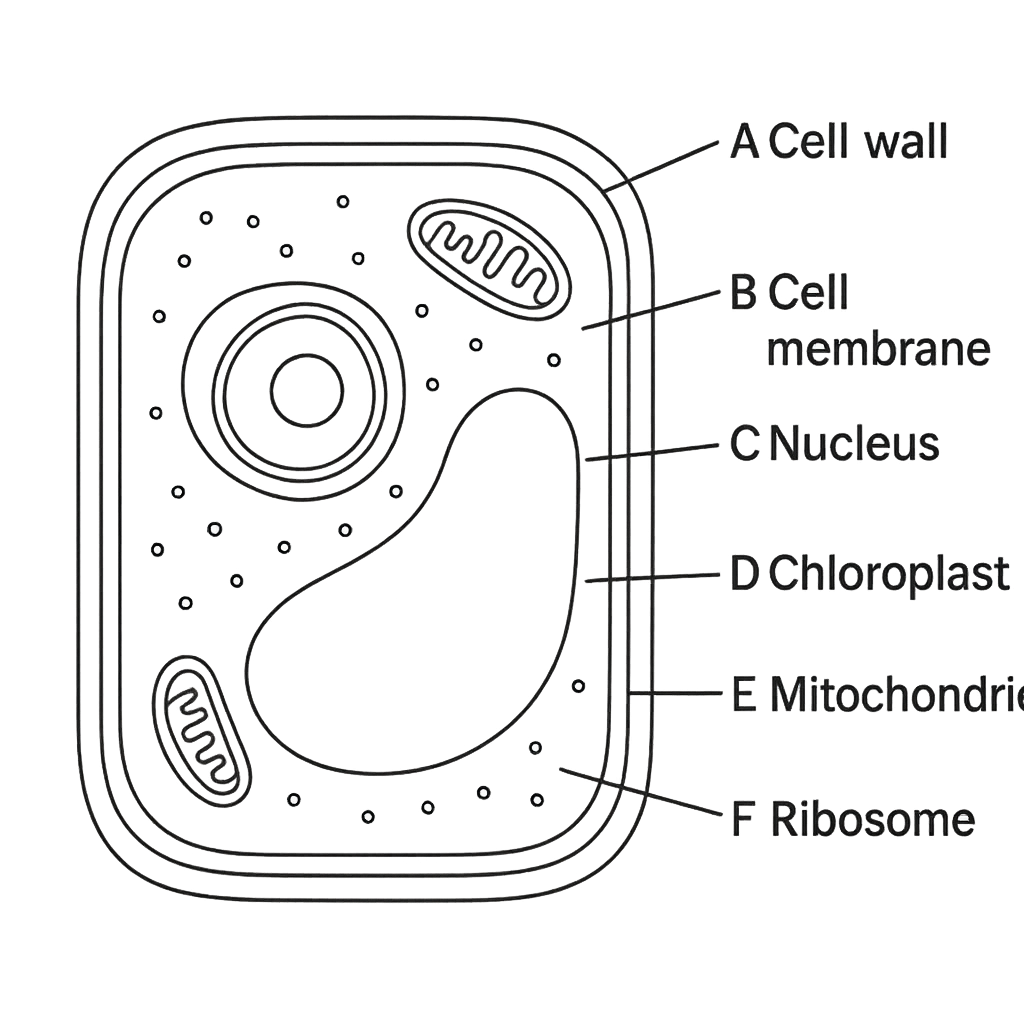
The diagram shows a typical plant cell with labelled structures. Identify the organelle that is absent in an animal cell and give one functional reason for its absence.
A. Mitochondrion - because animal cells do not require ATP production.
B. Nucleus - because animal cells lack DNA.
C. Cell membrane - because animal cells need a rigid barrier to maintain shape.
Correct D. Cell wall - because animal cells need flexibility and do not require the rigid structural support that a cell wall provides.

Correct Answer: D

Want to see the full step-by-step solution? Unlock AI Explanation & Analytics

Master the Exam!

You've seen a preview, but there are thousands more questions plus AI tutor to break down complex solutions.

Unlock Full Access Available for Android & Windows
Help others prepare! Share this practice hub:
Chat with Support