igcse model questions vol1 2021 physics | Objective

Prepare for your exams with igcse model questions vol1 questions? Reviewing past/model questions is one of the most effective ways to guarantee a high score. This practice hub features authentic 2021 physics (Objective) questions designed to simulate the real exam environment.

Practice these randomly selected questions to test your readiness.

Question 1 View Details
An air piston of area \(0.020\ \text{m}^2\) is used to lift a weight of \(150\ \text{N}\). The piston is connected to a vertical tube filled with water (density \(1000\ \text{kg m}^{-3}\)). (a) Calculate the pressure exerted by the piston. (b) Determine the height of a water column that would produce the same pressure. (c) If the tube were instead filled with oil of density \(800\ \text{kg m}^{-3}\), what height of oil would be required to give the same pressure?
A. Pressure = 7.5×10^3 Pa; water column height ≈ 0.87 m; oil column height ≈ 0.96 m
B. Pressure = 7.5×10^2 Pa; water column height ≈ 0.77 m; oil column height ≈ 0.96 m
Correct C. Pressure = 7.5×10^3 Pa; water column height ≈ 0.77 m; oil column height ≈ 0.96 m
D. Pressure = 7.5×10^3 Pa; water column height ≈ 0.77 m; oil column height ≈ 1.20 m

Correct Answer: C

Want to see the full step-by-step solution? Unlock AI Explanation & Analytics
Question 2 View Details
A car travels \(60\ \text{km}\) north and then \(80\ \text{km}\) east. Find the magnitude of the resultant displacement and state its direction as an angle east of north, correct to one decimal place.
A. Displacement = 140 km; direction = 53.1° east of north
B. Displacement = 100 km; direction = 45.0° east of north
C. Displacement = 100 km; direction = 60.0° east of north
Correct D. Displacement = 100 km; direction = 53.1° east of north

Correct Answer: D

Want to see the full step-by-step solution? Unlock AI Explanation & Analytics
Question 3 View Details
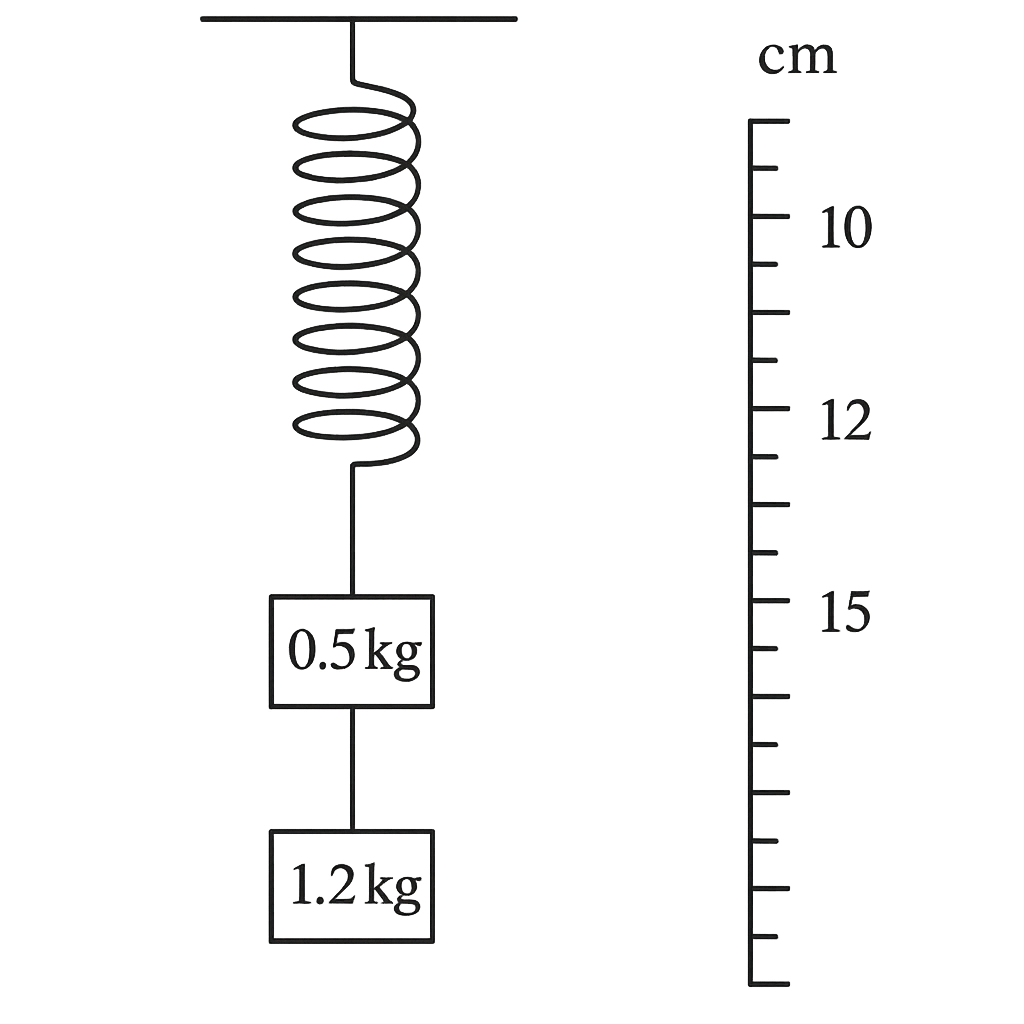
From the diagram of a spring‑mass apparatus, the unstretched length of the spring is \(10.0\ \text{cm}\). When a \(0.5\ \text{kg}\) mass is hung, the length becomes \(12.5\ \text{cm}\). When a \(1.2\ \text{kg}\) mass is hung, the length becomes \(15.5\ \text{cm}\). (a) Determine the spring constant \(k\). (b) Using this \(k\), predict the extension for the \(1.2\ \text{kg}\) mass and compare with the observed extension, giving the percentage error.
A. k = 196 N m⁻¹; predicted extension = 5.8 cm; percentage error ≈ 9.5 %
B. k = 210 N m⁻¹; predicted extension = 5.5 cm; percentage error ≈ 12.0 %
Correct C. k = 196 N m⁻¹; predicted extension = 6.0 cm; percentage error ≈ 8.3 %
D. k = 180 N m⁻¹; predicted extension = 6.5 cm; percentage error ≈ 4.0 %

Correct Answer: C

Want to see the full step-by-step solution? Unlock AI Explanation & Analytics
Question 4 View Details
A rectangular coil has 30 turns, each side \(0.10\ \text{m}\). It rotates at \(50\) revolutions per second in a uniform magnetic field of \(0.20\ \text{T}\), the axis of rotation being perpendicular to the field. (a) Find the maximum emf induced in the coil. (b) If the coil is connected to a resistor of \(10\ \Omega\), calculate the peak current. (c) Determine the average electrical power dissipated in the resistor. (d) If the motor driving the coil supplies a mechanical power of \(20\ \text{W}\), calculate the efficiency of the system.
A. Maximum emf ≈ 20.0 V; peak current ≈ 2.00 A; average power ≈ 20.0 W; efficiency ≈ 100 %
Correct B. Maximum emf ≈ 18.9 V; peak current ≈ 1.89 A; average power ≈ 17.8 W; efficiency ≈ 89 %
C. Maximum emf ≈ 15.0 V; peak current ≈ 1.50 A; average power ≈ 13.5 W; efficiency ≈ 68 %
D. Maximum emf ≈ 18.9 V; peak current ≈ 1.00 A; average power ≈ 10.0 W; efficiency ≈ 50 %

Correct Answer: B

Want to see the full step-by-step solution? Unlock AI Explanation & Analytics
Question 5 View Details
A hydrogen atom makes a transition from the \(n=4\) level to the \(n=2\) level, emitting a photon. (a) Calculate the wavelength of the emitted photon (give answer in nanometres). (b) Using the Bohr model, find the radius of the electron's orbit in the \(n=4\) state (express in metres). (c) If a uniform magnetic field of \(2.0\ \text{T}\) is applied perpendicular to the plane of the orbit, compute the magnetic force on the electron moving in that orbit.
A. Wavelength = 410 nm; orbit radius = 1.69×10⁻⁹ m; magnetic force ≈ 2.2×10⁻¹³ N
B. Wavelength = 656 nm; orbit radius = 2.12×10⁻⁹ m; magnetic force ≈ 9.0×10⁻¹³ N
C. Wavelength = 434 nm; orbit radius = 5.29×10⁻¹¹ m; magnetic force ≈ 3.5×10⁻¹³ N
Correct D. Wavelength = 486 nm; orbit radius = 8.46×10⁻¹⁰ m; magnetic force ≈ 1.76×10⁻¹³ N

Correct Answer: D

Want to see the full step-by-step solution? Unlock AI Explanation & Analytics
Question 6 View Details
A siren emits a sound of frequency \(500\ \text{Hz}\). The speed of sound in air is \(340\ \text{m s}^{-1}\). An observer hears a frequency of \(531\ \text{Hz}\) as the source approaches and \(472\ \text{Hz}\) as it recedes. Assuming the observer is stationary, calculate the speed of the siren (in \(\text{m s}^{-1}\)), giving your answer to two significant figures.
A. 15 m/s
B. 25 m/s
C. 30 m/s
Correct D. 20 m/s

Correct Answer: D

Want to see the full step-by-step solution? Unlock AI Explanation & Analytics
Question 7 View Details
A block of mass \(12\ \text{kg}\) is lifted vertically a distance of \(0.50\ \text{m}\) using a block‑and‑tackle system that has three supporting rope segments (mechanical advantage \(=3\)). The input rope is pulled through a distance of \(2.00\ \text{m}\) and the measured input force is \(45\ \text{N}\). (a) Calculate the work done by the input force. (b) Calculate the increase in gravitational potential energy of the block. (c) Determine the efficiency of the system (percentage to one decimal place).
Correct A. 65.3 %
B. 72.1 %
C. 80.0 %
D. 58.7 %

Correct Answer: A

Want to see the full step-by-step solution? Unlock AI Explanation & Analytics
Question 8 View Details
Two forces act on a point: a \(30\ \text{N}\) force directed east and a \(40\ \text{N}\) force directed north. Find the magnitude of the resultant force (in newtons) and the angle it makes with the east direction (to the nearest degree).
Correct A. 50 N, 53° north of east
B. 50 N, 45° north of east
C. 30 N, 45° north of east
D. 70 N, 60° north of east

Correct Answer: A

Want to see the full step-by-step solution? Unlock AI Explanation & Analytics
Question 9 View Details
A \(150\ \text{g}\) metal rod at \(120^{\circ}\text{C}\) is placed into \(200\ \text{g}\) of water at \(25^{\circ}\text{C}\) in an insulated container. The final equilibrium temperature is \(30^{\circ}\text{C}\). Assuming the specific heat capacity of water is \(4.18\ \text{J g}^{-1}\text{K}^{-1}\) and that no heat is lost to the surroundings, calculate the specific heat capacity of the metal (in \(\text{J g}^{-1}\text{K}^{-1}\)) to two decimal places.
Correct A. 0.31 J/g·K
B. 0.25 J/g·K
C. 0.40 J/g·K
D. 0.35 J/g·K

Correct Answer: A

Want to see the full step-by-step solution? Unlock AI Explanation & Analytics
Question 10 View Details
A sample contains \(2.0\times10^{6}\) atoms of a radioactive isotope X. Each decay emits a beta particle with kinetic energy \(0.5\ \text{MeV}\). The half‑life of X is \(30\ \text{min}\).\n(a) Calculate the activity of the sample at the start (in becquerels).\n(b) Determine the total energy released as radiation during the first hour (in joules).\n(c) If the sample is placed \(0.5\ \text{m}\) from a detector that records 1% of the emitted beta particles, estimate the count rate recorded after \(45\ \text{min}\).
A. a) 385 Bq; b) 6.0×10⁻⁸ J; c) ≈1.3 counts s⁻¹
B. a) 770 Bq; b) 1.20×10⁻⁶ J; c) ≈0.27 counts s⁻¹
C. a) 1.5×10³ Bq; b) 2.4×10⁻⁷ J; c) ≈5.4 counts s⁻¹
Correct D. a) 770 Bq; b) 1.20×10⁻⁷ J; c) ≈2.7 counts s⁻¹

Correct Answer: D

Want to see the full step-by-step solution? Unlock AI Explanation & Analytics
Question 11 View Details
Two point charges, +5 µC and -3 µC, are 0.12 m apart on a straight line. A test charge of +2 µC is placed at a point where the net electric field due to the two charges is zero. It is then moved 0.04 m closer to the +5 µC charge. Calculate the work done by the electric field in this displacement. Give your answer in joules (use two significant figures).
A. 2.5e-4 J
B. 4.1e-4 J
Correct C. 3.4e-4 J
D. 3.4e-3 J

Correct Answer: C

Want to see the full step-by-step solution? Unlock AI Explanation & Analytics
Question 12 View Details
A cyclist starts from rest, accelerates uniformly for 4.0 s, then rides at constant speed, and finally decelerates uniformly to rest over a distance of 25 m. The total time from start to stop is 20.0 s and the total distance travelled is 300 m. Determine (a) the magnitude of the acceleration during the first phase and (b) the magnitude of the deceleration in the final phase. Give your answers to two significant figures.
A. a ≈ 3.2 m/s², deceleration ≈ 5.8 m/s²
Correct B. a ≈ 4.5 m/s², deceleration ≈ 6.5 m/s²
C. a ≈ 4.5 m/s², deceleration ≈ 5.0 m/s²
D. a ≈ 5.0 m/s², deceleration ≈ 7.2 m/s²

Correct Answer: B

Want to see the full step-by-step solution? Unlock AI Explanation & Analytics
Question 13 View Details
A rectangular coil of 200 turns and area \(0.030\,\text{m}^2\) rotates at constant angular speed \(\omega\) in a uniform magnetic field of magnitude \(0.50\,\text{T}\). The coil is connected to a resistor of \(10\,\Omega\). The average power dissipated in the resistor is measured to be \(3.0\,\text{W}\). Find the angular speed \(\omega\) in rad s⁻¹, giving your answer to two significant figures.
A. 4.0 rad/s
Correct B. 2.6 rad/s
C. 1.8 rad/s
D. 3.1 rad/s

Correct Answer: B

Want to see the full step-by-step solution? Unlock AI Explanation & Analytics
Question 14 View Details
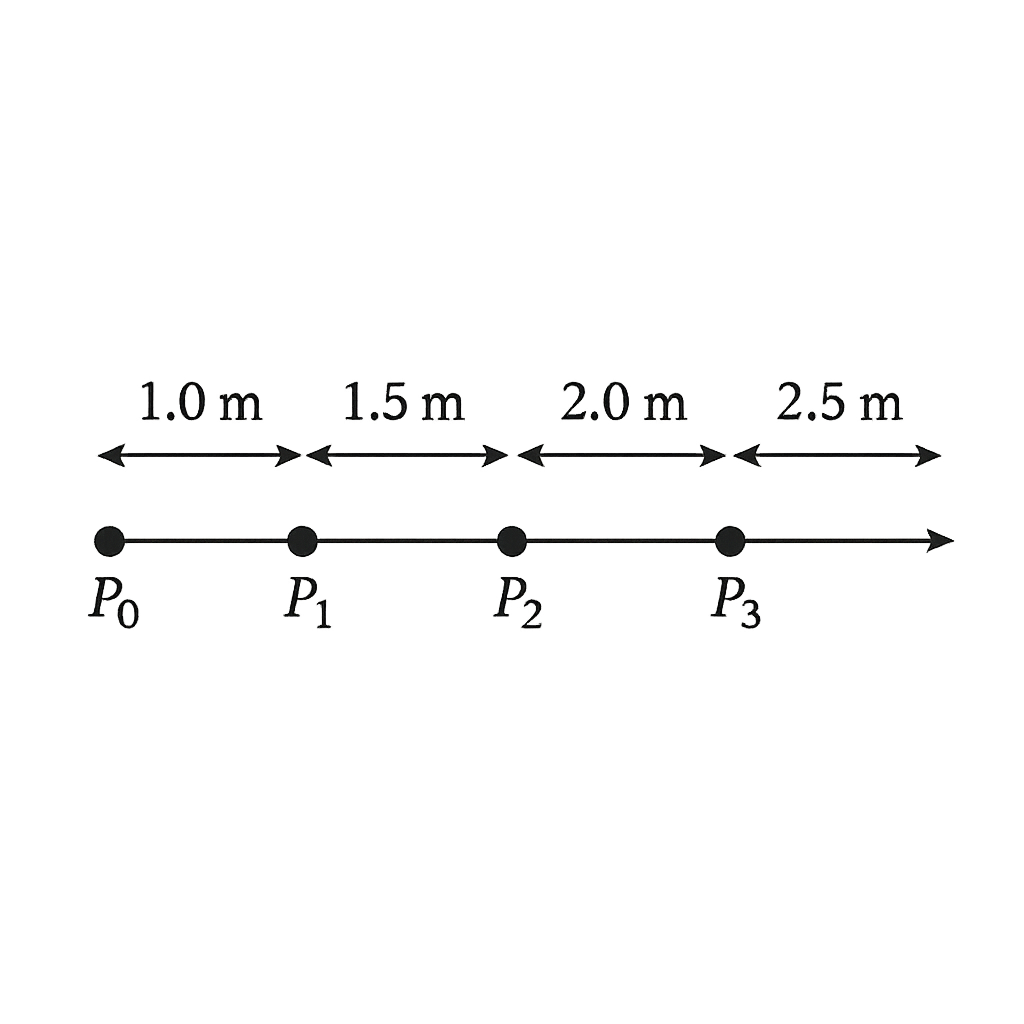
The diagram shows a particle moving in a straight line. Positions P₀, P₁, P₂, P₃ and P₄ are recorded at equal time intervals of 0.5 s. The distances between successive positions are 1.0 m, 1.5 m, 2.0 m and 2.5 m respectively. Assuming the motion is uniformly accelerated, determine the magnitude of the particle's acceleration in m s⁻² (give your answer to one decimal place).
A. 3.0 m/s²
Correct B. 2.0 m/s²
C. 2.5 m/s²
D. 1.5 m/s²

Correct Answer: B

Want to see the full step-by-step solution? Unlock AI Explanation & Analytics
Question 15 View Details
A string of length 0.80 m is fixed at both ends. When a tension of 40 N is applied, its fundamental frequency is 120 Hz. The string is then cut into two equal pieces, each of length 0.40 m, and the same tension of 40 N is applied to each piece. The fundamental frequency of each piece is measured to be 210 Hz. Using these two measurements, calculate the percentage difference between the linear mass densities obtained from the two experiments. Give your answer as a percentage to the nearest whole number.
A. 45%
B. 33%
Correct C. 27%
D. 15%

Correct Answer: C

Want to see the full step-by-step solution? Unlock AI Explanation & Analytics
Question 16 View Details
An ideal battery of emf \(E\) volts and internal resistance \(r\) ohms is connected to a circuit as follows. A resistor \(R_{1}=6\ \Omega\) is attached to the battery terminals. When only \(R_{1}\) is connected, the current measured is \(2.0\ \text{A}\). A second resistor \(R_{2}\) (unknown resistance) is then connected in parallel with \(R_{1}\). With both resistors present the current increases to \(2.5\ \text{A}\) and the power dissipated in \(R_{2}\) is measured to be \(6\ \text{W}\). Determine the emf \(E\) of the battery, its internal resistance \(r\), and the value of \(R_{2}\).
Correct A. E = 48 V, r = 18 Ω, R₂ = 1.5 Ω
B. E = 48 V, r = 12 Ω, R₂ = 2.5 Ω
C. E = 45 V, r = 15 Ω, R₂ = 2.0 Ω
D. E = 50 V, r = 20 Ω, R₂ = 1.0 Ω

Correct Answer: A

Want to see the full step-by-step solution? Unlock AI Explanation & Analytics
Question 17 View Details
A rectangular conducting loop of width \(0.10\ \text{m}\) and height \(0.20\ \text{m}\) lies in a uniform magnetic field of magnitude \(0.5\ \text{T}\) directed into the page. The loop is pulled to the right at a constant speed so that it leaves the field region. When the loop has moved such that exactly three‑quarters of its original area remains within the field, the induced emf measured around the loop is \(0.25\ \text{V}\). The total resistance of the loop is \(2\ \Omega\). (i) Find the speed of the loop. (ii) Determine the magnitude of the magnetic force acting on the vertical segment of the loop that is still inside the field at that instant.
A. v = 3.0 m\/s, F = 0.0150 N
B. v = 2.5 m\/s, F = 0.0200 N
C. v = 2.0 m\/s, F = 0.0100 N
Correct D. v = 2.5 m/s, F = 0.0125 N

Correct Answer: D

Want to see the full step-by-step solution? Unlock AI Explanation & Analytics
Question 18 View Details
A thin converging lens of unknown focal length is placed in air. An object is positioned \(25\ \text{cm}\) in front of the lens and a sharp real image is formed on a screen \(75\ \text{cm}\) behind the lens. (a) Find the focal length of the lens in air. (b) The same lens is now immersed in water (refractive index \(n_{\text{water}} = 1.33\)). The lens material has refractive index \(n_{\text{lens}} = 1.50\). Keeping the object at the same \(25\ \text{cm}\) distance (measured in water), determine the position of the image formed (state the image distance from the lens and indicate whether the image is real or virtual).
A. f_air ≈ 22.5 cm; in water the image is virtual, 45 cm in front of the lens
B. f_air ≈ 18.8 cm; in water the image is virtual, 30 cm in front of the lens
Correct C. f_air ≈ 18.8 cm; in water the image is virtual, 38 cm in front of the lens
D. f_air ≈ 15.0 cm; in water the image is real, 38 cm behind the lens

Correct Answer: C

Want to see the full step-by-step solution? Unlock AI Explanation & Analytics
Question 19 View Details
A string of length \(1.20\ \text{m}\) is fixed at both ends. Its fundamental frequency is \(80\ \text{Hz}\). The tension in the string is then increased, raising the fundamental frequency to \(100\ \text{Hz}\). (i) By what factor does the tension increase? (ii) After the tension change, what is the frequency of the third harmonic of the string?
A. Tension increases by a factor of 2.00; third harmonic frequency = 320 Hz
Correct B. Tension increases by a factor of 1.56; third harmonic frequency = 300 Hz
C. Tension increases by a factor of 1.56; third harmonic frequency = 280 Hz
D. Tension increases by a factor of 1.25; third harmonic frequency = 250 Hz

Correct Answer: B

Want to see the full step-by-step solution? Unlock AI Explanation & Analytics
Question 20 View Details
A sealed container of initial volume \(V_{0}=2.0\ \text{L}\) holds an ideal gas at \(27^{\circ}\text{C}\) and pressure \(1.00\ \text{atm}\). The container's volume expands linearly with temperature according to \(V=V_{0}[1+\alpha (T-27)]\), where \(\alpha=1.0\times10^{-4}\ \text{°C}^{-1}\) and \(T\) is the temperature in degrees Celsius. The gas is heated until the pressure reaches \(2.5\ \text{atm}\). Determine the temperature \(T\) (in °C) at which this pressure is attained.
A. T ≈ 450 °C
B. T ≈ 600 °C
Correct C. T ≈ 514 °C
D. T ≈ 300 °C

Correct Answer: C

Want to see the full step-by-step solution? Unlock AI Explanation & Analytics
Question 21 View Details
A coil of 200 turns and area \(0.02\ \text{m}^2\) rotates uniformly in a uniform magnetic field of flux density \(0.5\ \text{T}\) at a rate of 50 revolutions per second. The coil has an internal resistance of \(5\ \Omega\) and is connected to an external resistor \(R\).\n\n(a) Determine the value of \(R\) that makes the average power dissipated in the external resistor a maximum.\n\n(b) Calculate that maximum average power (in watts, give your answer to three significant figures).
A. R = 10 \ \Omega; maximum average power \approx 4.93 \times 10^{3} \ \text{W}
B. R = 7.5 \ \Omega; maximum average power \approx 7.42 \times 10^{3} \ \text{W}
Correct C. R = 5 \ \Omega; maximum average power \approx 9.87 \times 10^{3} \ \text{W}
D. R = 2.5 \ \Omega; maximum average power \approx 5.00 \times 10^{3} \ \text{W}

Correct Answer: C

Want to see the full step-by-step solution? Unlock AI Explanation & Analytics
Question 22 View Details
Water flows steadily through a horizontal pipe that consists of two sections in series. Section A is 0.5 m long with a cross‑sectional area of \(2.0\times10^{-3}\ \text{m}^2\). Section B is also 0.5 m long but its area is \(5.0\times10^{-4}\ \text{m}^2\). The pressure at the inlet of section A is \(150\ \text{kPa}\). The pressure drop due to friction in each section is proportional to its length and inversely proportional to its area, i.e. \(\Delta P = k\,L/A\), where \(k\) is a constant (same for both sections). The total pressure drop from the inlet of A to the outlet of B is measured to be \(30\ \text{kPa}\).\n\n(a) Find the value of the friction constant \(k\) (in \(\text{kPa·m}\)).\n\n(b) What is the force exerted by the water on a piston of area equal to that of section B at the outlet?
A. k = 0.030 \ \text{kPa·m}; force = 45 \ \text{N}
B. k = 0.020 \ \text{kPa·m}; force = 55 \ \text{N}
Correct C. k = 0.024 \ \text{kPa·m}; force = 60 \ \text{N}
D. k = 0.018 \ \text{kPa·m}; force = 75 \ \text{N}

Correct Answer: C

Want to see the full step-by-step solution? Unlock AI Explanation & Analytics
Question 23 View Details
A battery of emf \(E\) V and internal resistance \(0.5\ \Omega\) supplies two appliances that are connected in parallel: a heater and a motor. The heater draws a current of \(5\ \text{A}\) and the motor draws \(2\ \text{A}\). The terminal voltage across the appliances is measured to be \(12\ \text{V}\).\n\n(a) Determine the emf \(E\) of the battery (in volts).\n\n(b) Find the resistance of the heater (in \(\Omega\)).\n\n(c) Calculate the efficiency of the battery, defined as the ratio of the total power delivered to the appliances to the total power developed by the battery (express your answer as a percentage to one decimal place).
A. E = 14.0 \ \text{V}; heater resistance = 2.0 \ \Omega; efficiency = 70.0\%
B. E = 15.5 \ \text{V}; heater resistance = 2.8 \ \Omega; efficiency = 75.0\%
C. E = 16.2 \ \text{V}; heater resistance = 3.0 \ \Omega; efficiency = 80.5\%
Correct D. E = 15.5 \ \text{V}; heater resistance = 2.4 \ \Omega; efficiency = 77.4\%

Correct Answer: D

Want to see the full step-by-step solution? Unlock AI Explanation & Analytics
Question 24 View Details
A \(250\ \text{g}\) block of copper at \(150^{\circ}\text{C}\) is placed into a calorimeter that initially contains \(500\ \text{g}\) of water at \(20^{\circ}\text{C}\). The calorimeter itself has a heat capacity of \(100\ \text{J °C}^{-1}\). No heat is lost to the surroundings. The specific heat capacities are: copper \(c_{\text{Cu}} = 385\ \text{J kg}^{-1}\text{°C}^{-1}\), water \(c_{\text{w}} = 4186\ \text{J kg}^{-1}\text{°C}^{-1}\). After the system reaches equilibrium the final temperature is \(30^{\circ}\text{C}\). Assuming that a certain mass of ice at \(0^{\circ}\text{C}\) was present in the water initially and melted during the experiment, determine the mass of ice (in grams) that must have been present.
Correct A. ≈ 23 \ \text{g}
B. ≈ 30 \ \text{g}
C. ≈ 18 \ \text{g}
D. ≈ 25 \ \text{g}

Correct Answer: A

Want to see the full step-by-step solution? Unlock AI Explanation & Analytics
Question 25 View Details
A simple lever is used to lift a load. The lever is \(1.2\ \text{m}\) long and is pivoted \(0.3\ \text{m}\) from the effort end. The effort is applied vertically downward at the effort end and moves through a distance of \(0.8\ \text{m}\). The load is lifted vertically upward at the load end and moves through a distance of \(0.2\ \text{m}\). The load has a weight of \(150\ \text{N}\). The overall efficiency of the system is \(80\%\).\n\n(a) Calculate the magnitude of the effort force required (in newtons).\n\n(b) If the effort is applied at a constant speed taking \(2\ \text{s}\) to move through its distance, determine the power output of the system (in watts, to two significant figures).
A. Effort = 750 \ \text{N}; power output = 20 \ \text{W}
B. Effort = 900 \ \text{N}; power output = 18 \ \text{W}
Correct C. Effort = 750 \ \text{N}; power output = 15 \ \text{W}
D. Effort = 600 \ \text{N}; power output = 12 \ \text{W}

Correct Answer: C

Want to see the full step-by-step solution? Unlock AI Explanation & Analytics

Master the Exam!

You've seen a preview, but there are thousands more questions plus AI tutor to break down complex solutions.

Unlock Full Access Available for Android & Windows
Help others prepare! Share this practice hub:
Chat with Support