igcse model questions vol1 2021 chemistry | Objective

Prepare for your exams with igcse model questions vol1 questions? Reviewing past/model questions is one of the most effective ways to guarantee a high score. This practice hub features authentic 2021 chemistry (Objective) questions designed to simulate the real exam environment.

Practice these randomly selected questions to test your readiness.

Question 1 View Details
A 12.0 g sample of iron(II) sulphate heptahydrate (FeSO4·7H2O) is mixed with excess solid potassium permanganate in acidic solution. Ignoring the water of crystallisation, the reaction proceeds according to the balanced equation: 2 KMnO4 + 5 FeSO4 + 3 H2SO4 → 2 MnSO4 + 5 Fe2(SO4)3 + K2SO4 + 3 H2O. Calculate the mass of MnSO4 formed (in grams).
Correct A. 2.61 g
B. 3.12 g
C. 2.16 g
D. 1.95 g

Correct Answer: A

Want to see the full step-by-step solution? Unlock AI Explanation & Analytics
Question 2 View Details
A 0.200 g sample of an unknown alcohol is oxidised completely, producing 0.440 g of carbon dioxide and 0.240 g of water. Assuming the oxidation converts all carbon to CO2 and all hydrogen to H2O, determine the molecular formula of the alcohol.
A. C₂H₆O
B. C₄H₁₀O
C. C₃H₆O
Correct D. C₃H₈O

Correct Answer: D

Want to see the full step-by-step solution? Unlock AI Explanation & Analytics
Question 3 View Details
A 250 mL water sample is analysed for nitrate (\( \text{NO}_3^- \)) using a colourimetric method. A 25.0 mL aliquot of the sample is diluted to 125.0 mL with distilled water and its absorbance at 540 nm is measured as 0.650. The calibration relationship for the diluted solutions is \( A = 0.020\,C + 0.040 \), where \( C \) is the nitrate concentration in \( \text{mg L}^{-1} \). Calculate the nitrate concentration in the original water sample (in \( \text{mg L}^{-1} \)) and state whether it exceeds the WHO guideline of 50 mg L(^{-1}\).
A. 78 mg L⁻¹ (does not exceed limit)
B. 50 mg L⁻¹ (does not exceed limit)
Correct C. 153 mg L⁻¹ (exceeds limit)
D. 210 mg L⁻¹ (exceeds limit)

Correct Answer: C

Want to see the full step-by-step solution? Unlock AI Explanation & Analytics
Question 4 View Details
In the reaction \( 2\,\text{Al} + 3\,\text{CuSO}_4 \rightarrow \text{Al}_2(\text{SO}_4)_3 + 3\,\text{Cu} \), 5.0 g of aluminium metal are mixed with 10.0 g of copper(II) sulphate. Determine the mass of copper that can be produced and the percent yield if 2.5 g of copper are actually obtained.
Correct A. 62.7 %
B. 55.2 %
C. 48.3 %
D. 75.0 %

Correct Answer: A

Want to see the full step-by-step solution? Unlock AI Explanation & Analytics
Question 5 View Details
The solubility product of silver chloride at 25 °C is \( K_{sp} = 1.8 \times 10^{-10} \). A solution is prepared by dissolving 0.10 g of sodium chloride in 250 mL of water, after which excess solid AgCl is added and the mixture is allowed to reach equilibrium. Calculate the equilibrium concentration of \( \text{Ag}^+ \) ions (in mol L(^{-1}\)) and the mass of AgCl that remains undissolved if 0.020 g of AgCl were initially added in excess.
A. 2.6×10⁻⁸ M; 0.0180 g
B. 2.6×10⁻⁷ M; 0.0200 g
C. 3.2×10⁻⁸ M; 0.0195 g
Correct D. 2.6×10⁻⁸ M; 0.0200 g

Correct Answer: D

Want to see the full step-by-step solution? Unlock AI Explanation & Analytics
Question 6 View Details
Using the standard enthalpies of formation (kJ mol⁻¹) given below: \(\Delta H_f^\circ(\text{CO}_2) = -393.5\), \(\Delta H_f^\circ(\text{SO}_2) = -296.8\), \(\Delta H_f^\circ(\text{NO}_2) = -33.2\), \(\Delta H_f^\circ(\text{P}_4\text{O}_{10}) = -2984\). For each oxide, calculate the heat released per gram of \(\text{O}_2\) consumed when the oxide is formed from its elements. Which oxide releases the greatest amount of heat per gram of \(\text{O}_2\)?
A. CO₂
B. NO₂
C. SO₂
Correct D. P₄O₁₀

Correct Answer: D

Want to see the full step-by-step solution? Unlock AI Explanation & Analytics
Question 7 View Details
A 5.00 L rigid container at 298 K initially contains 0.0200 mol of N₂ and 0.0600 mol of H₂, together with enough inert gas to give a total pressure of 1.00 atm. The mixture is allowed to react according to \(\text{N}_2 + 3\,\text{H}_2 \rightarrow 2\,\text{NH}_3\) until completion of the limiting reagent. Assuming temperature remains constant and ideal‑gas behaviour, calculate the final pressure in the container (atm).
A. 0.9
Correct B. 0.8
C. 0.6
D. 1.2

Correct Answer: B

Want to see the full step-by-step solution? Unlock AI Explanation & Analytics
Question 8 View Details
At 25 °C the esterification of ethanoic acid with ethanol has an equilibrium constant \(K_c = 4.0\). In a 1.00 L vessel 0.20 mol of ethanoic acid and 0.30 mol of ethanol are placed and allowed to reach equilibrium. Using an ICE table, determine the percentage of the initial ethanoic acid that has been converted to ethyl acetate at equilibrium.
A. 65.2
B. 84.1
Correct C. 78.5
D. 71

Correct Answer: C

Want to see the full step-by-step solution? Unlock AI Explanation & Analytics
Question 9 View Details
The enthalpy of vaporisation of water is \(40.7\) kJ mol⁻¹. Using the Clausius-Clapeyron equation, estimate the vapour pressure of water at \(80\) °C (353 K), given that the normal boiling point is \(100\) °C (373 K) at \(1.00\) atm. Give your answer in atm to two significant figures.
Correct A. 0.48
B. 0.62
C. 0.35
D. 0.55

Correct Answer: A

Want to see the full step-by-step solution? Unlock AI Explanation & Analytics
Question 10 View Details
Using Pauling's equation \(\%\,\text{ionic}=\bigl(1-e^{-0.25(\Delta EN)^2}\bigr)\times100\), calculate the percent ionic character of the Na-Cl bond. Take the electronegativities as EN(Na)=0.93 and EN(Cl)=3.16.
A. 68.5
Correct B. 71.2
C. 73.9
D. 61.4

Correct Answer: B

Want to see the full step-by-step solution? Unlock AI Explanation & Analytics
Question 11 View Details
A 0.10 mol dm⁻³ solution of an unknown carboxylic acid HA has a measured pH of 2.85 at 25 °C. A second acid HB is identical to HA but contains an α‑chloro substituent, which increases its acid dissociation constant by a factor of 5. Calculate the acid dissociation constant \(K_a\) of HA and the pH of a 0.10 mol dm⁻³ solution of HB under the same conditions.
A. K_a(HA)=1.0×10⁻⁵; pH(HB)=2.70
B. K_a(HA)=2.5×10⁻⁵; pH(HB)=2.55
Correct C. K_a(HA)=2.0×10⁻⁵; pH(HB)=2.50
D. K_a(HA)=3.0×10⁻⁵; pH(HB)=2.30

Correct Answer: C

Want to see the full step-by-step solution? Unlock AI Explanation & Analytics
Question 12 View Details
In a step‑growth polymerisation, 0.200 mol of adipic acid (C₆H₁₀O₄, \(M=146.14\) g mol⁻¹) reacts with 0.200 mol of ethylene glycol (C₂H₆O₂, \(M=62.07\) g mol⁻¹). At equilibrium 85 % of the functional groups have reacted. (i) Determine the number‑average degree of polymerisation \(DP_n\) and the number‑average molecular weight \(M_n\) of the resulting polyester. (ii) Using the Mark-Houwink relation \([\eta]=K M^{a}\) with \(K=1.2\times10^{-4}\,\text{dL g}^{-1}\) and \(a=0.75\), estimate the intrinsic viscosity of the polymer.
A. DP_n≈5.0; M_n≈9.5×10² g mol⁻¹; [η]≈0.0200 dL g⁻¹
Correct B. DP_n≈6.7; M_n≈1.27×10³ g mol⁻¹; [η]≈0.0255 dL g⁻¹
C. DP_n≈7.5; M_n≈1.40×10³ g mol⁻¹; [η]≈0.0280 dL g⁻¹
D. DP_n≈8.2; M_n≈1.55×10³ g mol⁻¹; [η]≈0.0300 dL g⁻¹

Correct Answer: B

Want to see the full step-by-step solution? Unlock AI Explanation & Analytics
Question 13 View Details
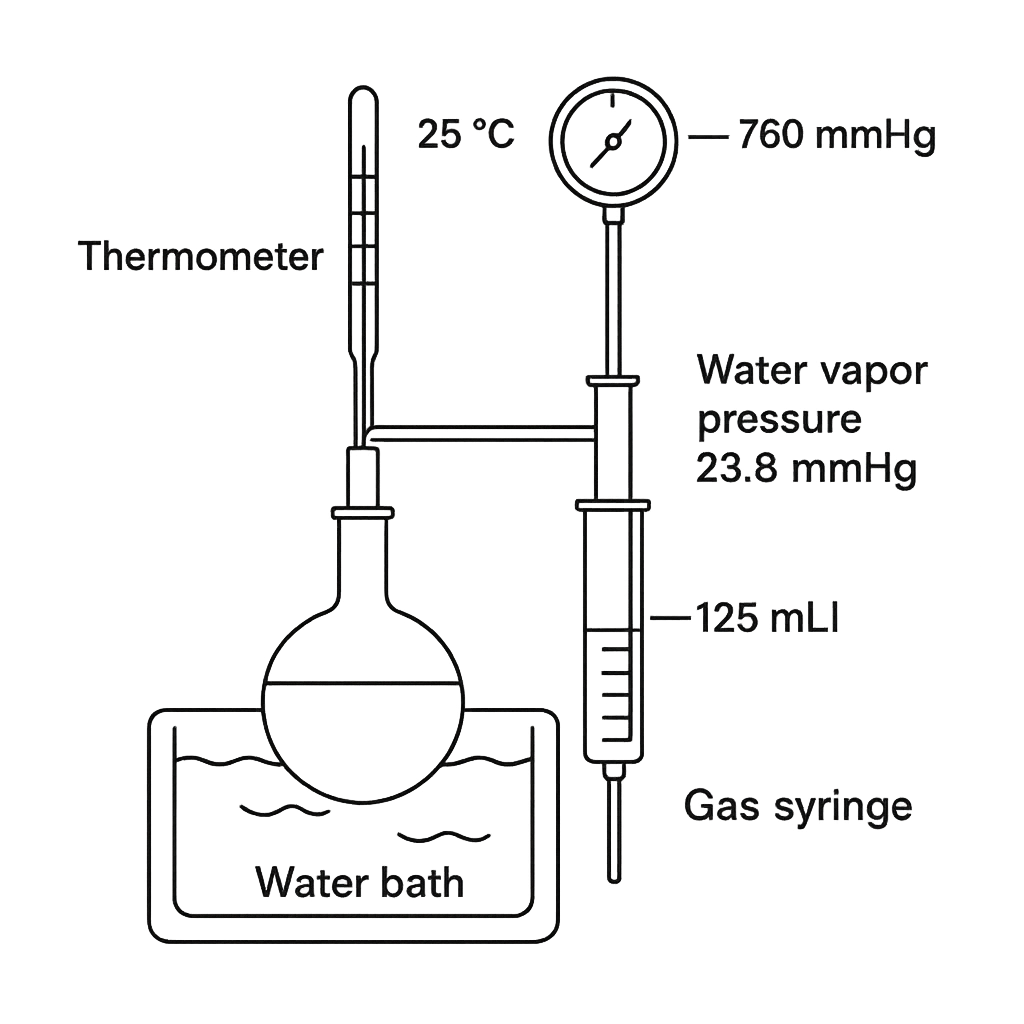
The diagram shows a gas‑collection apparatus in which hydrogen gas produced from magnesium reacting with excess hydrochloric acid is collected over water. The temperature reading is 25 °C, the total pressure is 760 mm Hg and the water‑vapour pressure at this temperature is 23.8 mm Hg. The volume of gas collected is 125 mL. (i) Calculate the number of moles of hydrogen collected. (ii) From this, determine the mass of magnesium that has reacted, given the reaction \(\text{Mg} + 2\text{HCl} \rightarrow \text{MgCl}_2 + \text{H}_2\) and the molar mass of Mg is 24.31 g mol⁻¹.
A. 0.098 g of Mg
B. 0.200 g of Mg
Correct C. 0.121 g of Mg
D. 0.150 g of Mg

Correct Answer: C

Want to see the full step-by-step solution? Unlock AI Explanation & Analytics
Question 14 View Details
5.00 g of 2‑bromo‑2‑methylpropane (\(C_4H_9Br\), \(M=136.99\) g mol⁻¹) is treated with excess aqueous NaOH under SN1 conditions, producing 2‑methyl‑2‑propanol. (i) Calculate the theoretical mass of 2‑methyl‑2‑propanol that can be obtained. (ii) If the same substrate were reacted with aqueous NaI in acetone, which product would be the major one?
A. 2.70 g of 2‑methyl‑2‑propanol; major product with NaI is 2‑iodo‑2‑methylpropane
Correct B. 2.70 g of 2‑methyl‑2‑propanol; major product with NaI is unchanged 2‑bromo‑2‑methylpropane
C. 2.85 g of 2‑methyl‑2‑propanol; major product with NaI is 2‑methyl‑2‑propanol
D. 2.55 g of 2‑methyl‑2‑propanol; major product with NaI is 2‑iodo‑2‑methylpropane

Correct Answer: B

Want to see the full step-by-step solution? Unlock AI Explanation & Analytics
Question 15 View Details
A concentration cell is set up with two copper electrodes. The left half‑cell contains a 0.010 mol dm⁻³ CuSO₄ solution and the right half‑cell contains a 0.10 mol dm⁻³ CuSO₄ solution, both at 25 °C. (i) Calculate the electromotive force (EMF) of the cell. (ii) The cell is connected across a 10 Ω resistor and allowed to run for 2.00 h. Assuming 100 % current efficiency, calculate the mass of copper deposited on the cathode. (Use \(F=96 500\) C mol⁻¹ and \(M_{\text{Cu}}=63.55\) g mol⁻¹.)
Correct A. EMF≈0.030 V; mass of Cu deposited≈0.0070 g
B. EMF≈0.045 V; mass of Cu deposited≈0.0105 g
C. EMF≈0.030 V; mass of Cu deposited≈0.0140 g
D. EMF≈0.015 V; mass of Cu deposited≈0.0035 g

Correct Answer: A

Want to see the full step-by-step solution? Unlock AI Explanation & Analytics
Question 16 View Details
A copper electrode is placed in a copper(II) sulphate solution and connected to a power supply that delivers a constant current of \(2.0\ \text{A}\) for \(30\ \text{min}\). The current efficiency for the deposition of copper is \(85\%\). Calculate the mass of copper that is actually deposited on the electrode. (Molar mass of Cu = \(63.55\ \text{g\ mol}^{-1}\), Faraday constant = \(96485\ \text{C\ mol}^{-1}\).)
A. 0.95 g
B. 0.85 g
Correct C. 1.01 g
D. 1.20 g

Correct Answer: C

Want to see the full step-by-step solution? Unlock AI Explanation & Analytics
Question 17 View Details
A metal strip of unknown identity loses exactly \(1.5\ \text{g}\) after reacting completely with excess aqueous silver nitrate solution, forming a precipitate of \(5.00\ \text{g}\) of metallic silver. The reaction is \( \text{X} + 2\text{AgNO}_3 \rightarrow \text{X(NO}_3)_2 + 2\text{Ag} \). Given the atomic masses: Zn = \(65.38\ \text{g\ mol}^{-1}\), Fe = \(55.85\ \text{g\ mol}^{-1}\), Mg = \(24.31\ \text{g\ mol}^{-1}\), determine which metal X is and calculate the mass of X that reacted.
A. Iron; 1.5 g
B. Zinc; 1.2 g
Correct C. Zinc; 1.5 g
D. Magnesium; 1.5 g

Correct Answer: C

Want to see the full step-by-step solution? Unlock AI Explanation & Analytics
Question 18 View Details
An element has atomic number \(20\), forms a \(+2\) ion in its compounds, is a good conductor of electricity and reacts slowly with cold water. Identify the element and state its group and period in the periodic table.
A. Potassium; group 1, period 4
B. Magnesium; group 2, period 3
C. Strontium; group 2, period 5
Correct D. Calcium; group 2, period 4

Correct Answer: D

Want to see the full step-by-step solution? Unlock AI Explanation & Analytics
Question 19 View Details
A \(2.00\ \text{g}\) sample of a hydrocarbon is burnt completely in excess oxygen, producing \(5.56\ \text{g}\) of carbon dioxide and \(2.24\ \text{g}\) of water. Determine (a) the empirical formula of the hydrocarbon, and (b) its molecular formula given that its molar mass is \(56\ \text{g\ mol}^{-1}\).
A. Empirical formula CH₃; molecular formula C₃H₉
B. Empirical formula C₃H₆; molecular formula C₆H₁₂
Correct C. Empirical formula CH₂; molecular formula C₄H₈
D. Empirical formula C₂H₄; molecular formula C₈H₁₆

Correct Answer: C

Want to see the full step-by-step solution? Unlock AI Explanation & Analytics
Question 20 View Details
In acidic solution, potassium permanganate oxidises oxalic acid according to the reaction: \( \mathrm{KMnO_4 + H_2C_2O_4 + H_2SO_4 \rightarrow K_2SO_4 + MnSO_4 + CO_2 + H_2O} \). (i) Balance the overall redox equation. (ii) Using the balanced equation, calculate how many moles of KMnO₄ are required to react completely with \(0.10\ \text{mol}\) of oxalic acid, and the volume of CO₂ produced at STP.
A. 0.08 mol KMnO₄; 8.96 L CO₂
B. 0.02 mol KMnO₄; 2.24 L CO₂
C. 0.05 mol KMnO₄; 5.60 L CO₂
Correct D. 0.04 mol KMnO₄; 4.48 L CO₂

Correct Answer: D

Want to see the full step-by-step solution? Unlock AI Explanation & Analytics
Question 21 View Details
A 150 g sample of substance X is initially at 25 °C. Substance X has a melting point of 120 °C and a boiling point of 250 °C. Its specific heat capacity is 0.5 J g⁻¹ °C⁻¹ in the solid state and 0.8 J g⁻¹ °C⁻¹ in the liquid state. The latent heat of fusion is 60 J g⁻¹ and the latent heat of vaporisation is 200 J g⁻¹. The sample is supplied with 45 000 J of energy. Assuming no heat loss, determine (a) the mass of X that has been vapourised and (b) the temperature of the remaining liquid.
A. 70.5 g vapourised; remaining liquid at 260 °C
B. 66.4 g vapourised; remaining liquid at 240 °C
Correct C. 66.4 g vapourised; remaining liquid at 250 °C
D. 58.2 g vapourised; remaining liquid at 250 °C

Correct Answer: C

Want to see the full step-by-step solution? Unlock AI Explanation & Analytics
Question 22 View Details
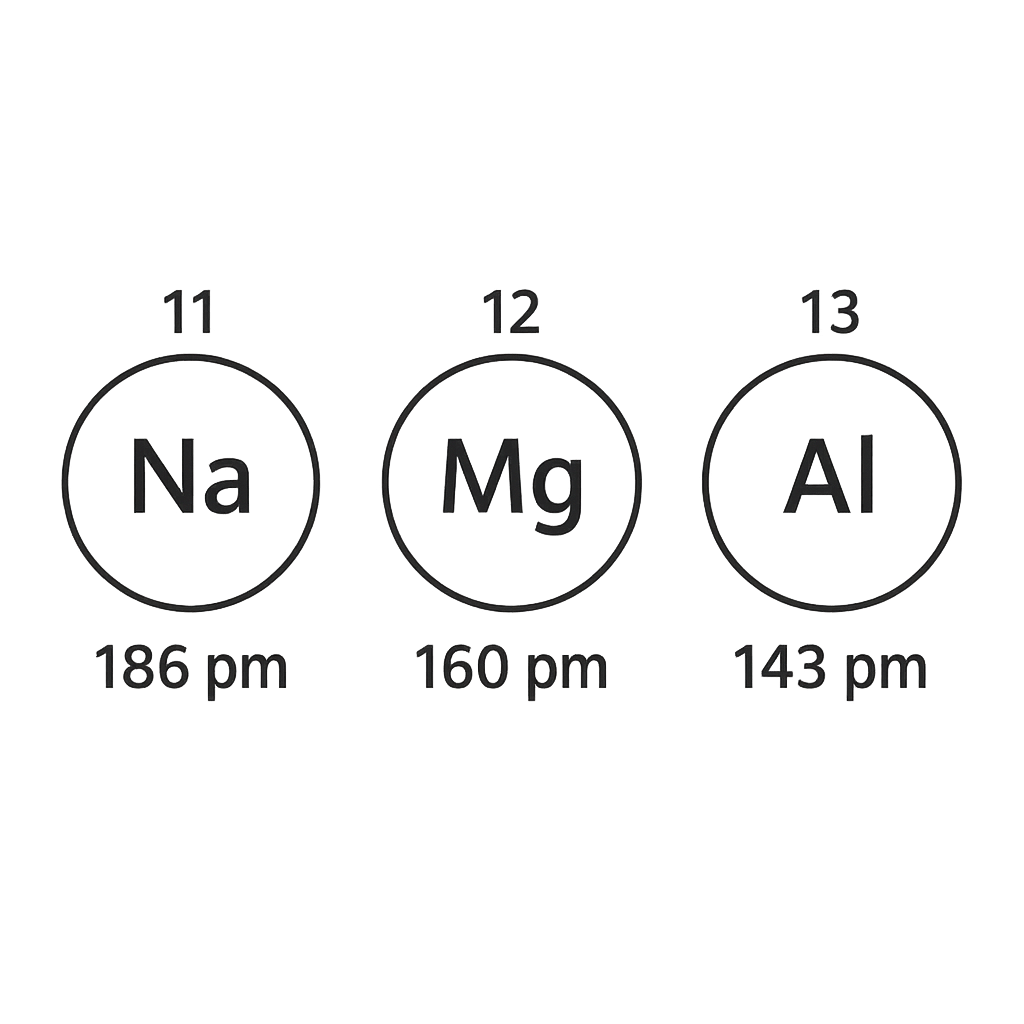
The diagram shows three elements from period 3 of the periodic table with their atomic numbers and atomic radii (in picometres). Using periodic trends, which element has the highest first ionisation energy?
Correct A. Mg
B. Al
C. Na
D. Si

Correct Answer: A

Want to see the full step-by-step solution? Unlock AI Explanation & Analytics
Question 23 View Details
A 0.500 g sample of sodium carbonate (Na₂CO₃) is dissolved in 250 mL of water. Then 0.0200 mol of HCl is added. Assuming complete reaction and no volume change, calculate the pH of the solution after the acid is added.
Correct A. 1.37
B. 0.85
C. 2.14
D. 3.02

Correct Answer: A

Want to see the full step-by-step solution? Unlock AI Explanation & Analytics
Question 24 View Details
Write the ground‑state electron configuration for a neutral chlorine atom and state the number of unpaired electrons.
A. [Ne] 3s² 3p⁶; 0 unpaired electrons
B. [Ne] 3s² 3p⁵; 0 unpaired electrons
C. [Ne] 3s² 3p⁴; 2 unpaired electrons
Correct D. [Ne] 3s² 3p⁵; 1 unpaired electron

Correct Answer: D

Want to see the full step-by-step solution? Unlock AI Explanation & Analytics
Question 25 View Details
A 0.250 g sample of an unknown hydrocarbon is combusted in excess oxygen, producing 0.825 g of CO₂ and 0.332 g of H₂O. (a) Determine the empirical formula of the hydrocarbon. (b) If the molar mass of the hydrocarbon is known to be 56 g mol⁻¹, determine its molecular formula.
A. Empirical formula CH; molecular formula C₄H₄
B. Empirical formula C₂H₄; molecular formula C₈H₁₆
Correct C. Empirical formula CH₂; molecular formula C₄H₈
D. Empirical formula C₂H₅; molecular formula C₈H₁₀

Correct Answer: C

Want to see the full step-by-step solution? Unlock AI Explanation & Analytics

Master the Exam!

You've seen a preview, but there are thousands more questions plus AI tutor to break down complex solutions.

Unlock Full Access Available for Android & Windows
Help others prepare! Share this practice hub:
Chat with Support