igcse model questions vol1 2021 biology | Objective

Prepare for your exams with igcse model questions vol1 questions? Reviewing past/model questions is one of the most effective ways to guarantee a high score. This practice hub features authentic 2021 biology (Objective) questions designed to simulate the real exam environment.

Practice these randomly selected questions to test your readiness.

Question 1 View Details
A typical leaf loses water at a rate of 0.5 g per hour per unit stomatal density when its stomata are open. The leaf keeps its stomata open for 12 hours each day. A desert cactus has only one‑third the stomatal density of the typical leaf and opens its stomata only at night for 6 hours. Assuming the water‑loss rate per unit stomatal density is the same for both plants, what fraction of the water lost by the typical leaf is lost by the cactus in one day? Express your answer as a common fraction.
A. 2/9
B. 1/12
Correct C. 1/6
D. 1/3

Correct Answer: C

Want to see the full step-by-step solution? Unlock AI Explanation & Analytics
Question 2 View Details
A sensory neuron conducts an impulse 0.80 m from a fingertip to the spinal cord at a speed of 80 m s(^{-1}). After a synaptic delay of 0.5 ms, a motor neuron conducts the impulse 0.60 m to a muscle at 60 m s(^{-1}). Calculate the total time taken from the stimulus at the fingertip to the arrival of the impulse at the muscle, in milliseconds. Give your answer to one decimal place.
Correct A. 20.5 ms
B. 19.5 ms
C. 21.0 ms
D. 22.5 ms

Correct Answer: A

Want to see the full step-by-step solution? Unlock AI Explanation & Analytics
Question 3 View Details
A flowering plant produces 200 individual flowers. Of these, 80 % are successfully pollinated. Of the pollinated flowers, 70 % develop into fruits. Each fruit initially contains 25 seeds, but 20 % of the fruits abort before seed maturation, losing all their seeds. Assuming the aborting of fruits is independent of the earlier stages, how many seeds are expected to be produced in total? Give your answer as a whole number.
A. 2400
B. 2800
Correct C. 2240
D. 2100

Correct Answer: C

Want to see the full step-by-step solution? Unlock AI Explanation & Analytics
Question 4 View Details
Renal plasma flow is 600 mL min(^{-1}) and the filtration fraction is 0.20. The plasma concentration of urea is 0.20 g L(^{-1}). Ninety percent of the filtered urea is re‑absorbed. Calculate the volume of urine produced per minute (in mL) assuming the urine urea concentration is 5 g L(^{-1}). Give your answer to two decimal places.
A. 0.96 mL/min
B. 0.60 mL/min
Correct C. 0.48 mL/min
D. 0.24 mL/min

Correct Answer: C

Want to see the full step-by-step solution? Unlock AI Explanation & Analytics
Question 5 View Details
In a particular tissue, 2 % of the cells are observed to be in the M phase at any instant. If the total cell‑cycle time for these cells is 24 h, estimate the average duration of the M phase in minutes. Give your answer to the nearest whole minute.
A. 35 minutes
Correct B. 29 minutes
C. 30 minutes
D. 24 minutes

Correct Answer: B

Want to see the full step-by-step solution? Unlock AI Explanation & Analytics
Question 6 View Details
Capillary type A is a cylindrical tube \(1.0\ \text{mm}\) long with an internal radius of \(5\ \mu\text{m}\). Capillary type B is \(2.0\ \text{mm}\) long with an internal radius of \(3\ \mu\text{m}\). Assuming that the rate of diffusion of a gas through a capillary is directly proportional to the surface area of the tube and inversely proportional to the diffusion distance (taken as the radius), calculate the ratio of the diffusion rate in capillary A to that in capillary B. Give your answer as a decimal to two significant figures.
A. 0.33
B. 1.0
C. 0.75
Correct D. 0.50

Correct Answer: D

Want to see the full step-by-step solution? Unlock AI Explanation & Analytics
Question 7 View Details
A resting adult has a heart rate of \(70\ \text{beats\ min}^{-1}\) and a stroke volume of \(70\ \text{mL}\) per beat. During moderate exercise the heart rate rises to \(110\ \text{beats\ min}^{-1}\) and the cardiac output is known to increase by \(50\%\) compared with the resting value. What is the stroke volume (in mL, to the nearest whole number) during exercise?
A. 70
B. 60
C. 80
Correct D. 67

Correct Answer: D

Want to see the full step-by-step solution? Unlock AI Explanation & Analytics
Question 8 View Details
The following five organisms are described: 1. Multicellular, eukaryotic, cell wall contains cellulose, chloroplasts present, stores starch, autotrophic nutrition. 2. Unicellular, prokaryotic, cell wall contains peptidoglycan, no chloroplasts, heterotrophic. 3. Multicellular, eukaryotic, cell wall contains chitin, no chloroplasts, heterotrophic, reproduces by spores. 4. Unicellular, eukaryotic, no cell wall, chloroplasts present, mixotrophic, stores lipids. 5. Multicellular, eukaryotic, cell wall contains cellulose, chloroplasts present, heterotrophic (parasitic), stores glycogen. Using the five kingdoms (Monera, Protista, Fungi, Plantae, Animalia), which kingdom is represented by the greatest number of the listed organisms? Provide the kingdom name.
Correct A. Plantae
B. Animalia
C. Protista
D. Fungi

Correct Answer: A

Want to see the full step-by-step solution? Unlock AI Explanation & Analytics
Question 9 View Details
In a plant, flower colour is controlled by gene \(R\) (dominant red, recessive white) and plant height by gene \(T\) (dominant tall, recessive dwarf). The two genes are linked with a recombination frequency of 12 %. A heterozygous plant with genotype \(RrTt\) in the coupling phase (\(RT/rt\)) is crossed with a homozygous recessive plant (\(rrtt\)). What percentage of the progeny are expected to be red and tall (\(RT\))?
A. 56
Correct B. 44
C. 12
D. 24

Correct Answer: B

Want to see the full step-by-step solution? Unlock AI Explanation & Analytics
Question 10 View Details
The table below lists six microorganisms and several of their characteristics. | Organism | Cell wall composition | Shape | Oxygen requirement | Reproduction | |----------|----------------------|-------|--------------------|--------------| | A | peptidoglycan | cocci in clusters | aerobic | binary fission | | B | cellulose | filamentous | photosynthetic | spores | | C | chitin | yeast | anaerobic | budding | | D | none | flagellated | aerobic | binary fission | | E | peptidoglycan | bacilli | facultative anaerobe | binary fission | | F | cellulose | unicellular | photosynthetic | binary fission | Using the five kingdoms (Monera, Protista, Fungi, Plantae, Animalia), which two organisms belong to the same kingdom? Give your answer as the letters of the two organisms separated by "and" (e.g., "A and E").
A. C and D
B. B and C
C. B and F
Correct D. A and E

Correct Answer: D

Want to see the full step-by-step solution? Unlock AI Explanation & Analytics
Question 11 View Details
A diet provides \(2500\) kcal per day. \(55\%\) of the energy comes from carbohydrates, \(30\%\) from fats and the remainder from proteins. A person weighing \(68\) kg requires \(0.8\) g protein per kg body weight per day. Does the protein supplied by the diet meet the requirement? Show your calculations.
A. No; the diet supplies about 48.6 g protein, which is below the required 54.4 g by roughly 5.8 g.
B. Yes; the diet supplies about 80.2 g protein, which exceeds the required 54.4 g by roughly 25.8 g.
C. Yes; the diet supplies about 100.5 g protein, which exceeds the required 54.4 g by roughly 46.1 g.
Correct D. Yes; the diet supplies about 93.8 g protein, which exceeds the required 54.4 g by roughly 39.4 g.

Correct Answer: D

Want to see the full step-by-step solution? Unlock AI Explanation & Analytics
Question 12 View Details
A population of a beetle is studied using a simple life‑table. The data are:\n\\[\n\begin{array}{c|c|c}\n\text{Age class (years)} & l_x & m_x \\ \hline\n0-1 & 1.0 & 0 \\n1-2 & 0.6 & 1.2 \\n2-3 & 0.3 & 2.5 \\n\end{array}\n\\]\nwhere \(l_x\) is the proportion surviving to the start of the age class and \(m_x\) is the average number of female offspring produced per individual in that class.\n\n(a) Calculate the net reproductive rate \(R_0\).\n(b) Calculate the generation time \(G\) using \(G = \frac{\sum x\,l_x m_x}{R_0}\), taking the midpoint of each age class as the representative age (\(x = 1.5\) for class 1‑2 and \(x = 2.5\) for class 2‑3).\n(c) Based on \(R_0\), will the population increase, decrease or remain stable?
Correct A. R₀ = 1.47; generation time G ≈ 2.0 years; the population will increase.
B. R₀ = 1.20; generation time G ≈ 2.0 years; the population will remain stable.
C. R₀ = 0.93; generation time G ≈ 1.8 years; the population will decrease.
D. R₀ = 1.47; generation time G ≈ 2.5 years; the population will increase.

Correct Answer: A

Want to see the full step-by-step solution? Unlock AI Explanation & Analytics
Question 13 View Details
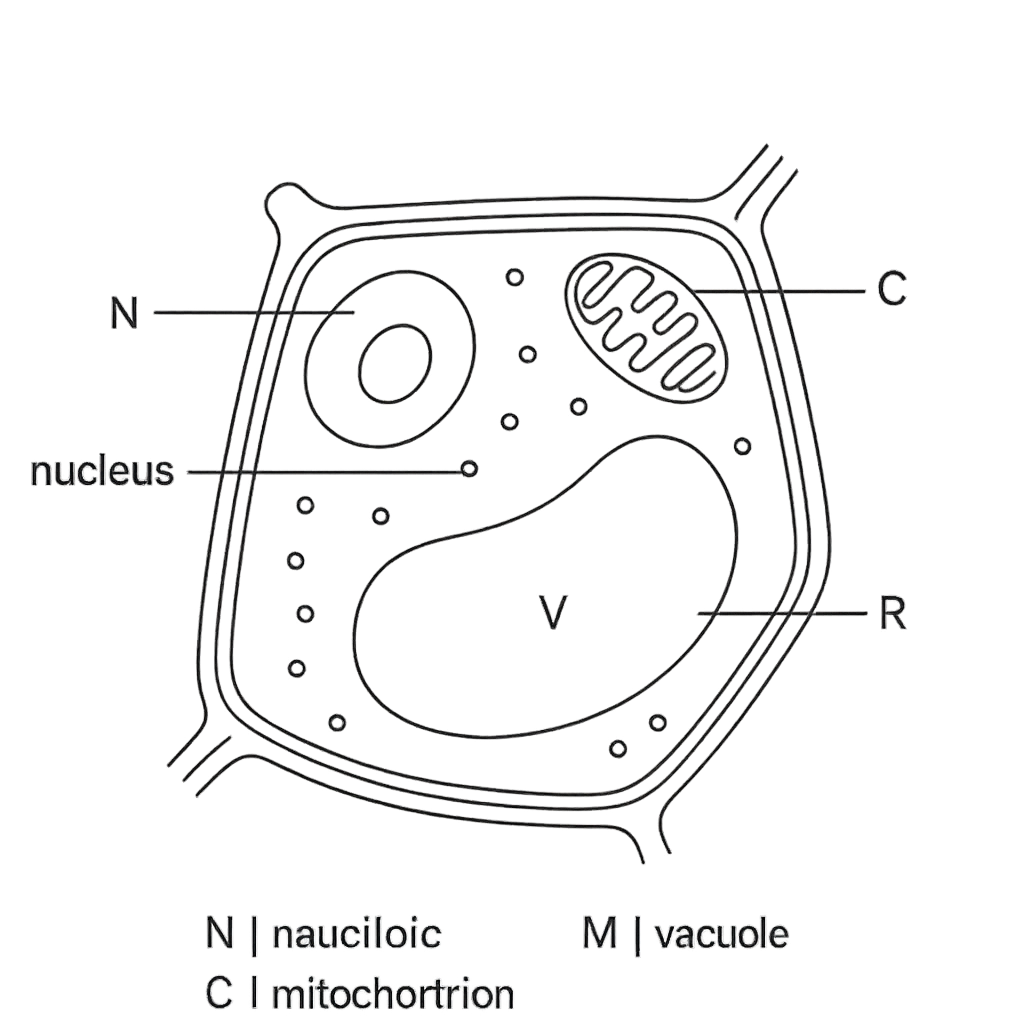
The diagram shows a typical plant cell with its major organelles labelled. A toxin blocks the electron transport chain in one organelle, preventing ATP synthesis.\n\n(a) Identify the organelle most likely affected.\n(b) Explain briefly how inhibition of this organelle would affect the cell's energy supply.
Correct A. a) Mitochondrion. b) Inhibition stops oxidative phosphorylation, drastically reducing ATP availability for the cell.
B. a) Golgi apparatus. b) Inhibition prevents vesicle trafficking, decreasing delivery of ATP to the cytoplasm.
C. a) Endoplasmic reticulum. b) Inhibition halts protein folding, limiting enzyme availability for cellular processes.
D. a) Chloroplast. b) Inhibition stops photosynthetic electron transport, reducing glucose production for the cell.

Correct Answer: A

Want to see the full step-by-step solution? Unlock AI Explanation & Analytics
Question 14 View Details
A small mammal has a body surface area of \(0.02\;\text{m}^2\). Its fur reduces heat loss by 60\% compared with naked skin. The thermal conductance of naked skin is \(0.5\;\text{W·m}^{-2}\text{K}^{-1}\). The animal's basal metabolic rate is \(5\;\text{W}\).\n\n(a) Calculate the effective thermal conductance of the furred animal.\n(b) If the ambient temperature falls to \(-10^{\circ}\text{C}\) while the core temperature remains at \(37^{\circ}\text{C}\), determine the rate of heat loss (in watts).\n(c) What is the minimum metabolic rate required to maintain core temperature at this ambient temperature?
A. Effective conductance = 0.25 W·m⁻²K⁻¹; heat loss ≈ 0.24 W; minimum metabolic rate ≈ 0.24 W.
Correct B. Effective conductance = 0.20 W·m⁻²K⁻¹; heat loss ≈ 0.19 W; minimum metabolic rate ≈ 0.19 W.
C. Effective conductance = 0.15 W·m⁻²K⁻¹; heat loss ≈ 0.14 W; minimum metabolic rate ≈ 0.14 W.
D. Effective conductance = 0.30 W·m⁻²K⁻¹; heat loss ≈ 0.28 W; minimum metabolic rate ≈ 0.28 W.

Correct Answer: B

Want to see the full step-by-step solution? Unlock AI Explanation & Analytics
Question 15 View Details
In a species, red‑green colour blindness is an X‑linked recessive trait. A female is a carrier (genotype \(X^{N}X^{c}\)) and a normal male is \(X^{N}Y\). They have two children. Assuming each child's sex is independent and equally likely, calculate the probability that at least one of the two children is colour blind.
Correct A. 7/16 (approximately 0.44)
B. 3/8 (approximately 0.38)
C. 1/4 (approximately 0.25)
D. 9/16 (approximately 0.56)

Correct Answer: A

Want to see the full step-by-step solution? Unlock AI Explanation & Analytics
Question 16 View Details
The phylogenetic tree below shows three species X, Y and Z. The branch length from the root to the common ancestor of X and Y is \(0.10\) substitutions per site. From that node to X is \(0.20\) and to Y is \(0.35\). The branch from the root directly to Z is \(0.60\) substitutions per site. (a) Which two species are most closely related? (b) Assuming a molecular clock of \(1\times10^{-8}\) substitutions per site per year, estimate the time since X and Y diverged. (c) The earliest fossil of this genus is dated at 5 million years ago. Discuss whether the molecular estimate supports the fossil evidence.
A. X and Y; about 5 million years; the molecular estimate aligns with the fossil, confirming the clock rate.
B. Y and Z; about 27.5 million years; the molecular estimate matches the fossil age, supporting the fossil record.
Correct C. X and Y; about 27.5 million years; the molecular estimate is much older than the 5 million‑year fossil, suggesting the fossil record may be incomplete or the clock rate overestimated.
D. X and Z; about 15 million years; the molecular estimate is younger than the 5 million‑year fossil, indicating the clock may be too fast.

Correct Answer: C

Want to see the full step-by-step solution? Unlock AI Explanation & Analytics
Question 17 View Details
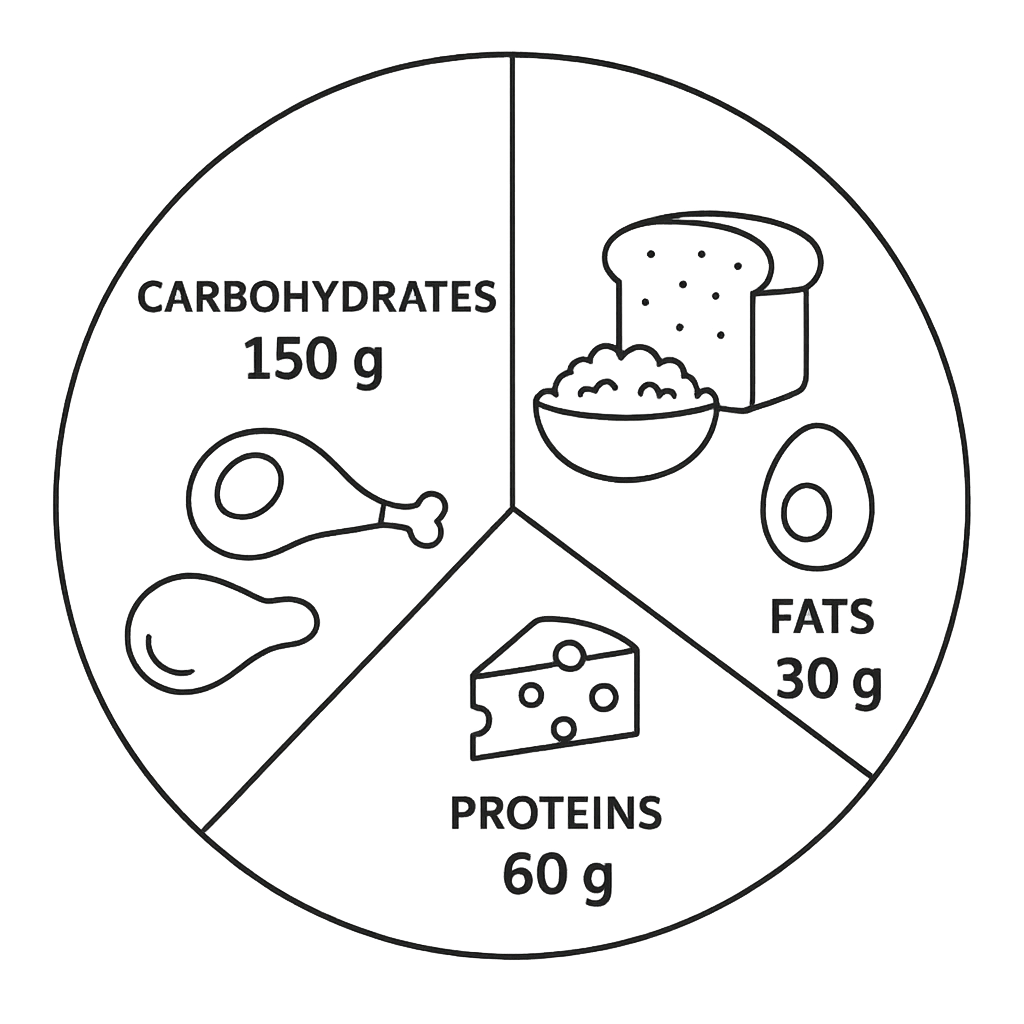
A labelled plate diagram shows three food groups with the following amounts: Carbohydrates \(150\) g, Proteins \(60\) g, and Fats \(30\) g. Using energy values of \(4\) kcal g\(^{-1}\) for carbohydrates and proteins and \(9\) kcal g\(^{-1}\) for fats, (a) calculate the total energy supplied by the plate, (b) the percentage of total energy contributed by each macronutrient, and (c) identify which macronutrient exceeds the recommended maximum of \(30\%\) of total energy.
Correct A. Total energy = 1110 kcal; Carbohydrates ≈ 54 %, Proteins ≈ 22 %, Fats ≈ 24 %; Carbohydrates exceed the 30 % limit.
B. Total energy = 1080 kcal; Carbohydrates ≈ 55 %, Proteins ≈ 20 %, Fats ≈ 25 %; Proteins exceed the 30 % limit.
C. Total energy = 1200 kcal; Carbohydrates ≈ 50 %, Proteins ≈ 25 %, Fats ≈ 25 %; No macronutrient exceeds the 30 % limit.
D. Total energy = 1110 kcal; Carbohydrates ≈ 45 %, Proteins ≈ 30 %, Fats ≈ 25 %; Proteins exceed the 30 % limit.

Correct Answer: A

Want to see the full step-by-step solution? Unlock AI Explanation & Analytics
Question 18 View Details
A 30‑year‑old female weighing \(60\) kg and \(165\) cm tall has a basal metabolic rate (BMR) given by the Harris‑Benedict equation: \( \text{BMR}=655+(9.6\times\text{weight})+(1.8\times\text{height})-(4.7\times\text{age})\). She leads a moderately active lifestyle with an activity factor of \(1.55\). (a) Calculate her BMR and her total daily energy expenditure (TEE). (b) If her diet provides \(1800\) kcal per day, determine whether she is in energy deficit or surplus and by how many kilocalories.
Correct A. BMR ≈ 1387 kcal day⁻¹; TEE ≈ 2150 kcal day⁻¹; diet gives a deficit of about 350 kcal per day.
B. BMR ≈ 1300 kcal day⁻¹; TEE ≈ 2015 kcal day⁻¹; diet gives a surplus of about 215 kcal per day.
C. BMR ≈ 1500 kcal day⁻¹; TEE ≈ 2325 kcal day⁻¹; diet gives a deficit of about 525 kcal per day.
D. BMR ≈ 1387 kcal day⁻¹; TEE ≈ 2150 kcal day⁻¹; diet gives a surplus of about 350 kcal per day.

Correct Answer: A

Want to see the full step-by-step solution? Unlock AI Explanation & Analytics
Question 19 View Details
In a randomized clinical trial, 150 patients receive a new drug and 150 receive a placebo. After six months, 45 patients in the drug group show improvement, whereas 30 patients in the placebo group improve. (a) Calculate the absolute risk reduction (ARR), the relative risk reduction (RRR) and the number needed to treat (NNT). (b) Briefly interpret these results for clinical practice.
A. ARR = 10 % (0.10); RRR = 40 % (0.40); NNT = 12; the drug gives one extra improvement for every twelve patients treated versus placebo.
B. ARR = 5 % (0.05); RRR = 25 % (0.25); NNT = 20; the drug gives one extra improvement for every twenty patients treated versus placebo.
C. ARR = 15 % (0.15); RRR = 75 % (0.75); NNT = 7; the drug gives one extra improvement for every seven patients treated versus placebo.
Correct D. ARR = 10 % (0.10); RRR = 50 % (0.50); NNT = 10; the drug gives one extra improvement for every ten patients treated versus placebo.

Correct Answer: D

Want to see the full step-by-step solution? Unlock AI Explanation & Analytics
Question 20 View Details
Glucose uptake by liver cells follows Michaelis‑Menten kinetics described by \( V = \frac{kI}{I+K_m} \), where \(V\) is the uptake rate (µmol min\(^{-1}\)) and \(I\) is the insulin concentration (µU mL\(^{-1}\)). Experimental data give \(V=120\) µmol min\(^{-1}\) at \(I=80\) µU mL\(^{-1}\) and \(V=180\) µmol min\(^{-1}\) at \(I=200\) µU mL\(^{-1}\). (a) Determine the constants \(K_m\) and \(k\). (b) Predict the uptake rate when the insulin concentration is \(150\) µU mL\(^{-1}\).
Correct A. K_m = 100 µU mL⁻¹, k = 270; predicted uptake at I = 150 µU mL⁻¹ is V = 162 µmol min⁻¹.
B. K_m = 80 µU mL⁻¹, k = 300; predicted uptake at I = 150 µU mL⁻¹ is V = 150 µmol min⁻¹.
C. K_m = 120 µU mL⁻¹, k = 250; predicted uptake at I = 150 µU mL⁻¹ is V = 170 µmol min⁻¹.
D. K_m = 100 µU mL⁻¹, k = 260; predicted uptake at I = 150 µU mL⁻¹ is V = 158 µmol min⁻¹.

Correct Answer: A

Want to see the full step-by-step solution? Unlock AI Explanation & Analytics
Question 21 View Details
A kidney filters plasma at a glomerular filtration rate of 120 mL min\(^{-1}\). The plasma concentration of urea is 0.25 g L\(^{-1}\). If 60 % of the filtered urea is re‑absorbed, how many grams of urea are excreted in one hour?
A. 0.432 g h⁻¹
Correct B. 0.72 g h⁻¹
C. 0.012 g h⁻¹
D. 0.90 g h⁻¹

Correct Answer: B

Want to see the full step-by-step solution? Unlock AI Explanation & Analytics
Question 22 View Details
In a simple spinal reflex, the distance from a skin receptor to the spinal cord is 0.5 m and the sensory nerve conducts impulses at 50 m s\(^{-1}\). The synaptic delay in the spinal cord is 0.5 ms. The motor neuron travels 0.3 m to the effector muscle at 60 m s\(^{-1}\) and the muscle contraction latency is 5 ms. Calculate the total time from the stimulus reaching the receptor to the onset of muscle contraction, giving your answer in milliseconds.
A. 20 ms
B. 15.5 ms
Correct C. 20.5 ms
D. 0.0205 ms

Correct Answer: C

Want to see the full step-by-step solution? Unlock AI Explanation & Analytics
Question 23 View Details
An undisturbed grassland has a gross primary productivity (GPP) of 1500 g C m\(^{-2}\) yr\(^{-1}\). Plant respiration uses 40 % of the GPP. Of the net primary productivity, 10 % is consumed by herbivores. Each adult rabbit requires 150 g of dry plant material per day, and dry plant material is 30 % carbon by mass. The grassland area is 2 km\(^{2}\). Assuming all the carbon transferred to herbivores is used to support the rabbit population, what is the maximum number of rabbits that can be sustainably supported by this grassland?
A. 8,567 rabbits (approximately)
Correct B. 10,958 rabbits (approximately)
C. 12,105 rabbits (approximately)
D. 9,842 rabbits (approximately)

Correct Answer: B

Want to see the full step-by-step solution? Unlock AI Explanation & Analytics
Question 24 View Details
At sea level the barometric pressure is 760 mmHg. Inspired air contains 21 % oxygen ((F_{O2}=0.21)). Water vapour pressure in the alveoli is 47 mmHg. The arterial partial pressure of carbon dioxide is 40 mmHg and the respiratory quotient (R) is 0.8. Using the alveolar gas equation \(P_{A O2}= (P_B-P_{H2O})F_{O2} - \frac{P_{a CO2}}{R}\), calculate the alveolar partial pressure of oxygen (\(P_{A O2}\)) in mmHg (give your answer to one decimal place).
Correct A. 99.7 mmHg
B. 95.3 mmHg
C. 101.2 mmHg
D. 107.5 mmHg

Correct Answer: A

Want to see the full step-by-step solution? Unlock AI Explanation & Analytics
Question 25 View Details
In a plant, two genes A/a and B/b are located on the same chromosome with a recombination frequency of 10 %. A plant heterozygous in coupling phase (genotype AB/ab) is crossed with a plant homozygous recessive (ab/ab). What proportion of the offspring will be heterozygous for both genes (genotype AB/ab)?
A. 0.35
B. 0.40
C. 0.55
Correct D. 0.45

Correct Answer: D

Want to see the full step-by-step solution? Unlock AI Explanation & Analytics

Master the Exam!

You've seen a preview, but there are thousands more questions plus AI tutor to break down complex solutions.

Unlock Full Access Available for Android & Windows
Help others prepare! Share this practice hub:
Chat with Support