igcse model questions vol1 2020 chemistry | Objective

Prepare for your exams with igcse model questions vol1 questions? Reviewing past/model questions is one of the most effective ways to guarantee a high score. This practice hub features authentic 2020 chemistry (Objective) questions designed to simulate the real exam environment.

Practice these randomly selected questions to test your readiness.

Question 1 View Details
A 0.250 g sample of a monoprotic weak acid HA (molar mass unknown) is dissolved in 250.0 mL of water. The solution is titrated with 0.100 M NaOH. It is found that 30.0 mL of the NaOH solution are required to reach the equivalence point, and the pH of the solution at equivalence is 8.72. Calculate the acid dissociation constant \(K_{a}\) of HA. (Give your answer in scientific notation to two significant figures.)
A. 2.1\times10^{-6}
Correct B. 3.9\times10^{-6}
C. 7.8\times10^{-6}
D. 1.5\times10^{-5}

Correct Answer: B

Want to see the full step-by-step solution? Unlock AI Explanation & Analytics
Question 2 View Details
Atmospheric carbon dioxide has a partial pressure of \(4.0\times10^{-4}\) atm. The Henry's law constant for CO₂ in water at 25 °C is \(k_H = 3.3\times10^{-2}\) mol·L⁻¹·atm⁻¹. CO₂ reacts with water to give carbonic acid (H₂CO₃), whose first dissociation constant is \(K_{a1}=4.3\times10^{-7}\).\n(a) Assuming only the first dissociation is important, calculate the pH of pure rainwater formed under these conditions.\n(b) Industrial emissions add \(0.02\) mol of SO₂ per litre of rainwater, which is completely converted to H₂SO₄ and fully dissociates. Calculate the new pH of the rainwater after this addition. Give both pH values to two decimal places.
A. 5.00 and 1.80
B. 5.45 and 1.25
Correct C. 5.12 and 1.40
D. 4.98 and 1.60

Correct Answer: C

Want to see the full step-by-step solution? Unlock AI Explanation & Analytics
Question 3 View Details
A saturated solution of calcium fluoride (CaF₂) at 25 °C has a fluoride ion concentration of \(6.6\times10^{-4}\) M. The solution is then mixed with enough solid sodium fluoride to raise the fluoride concentration to \(0.0100\) M. Given the solubility product \(K_{sp}=1.5\times10^{-10}\) for CaF₂ at 25 °C, calculate (a) the new equilibrium concentration of calcium ions, and (b) the mass of CaF₂ that will precipitate per litre of solution as a result of this addition. Assume the volume change is negligible.
A. 3.0\times10^{-6} M; 5.2\times10^{-2} g L^{-1}
Correct B. 1.5\times10^{-6} M; 2.6\times10^{-2} g L^{-1}
C. 1.5\times10^{-5} M; 2.6\times10^{-3} g L^{-1}
D. 7.5\times10^{-7} M; 1.3\times10^{-2} g L^{-1}

Correct Answer: B

Want to see the full step-by-step solution? Unlock AI Explanation & Analytics
Question 4 View Details
A buffer solution is prepared by mixing 0.250 mol of acetic acid (CH₃COOH, \(K_a = 1.8\times10^{-5}\)) with 0.150 mol of sodium acetate (CH₃COONa) in 1.00 L of water.\n(a) Calculate the initial pH of the buffer.\n(b) Then 0.050 mol of HCl is added to the buffer (volume change is negligible). Calculate the new pH.\n(c) How many moles of NaOH would be required to restore the pH to its original value?
A. 4.55; 4.30; 0.050 mol
B. 4.60; 4.35; 0.045 mol
C. 4.48; 4.20; 0.055 mol
Correct D. 4.52; 4.27; 0.050 mol

Correct Answer: D

Want to see the full step-by-step solution? Unlock AI Explanation & Analytics
Question 5 View Details
An element X has an atomic number of 15 and an atomic mass of 31.0 u.\n(a) State the number of protons, neutrons and electrons in a neutral atom of X.\n(b) Identify the element and give its chemical symbol.\n(c) Write the ground‑state electron configuration of X using the Aufbau principle.
A. 14 p, 17 n, 14 e; Si; 1s² 2s² 2p⁶ 3s² 3p³
B. 15 p, 16 n, 15 e; P; 1s² 2s² 2p⁶ 3s¹ 3p³
Correct C. 15 p, 16 n, 15 e; P; 1s² 2s² 2p⁶ 3s² 3p³
D. 15 p, 15 n, 15 e; P; 1s² 2s² 2p⁶ 3s² 3p²

Correct Answer: C

Want to see the full step-by-step solution? Unlock AI Explanation & Analytics
Question 6 View Details
A solution is prepared by dissolving solid silver chloride, α-AgCl, in 500 mL of water at 25°C. The solubility product of AgCl is (K_{sp}=1.8\times10^{-10}\). After the solution is saturated, 0.10 mol of NaCl is added and the mixture is allowed to reach equilibrium. (a) Calculate the concentration of α-Ag⁺ ions present after the addition of NaCl. (b) The solution is then diluted to a total volume of 1.0 L. Calculate the new concentration of α-Ag⁺ ions.
Correct A. 4.5\times10^{-10}\,\text{M}
B. 5.0\times10^{-9}\,\text{M}
C. 3.2\times10^{-10}\,\text{M}
D. 1.2\times10^{-10}\,\text{M}

Correct Answer: A

Want to see the full step-by-step solution? Unlock AI Explanation & Analytics
Question 7 View Details
An element is located in group 16 and period 3 of the periodic table. State the name of this element and give its most common oxidation state in compounds.
A. Selenium, oxidation state -2
Correct B. Sulphur, oxidation state -2
C. Sulphur, oxidation state +2
D. Oxygen, oxidation state -2

Correct Answer: B

Want to see the full step-by-step solution? Unlock AI Explanation & Analytics
Question 8 View Details
A galvanic cell is set up as follows: Zn|Zn^{2+} (0.010 M)||Cu^{2+} (0.10 M)|Cu at 25°C. Standard reduction potentials are: \(\text{Cu}^{2+}+2e^{-}\rightarrow\text{Cu}\) \(E^{\circ}=+0.34\,\text{V}\) and \(\text{Zn}^{2+}+2e^{-}\rightarrow\text{Zn}\) \(E^{\circ}=-0.76\,\text{V}\).\n(a) Calculate the cell EMF under the given concentrations.\n(b) If the concentration of Zn^{2+} is increased to 0.10 M (Cu^{2+} remains 0.10 M), what is the new cell EMF?
A. (a) 1.08 V; (b) 1.05 V
Correct B. (a) 1.13 V; (b) 1.10 V
C. (a) 1.20 V; (b) 1.18 V
D. (a) 0.95 V; (b) 0.92 V

Correct Answer: B

Want to see the full step-by-step solution? Unlock AI Explanation & Analytics
Question 9 View Details
The reaction \(2\,\text{Al} + 3\,\text{Cl}_{2} \rightarrow 2\,\text{AlCl}_{3}\) is carried out. If 5.0 g of aluminium reacts with excess chlorine and 20.0 g of aluminium chloride is obtained, calculate the percent yield of the reaction.
A. 68 %
B. 90 %
C. 75 %
Correct D. 81 %

Correct Answer: D

Want to see the full step-by-step solution? Unlock AI Explanation & Analytics
Question 10 View Details
A cyclic ether has the molecular formula C₄H₈O and reacts with water in the presence of acid to give a diol. Identify the ether and write the structural formula of the diol product.
A. 1,4‑dioxane; product is 1,4‑butanediol (HOCH₂CH₂CH₂CH₂OH)
Correct B. Tetrahydrofuran; product is 1,4‑butanediol (HOCH₂CH₂CH₂CH₂OH)
C. Oxetane; product is 1,3‑propanediol (HOCH₂CH₂CH₂OH)
D. Methyl tetrahydrofuran; product is 2‑methoxy‑1,4‑butanediol (HOCH₂CH₂CH₂CH₂OCH₃)

Correct Answer: B

Want to see the full step-by-step solution? Unlock AI Explanation & Analytics
Question 11 View Details
A solution contains 0.10 mol of acetic acid (\(\mathrm{CH_3COOH}\), \(K_a = 1.8 \times 10^{-5}\)) and 0.10 mol of formic acid (\(\mathrm{HCOOH}\), \(K_a = 1.8 \times 10^{-4}\)) dissolved in 1.0 L of water. The measured pH of the solution is 2.30. Assuming the acids dissociate independently, calculate the fraction of the total acid present as acetate ion (\(\mathrm{CH_3COO^-}\)).
A. 0.0010
B. 0.018
Correct C. 0.0018
D. 0.00018

Correct Answer: C

Want to see the full step-by-step solution? Unlock AI Explanation & Analytics
Question 12 View Details
An element with atomic number 12 (magnesium) occurs naturally as two stable isotopes, \(^{24}\mathrm{Mg}\) (atomic mass 23.985 u) and \(^{26}\mathrm{Mg}\) (atomic mass 25.983 u). The average atomic mass of magnesium is 24.305 u. Determine the percent abundance of \(^{24}\mathrm{Mg}\) in natural magnesium.
A. 86%
B. 80%
Correct C. 84%
D. 90%

Correct Answer: C

Want to see the full step-by-step solution? Unlock AI Explanation & Analytics
Question 13 View Details
When a 2.00 g sample of an unknown metal carbonate \(\mathrm{MCO_3}\) is heated, it decomposes according to \(\mathrm{MCO_3 \rightarrow MO + CO_2}\). The carbon dioxide produced occupies 0.88 L at 25 °C and 100 kPa. Calculate the molar mass of the metal \(M\) (in g mol\(^{-1}\)).
A. 27.5
B. 22.0
C. 30.1
Correct D. 24.3

Correct Answer: D

Want to see the full step-by-step solution? Unlock AI Explanation & Analytics
Question 14 View Details
Calcium carbonate (\(\mathrm{CaCO_3}\)) reacts with excess hydrochloric acid according to \(\mathrm{CaCO_3 + 2 HCl \rightarrow CaCl_2 + CO_2 + H_2O}\). A 5.00 g sample of \(\mathrm{CaCO_3}\) is used, and the carbon dioxide produced is collected over water at 25 °C and 750 mmHg. The vapour pressure of water at this temperature is 23.8 mmHg, and the volume of dry \(\mathrm{CO_2}\) collected is 1.20 L. Calculate the percent yield of \(\mathrm{CO_2}\) obtained.
Correct A. 94%
B. 76%
C. 88%
D. 102%

Correct Answer: A

Want to see the full step-by-step solution? Unlock AI Explanation & Analytics
Question 15 View Details
In acidic solution, potassium permanganate reacts with iron(II) sulfate according to the balanced equation \(\mathrm{MnO_4^- + 5 Fe^{2+} + 8 H^+ \rightarrow Mn^{2+} + 5 Fe^{3+} + 4 H_2O}\). If 0.025 mol of \(\mathrm{KMnO_4}\) is mixed with excess \(\mathrm{FeSO_4}\), how many grams of \(\mathrm{FeSO_4\cdot7H_2O}\) (molar mass 278 g mol\(^{-1}\)) are consumed?
Correct A. 34.8
B. 13.9
C. 6.9
D. 39.5

Correct Answer: A

Want to see the full step-by-step solution? Unlock AI Explanation & Analytics
Question 16 View Details
A compound X is formed from a metal M (atomic mass (55\ \text{u}\)) and a non‑metal N (atomic mass (14\ \text{u}\)). The solid has a melting point of 800 °C and conducts electricity when molten but not in the solid state. Assuming the simplest whole‑number ratio of atoms, determine the type of chemical bond in X and write the empirical formula of the compound.
Correct A. Ionic bond; empirical formula \(\mathrm{MN}\)
B. Ionic bond; empirical formula \(\mathrm{M_2N_3}\)
C. Covalent bond; empirical formula \(\mathrm{M_2N}\)
D. Metallic bond; empirical formula \(\mathrm{MN_2}\)

Correct Answer: A

Want to see the full step-by-step solution? Unlock AI Explanation & Analytics
Question 17 View Details
Two isomers of pentane, A and B, are combusted completely. Isomer A releases 3310 kJ mol\(^{-1}\) and isomer B releases 3325 kJ mol\(^{-1}\). Which isomer is more highly branched and what is the percentage difference in the heat released between the two isomers (to two decimal places)?
Correct A. Isomer A is more highly branched; percentage difference \(\approx 0.45\%\)
B. Isomer B is more highly branched; percentage difference \(\approx 0.30\%\)
C. Isomer A is more highly branched; percentage difference \(\approx 0.30\%\)
D. Isomer B is more highly branched; percentage difference \(\approx 0.45\%\)

Correct Answer: A

Want to see the full step-by-step solution? Unlock AI Explanation & Analytics
Question 18 View Details
A 12.0 g sample of an unknown primary alcohol with molecular formula \(\mathrm{C}_n\mathrm{H}_{2n+2}\mathrm{O}\) is oxidised by excess \(\mathrm{K}_2\mathrm{Cr}_2\mathrm{O}_7\) in acidic medium to give the corresponding carboxylic acid. The mass of the acid obtained is 14.8 g. Determine the value of \(n\), write the molecular formula of the alcohol, and calculate the mass of oxygen atoms that were added during the oxidation.
Correct A. n = 3; alcohol formula \(\mathrm{C}_3\mathrm{H}_8\mathrm{O}\); oxygen added = 2.8 g
B. n = 2; alcohol formula \(\mathrm{C}_2\mathrm{H}_6\mathrm{O}\); oxygen added = 1.9 g
C. n = 4; alcohol formula \(\mathrm{C}_4\mathrm{H}_{10}\mathrm{O}\); oxygen added = 3.7 g
D. n = 5; alcohol formula \(\mathrm{C}_5\mathrm{H}_{12}\mathrm{O}\); oxygen added = 4.5 g

Correct Answer: A

Want to see the full step-by-step solution? Unlock AI Explanation & Analytics
Question 19 View Details
In a calorimeter, 50.0 g of ice at \(-10^{\circ}\mathrm{C}\) is placed in 100.0 g of water at \(25^{\circ}\mathrm{C}\). No heat is lost to the surroundings. The specific heat capacities are \(c_{\text{ice}} = 2.1\ \mathrm{J\,g^{-1}\,K^{-1}}\), \(c_{\text{water}} = 4.18\ \mathrm{J\,g^{-1}\,K^{-1}}\), and the latent heat of fusion of ice is \(L_f = 334\ \mathrm{J\,g^{-1}}\). Determine the final temperature of the system and the mass of ice remaining (if any).
A. Final temperature -3°C; 30.0 g ice remains (and 120.0 g water).
B. Final temperature 2°C; 0 g ice remains (and 150.0 g water).
Correct C. Final temperature 0°C; 21.9 g ice remains (and 128.1 g water).
D. Final temperature 0°C; 5.0 g ice remains (and 145.0 g water).

Correct Answer: C

Want to see the full step-by-step solution? Unlock AI Explanation & Analytics
Question 20 View Details
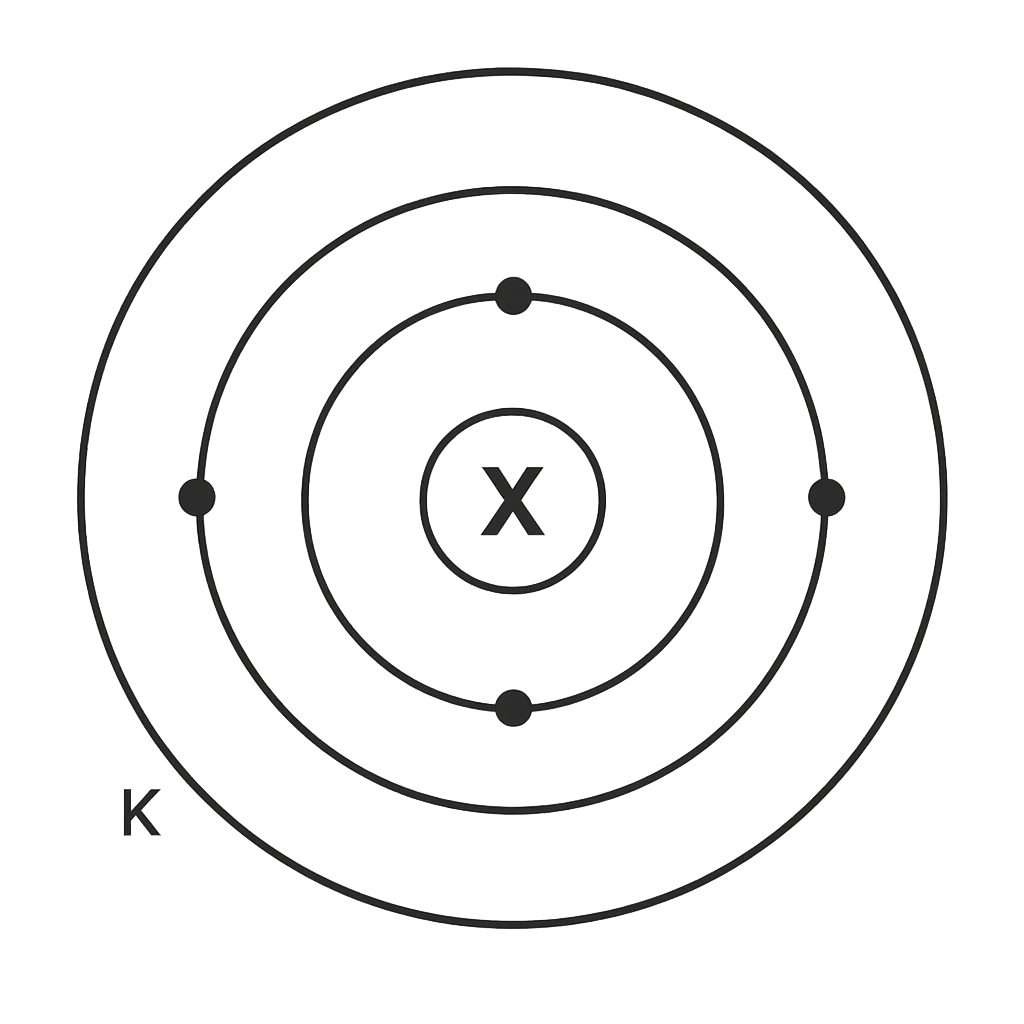
The diagram shows a Bohr model of an element X. The first shell contains 2 electrons, the second shell contains 8 electrons, and the third shell contains 1 electron. Using this information, state the atomic number of X, identify the element, and give the number of valence electrons.
A. Atomic number 12; element Magnesium (Mg); 2 valence electrons.
B. Atomic number 10; element Neon (Ne); 0 valence electrons.
Correct C. Atomic number 11; element Sodium (Na); 1 valence electron.
D. Atomic number 13; element Aluminum (Al); 3 valence electrons.

Correct Answer: C

Want to see the full step-by-step solution? Unlock AI Explanation & Analytics
Question 21 View Details
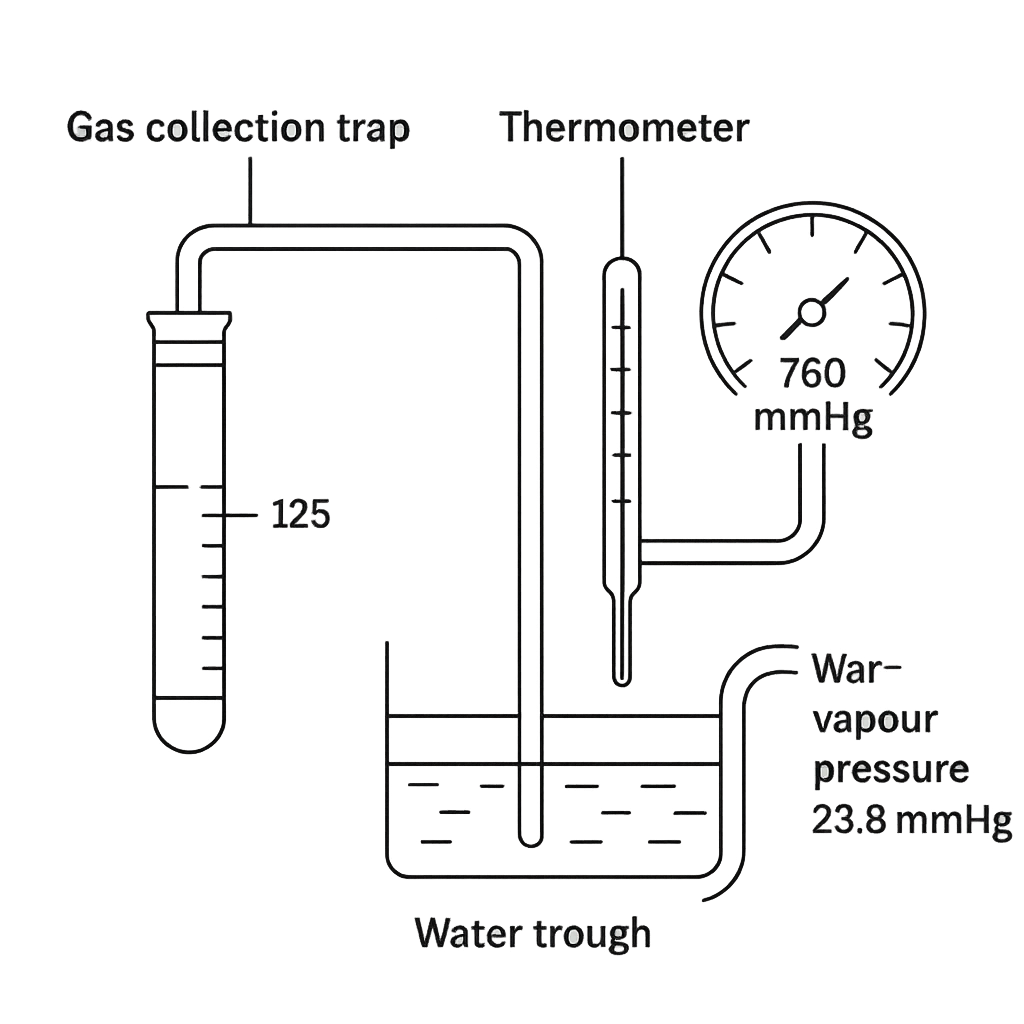
The diagram shows a gas‑collection‑over‑water apparatus with the following readings: volume = \(125\ \text{mL}\), temperature = \(298\ \text{K}\), atmospheric pressure = \(760\ \text{mmHg}\), water vapour pressure = \(23.8\ \text{mmHg}\). Assuming the gas behaves ideally, calculate the number of moles of gas collected.
A. 4.2×10⁻³ mol
B. 6.0×10⁻³ mol
C. 5.2×10⁻³ mol
Correct D. 4.9×10⁻³ mol

Correct Answer: D

Want to see the full step-by-step solution? Unlock AI Explanation & Analytics
Question 22 View Details
A 250.0 mL aqueous solution is prepared by reacting excess solid NaOH with \(35.5\ \text{g}\) of chlorine gas at \(25\ ^\circ\text{C}\). The reaction proceeds according to \(\mathrm{Cl_2 + 2\,NaOH \rightarrow NaCl + NaOCl + H_2O}\). Assuming 100 % yield, calculate the concentration of \(\mathrm{NaOCl}\) in the solution (in \(\text{mol\,L}^{-1}\)).
A. 2.50 mol\/L
B. 1.75 mol\/L
C. 1.20 mol\/L
Correct D. 2.00 mol/L

Correct Answer: D

Want to see the full step-by-step solution? Unlock AI Explanation & Analytics
Question 23 View Details
A piece of iron weighing \(5.00\ \text{g}\) is immersed in \(250\ \text{cm}^3\) of \(0.200\ \text{M}\) copper(II) sulfate solution. The reaction proceeds according to \(\mathrm{Fe + CuSO_4 \rightarrow FeSO_4 + Cu}\). Assuming the reaction goes to completion, calculate the mass of copper that will be deposited on the iron surface (in grams).
A. 4.20 g
B. 2.55 g
C. 1.90 g
Correct D. 3.18 g

Correct Answer: D

Want to see the full step-by-step solution? Unlock AI Explanation & Analytics
Question 24 View Details
In a step‑growth polymerisation, a diacid of molar mass \(146\ \text{g·mol}^{-1}\) reacts with a diol of molar mass \(62\ \text{g·mol}^{-1}\). Initially, \(0.500\ \text{mol}\) of each monomer are present. At a certain stage the number‑average degree of polymerisation is measured to be 250. Assuming ideal step‑growth behaviour, calculate the mass of polymer present at that stage (in grams).
A. 85.2 g
B. 78.5 g
Correct C. 94.6 g
D. 102.3 g

Correct Answer: C

Want to see the full step-by-step solution? Unlock AI Explanation & Analytics
Question 25 View Details
Solid chlorine gas is introduced into a solution containing \(0.10\ \text{M}\) bromide ions. The possible redox reaction is \(\mathrm{Cl_2 + 2\,Br^- \rightarrow 2\,Cl^- + Br_2}\). Using the standard reduction potentials \(\mathrm{Cl_2 + 2e^- \rightarrow 2Cl^-}\) \(E^\circ = +1.36\ \text{V}\) and \(\mathrm{Br_2 + 2e^- \rightarrow 2Br^-}\) \(E^\circ = +1.07\ \text{V}\), (a) calculate the standard cell potential for the reaction, (b) state whether bromine gas will be produced spontaneously, and (c) calculate the equilibrium constant \(K\) at \(25\ ^\circ\text{C}\).
Correct A. E° = 0.29 V; reaction is spontaneous; K ≈ 6.3×10⁹
B. E° = 0.45 V; reaction is spontaneous; K ≈ 1.0×10¹⁶
C. E° = -0.29 V; reaction is non‑spontaneous; K ≈ 1.6×10⁻¹⁰
D. E° = 0.15 V; reaction is spontaneous; K ≈ 2.0×10⁴

Correct Answer: A

Want to see the full step-by-step solution? Unlock AI Explanation & Analytics

Master the Exam!

You've seen a preview, but there are thousands more questions plus AI tutor to break down complex solutions.

Unlock Full Access Available for Android & Windows
Help others prepare! Share this practice hub:
Chat with Support