igcse model questions vol1 2019 physics | Objective

Prepare for your exams with igcse model questions vol1 questions? Reviewing past/model questions is one of the most effective ways to guarantee a high score. This practice hub features authentic 2019 physics (Objective) questions designed to simulate the real exam environment.

Practice these randomly selected questions to test your readiness.

Question 1 View Details
An ideal gas occupies a rigid container of volume \(2.0\ \text{L}\) at a temperature of \(300\ \text{K}\). The container holds \(0.50\ \text{mol}\) of the gas. The gas is heated to \(350\ \text{K}\) while the volume remains fixed, and then it expands isothermally at \(350\ \text{K}\) until its pressure becomes half of the pressure after heating. What is the final volume of the gas in litres?
Correct A. 4.0
B. 5.0
C. 3.0
D. 2.5

Correct Answer: A

Want to see the full step-by-step solution? Unlock AI Explanation & Analytics
Question 2 View Details
A block of mass \(30\ \text{kg}\) is lifted at constant speed by a simple block‑and‑tackle consisting of a fixed pulley and a single movable pulley. The rope passes over the fixed pulley, then under the movable pulley attached to the block, and the free end is pulled vertically upward. Because of friction in the fixed pulley, the tension in the rope segment supporting the block is \(4\%\) less than the tension in the segment where the effort is applied. What magnitude of effort force (in newtons) must be applied to raise the block?
A. 120
B. 140
Correct C. 153
D. 165

Correct Answer: C

Want to see the full step-by-step solution? Unlock AI Explanation & Analytics
Question 3 View Details
In a U‑tube manometer, the left leg contains oil (\(\rho = 800\ \text{kg m}^{-3}\)) and the right leg contains water (\(\rho = 1000\ \text{kg m}^{-3}\)). The oil surface is \(30\ \text{cm}\) higher than the water surface. If the height of the oil column above the interface is \(40\ \text{cm}\), what is the height of the water column above the interface (in centimetres)?
A. 2.5
B. 1.5
Correct C. 2.0
D. 3.0

Correct Answer: C

Want to see the full step-by-step solution? Unlock AI Explanation & Analytics
Question 4 View Details
Vector \(\mathbf{A}\) has magnitude \(8\ \text{N}\) and vector \(\mathbf{B}\) has magnitude \(6\ \text{N}\). The angle between \(\mathbf{A}\) and \(\mathbf{B}\) is \(60^{\circ}\). Find the magnitude of the resultant vector \(\mathbf{R}=\mathbf{A}+\mathbf{B}\). Give your answer in exact form.
A. 2\sqrt{30}
B. 2\sqrt{45}
C. 4\sqrt{37}
Correct D. 2\sqrt{37}

Correct Answer: D

Want to see the full step-by-step solution? Unlock AI Explanation & Analytics
Question 5 View Details
A rectangular coil has \(200\) turns, each side \(0.10\ \text{m}\) long, and rotates in a uniform magnetic field of magnitude \(0.5\ \text{T}\). The axis of rotation is perpendicular to the field. The coil makes \(1200\) revolutions per minute and is connected to a resistor of \(10\ \Omega\). (a) Calculate the maximum induced emf (in volts). (b) Determine the average power dissipated in the resistor (in watts).
A. 100.0 V; 630 W
B. 62.8 V; 395 W
C. 251.4 V; 1580 W
Correct D. 125.7 V; 790 W

Correct Answer: D

Want to see the full step-by-step solution? Unlock AI Explanation & Analytics
Question 6 View Details
A 5.0 kg block rests on a rough plane inclined at \(30^{\circ}\). The coefficient of static friction between the block and the plane is \(0.40\). A horizontal force \(P\) is applied to push the block up the plane. What is the minimum magnitude of \(P\) (in newtons) required to start moving the block up the plane?
Correct A. 62 N
B. 70 N
C. 55 N
D. 48 N

Correct Answer: A

Want to see the full step-by-step solution? Unlock AI Explanation & Analytics
Question 7 View Details
A boat sails 8.0 km due north and then 6.0 km due east. What is the straight‑line distance from its starting point to its final position?
A. 9 km
Correct B. 10 km
C. 14 km
D. 12 km

Correct Answer: B

Want to see the full step-by-step solution? Unlock AI Explanation & Analytics
Question 8 View Details
A converging lens of focal length \(f_{1}=12\,\text{cm}\) forms a real image of a candle placed \(18\,\text{cm}\) from the lens. A second converging lens of focal length \(f_{2}=24\,\text{cm}\) is positioned \(30\,\text{cm}\) to the right of the first lens. Determine the position of the final image relative to the second lens (give the distance in centimetres, positive if the image is on the opposite side to the object).
A. 9.5 cm
B. 7.8 cm
C. 13.2 cm
Correct D. 11.7 cm

Correct Answer: D

Want to see the full step-by-step solution? Unlock AI Explanation & Analytics
Question 9 View Details
A battery has an emf of \(15\,\text{V}\) and an internal resistance \(r\) (unknown). It is connected to a circuit consisting of a \(4\,\Omega\) resistor in series with a parallel combination of a \(6\,\Omega\) resistor and a \(12\,\Omega\) resistor. The terminal voltage across the external circuit is measured to be \(12\,\text{V}\). Determine the internal resistance \(r\) of the battery and the power dissipated in the \(12\,\Omega\) resistor (give the power in watts).
A. r = 2 Ω, P = 4 W
B. r = 3 Ω, P = 2 W
Correct C. r = 2 Ω, P = 3 W
D. r = 1 Ω, P = 4 W

Correct Answer: C

Want to see the full step-by-step solution? Unlock AI Explanation & Analytics
Question 10 View Details
A 0.50 kg copper block (specific heat \(c_{Cu}=385\,\text{J kg}^{-1}\text{K}^{-1}\)) at \(150^{\circ}\text{C}\) is placed into 2.0 kg of water (specific heat \(c_{w}=4186\,\text{J kg}^{-1}\text{K}^{-1}\)) initially at \(20^{\circ}\text{C}\) inside an insulated container. The container loses heat to the surroundings at a constant rate of \(10\,\text{J s}^{-1}\). After 5 minutes the system reaches thermal equilibrium. Assuming no other losses, determine the final equilibrium temperature (in °C, to one decimal place) and the total heat transferred to the surroundings (in joules).
Correct A. 22.6 °C, 3000 J
B. 21.5 °C, 3500 J
C. 23.0 °C, 2500 J
D. 22.6 °C, 3500 J

Correct Answer: A

Want to see the full step-by-step solution? Unlock AI Explanation & Analytics
Question 11 View Details
A 2.0 g sample of a radioactive isotope X (atomic mass 240 g·mol\(^{-1}\)) undergoes alpha decay releasing 5 MeV of energy per decay. The sample is placed in 1.0 kg of water (specific heat capacity 4180 J·kg\(^{-1}\)·K\(^{-1}\)). After 10 minutes the temperature of the water has risen by 0.5 °C. Assuming all the released energy is absorbed by the water, calculate the half‑life of isotope X. Give your answer in years (to two significant figures).
Correct A. 25 years
B. 0.25 years
C. 250 years
D. 2.5 years

Correct Answer: A

Want to see the full step-by-step solution? Unlock AI Explanation & Analytics
Question 12 View Details
A 200 g block of copper (specific heat capacity \(c_{\text{Cu}}=0.385\) J·g\(^{-1}\)·K\(^{-1}\)) at \(150\) °C is placed into a well‑insulated container that holds 100 g of water at \(20\) °C (specific heat capacity \(c_{\text{w}}=4.18\) J·g\(^{-1}\)·K\(^{-1}\)). The container itself is initially at \(20\) °C. After the system reaches equilibrium the final temperature is \(30\) °C. It is known that 5 % of the heat released by the copper is lost to the surroundings. Determine the heat capacity of the container (in J·K\(^{-1}\)), assuming its temperature also rises to the final equilibrium temperature.
A. 420 J/K
B. 380 J/K
Correct C. 460 J/K
D. 500 J/K

Correct Answer: C

Want to see the full step-by-step solution? Unlock AI Explanation & Analytics
Question 13 View Details
A uranium‑235 nucleus (atomic mass \(235.0439\) u) absorbs a neutron (mass \(1.008665\) u) and fissions into barium‑141 (mass \(140.9144\) u), krypton‑92 (mass \(91.9262\) u) and three neutrons. Using \(1\) u = \(931.5\) MeV, calculate the total energy released in a single fission event. Give your answer in MeV (to three significant figures).
A. 180 MeV
Correct B. 173 MeV
C. 160 MeV
D. 150 MeV

Correct Answer: B

Want to see the full step-by-step solution? Unlock AI Explanation & Analytics
Question 14 View Details
A rigid sealed container holds \(0.5\) mol of an ideal gas at \(300\) K and \(1.0\) atm. The gas is heated until its pressure doubles. While the temperature is held at this new value, a valve is opened and gas escapes until the pressure returns to \(1.0\) atm, after which the valve is closed and the container is allowed to cool back to \(300\) K. What is the final pressure of the gas remaining in the container (in atm)?
A. 0.75 atm
Correct B. 0.5 atm
C. 0.25 atm
D. 1.0 atm

Correct Answer: B

Want to see the full step-by-step solution? Unlock AI Explanation & Analytics
Question 15 View Details
A block of mass \(5\) kg rests on a rough inclined plane that makes an angle of \(30^{\circ}\) with the horizontal. The coefficient of static friction between the block and the plane is \(0.20\). A horizontal force \(F\) is applied to the block (pushing it up the incline). Determine the minimum magnitude of \(F\) required to start moving the block up the plane. Give your answer in newtons (N) to two significant figures.
A. 50 N
B. 30 N
C. 38 N
Correct D. 43 N

Correct Answer: D

Want to see the full step-by-step solution? Unlock AI Explanation & Analytics
Question 16 View Details
A rectangular garden is \(12.5\ \text{m}\) long and \(8.0\ \text{m}\) wide. What is its area in square centimetres? Express your answer as an integer.
A. 100000
Correct B. 1000000
C. 1250000
D. 800000

Correct Answer: B

Want to see the full step-by-step solution? Unlock AI Explanation & Analytics
Question 17 View Details
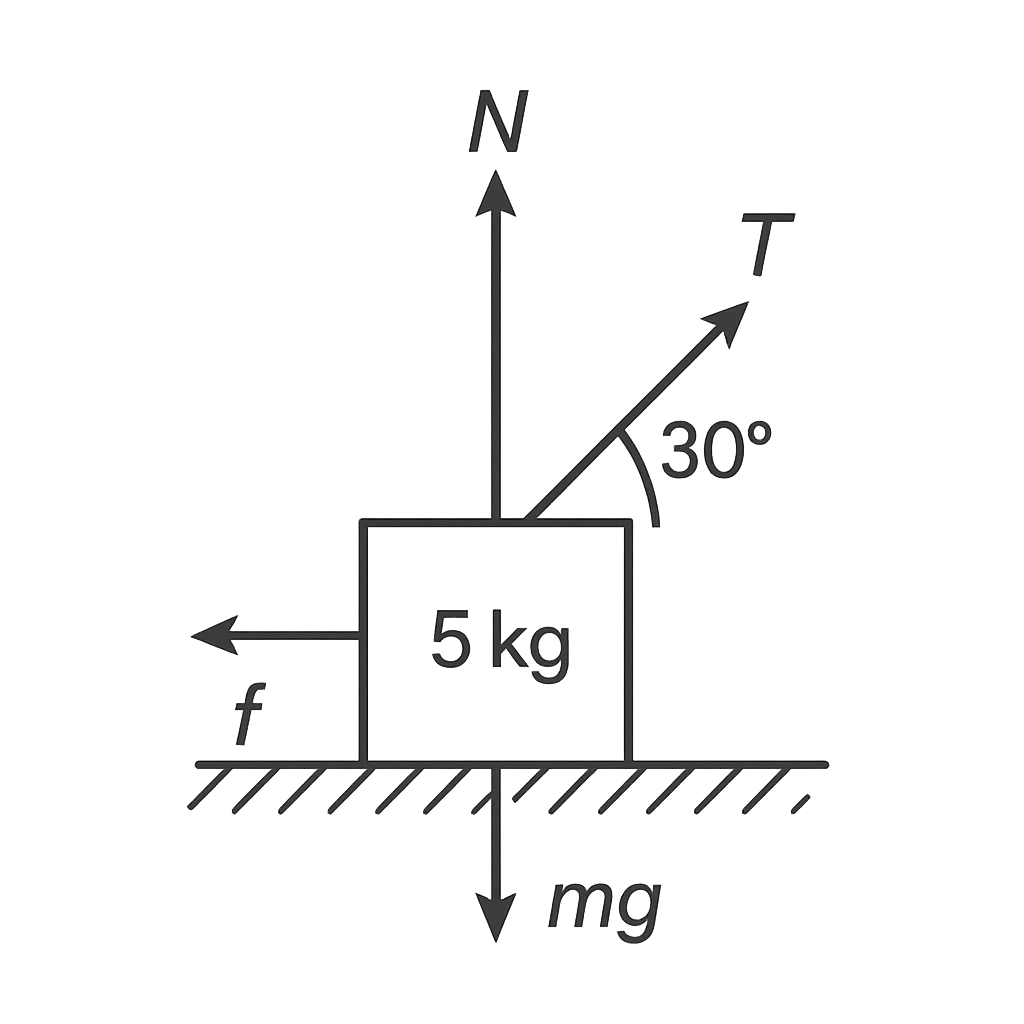
A \(5.0\ \text{kg}\) block rests on a horizontal surface. It is pulled to the right by a rope that makes an angle of \(30^{\circ}\) above the horizontal. The coefficient of kinetic friction between the block and the surface is 0.30. The block moves at constant speed. Find the magnitude of the tension in the rope (in newtons) to two significant figures.
A. 12.0
B. 16.0
C. 10.5
Correct D. 14.5

Correct Answer: D

Want to see the full step-by-step solution? Unlock AI Explanation & Analytics
Question 18 View Details
A source emits sound of frequency \(500\ \text{Hz}\) in still air where the speed of sound is \(340\ \text{m s}^{-1}\). The source moves towards a stationary observer at \(20\ \text{m s}^{-1}\). At the same time the observer moves away from the source at \(10\ \text{m s}^{-1}\). What frequency does the observer hear? Give your answer to the nearest hertz.
Correct A. 458
B. 500
C. 472
D. 440

Correct Answer: A

Want to see the full step-by-step solution? Unlock AI Explanation & Analytics
Question 19 View Details
A traveller walks \(5\ \text{km}\) north and then \(12\ \text{km}\) east. Determine the magnitude of the resultant displacement in kilometres and the angle it makes north of east. Give the magnitude to one decimal place and the angle to one decimal place.
A. 13 km, 15.0° north of east
B. 13 km, 30.0° north of east
C. 12.5 km, 22.6° north of east
Correct D. 13 km, 22.6° north of east

Correct Answer: D

Want to see the full step-by-step solution? Unlock AI Explanation & Analytics
Question 20 View Details
An electron in a hydrogen atom drops from the \(n=5\) level to the \(n=2\) level, emitting a photon. It then absorbs a photon and is excited to the \(n=4\) level. Using the Rydberg constant \(R = 1.097\times10^{7}\ \text{m}^{-1}\), calculate the wavelength of the absorbed photon in nanometres. Give your answer to three significant figures.
Correct A. 486 nm
B. 560 nm
C. 434 nm
D. 512 nm

Correct Answer: A

Want to see the full step-by-step solution? Unlock AI Explanation & Analytics
Question 21 View Details
A pipe closed at one end and open at the other has a length of \(1.2\) m. The speed of sound at \(20^{\circ}\)C is \(340\) m s\(^{-1}\). When the temperature is raised to \(60^{\circ}\)C, the speed of sound changes proportionally to \(\sqrt{T+273}\). Calculate the increase in the fundamental frequency of the pipe, in hertz, to one decimal place.
Correct A. 4.7 Hz
B. 7.1 Hz
C. 5.9 Hz
D. 3.2 Hz

Correct Answer: A

Want to see the full step-by-step solution? Unlock AI Explanation & Analytics
Question 22 View Details
Two point charges lie on the x‑axis. A charge \(+8\) nC is at the origin and a charge \(-2\) nC is at \(x = 0.12\) m.\n(a) Find the position on the axis between the charges where the net electric field is zero.\n(b) Calculate the electric potential at that point relative to infinity, giving your answer in volts to the nearest volt.
Correct A. 450 V
B. 350 V
C. 600 V
D. 500 V

Correct Answer: A

Want to see the full step-by-step solution? Unlock AI Explanation & Analytics
Question 23 View Details
A particle moves in a straight line with a time‑dependent acceleration given by \(a(t) = 4t - 2\) m s\(^{-2}\), where \(t\) is in seconds. The particle starts from rest at the origin when \(t = 0\). Determine its displacement after \(5\) s, giving your answer in metres to one decimal place.
A. 53.0 m
Correct B. 58.3 m
C. 62.5 m
D. 47.8 m

Correct Answer: B

Want to see the full step-by-step solution? Unlock AI Explanation & Analytics
Question 24 View Details
A \(2.0\) kg block starts from rest at the top of a smooth incline that is \(5.0\) m high. After reaching the bottom, the block moves onto a horizontal surface where the coefficient of kinetic friction is \(\mu_k = 0.20\). Assuming \(g = 9.8\) m s\(^{-2}\), how far does the block travel on the horizontal surface before coming to rest? Give your answer in metres to one decimal place.
A. 20.0 m
B. 30.0 m
C. 15.0 m
Correct D. 25.0 m

Correct Answer: D

Want to see the full step-by-step solution? Unlock AI Explanation & Analytics
Question 25 View Details
A sealed container holds \(0.5\) mol of an ideal gas at \(300\) K and a pressure of \(1.0\times10^{5}\) Pa. The gas is heated until its pressure doubles while the volume expands by \(20\)% of its original volume.\n(a) What is the temperature of the gas after this heating?\n(b) The gas then cools at the new constant pressure until its volume returns to the original volume. What is the final temperature after this cooling? Give your answer for part (b) in kelvin.
A. 700 K
Correct B. 600 K
C. 500 K
D. 550 K

Correct Answer: B

Want to see the full step-by-step solution? Unlock AI Explanation & Analytics

Master the Exam!

You've seen a preview, but there are thousands more questions plus AI tutor to break down complex solutions.

Unlock Full Access Available for Android & Windows
Help others prepare! Share this practice hub:
Chat with Support