igcse model questions vol1 2019 chemistry | Objective

Prepare for your exams with igcse model questions vol1 questions? Reviewing past/model questions is one of the most effective ways to guarantee a high score. This practice hub features authentic 2019 chemistry (Objective) questions designed to simulate the real exam environment.

Practice these randomly selected questions to test your readiness.

Question 1 View Details
A gas collection over water apparatus is used to collect hydrogen gas produced when magnesium reacts with excess hydrochloric acid. The graduated cylinder reading is \(125.0\ \text{mL}\) at \(25\ ^\circ\text{C}\). Atmospheric pressure is \(760\ \text{mm\,Hg}\) and the water vapour pressure at \(25\ ^\circ\text{C}\) is \(23.8\ \text{mm\,Hg}\). The mass of magnesium used is \(0.0300\ \text{g}\). Using the diagram, determine which reactant is the limiting reagent and calculate the number of moles of hydrogen gas actually produced.
Correct A. 0.00123 mol
B. 0.00100 mol
C. 0.00150 mol
D. 0.00098 mol

Correct Answer: A

Want to see the full step-by-step solution? Unlock AI Explanation & Analytics
Question 2 View Details
When an unknown hydrocarbon \(C_{x}H_{y}\) is burned completely in excess oxygen, \(44.5\ \text{g}\) of carbon dioxide and \(18.2\ \text{g}\) of water are produced. (a) Determine the empirical formula of the hydrocarbon. (b) If \(5.00\ \text{g}\) of this hydrocarbon is burned, calculate the volume of oxygen gas consumed at STP.
A. 14.5 L
B. 10.0 L
Correct C. 12.0 L
D. 8.3 L

Correct Answer: C

Want to see the full step-by-step solution? Unlock AI Explanation & Analytics
Question 3 View Details
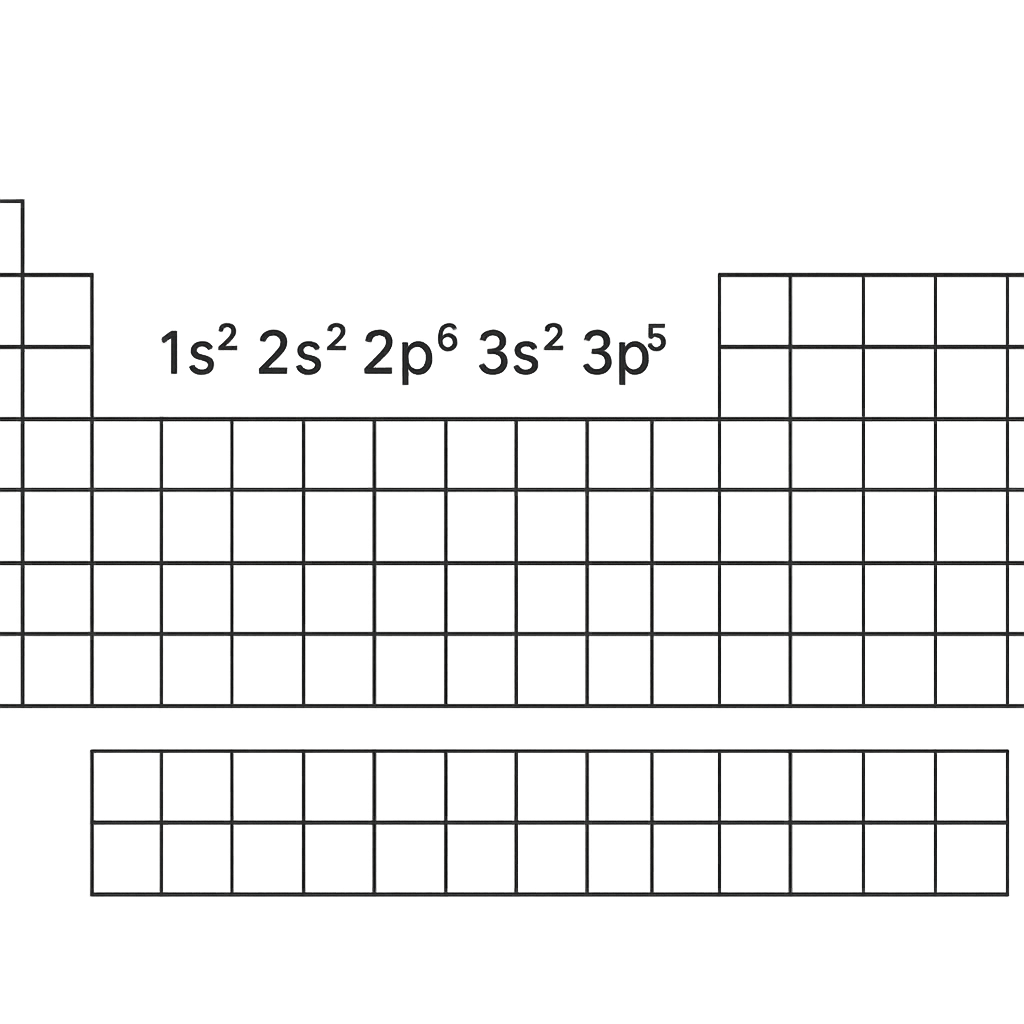
The diagram shows the electron configuration of an element and its position in the periodic table. Identify the element.
A. Phosphorus
B. Argon
Correct C. Chlorine
D. Sulfur

Correct Answer: C

Want to see the full step-by-step solution? Unlock AI Explanation & Analytics
Question 4 View Details
In a sealed \(298\ \text{K}\) container, \(2.00\ \text{L}\) of nitrogen gas at \(1.00\ \text{atm}\) and \(3.00\ \text{L}\) of hydrogen gas at \(1.00\ \text{atm}\) are mixed. The gases react according to \(\mathrm{N_{2} + 3\,H_{2} \rightarrow 2\,NH_{3}}\). Assuming the reaction goes to completion, calculate the mass of ammonia formed.
A. 1.55 g
Correct B. 1.39 g
C. 0.93 g
D. 1.12 g

Correct Answer: B

Want to see the full step-by-step solution? Unlock AI Explanation & Analytics
Question 5 View Details
A \(0.250\ \text{M}\) solution of acetic acid (\(\mathrm{CH_{3}COOH}\), \(K_{a}=1.8\times10^{-5}\)) is prepared. \(25.0\ \text{mL}\) of this solution is mixed with \(25.0\ \text{mL}\) of \(0.250\ \text{M}\) sodium acetate solution. (a) Calculate the pH of the resulting buffer. (b) How many millilitres of \(0.100\ \text{M}\) NaOH are required to raise the pH by \(0.50\) units?
Correct A. pH = 4.74; 32.5 mL NaOH
B. pH = 4.84; 30.0 mL NaOH
C. pH = 4.60; 28.0 mL NaOH
D. pH = 5.00; 35.0 mL NaOH

Correct Answer: A

Want to see the full step-by-step solution? Unlock AI Explanation & Analytics
Question 6 View Details
A sample containing 5.0 g of aluminium metal is mixed with 10.0 g of copper(II) chloride solution. The reaction is \(2Al + 3CuCl_{2} \rightarrow 2AlCl_{3} + 3Cu\). If the reaction yields 80 % of the theoretical amount of copper, calculate the mass of copper actually produced.
A. 2.84 g
Correct B. 3.78 g
C. 4.73 g
D. 5.67 g

Correct Answer: B

Want to see the full step-by-step solution? Unlock AI Explanation & Analytics
Question 7 View Details
Two aqueous solutions are mixed: 100 mL of 0.010 M silver nitrate and 100 mL of 0.015 M sodium chloride. The solubility product of silver chloride is \(K_{sp}=1.8\times10^{-10}\). Determine the mass of silver chloride that precipitates when the mixture reaches equilibrium.
A. 0.203 g
Correct B. 0.141 g
C. 0.176 g
D. 0.112 g

Correct Answer: B

Want to see the full step-by-step solution? Unlock AI Explanation & Analytics
Question 8 View Details
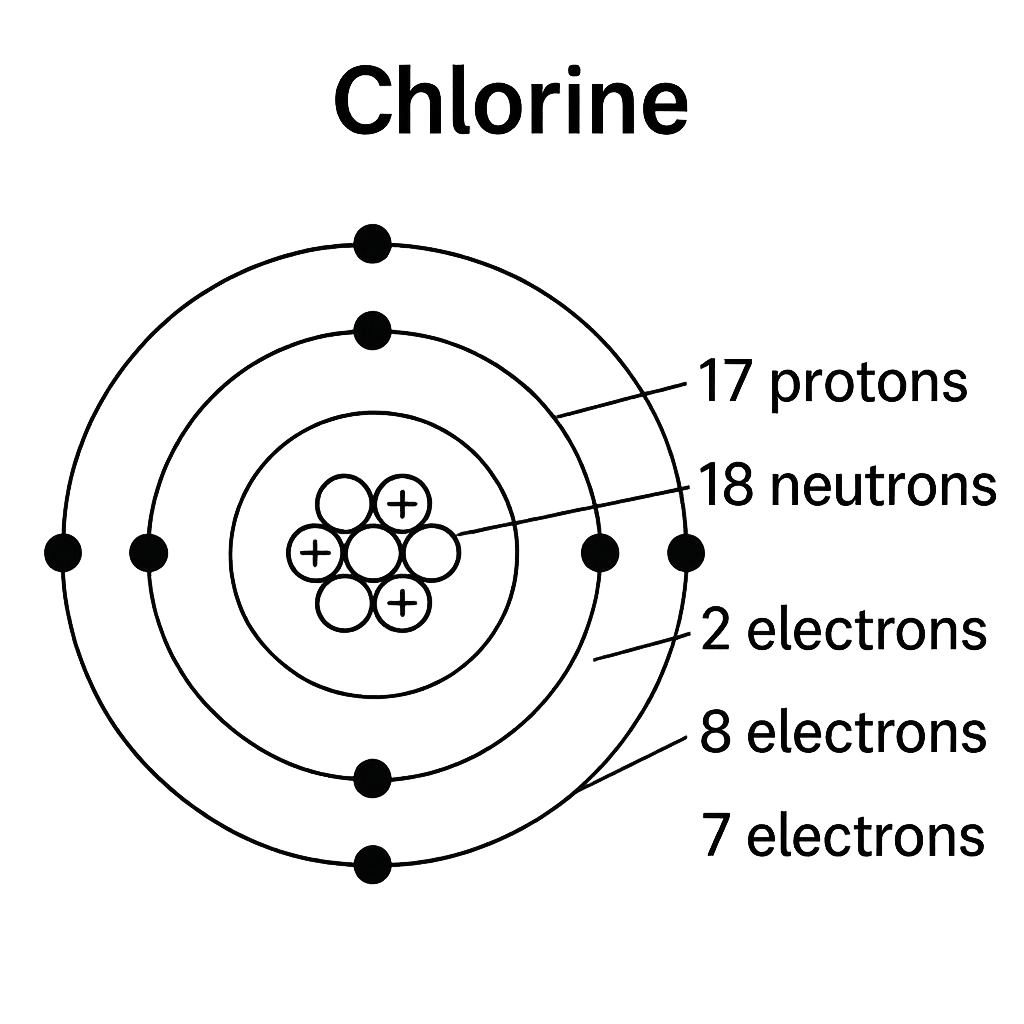
The diagram shows a neutral atom of an element. Using the information shown, state the atomic number, the mass number, and the number of electrons in the outermost shell.
Correct A. Atomic number = 17; mass number = 35; outermost electrons = 7
B. Atomic number = 18; mass number = 35; outermost electrons = 8
C. Atomic number = 16; mass number = 35; outermost electrons = 6
D. Atomic number = 17; mass number = 36; outermost electrons = 7

Correct Answer: A

Want to see the full step-by-step solution? Unlock AI Explanation & Analytics
Question 9 View Details
The nitrite ion, \(\mathrm{NO_2^-}\), exhibits resonance. Determine the hybridisation of the nitrogen atom and give the approximate N-O bond angle in the ion.
A. sp³ hybridisation; bond angle ≈109.5°
B. sp² hybridisation; bond angle ≈120°
C. sp hybridisation; bond angle ≈180°
Correct D. sp² hybridisation; bond angle ≈115°

Correct Answer: D

Want to see the full step-by-step solution? Unlock AI Explanation & Analytics
Question 10 View Details
The solubility of potassium nitrate, \(\mathrm{KNO_3}\), is 31.6 g per 100 g water at 20 °C and 109 g per 100 g water at 60 °C. A student adds 150 g of solid \(\mathrm{KNO_3}\) to 200 g of water at 20 °C and then heats the mixture to 60 °C until all the solid dissolves. After the solution is cooled back to 20 °C, how many grams of \(\mathrm{KNO_3}\) will crystallise out?
A. 39.4 g
B. 130.3 g
Correct C. 86.8 g
D. 118.4 g

Correct Answer: C

Want to see the full step-by-step solution? Unlock AI Explanation & Analytics
Question 11 View Details
A galvanic cell is set up with a fluorine electrode (F₂ gas at 1 atm) in a 0.10 M KF solution as the cathode, and a chlorine electrode (Cl₂ gas at 1 atm) in a 0.10 M KCl solution as the anode. Standard reduction potentials are \( \mathrm{F_2 + 2e^- -> 2F^-} \) E° = +2.87 V and \( \mathrm{Cl_2 + 2e^- -> 2Cl^-} \) E° = +1.36 V. (a) Write the overall cell reaction. (b) Calculate the standard cell potential \(E^\circ_{\text{cell}}\). (c) Determine the standard Gibbs free energy change \( \Delta G^\circ \) for the cell reaction.
A. E°cell = 1.51 V; ΔG° = -1.45×10⁵ J
B. E°cell = 1.51 V; ΔG° = -2.91×10⁶ J
C. E°cell = 0.51 V; ΔG° = -2.91×10⁵ J
Correct D. E°cell = 1.51 V; ΔG° = -2.91×10⁵ J

Correct Answer: D

Want to see the full step-by-step solution? Unlock AI Explanation & Analytics
Question 12 View Details
When 2.00 g of magnesium reacts with excess hydrochloric acid according to \( \mathrm{Mg + 2HCl -> MgCl_2 + H_2} \), the hydrogen gas is collected over water at 25 °C and 750 mmHg. The measured volume of gas is 0.850 L. Calculate the percentage yield of hydrogen relative to the theoretical yield.
A. 62.5%
B. 55.2%
Correct C. 40.4%
D. 28.7%

Correct Answer: C

Want to see the full step-by-step solution? Unlock AI Explanation & Analytics
Question 13 View Details
In acidic solution, potassium permanganate reacts with iron(II) sulfate according to \( \mathrm{MnO_4^- + Fe^{2+} -> Mn^{2+} + Fe^{3+}} \). If 0.500 mol of \( \mathrm{KMnO_4} \) reacts completely with excess \( \mathrm{FeSO_4} \), how many grams of \( \mathrm{Fe_2(SO_4)_3} \) are formed?
A. 1.00×10³ g
B. 2.50×10² g
Correct C. 5.00×10² g
D. 7.50×10² g

Correct Answer: C

Want to see the full step-by-step solution? Unlock AI Explanation & Analytics
Question 14 View Details
A 5.00 g sample of an unknown volatile alcohol is dissolved in 100.0 g of water containing 0.500 g of glucose (a non‑volatile solute). The boiling point of the solution is 100.56 °C. Given the boiling‑point elevation constant of water \(K_b = 0.512 °C·kg·mol^{-1}\), determine the molar mass of the alcohol and identify it from the list: methanol (32.0 g mol⁻¹), ethanol (46.1 g mol⁻¹), propan‑1‑ol (60.1 g mol⁻¹), butanol (74.1 g mol⁻¹).
A. methanol
B. butanol
Correct C. ethanol
D. propan‑1‑ol

Correct Answer: C

Want to see the full step-by-step solution? Unlock AI Explanation & Analytics
Question 15 View Details
A solution of copper(II) sulfate is electrolysed with a constant current of 2.00 A for 30.0 min. The cathode reaction is \( \mathrm{Cu^{2+} + 2e^- -> Cu(s)} \). Calculate the mass of copper deposited at the cathode.
A. 0.95 g
B. 1.50 g
Correct C. 1.19 g
D. 2.38 g

Correct Answer: C

Want to see the full step-by-step solution? Unlock AI Explanation & Analytics
Question 16 View Details
A metal oxide \(\mathrm{M_2O_3}\) is reduced to the metal \(\mathrm{M}\) by carbon at 1500 °C according to the reaction \(\mathrm{M_2O_3 + 3C \rightarrow 2M + 3CO}\). The standard enthalpy of formation of \(\mathrm{M_2O_3}\) is -800 kJ mol⁻¹, and the standard enthalpy of formation of CO(g) from C(s) and \(\tfrac{1}{2}\) O₂(g) is -110.5 kJ mol⁻¹. The molar entropy of CO(g) at 1500 °C is 197 J mol⁻¹ K⁻¹, while the reactants are solids with negligible gas entropy. Determine whether the reduction is thermodynamically feasible at 1500 °C. (Assume \(\Delta G \approx \Delta H - T\Delta S\).)
A. No; the reaction becomes spontaneous only above about 2.1×10³ K, which is higher than the furnace temperature of 1773 K.
B. No; ΔG remains positive at 1773 K, so the reduction is not thermodynamically feasible.
C. Yes; the reaction becomes spontaneous above about 5.0×10² K, and the furnace temperature of 1773 K satisfies this.
Correct D. Yes; the reaction becomes spontaneous above about 7.9×10² K, and the furnace temperature of 1773 K satisfies this.

Correct Answer: D

Want to see the full step-by-step solution? Unlock AI Explanation & Analytics
Question 17 View Details
A diatomic molecule AB has a measured dipole moment of 2.5 D and an internuclear distance of 120 pm. (1 D = 3.336 × 10⁻³⁰ C·m.) Assuming the dipole arises from a separation of partial charges ±q, calculate the effective charge q and decide whether the bond is polar covalent or ionic. Treat a bond as ionic if \(q > 0.5\,e\), where \(e = 1.602\times10^{-19}\) C.
A. Non-polar covalent
B. Ionic
C. Metallic
Correct D. Polar covalent

Correct Answer: D

Want to see the full step-by-step solution? Unlock AI Explanation & Analytics
Question 18 View Details
Acetic acid (CH₃COOH) has an acid dissociation constant \(K_a = 1.8\times10^{-5}\). Each chlorine atom attached to the \(\alpha\)-carbon of a carboxylic acid increases its acidity by a factor of 10. For chloroacetic acid (ClCH₂COOH) calculate its \(K_a\) and the pH of a 0.10 M aqueous solution of the acid at 25 °C. (Ignore activity coefficients.)
A. Ka = 1.8×10⁻⁴; pH ≈ 3.37
B. Ka = 1.8×10⁻⁵; pH ≈ 3.37
Correct C. Ka = 1.8×10⁻⁴; pH ≈ 2.37
D. Ka = 1.8×10⁻³; pH ≈ 1.87

Correct Answer: C

Want to see the full step-by-step solution? Unlock AI Explanation & Analytics
Question 19 View Details
A 5.00 g sample of calcium carbonate is heated in a closed apparatus, producing calcium oxide and carbon dioxide: \(\mathrm{CaCO_3 \rightarrow CaO + CO_2}\). The CO₂ is collected over water at 25 °C, total pressure 750 mmHg, water vapour pressure 23.8 mmHg. If the experiment gives an 85 % yield of CaO, calculate the mass of CaO obtained.
A. 2.05 g
Correct B. 2.38 g
C. 1.90 g
D. 2.71 g

Correct Answer: B

Want to see the full step-by-step solution? Unlock AI Explanation & Analytics
Question 20 View Details
A polymer solution at 25 °C has an intrinsic viscosity \([\eta] = 0.85\ \text{dL g}^{-1}\). For this polymer the Mark-Houwink equation is \([\eta] = K\,M^{a}\) with \(K = 1.2\times10^{-3}\ \text{dL g}^{-1}\) and \(a = 0.75\). The monomer molar mass is 100 g mol⁻¹. Determine the average degree of polymerisation (DP) of the polymer.
A. 78
B. 92
C. 45
Correct D. 63

Correct Answer: D

Want to see the full step-by-step solution? Unlock AI Explanation & Analytics
Question 21 View Details
Calcium has an atomic number of \(20\). Using the principle that electrons fill shells in the order \(2, 8, 8, 2\), determine how many electrons are in the outermost (valence) shell of a neutral calcium atom.
A. 3
B. 1
C. 4
Correct D. 2

Correct Answer: D

Want to see the full step-by-step solution? Unlock AI Explanation & Analytics
Question 22 View Details
A compound containing only carbon, hydrogen and oxygen is combusted. From a sample of \(0.850\ \text{g}\) of the compound, \(2.34\ \text{g}\) of carbon dioxide and \(0.945\ \text{g}\) of water are produced. Determine the empirical formula of the compound.
A. C8H12O2
Correct B. C8H16O
C. C6H12O
D. C4H8O2

Correct Answer: B

Want to see the full step-by-step solution? Unlock AI Explanation & Analytics
Question 23 View Details
A \(2.00\ \text{L}\) container holds nitrogen gas at \(298\ \text{K}\) and \(1.00\ \text{atm}\). The gas is heated to \(350\ \text{K}\) and the container volume is reduced to \(1.50\ \text{L}\). Assuming ideal behaviour, calculate the final pressure of the nitrogen gas.
A. 2.01 atm
Correct B. 1.57 atm
C. 1.23 atm
D. 0.98 atm

Correct Answer: B

Want to see the full step-by-step solution? Unlock AI Explanation & Analytics
Question 24 View Details
A \(150\ \text{g}\) sample of ice at \(-10^{\circ}\text{C}\) is placed in a calorimeter. The ice is heated until it becomes water at \(25^{\circ}\text{C}\). The specific heat capacity of ice is \(2.1\ \text{J g}^{-1}\text{K}^{-1}\), the latent heat of fusion of water is \(334\ \text{J g}^{-1}\), and the specific heat capacity of liquid water is \(4.18\ \text{J g}^{-1}\text{K}^{-1}\). Calculate the total amount of heat energy required for this process.
Correct A. 68925 J
B. 65230 J
C. 73500 J
D. 57800 J

Correct Answer: A

Want to see the full step-by-step solution? Unlock AI Explanation & Analytics
Question 25 View Details
A polymer solution obeys the Mark-Houwink equation \( \eta = K M^{a} \) where \( \eta \) is the intrinsic viscosity, \( M \) is the viscosity‑average molecular weight, and the constants are \( K = 1.5 \times 10^{-4}\ \text{dL g}^{-1} \) and \( a = 0.75 \). An experiment measures an intrinsic viscosity of \(0.85\ \text{dL g}^{-1}\) for the polymer. (a) Calculate the viscosity‑average molecular weight \( M \) of the polymer. (b) If the monomer unit has a molar mass of \(100\ \text{g mol}^{-1}\), estimate the degree of polymerisation (DP) of the polymer.
A. M = 9.8×10^3 g mol^{-1}; DP ≈ 98
B. M = 8.5×10^4 g mol^{-1}; DP ≈ 850
Correct C. M = 9.8×10^4 g mol^{-1}; DP ≈ 980
D. M = 1.2×10^5 g mol^{-1}; DP ≈ 1200

Correct Answer: C

Want to see the full step-by-step solution? Unlock AI Explanation & Analytics

Master the Exam!

You've seen a preview, but there are thousands more questions plus AI tutor to break down complex solutions.

Unlock Full Access Available for Android & Windows
Help others prepare! Share this practice hub:
Chat with Support