igcse model questions vol1 2019 chemistry | Essay

Prepare for your exams with igcse model questions vol1 questions? Reviewing past/model questions is one of the most effective ways to guarantee a high score. This practice hub features authentic 2019 chemistry (Essay) questions designed to simulate the real exam environment.

Practice these randomly selected questions to test your readiness.
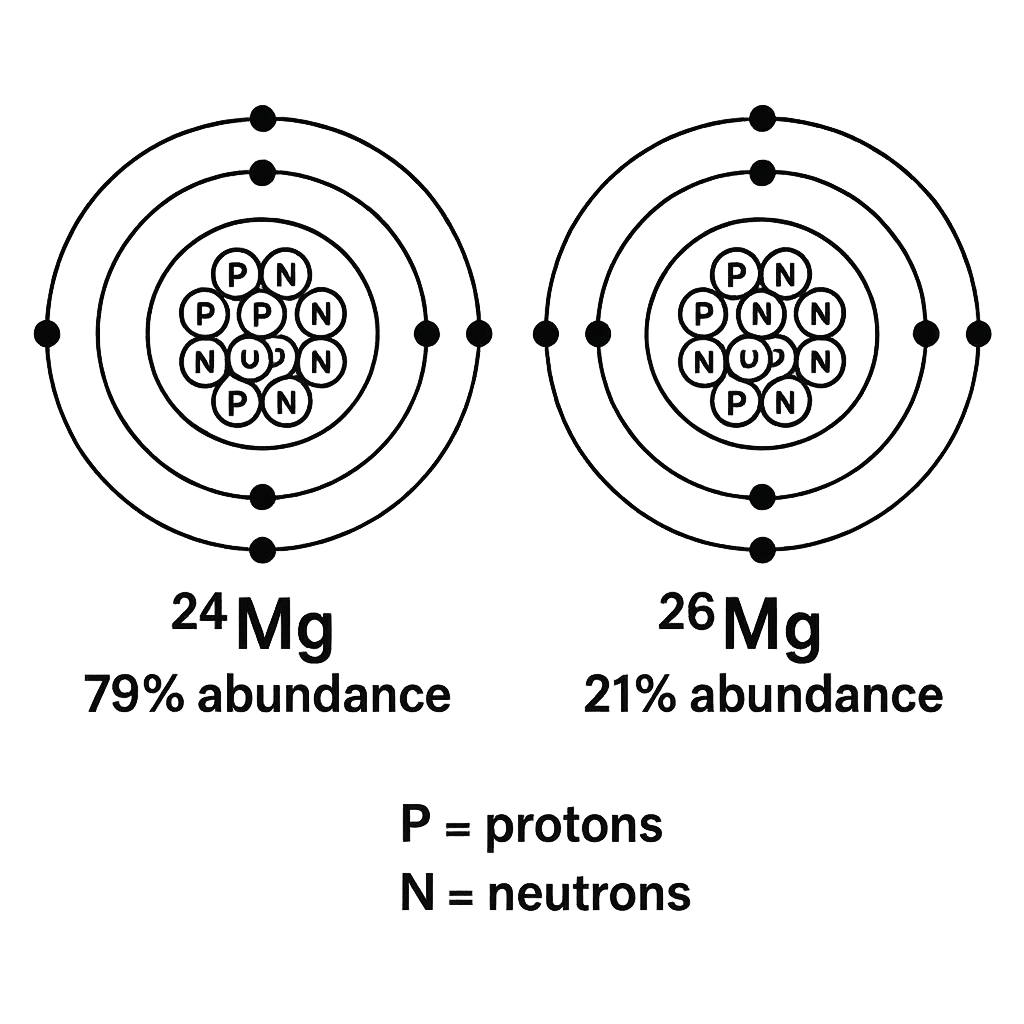
Question 1 View Details
The diagram shows two naturally occurring isotopes of an element. Each isotope is labelled with its mass number and its percentage natural abundance. The nucleus of each isotope is drawn showing the number of protons and neutrons, and the electron shells are illustrated with the distribution of electrons.
Question Parts
(a)
State the chemical symbol of the element and give its atomic number.
(b)
For each isotope shown, write the number of protons, neutrons and electrons present in a neutral atom.
(c)
Calculate the average (relative) atomic mass of the element using the isotopic abundances shown.
(d)
A 2.00 g sample of the element is completely oxidised to magnesium oxide (MgO). Using the average atomic mass obtained in part (c), calculate the mass of oxygen that combines with the magnesium. (Molar mass of MgO = 40.30 g·mol⁻¹, atomic mass of O = 16.00 u).
Detailed Essay Solution & Marking Scheme Available

Get the step-by-step mathematical proofs, key points required by examiners, and a comprehensive breakdown from our AI Tutor.
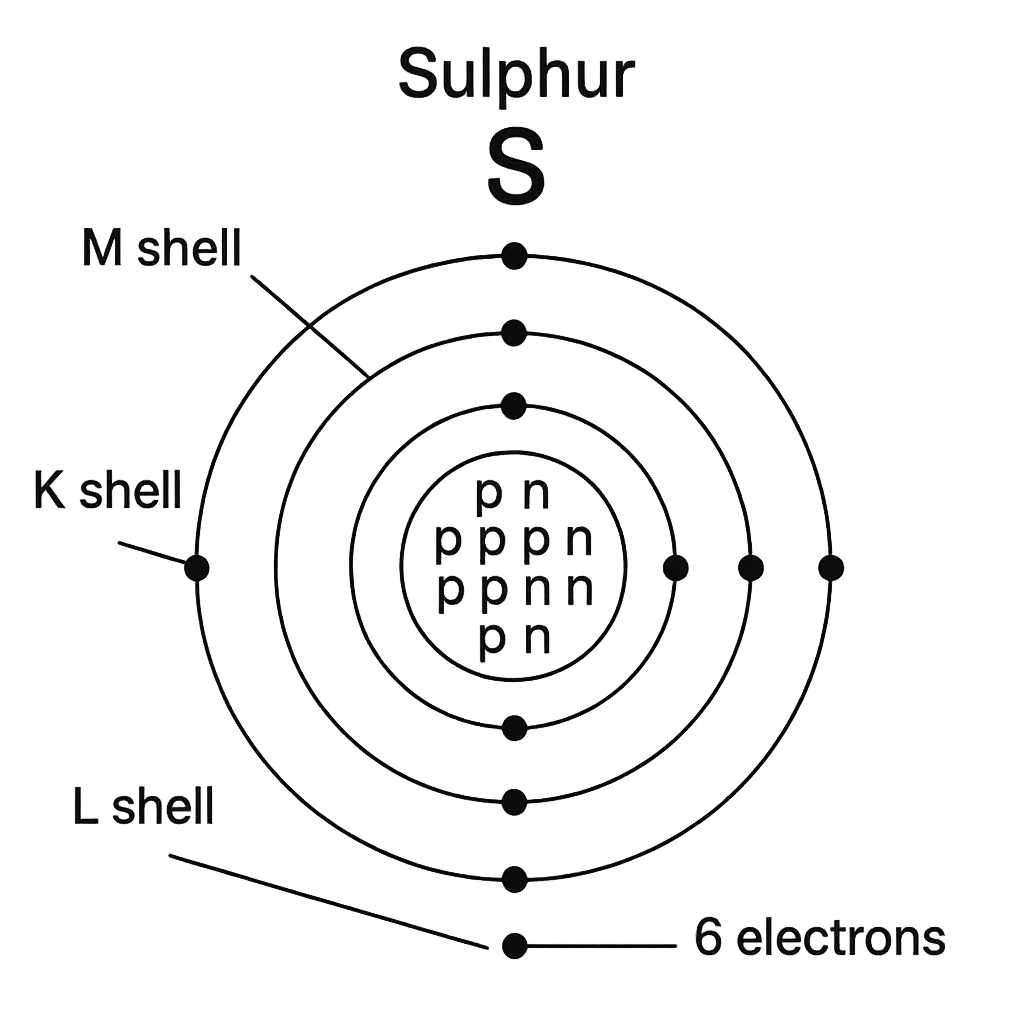
Question 2 View Details
The diagram shows a schematic representation of a sulphur (S) atom. The nucleus contains 16 protons and 16 neutrons. The 16 electrons are arranged in three shells: 2 electrons in the first shell, 8 in the second shell and 6 in the third shell.
Question Parts
(a)
Write the full ground‑state electron configuration of sulphur and indicate how many electrons are in its valence shell.
(b)
Using the diagram, explain why sulphur is more likely to gain two electrons than to lose six electrons when forming an ion. Include reference to effective nuclear charge and energy considerations.
(c)
Write the formula of the ionic compound formed when sulphur reacts with magnesium. Justify the formula using the charges on the ions.
(d)
Sulphur is in period 3, group 16 of the periodic table, whereas oxygen is in period 2, group 16. Compare their atomic radii and first ionisation energies, and explain the differences using periodic trends.
Detailed Essay Solution & Marking Scheme Available

Get the step-by-step mathematical proofs, key points required by examiners, and a comprehensive breakdown from our AI Tutor.
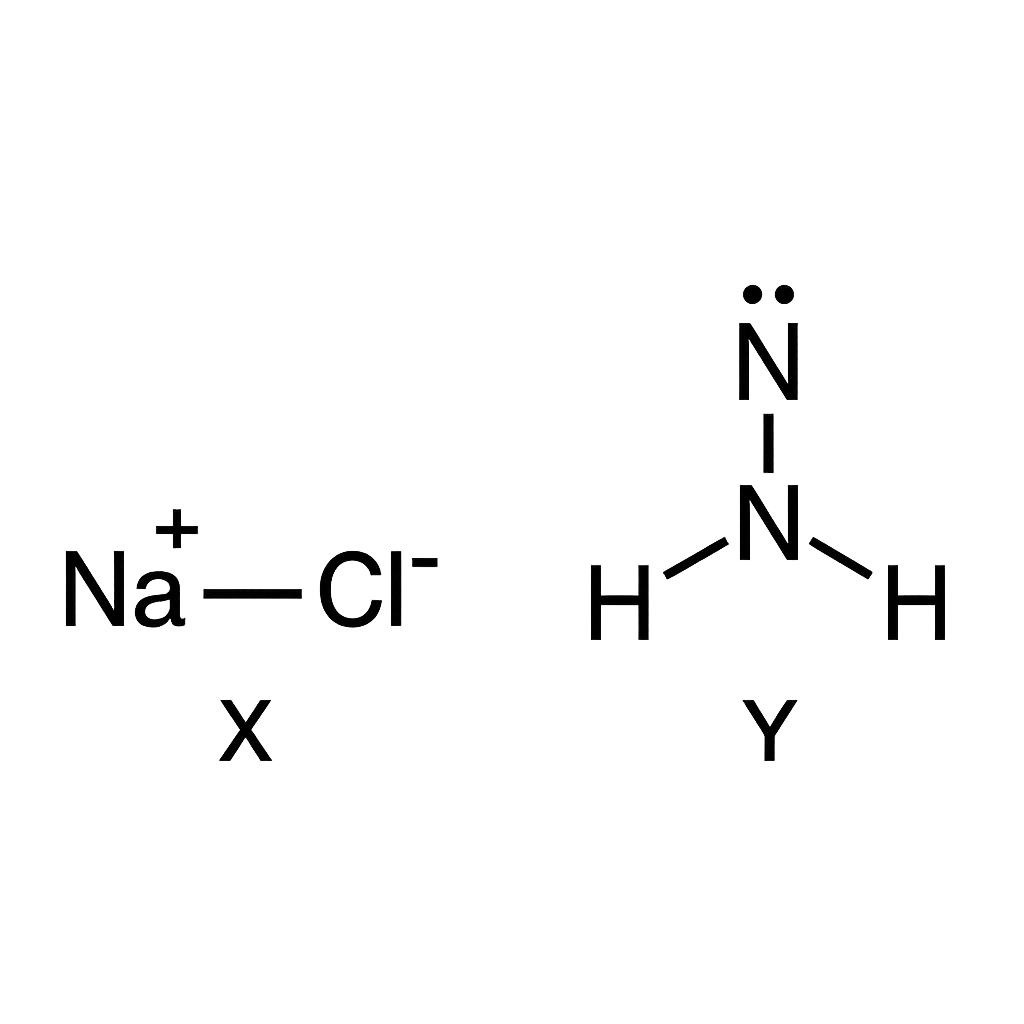
Question 3 View Details
The diagram shows the Lewis structures of two compounds, labelled X and Y.
Question Parts
(a)
Identify the type of bonding present in each compound.
(b)
For compound Y, calculate the formal charge on each atom and state whether the octet rule is satisfied for all atoms.
(c)
Explain how the lattice energy of compound X influences its melting point compared with compound Y.
(d)
For compound Y:
() State the molecular shape using VSEPR theory.
() Give the approximate bond angle between the N–H bonds.
Detailed Essay Solution & Marking Scheme Available

Get the step-by-step mathematical proofs, key points required by examiners, and a comprehensive breakdown from our AI Tutor.

Question 4 View Details
The labelled diagram shows the structural formula of an organic compound X. The molecule contains only carbon (C), hydrogen (H) and oxygen (O). A 2.00 g sample of X was completely combusted in excess oxygen. The combustion products were collected and weighed, giving 4.55 g of carbon dioxide (CO₂) and 1.86 g of water (H₂O).
Question Parts
(a)
From the diagram, write the molecular formula of X.
Detailed Essay Solution & Marking Scheme Available

Get the step-by-step mathematical proofs, key points required by examiners, and a comprehensive breakdown from our AI Tutor.

Question 5 View Details
Aluminium metal reacts with aqueous copper(II) sulphate according to the equation: 2Al(s) + 3CuSO4(aq) → Al2(SO4)3(aq) + 3Cu(s) A student carries out the reaction using 5.0 g of aluminium and 12.0 g of anhydrous copper(II) sulphate. After the reaction the copper obtained is weighed and found to be 4.2 g. Answer the following questions.
Question Parts
(a)
State which reactant is the limiting reagent and show the calculation that leads to your conclusion.
(b)
Calculate the theoretical mass of copper that could be produced from the quantities of reactants used.
(c)
Given that the actual mass of copper obtained is 4.2 g, calculate the percent yield of the reaction.
(d)
Write the net ionic equation for the reaction and explain the changes in oxidation state for the elements that are oxidised and reduced.
Detailed Essay Solution & Marking Scheme Available

Get the step-by-step mathematical proofs, key points required by examiners, and a comprehensive breakdown from our AI Tutor.

Question 6 View Details
A sample of 100 g of ice at –10 °C is placed in a calorimeter and heated until the resulting steam reaches 120 °C. The following data are given: • Specific heat capacity of ice = 2.1 J g⁻¹ K⁻¹ • Latent heat of fusion of water = 334 J g⁻¹ • Specific heat capacity of liquid water = 4.18 J g⁻¹ K⁻¹ • Latent heat of vaporisation of water = 2260 J g⁻¹ • Specific heat capacity of steam = 2.0 J g⁻¹ K⁻¹ Answer the following questions.
Question Parts
(a)
Calculate the amount of heat required to raise the temperature of the ice from –10 °C to 0 °C.
(b)
Determine the heat required to melt the ice at 0 °C to liquid water.
Detailed Essay Solution & Marking Scheme Available

Get the step-by-step mathematical proofs, key points required by examiners, and a comprehensive breakdown from our AI Tutor.

Question 7 View Details
A 0.500 g sample of a monoprotic weak acid HA (molar mass 60 g mol⁻¹) is dissolved in 250 mL of water at 25 °C. The resulting solution has a measured pH of 3.80. (a) Calculate the acid dissociation constant (Kₐ) of HA. (b) 20.0 mL of 0.100 M NaOH is added to the solution. Calculate the pH of the resulting mixture, showing all steps.
Question Parts
(a)
Calculate the acid dissociation constant (Kₐ) of HA.
(b)
20.0 mL of 0.100 M NaOH is added to the solution. Calculate the pH of the resulting mixture, showing all steps.
Detailed Essay Solution & Marking Scheme Available

Get the step-by-step mathematical proofs, key points required by examiners, and a comprehensive breakdown from our AI Tutor.

Question 8 View Details
The solubility product of silver chloride at 25 °C is Ksp(AgCl) = 1.8 × 10⁻¹⁰. A solution is prepared by dissolving 0.50 g of NaCl in 250 mL of water at 25 °C. Excess solid AgNO₃ is then added until the solution becomes saturated with respect to AgCl. (a) Calculate the mass of AgCl that precipitates. (b) The temperature is raised to 35 °C, where Ksp(AgCl) = 2.5 × 10⁻¹⁰. i. Determine the new solubility of AgCl (in mol L⁻¹) at 35 °C. ii. If the saturated solution from part (a) is heated to 35 °C, calculate the mass of AgCl that will dissolve back into the solution. (c) Explain qualitatively how the addition of 0.10 M NaNO₃ to the saturated solution at 25 °C would affect the amount of AgCl that remains dissolved, citing the relevant principle.
Question Parts
(a)
Calculate the mass of AgCl that precipitates.
(b)
The temperature is raised to 35 °C, where Ksp(AgCl) = 2.5 × 10⁻¹⁰. i. Determine the new solubility of AgCl (in mol L⁻¹) at 35 °C. ii. If the saturated solution from part (a) is heated to 35 °C, calculate the mass of AgCl that will dissolve back into the solution.
(c)
Explain qualitatively how the addition of 0.10 M NaNO₃ to the saturated solution at 25 °C would affect the amount of AgCl that remains dissolved, citing the relevant principle.
Detailed Essay Solution & Marking Scheme Available

Get the step-by-step mathematical proofs, key points required by examiners, and a comprehensive breakdown from our AI Tutor.

Question 9 View Details
A sample of an aqueous solution contains potassium permanganate (KMnO₄) and oxalic acid (H₂C₂O₄). The solution is acidified with dilute sulphuric acid and heated, causing the permanganate ion to be reduced to Mn²⁺ while oxalic acid is oxidised to carbon dioxide.
Question Parts
(a)
Write the balanced overall redox equation for the reaction in acidic medium.
(b)
Using the half‑reaction method, show the steps required to balance the equation, including the identification of oxidation numbers for Mn and C in the reactants and products.
(c)
If 0.10 mol of KMnO₄ reacts completely with excess oxalic acid, calculate the volume of CO₂ gas produced at STP (22.4 L mol⁻¹).
(d)
The reaction mixture is later titrated with a standard solution of sodium thiosulphate (Na₂S₂O₃) to determine the amount of unreacted permanganate. Explain how the titration would be carried out, including the chemical equation for the titration reaction and the indicator used.
Detailed Essay Solution & Marking Scheme Available

Get the step-by-step mathematical proofs, key points required by examiners, and a comprehensive breakdown from our AI Tutor.

Question 10 View Details
A galvanic cell is constructed using a copper electrode immersed in a CuSO₄ solution and a silver electrode immersed in an AgNO₃ solution. The two half‑cells are connected by a salt bridge containing KNO₃.
Question Parts
(a)
Write the cell notation for the galvanic cell.
(b)
Identify the anode and cathode and write the overall cell reaction.
Detailed Essay Solution & Marking Scheme Available

Get the step-by-step mathematical proofs, key points required by examiners, and a comprehensive breakdown from our AI Tutor.

Master the Exam!

You've seen a preview, but there are thousands more questions plus AI tutor to break down complex solutions.

Unlock Full Access Available for Android & Windows
Help others prepare! Share this practice hub:
Chat with Support