igcse model questions vol1 2018 chemistry | Objective

Prepare for your exams with igcse model questions vol1 questions? Reviewing past/model questions is one of the most effective ways to guarantee a high score. This practice hub features authentic 2018 chemistry (Objective) questions designed to simulate the real exam environment.

Practice these randomly selected questions to test your readiness.

Question 1 View Details
A river flows at \(200\,000\ \text{L min}^{-1}\) with a nitrate concentration of \(2\ \text{mg L}^{-1}\). An industrial plant discharges effluent at \(20\,000\ \text{L min}^{-1}\) containing nitrate at \(50\ \text{mg L}^{-1}\). The combined water enters a denitrification tank where \(80\%\) of the nitrate is removed. After the tank, \(100\,000\ \text{L min}^{-1}\) of clean water is added. Calculate the nitrate concentration (in \(\text{mg L}^{-1}\)) in the water downstream of the dilution point.
Correct A. 0.875 mg L⁻¹
B. 0.65 mg L⁻¹
C. 0.78 mg L⁻¹
D. 1.10 mg L⁻¹

Correct Answer: A

Want to see the full step-by-step solution? Unlock AI Explanation & Analytics
Question 2 View Details
A copper electroplating cell operates at a constant current of \(2.0\ \text{A}\) for \(3\) hours. Only \(85\%\) of the current is used for the reduction of copper ions, the remainder producing hydrogen gas. Using Faraday's law, calculate the mass of copper deposited on the cathode. (Molar mass of Cu = \(63.55\ \text{g mol}^{-1}\), \(n = 2\) electrons per Cu atom, Faraday constant \(F = 96\,485\ \text{C mol}^{-1}\)).
A. 7.1 g
B. 4.8 g
Correct C. 6.05 g
D. 5.2 g

Correct Answer: C

Want to see the full step-by-step solution? Unlock AI Explanation & Analytics
Question 3 View Details
Given the standard reduction potentials: \(\text{Fe}^{3+}+e^- \rightarrow \text{Fe}^{2+}\) \(E^{\circ}=+0.77\ \text{V}\) and \(\text{Cu}^{2+}+2e^- \rightarrow \text{Cu}\) \(E^{\circ}=+0.34\ \text{V}\). Construct a galvanic cell in which iron(III) ions are reduced and copper metal is oxidised. (i) Write the overall balanced redox equation, (ii) calculate the standard cell potential \(E^{\circ}_{\text{cell}}\), and (iii) determine the equilibrium constant \(K\) at \(25^{\circ}\text{C}\). (Use \(R=8.314\ \text{J mol}^{-1}\text{K}^{-1}\), \(T=298\ \text{K}\), \(F=96\,485\ \text{C mol}^{-1}\)).
A. Overall equation: 2Fe^{3+}+Cu → 2Fe^{2+}+Cu^{2+}; E°cell = 0.43 V; K ≈ 3×10^{12}
Correct B. Overall equation: 2Fe^{3+}+Cu → 2Fe^{2+}+Cu^{2+}; E°cell = 0.43 V; K ≈ 3×10^{14}
C. Overall equation: 2Fe^{3+}+Cu → 2Fe^{2+}+Cu^{2+}; E°cell = 0.11 V; K ≈ 3×10^{14}
D. Overall equation: Fe^{3+}+Cu → Fe^{2+}+Cu^{2+}; E°cell = 0.43 V; K ≈ 3×10^{14}

Correct Answer: B

Want to see the full step-by-step solution? Unlock AI Explanation & Analytics
Question 4 View Details
An element is located in period 3 and group 16 of the periodic table. At standard temperature and pressure it exists as a colourless diatomic gas, and its oxide is acidic. Identify the element.
A. Oxygen (O)
B. Selenium (Se)
C. Phosphorus (P)
Correct D. Sulfur (S)

Correct Answer: D

Want to see the full step-by-step solution? Unlock AI Explanation & Analytics
Question 5 View Details
Calcium fluoride has a solubility product \(K_{sp}=1.5\times10^{-10}\). A solution initially contains \(0.010\ \text{M}\) \(\text{Ca}^{2+}\). Sodium fluoride is added until the total fluoride concentration reaches \(0.001\ \text{M}\). (i) Calculate the minimum fluoride concentration required to start precipitation of \(\text{CaF}_2\). (ii) After addition, determine the equilibrium concentration of \(\text{Ca}^{2+}\) in the solution.
Correct A. i) 1.2×10⁻⁴ M; ii) 1.5×10⁻⁴ M
B. i) 2.0×10⁻⁴ M; ii) 2.5×10⁻⁴ M
C. i) 1.2×10⁻⁴ M; ii) 2.0×10⁻⁴ M
D. i) 1.2×10⁻⁵ M; ii) 1.5×10⁻⁵ M

Correct Answer: A

Want to see the full step-by-step solution? Unlock AI Explanation & Analytics
Question 6 View Details
An isotope of the element with atomic number (27) has a mass number of (59). How many neutrons are present in one atom of this isotope?
A. 28
B. 34
Correct C. 32
D. 30

Correct Answer: C

Want to see the full step-by-step solution? Unlock AI Explanation & Analytics
Question 7 View Details
A 0.550 g sample of an unknown compound containing carbon, hydrogen and chlorine is combusted completely. The combustion produces 1.20 g of (\mathrm{CO_{2}}) and 0.540 g of (\mathrm{H_{2}O}\). The molar mass of the compound is (120\,\text{g mol}^{-1}\). Determine the molecular formula of the compound.
Correct A. C6H13Cl
B. C6H12Cl
C. C7H13Cl
D. C5H11Cl

Correct Answer: A

Want to see the full step-by-step solution? Unlock AI Explanation & Analytics
Question 8 View Details
A sealed container holds (2.00\,\text{g}\) of nitrogen gas at (298\,\text{K}\) and (1.00\,\text{atm}\). The gas is cooled to (273\,\text{K}\) and the pressure measured after cooling is (0.70\,\text{atm}\). Assuming ideal‑gas behaviour for the remaining gas, calculate the mass of nitrogen that has liquefied during the cooling.
A. 0.72 g
Correct B. 0.48 g
C. 0.96 g
D. 0.24 g

Correct Answer: B

Want to see the full step-by-step solution? Unlock AI Explanation & Analytics
Question 9 View Details
When nitrogen monoxide reacts with oxygen according to \(2\,\text{NO} + \text{O}_{2} \rightarrow 2\,\text{NO}_{2}\), the enthalpy change is \(-114\,\text{kJ}\) per mole of NO reacted. Given average bond enthalpies: \(\text{N-O (in NO)} = 607\,\text{kJ mol}^{-1}\), \(\text{O=O} = 498\,\text{kJ mol}^{-1}\), and the unknown average N-O bond enthalpy in \(\text{NO}_{2}\) is \(x\,\text{kJ mol}^{-1}\). Determine the value of \(x\).
A. 420 kJ mol^{-1}
Correct B. 485 kJ mol^{-1}
C. 600 kJ mol^{-1}
D. 530 kJ mol^{-1}

Correct Answer: B

Want to see the full step-by-step solution? Unlock AI Explanation & Analytics
Question 10 View Details
A galvanic cell consists of a copper electrode in 0.10 M CuSO₄ solution and a silver electrode in a silver nitrate solution of unknown concentration. Standard reduction potentials are \(E^{\circ}(\text{Cu}^{2+}/\text{Cu}) = +0.34\,\text{V}\) and \(E^{\circ}(\text{Ag}^{+}/\text{Ag}) = +0.80\,\text{V}\). The measured cell potential at 25 °C is \(+0.44\,\text{V}\) with the copper electrode acting as the anode. Calculate the concentration of \(\text{Ag}^{+}\) in the silver nitrate solution.
A. 0.30 M
B. 0.05 M
C. 0.20 M
Correct D. 0.15 M

Correct Answer: D

Want to see the full step-by-step solution? Unlock AI Explanation & Analytics
Question 11 View Details
An atom of the element chlorine has an atomic number of 17 and a mass number of 35. What is the number of neutrons in this atom?
A. 19
B. 16
C. 17
Correct D. 18

Correct Answer: D

Want to see the full step-by-step solution? Unlock AI Explanation & Analytics
Question 12 View Details
A 25.0 cm³ sample of an unknown monoprotic acid is titrated with 0.100 M NaOH solution. The equivalence point is reached after the addition of 30.0 cm³ of NaOH. When exactly 15.0 cm³ of NaOH has been added, the measured pH of the solution is 4.75. Determine the acid dissociation constant \(K_{a}\) of the unknown acid.
A. 2.5×10⁻⁵
B. 9.0×10⁻⁶
Correct C. 1.8×10⁻⁵
D. 1.8×10⁻⁴

Correct Answer: C

Want to see the full step-by-step solution? Unlock AI Explanation & Analytics
Question 13 View Details
A 2.00 g sample of an unknown hydrocarbon is completely combusted in excess oxygen. The combustion produces 5.53 g of carbon dioxide and 2.24 g of water. (a) Determine the empirical formula of the hydrocarbon. (b) If the molar mass of the hydrocarbon is known to be 58 g·mol\(^{-1}\), deduce its molecular formula.
A. Empirical formula: CH₃; Molecular formula: C₃H₉
Correct B. Empirical formula: CH₂; Molecular formula: C₄H₈
C. Empirical formula: C₃H₆; Molecular formula: C₉H₁₈
D. Empirical formula: C₂H₃; Molecular formula: C₆H₉

Correct Answer: B

Want to see the full step-by-step solution? Unlock AI Explanation & Analytics
Question 14 View Details
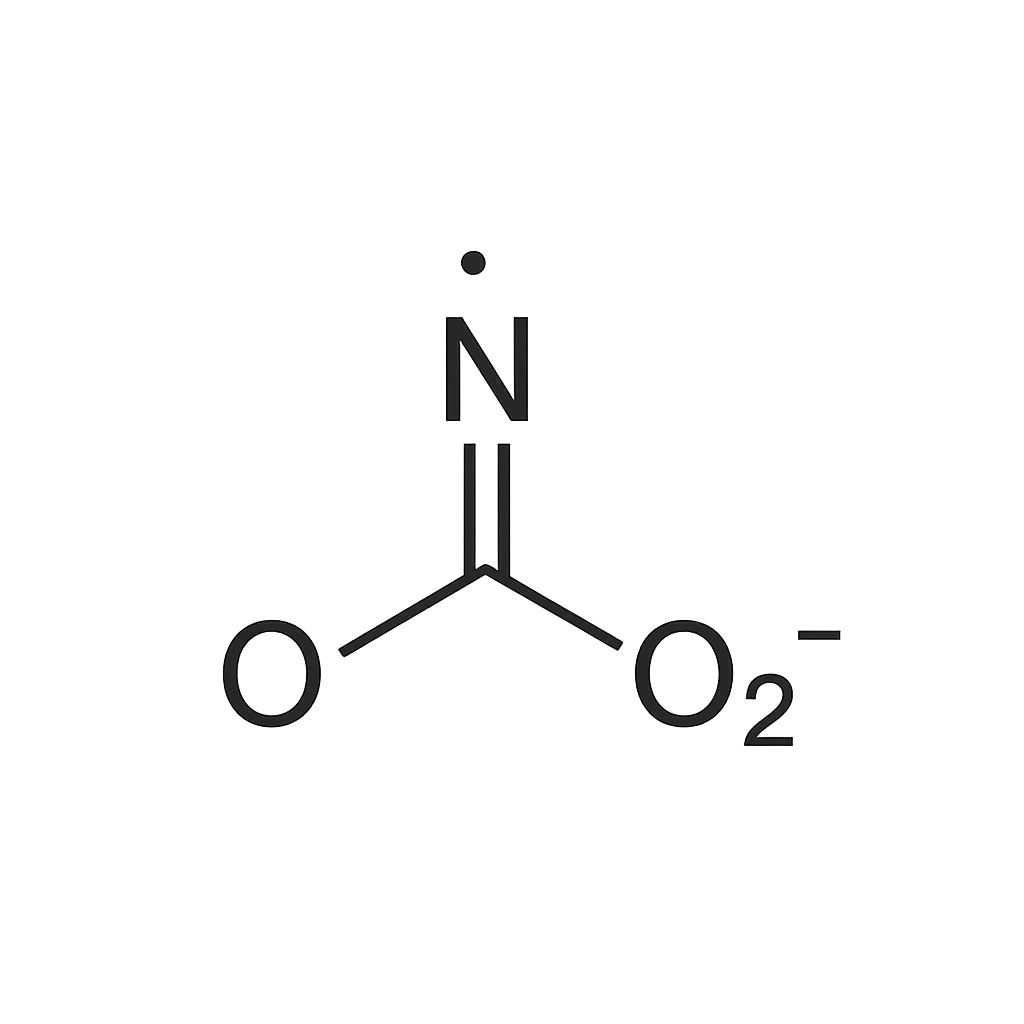
The diagram shows the Lewis structure of the nitrite ion \(\mathrm{NO_2^-}\). Using the diagram, calculate (a) the bond order of each N-O bond, and (b) the formal charge on each atom.
A. Bond order = 1; Formal charges - N: +1, double‑bond O: -1, single‑bond O: 0
Correct B. Bond order = 1.5; Formal charges - N: 0, double‑bond O: 0, single‑bond O: -1
C. Bond order = 2; Formal charges - N: 0, double‑bond O: -1, single‑bond O: -1
D. Bond order = 1.5; Formal charges - N: +1, double‑bond O: 0, single‑bond O: -2

Correct Answer: B

Want to see the full step-by-step solution? Unlock AI Explanation & Analytics
Question 15 View Details
Phosphorus trichloride reacts with water according to the equation \(\mathrm{PCl_3 + 3 H_2O \rightarrow H_3PO_3 + 3 HCl}\). (a) If 5.00 g of solid \(\mathrm{PCl_3}\) is completely reacted with excess water, calculate the volume of \(\mathrm{HCl}\) gas produced at standard temperature and pressure (STP, 0 °C, 1 atm). (b) The gas is collected over water at 25 °C, where the vapour pressure of water is 23.8 mm Hg. If the total pressure in the collection container is 760 mm Hg, what volume of dry \(\mathrm{HCl}\) gas is collected?
Correct A. a) 2.45 L at STP; b) 2.75 L of dry HCl at 25 °C and 760 mm Hg
B. a) 2.20 L at STP; b) 2.50 L of dry HCl at 25 °C and 760 mm Hg
C. a) 2.45 L at STP; b) 2.30 L of dry HCl at 25 °C and 760 mm Hg
D. a) 2.60 L at STP; b) 2.85 L of dry HCl at 25 °C and 760 mm Hg

Correct Answer: A

Want to see the full step-by-step solution? Unlock AI Explanation & Analytics
Question 16 View Details
A metal X is extracted from its oxide \(\mathrm{X_2O_3}\) by reduction with carbon according to the equation \(\mathrm{X_2O_3 + 3C \rightarrow 2X + 3CO}\). The atomic mass of X is 55.8 g mol\(^{-1}\). A sample of 150 g of \(\mathrm{X_2O_3}\) is reduced, and the process gives an 80 % yield based on the theoretical amount of metal. (a) Calculate the mass of metal X obtained. (b) The reactivity series (most reactive to least) is: K > Ca > Na > Mg > Al > Zn > Fe > Ni > Sn > Pb > H > Cu > Ag > Au. Based on this series, can metal X be extracted by reduction with carbon, or does it require electrolysis? Justify your answer.
A. 96.0 g
B. 108.0 g
Correct C. 84.0 g
D. 72.0 g

Correct Answer: C

Want to see the full step-by-step solution? Unlock AI Explanation & Analytics
Question 17 View Details
A buffer solution is prepared by dissolving 0.200 mol of acetic acid \(\mathrm{CH_3COOH}\) and 0.150 mol of sodium acetate \(\mathrm{CH_3COONa}\) in enough water to make 1.00 L of solution. The acid dissociation constant of acetic acid is \(K_a = 1.8 \times 10^{-5}\). (a) Calculate the initial pH of the buffer. (b) How many millilitres of 0.100 M HCl must be added to the buffer to lower its pH to exactly 4.00? Assume the volume change on addition is negligible.
A. 720 mL
B. 850 mL
Correct C. 966 mL
D. 1020 mL

Correct Answer: C

Want to see the full step-by-step solution? Unlock AI Explanation & Analytics
Question 18 View Details
The standard enthalpy of formation of solid sodium chloride is \(\Delta_f H^{\circ}(\mathrm{NaCl(s)}) = -411 \text{ kJ mol}^{-1}\). Using a Born-Haber cycle, calculate the lattice energy of NaCl (in kJ mol\(^{-1}\)). The following data are given: sublimation energy of Na(s): \(\Delta H_{\text{sub}} = +108 \text{ kJ mol}^{-1}\); ionisation energy of Na(g): \(IE_1 = +496 \text{ kJ mol}^{-1}\); bond dissociation energy of Cl₂(g): \(D_{\text{Cl-Cl}} = +242 \text{ kJ mol}^{-1}\) (per mole of Cl₂); electron affinity of Cl(g): \(EA = -349 \text{ kJ mol}^{-1}\). Assume that one mole of NaCl is formed from one mole of Na atoms and one mole of Cl atoms.
A. 720 kJ mol^{-1}
B. 900 kJ mol^{-1}
Correct C. 787 kJ mol^{-1}
D. 845 kJ mol^{-1}

Correct Answer: C

Want to see the full step-by-step solution? Unlock AI Explanation & Analytics
Question 19 View Details
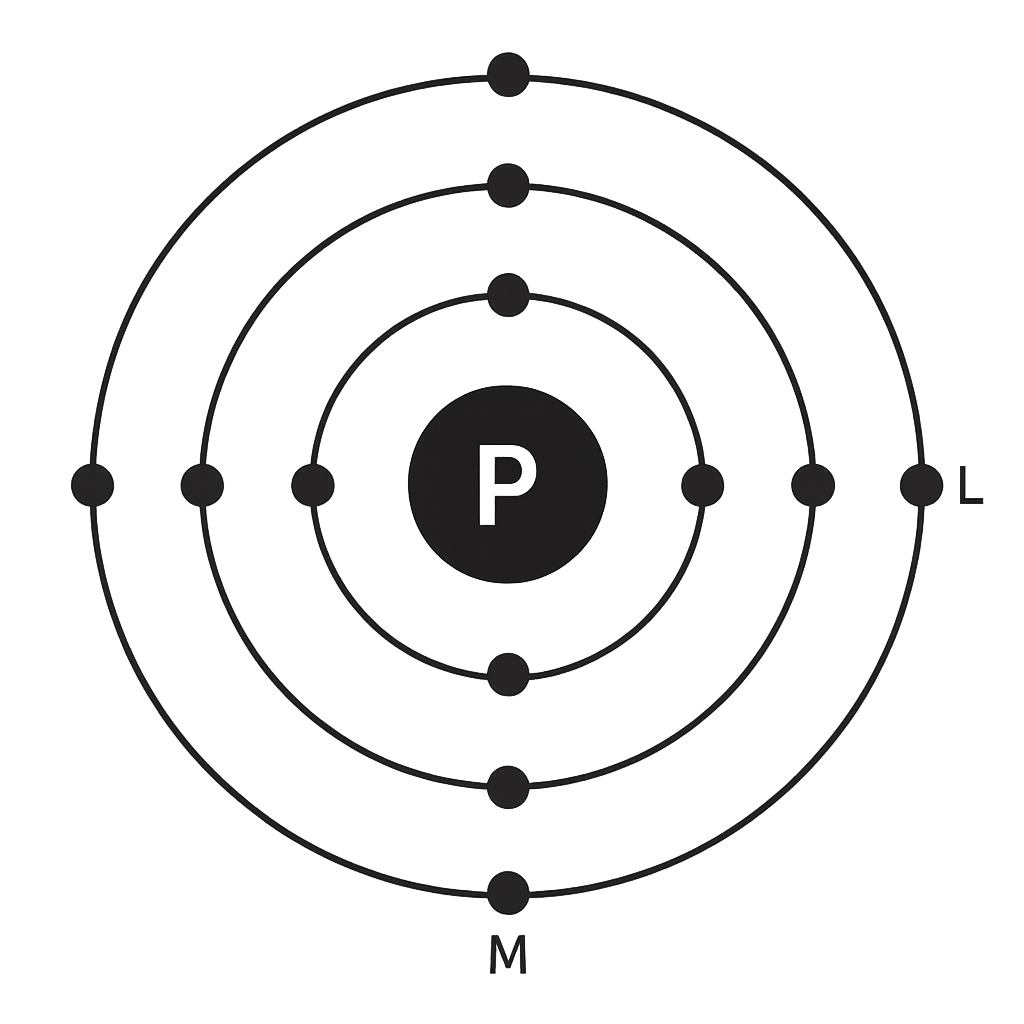
The diagram shows the Bohr model of an atom of phosphorus (atomic number 15). The K shell contains 2 electrons, the L shell contains 8 electrons and the M shell contains 5 electrons. (a) Write the electron configuration of phosphorus using the notation \(1s^2 2s^2 2p^6 3s^2 3p^3\). (b) State the number of valence electrons.
A. Electron configuration: 1s^2 2s^2 2p^6 3s^2 3p^4; Valence electrons: 6
B. Electron configuration: 1s^2 2s^2 2p^6 3s^2 3p^2; Valence electrons: 4
Correct C. Electron configuration: 1s^2 2s^2 2p^6 3s^2 3p^3; Valence electrons: 5
D. Electron configuration: 1s^2 2s^2 2p^6 3s^1 3p^4; Valence electrons: 5

Correct Answer: C

Want to see the full step-by-step solution? Unlock AI Explanation & Analytics
Question 20 View Details
Nylon‑6,6 is a condensation polymer formed from hexamethylenediamine \(\mathrm{C_6H_{16}N_2}\) (molar mass 116.21 g mol\(^{-1}\)) and adipic acid \(\mathrm{C_6H_{10}O_4}\) (molar mass 146.14 g mol\(^{-1}\)). Each repeat unit of nylon‑6,6 is produced by the reaction of one molecule of each monomer with the loss of one molecule of water \(\mathrm{H_2O}\) (18.02 g mol\(^{-1}\)). (a) If 150 g of hexamethylenediamine and 150 g of adipic acid are reacted, and the overall yield of polymer is 85 % of the theoretical amount, calculate the mass of nylon‑6,6 obtained. (b) The number‑average molecular weight (\(M_n\)) of the polymer sample is measured as 28 000 g mol\(^{-1}\). Determine the number‑average degree of polymerisation (DP) of the sample.
A. Mass obtained: 251 g; DP: 115
Correct B. Mass obtained: 213 g; DP: 115
C. Mass obtained: 190 g; DP: 115
D. Mass obtained: 213 g; DP: 114

Correct Answer: B

Want to see the full step-by-step solution? Unlock AI Explanation & Analytics
Question 21 View Details
A 250 mL solution contains 0.010 M NaCl. At 25 °C the solubility product of AgCl is \(1.8\times10^{-10}\). When the solution is heated to 35 °C the solubility product becomes \(2.5\times10^{-10}\). Assuming no AgCl precipitates during heating, calculate the additional mass of AgCl (in grams) that can dissolve after the temperature rise.
A. 1.8e-7
B. 3.2e-7
Correct C. 2.5e-7
D. 5.0e-7

Correct Answer: C

Want to see the full step-by-step solution? Unlock AI Explanation & Analytics
Question 22 View Details
In a sealed 1.0 L reactor at 60 °C, 0.500 mol of ethanol reacts with 0.500 mol of acetic acid to form ethyl acetate and water. The equilibrium constant for the esterification reaction at this temperature is \(K_c = 4.0\). (i) Calculate the maximum mass of ethyl acetate (C₄H₈O₂) that can be present at equilibrium. (ii) If 25.0 g of ethyl acetate are actually isolated, determine the percentage yield.
A. 27.0 g; 92 %
B. 24.5 g; 65 %
C. 31.2 g; 78 %
Correct D. 29.4 g; 85 %

Correct Answer: D

Want to see the full step-by-step solution? Unlock AI Explanation & Analytics
Question 23 View Details
A 1.00 g sample of an unknown compound containing C, H, N and O is combusted. The combustion yields 2.20 g of CO₂ and 0.90 g of H₂O. When the same sample is heated with CuO, 0.070 g of N₂ is produced. Determine the empirical formula of the compound.
A. C9H18NO3
B. C10H22NO3
C. C10H20N2O3
Correct D. C10H20NO3

Correct Answer: D

Want to see the full step-by-step solution? Unlock AI Explanation & Analytics
Question 24 View Details
A wastewater stream contains phenol at a concentration of 150 mg L⁻¹. First, a biological treatment removes 60 % of the phenol. The remaining phenol is then oxidised completely by potassium permanganate according to \(3\,\text{C}_6\text{H}_5\text{OH} + 2\,\text{KMnO}_4 \rightarrow 3\,\text{C}_6\text{H}_4\text{O}_2 + 2\,\text{MnO}_2 + 2\,\text{KOH} + 3\,\text{H}_2\text{O}\). (i) Calculate the mass of KMnO₄ (in mg L⁻¹) required for the oxidation of the phenol that remains after the biological stage. (ii) Determine the total theoretical oxygen demand (as mg L⁻¹ of O₂) for the complete oxidation of the phenol (both stages). Use molar masses: phenol 94.11 g mol⁻¹, KMnO₄ 158.04 g mol⁻¹, O₂ 32.00 g mol⁻¹.
A. 55 mg/L; 300 mg/L
B. 60 mg/L; 340 mg/L
Correct C. 67 mg/L; 357 mg/L
D. 70 mg/L; 380 mg/L

Correct Answer: C

Want to see the full step-by-step solution? Unlock AI Explanation & Analytics
Question 25 View Details
Five grams of magnesium metal are placed in excess hydrochloric acid. The reaction \( \text{Mg} + 2\,\text{HCl} \rightarrow \text{MgCl}_2 + \text{H}_2 \) produces hydrogen gas, which is collected over water at 25 °C and 750 mmHg. The water vapour pressure at this temperature is 23.8 mmHg and the dry hydrogen volume measured is 0.850 L. Calculate the percentage yield of hydrogen based on the magnesium used.
A. 18.5
B. 12.3
Correct C. 16.2
D. 14.8

Correct Answer: C

Want to see the full step-by-step solution? Unlock AI Explanation & Analytics

Master the Exam!

You've seen a preview, but there are thousands more questions plus AI tutor to break down complex solutions.

Unlock Full Access Available for Android & Windows
Help others prepare! Share this practice hub:
Chat with Support