igcse model questions vol1 2018 biology | Objective

Prepare for your exams with igcse model questions vol1 questions? Reviewing past/model questions is one of the most effective ways to guarantee a high score. This practice hub features authentic 2018 biology (Objective) questions designed to simulate the real exam environment.

Practice these randomly selected questions to test your readiness.

Question 1 View Details
A plant cell is approximated as a sphere of radius \(10\ \text{µm}\). Its nucleus is a sphere of radius \(5\ \text{µm}\). What fraction of the cell's total volume is occupied by the cytoplasm (i.e., cell volume minus nuclear volume)?
A. 1/2
B. 5/8
C. 3/4
Correct D. 7/8

Correct Answer: D

Want to see the full step-by-step solution? Unlock AI Explanation & Analytics
Question 2 View Details
The glomerular filtration rate of a kidney is \(180\ \text{mL min}^{-1}\). The blood plasma contains glucose at a concentration of \(0.9\ \text{g L}^{-1}\). In the proximal tubule, \(85\%\) of the filtered glucose is reabsorbed, and no further glucose is reabsorbed downstream. Calculate the amount of glucose excreted in the urine each minute (in mg).
A. 30.0 mg
B. 12.7 mg
Correct C. 24.3 mg
D. 18.5 mg

Correct Answer: C

Want to see the full step-by-step solution? Unlock AI Explanation & Analytics
Question 3 View Details
A 12‑year‑old boy eats \(250\ \text{g}\) of food per day. The food composition by weight is \(55\%\) carbohydrate, \(30\%\) fat and \(15\%\) protein. Energy yields are \(4\ \text{kcal g}^{-1}\) for carbohydrate and protein, and \(9\ \text{kcal g}^{-1}\) for fat. His basal metabolic rate (BMR) is \(1200\ \text{kcal day}^{-1}\) and he requires an additional \(300\ \text{kcal day}^{-1}\) for activity. What percentage of his total daily energy requirement is supplied by the protein in his diet?
Correct A. 10%
B. 15%
C. 12%
D. 8%

Correct Answer: A

Want to see the full step-by-step solution? Unlock AI Explanation & Analytics
Question 4 View Details
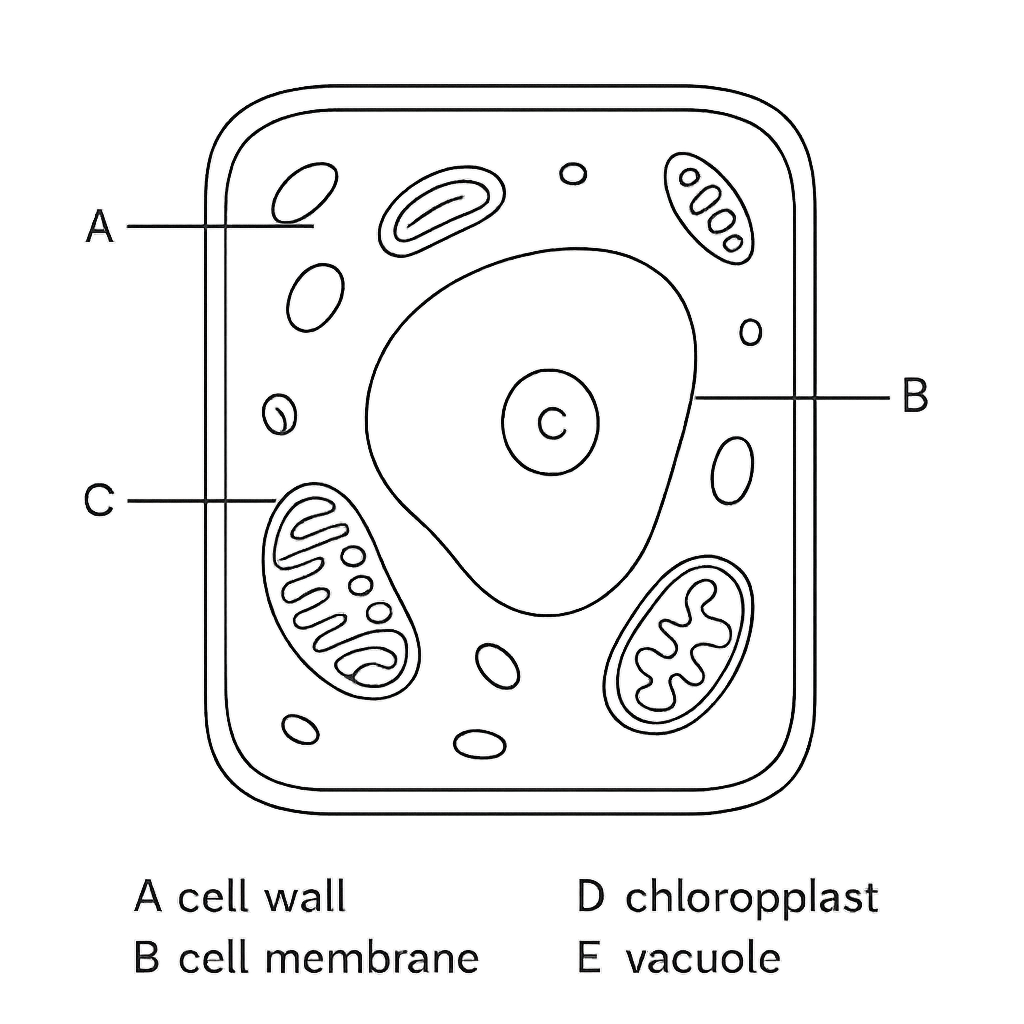
In the labelled diagram of a plant cell, the structure marked with label D is the site of photosynthesis. Identify this structure.
Correct A. chloroplast
B. mitochondrion
C. vacuole
D. nucleus

Correct Answer: A

Want to see the full step-by-step solution? Unlock AI Explanation & Analytics
Question 5 View Details
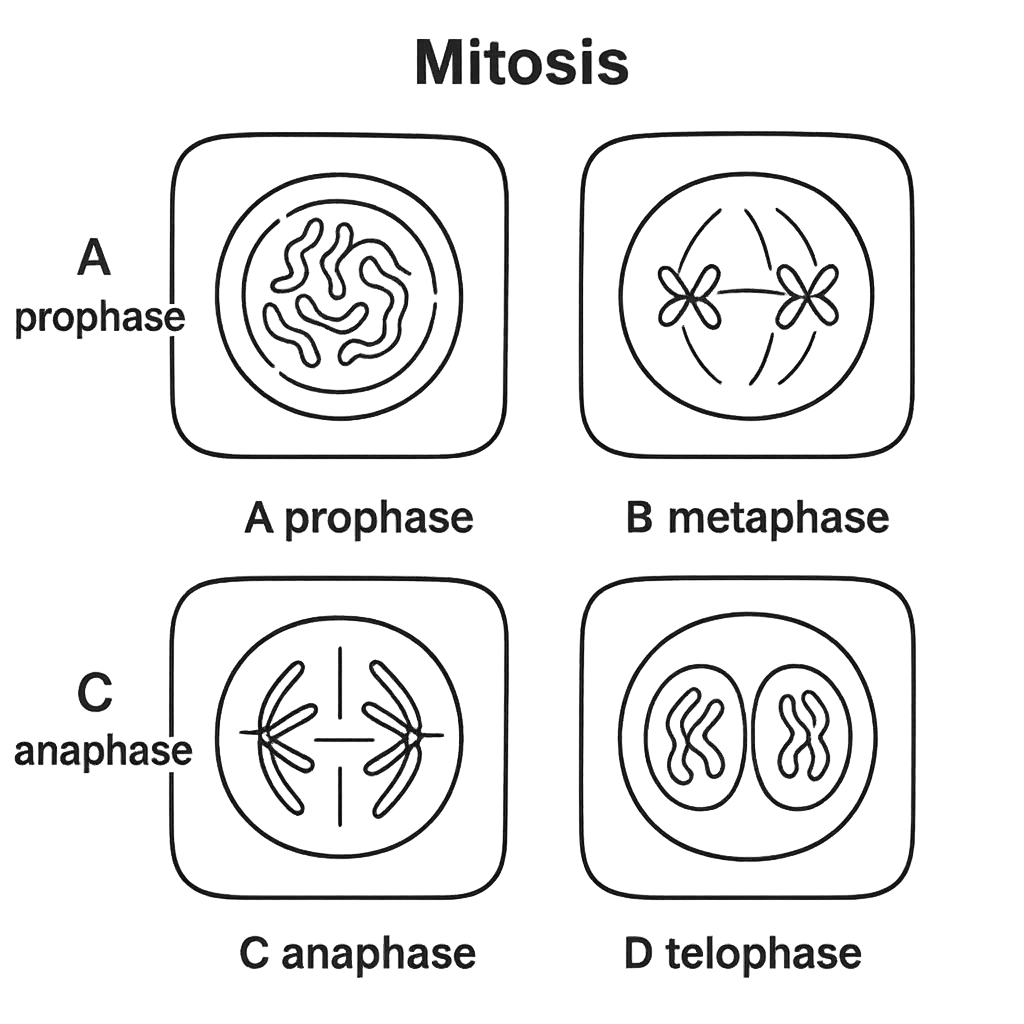
A labelled diagram shows the stages of mitosis in a plant cell: A = prophase, B = metaphase, C = anaphase, D = telophase. During which stage, labelled C, do sister chromatids separate and move to opposite poles? Provide the name of the stage.
A. metaphase
B. prophase
Correct C. anaphase
D. telophase

Correct Answer: C

Want to see the full step-by-step solution? Unlock AI Explanation & Analytics
Question 6 View Details
A leaf cell has a semi‑permeable membrane with permeability coefficient \(P = 1.2 \times 10^{-5}\ \text{m s}^{-1}\) and an area \(A = 2.0 \times 10^{-6}\ \text{m}^2\). Inside the cell the solute concentration is \(0.15\ \text{mol L}^{-1}\) and the pressure potential is \(+0.12\ \text{MPa}\). Outside, the solute concentration is \(0.05\ \text{mol L}^{-1}\) and the pressure potential is \(0\ \text{MPa}\). Using \(R = 0.00831\ \text{MPa L mol}^{-1}\text{K}^{-1}\) and \(T = 298\ \text{K}\), calculate the magnitude of the volume flow rate of water through the membrane (in \(\text{m}^3\ \text{s}^{-1}\)). Indicate the direction of flow.
Correct A. 3.1 × 10⁻⁶ m³ s⁻¹ outward
B. 2.5 × 10⁻⁶ m³ s⁻¹ outward
C. 3.1 × 10⁻⁵ m³ s⁻¹ outward
D. 3.1 × 10⁻⁶ m³ s⁻¹ inward

Correct Answer: A

Want to see the full step-by-step solution? Unlock AI Explanation & Analytics
Question 7 View Details
An endocrine gland secretes hormone X at a constant rate of \(5 \times 10^{-9}\ \text{mol s}^{-1}\) into the bloodstream. The blood volume is \(5\ \text{L}\) and the hormone is removed by the liver with a first‑order rate constant \(k = 0.02\ \text{s}^{-1}\). At steady state, 80 % of the hormone remains free (active). What is the steady‑state concentration of active hormone X in the plasma (in \(\text{mol L}^{-1}\))?
A. 5.0 × 10⁻⁸ mol L⁻¹
Correct B. 4.0 × 10⁻⁸ mol L⁻¹
C. 4.0 × 10⁻⁷ mol L⁻¹
D. 3.2 × 10⁻⁸ mol L⁻¹

Correct Answer: B

Want to see the full step-by-step solution? Unlock AI Explanation & Analytics
Question 8 View Details
A small mammal of mass \(200\ \text{g}\) has a surface area of \(0.03\ \text{m}^2\). Heat is lost to the environment according to \(\dot{Q}_{\text{loss}} = k A (T_{\text{core}} - T_{\text{amb}})\) where the thermal conductance coefficient \(k = 10\ \text{W m}^{-2}\,^{\circ}\text{C}^{-1}\), core temperature \(T_{\text{core}} = 37^{\circ}\text{C}\) and ambient temperature \(T_{\text{amb}} = 5^{\circ}\text{C}\). The animal's basal metabolic heat production is \(0.02\ \text{W g}^{-1}\). When shivering, metabolic heat production increases by 30 %. Can shivering alone generate enough heat to balance the loss? State "yes" or "no" and give the net heat balance (in watts).
A. Yes - net surplus 1.2 W
Correct B. No - net deficit 4.4 W
C. No - net deficit 2.8 W
D. Yes - net surplus 4.4 W

Correct Answer: B

Want to see the full step-by-step solution? Unlock AI Explanation & Analytics
Question 9 View Details
A desert plant leaf has an area of \(0.02\ \text{m}^2\) and a stomatal density of \(150\ \text{stomata mm}^{-2}\). During peak heat only 20 % of the stomata open, each losing water at a rate of \(0.5\ \mu\text{L h}^{-1}\). The plant stores \(0.5\ \text{kg}\) of water and can lose at most 5 % of this store per hour. (a) Calculate the total water loss per hour (in \(\mu\text{L h}^{-1}\) and in kg h⁻¹). (b) What maximum percentage of the total stomata can remain open without exceeding the 5 % loss limit?
A. a) 300 000 µL h⁻¹ (0.30 kg h⁻¹); b) ≈5 % of stomata can stay open
Correct B. a) 300 000 µL h⁻¹ (0.30 kg h⁻¹); b) ≈1.7 % of stomata can stay open
C. a) 450 000 µL h⁻¹ (0.45 kg h⁻¹); b) ≈0.9 % of stomata can stay open
D. a) 150 000 µL h⁻¹ (0.15 kg h⁻¹); b) ≈3.4 % of stomata can stay open

Correct Answer: B

Want to see the full step-by-step solution? Unlock AI Explanation & Analytics
Question 10 View Details
Blood calcium concentration is normally \(2.5\ \text{mM}\). A drop to \(2.2\ \text{mM}\) triggers secretion of parathyroid hormone (PTH). PTH increases renal calcium reabsorption by 40 % (baseline reabsorption \(0.5\ \text{mM h}^{-1}\)) and stimulates bone to release calcium at \(0.15\ \text{mM h}^{-1}\). Assuming PTH secretion continues until the calcium level returns to the normal set‑point, what will the calcium concentration be after 2 h? (Ignore other regulatory mechanisms.)
A. 2.3 mM
B. 3.0 mM
Correct C. 2.5 mM
D. 2.7 mM

Correct Answer: C

Want to see the full step-by-step solution? Unlock AI Explanation & Analytics
Question 11 View Details
In a diploid beetle population the allele R (brown) is dominant over r (green). The initial genotype frequencies are \(RR = 0.25\), \(Rr = 0.50\) and \(rr = 0.25\). Survival after one generation of natural selection is \(90\%\) for \(RR\), \(80\%\) for \(Rr\) and \(60\%\) for \(rr\). Assuming survivors reproduce in proportion to their numbers, calculate the frequency of allele \(R\) in the next generation. Give your answer as a decimal to two significant figures.
A. 0.45
B. 0.50
Correct C. 0.55
D. 0.60

Correct Answer: C

Want to see the full step-by-step solution? Unlock AI Explanation & Analytics
Question 12 View Details
A resting person produces \(250\ \text{mL}\) of \(\text{CO}_2\) per minute. The respiratory quotient (RQ) is \(0.85\). (a) Calculate the rate of \(\text{O}_2\) consumption in \(\text{mL min}^{-1}\). (b) Express this rate in litres per hour. (c) If during exercise the \(\text{CO}_2\) production rises to \(500\ \text{mL min}^{-1}\) while RQ remains \(0.85\), repeat parts (a) and (b). Provide the four numerical results in order.
A. 280 mL/min, 16.8 L/h, 560 mL/min, 33.6 L/h
B. 300 mL/min, 18.0 L/h, 600 mL/min, 36.0 L/h
Correct C. 294 mL/min, 17.6 L/h, 588 mL/min, 35.3 L/h
D. 260 mL/min, 15.6 L/h, 520 mL/min, 31.2 L/h

Correct Answer: C

Want to see the full step-by-step solution? Unlock AI Explanation & Analytics
Question 13 View Details
In a population study of 2000 individuals, 800 are smokers and 1200 are non‑smokers. Among smokers, 120 develop lung disease; among non‑smokers, 30 develop lung disease. (a) Calculate the relative risk (RR) of lung disease for smokers compared with non‑smokers. (b) Calculate the attributable risk percent (AR%). (c) If a health programme reduces the number of smokers by 25 % (the same incidence rates apply), estimate how many fewer new cases of lung disease would occur per year.
A. RR = 5; AR% = 80%; reduction = 22 cases
B. RR = 4; AR% = 75%; reduction = 20 cases
C. RR = 7; AR% = 85%; reduction = 30 cases
Correct D. RR = 6; AR% = 83%; reduction = 25 cases

Correct Answer: D

Want to see the full step-by-step solution? Unlock AI Explanation & Analytics
Question 14 View Details
Which organelle in a plant cell contains the enzyme RuBisCO and is the site of photosynthesis?
Correct A. chloroplast
B. vacuole
C. mitochondrion
D. nucleus

Correct Answer: A

Want to see the full step-by-step solution? Unlock AI Explanation & Analytics
Question 15 View Details
Fossil measurements of a jaw bone show an average length of \(45\ \text{mm}\) in the older species A and \(60\ \text{mm}\) in the younger species B. The stratigraphic record indicates a time interval of 5 million years between the two species. (a) Assuming a constant linear change, calculate the rate of change in mm per million years. (b) An intermediate fossil dated 2.5 million years after species A has a jaw length of \(52\ \text{mm}\). Based on the rate from part (a), what length would be expected at that time, and does the observed length support the linear model? Provide the expected length and a brief conclusion.
A. Rate = 4 mm/Myr; expected length = 55 mm; observed 52 mm suggests deviation from linear model
B. Rate = 3 mm/Myr; expected length = 51 mm; observed 52 mm indicates slight inconsistency with linearity
C. Rate = 2 mm/Myr; expected length = 50 mm; observed 52 mm does not support linearity
Correct D. Rate = 3 mm/Myr; expected length = 52.5 mm; observed 52 mm supports approximate linearity

Correct Answer: D

Want to see the full step-by-step solution? Unlock AI Explanation & Analytics
Question 16 View Details
A bacterial culture starts with \(5.0 \times 10^{6}\) cells. After 2 h the population is \(8.0 \times 10^{7}\) cells. Assuming exponential growth, a bacteriostatic agent is applied that reduces the growth rate constant by 30 %. What will be the population after 6 h of growth in the presence of the agent? Give your answer in scientific notation to two significant figures.
A. 1.2 × 10^9 cells
B. 2.1 × 10^9 cells
C. 1.7 × 10^8 cells
Correct D. 1.7 × 10^9 cells

Correct Answer: D

Want to see the full step-by-step solution? Unlock AI Explanation & Analytics
Question 17 View Details
Each inflorescence of a certain flowering plant bears 5 flowers. Every flower contains 4 ovules. Pollination succeeds for 60 % of the ovules, and each successfully fertilised ovule produces 2 seeds. If a plant produces 120 inflorescences, how many seeds are expected in total?
A. 2400
B. 3120
C. 3600
Correct D. 2880

Correct Answer: D

Want to see the full step-by-step solution? Unlock AI Explanation & Analytics
Question 18 View Details
In a simple reflex arc, the sensory neuron is 0.8 m long and conducts impulses at 80 m s\(^{-1}\). The motor neuron is 0.6 m long and conducts at 60 m s\(^{-1}\). Each of the two synapses introduces a delay of 0.5 ms, and the muscle contracts 15 ms after the motor impulse arrives. Calculate the total time from the initial stimulus to the start of muscle contraction, in milliseconds.
A. 42 ms
Correct B. 36 ms
C. 38 ms
D. 30 ms

Correct Answer: B

Want to see the full step-by-step solution? Unlock AI Explanation & Analytics
Question 19 View Details
Three microorganisms are described as follows:\n- Organism A: prokaryotic, no nucleus, cell wall contains peptidoglycan, reproduces by binary fission.\n- Organism B: eukaryotic, cell wall of cellulose, chloroplasts present, reproduces by spores.\n- Organism C: eukaryotic, cell wall of chitin, no chloroplasts, reproduces by spores.\nUsing the IGCSE classification criteria, assign each organism to its correct kingdom (Monera, Plantae, or Fungi). Provide your answer as a comma‑separated list in the order A, B, C.
A. Fungi, Plantae, Monera
B. Plantae, Monera, Fungi
Correct C. Monera, Plantae, Fungi
D. Monera, Fungi, Plantae

Correct Answer: C

Want to see the full step-by-step solution? Unlock AI Explanation & Analytics
Question 20 View Details
A bacterial suspension has an initial concentration of \(1.0 \times 10^{6}\) CFU ml\(^{-1}\). An antibiotic at concentration \(C\) µg ml\(^{-1}\) reduces the population according to \(N = N_{0} e^{-k t}\) where \(k = 0.05 C\) h\(^{-1}\). If the antibiotic is applied at \(20\) µg ml\(^{-1}\), after how many hours will the concentration fall below \(1.0 \times 10^{2}\) CFU ml\(^{-1}\)? Give your answer to one decimal place.
A. 10.7 h
B. 8.2 h
Correct C. 9.3 h
D. 12.4 h

Correct Answer: C

Want to see the full step-by-step solution? Unlock AI Explanation & Analytics
Question 21 View Details
A desert plant reduces its leaf surface area by 40 % and its stomatal density by 30 % compared with a related mesic plant. The mesic plant loses water at a rate of \(5\) mg cm\(^{-2}\) h\(^{-1}\) under the same conditions. (i) Assuming water loss is directly proportional to leaf area and stomatal density, calculate the water‑loss rate of the desert plant. (ii) The desert plant also has a cuticle that reduces the remaining loss by an additional 15 %. Determine the overall percentage reduction in water loss relative to the mesic plant, rounded to the nearest whole percent.
Correct A. 64
B. 56
C. 48
D. 70

Correct Answer: A

Want to see the full step-by-step solution? Unlock AI Explanation & Analytics
Question 22 View Details
In a plant, flower colour (R = red, r = white) and plant height (T = tall, t = dwarf) are controlled by two linked genes on the same chromosome with a recombination frequency of \(10\%\). A heterozygous plant in coupling phase (genotype \(R T / r t\)) is crossed with a homozygous recessive plant (\(r r t t\)). What percentage of the offspring are expected to have the red‑dwarf phenotype (\(R t\))?
A. 10
B. 15
Correct C. 5
D. 20

Correct Answer: C

Want to see the full step-by-step solution? Unlock AI Explanation & Analytics
Question 23 View Details
A small mammal maintains a core body temperature of \(37^{\circ}\)C. At rest in an environment of \(25^{\circ}\)C it produces metabolic heat at a rate of \(120\) W, which exactly balances heat loss. Heat loss occurs by convection and is proportional to the temperature difference between the core and the environment, i.e. \( \text{Loss}=k\,(T_{\text{core}}-T_{\text{env}}) \). (i) Determine the proportionality constant \(k\). (ii) If the ambient temperature falls to \(10^{\circ}\)C, calculate the new metabolic heat production required to maintain the core temperature, and state the percentage increase in metabolic rate relative to the resting value.
A. 150
B. 75
C. 100
Correct D. 125

Correct Answer: D

Want to see the full step-by-step solution? Unlock AI Explanation & Analytics
Question 24 View Details
During mitosis, at which stage are the sister chromatids pulled apart and move toward opposite poles of the cell?
Correct A. Anaphase
B. Telophase
C. Prophase
D. Metaphase

Correct Answer: A

Want to see the full step-by-step solution? Unlock AI Explanation & Analytics
Question 25 View Details
A newly discovered unicellular organism shows the following characteristics: (i) it possesses a true nucleus, (ii) its cell wall is composed of chitin, (iii) it stores excess carbohydrate as glycogen, (iv) it reproduces both asexually by binary fission and sexually by formation of gametes, and (v) its mitochondria have cristae. Based on these traits, to which kingdom should the organism be assigned? Choose from Plantae, Animalia, Fungi or Protista.
A. Plantae
B. Protista
Correct C. Fungi
D. Animalia

Correct Answer: C

Want to see the full step-by-step solution? Unlock AI Explanation & Analytics

Master the Exam!

You've seen a preview, but there are thousands more questions plus AI tutor to break down complex solutions.

Unlock Full Access Available for Android & Windows
Help others prepare! Share this practice hub:
Chat with Support