igcse model questions vol1 2017 physics | Objective

Prepare for your exams with igcse model questions vol1 questions? Reviewing past/model questions is one of the most effective ways to guarantee a high score. This practice hub features authentic 2017 physics (Objective) questions designed to simulate the real exam environment.

Practice these randomly selected questions to test your readiness.

Question 1 View Details
A car starts from rest and accelerates uniformly. After 5 s its speed is 20 m s\(^{-1}\). It continues with the same acceleration and travels a total distance of 250 m from the start to point A. At point A the driver applies a uniform braking force that brings the car to rest over the next 30 m. What is the magnitude of the deceleration during the braking phase? Give your answer in \(\text{m s}^{-2}\) to three significant figures.
A. 36.7 m s^{-2}
Correct B. 33.3 m s^{-2}
C. 28.9 m s^{-2}
D. 30.0 m s^{-2}

Correct Answer: B

Want to see the full step-by-step solution? Unlock AI Explanation & Analytics
Question 2 View Details
A train horn emits a sound of frequency \(500\ \text{Hz}\). An observer on the platform hears a frequency of \(526\ \text{Hz}\) as the train approaches, and later hears \(476\ \text{Hz}\) as the train recedes. Assuming the speed of sound in air is \(340\ \text{m s}^{-1}\), determine the speed of the train. Express your answer as a fraction of the speed of sound and also in \(\text{m s}^{-1}\) to two significant figures.
Correct A. 0.05 c (≈17 m s^{-1})
B. 0.07 c (≈24 m s^{-1})
C. 0.04 c (≈14 m s^{-1})
D. 0.06 c (≈20 m s^{-1})

Correct Answer: A

Want to see the full step-by-step solution? Unlock AI Explanation & Analytics
Question 3 View Details
A hydrogen atom is initially in the \(n = 5\) energy level. It makes a transition directly to the \(n = 2\) level, emitting a photon. The photon is completely absorbed by a stationary free electron, giving the electron kinetic energy equal to the photon energy. The electron then collides elastically and head‑on with a stationary proton. What is the speed of the proton after the collision? Give your answer in \(\text{m s}^{-1}\) to two significant figures.
A. 9.8×10^2 m s^{-1}
B. 2.0×10^3 m s^{-1}
C. 1.3×10^3 m s^{-1}
Correct D. 1.1×10^3 m s^{-1}

Correct Answer: D

Want to see the full step-by-step solution? Unlock AI Explanation & Analytics
Question 4 View Details
A fixed point charge \(+Q = 5.0\ \mu\text{C}\) is located at the origin of an x‑axis. A particle of charge \(q = -2.0\ \mu\text{C}\) and mass \(m = 2.0 \times 10^{-3}\ \text{kg}\) is released from rest at point \(P\) which lies \(0.10\ \text{m}\) to the right of the origin. No other forces act. (a) Find the magnitude of the electric field at \(P\). (b) Find the initial acceleration of the particle. (c) Assuming the particle moves directly towards the fixed charge, determine its speed after it has travelled \(5.0\ \text{cm}\). Give the speed in \(\text{m s}^{-1}\) to two significant figures.
A. 25 m s^{-1}
B. 45 m s^{-1}
Correct C. 30 m s^{-1}
D. 35 m s^{-1}

Correct Answer: C

Want to see the full step-by-step solution? Unlock AI Explanation & Analytics
Question 5 View Details
A block of mass \(10\ \text{kg}\) is lifted vertically through a height of \(0.50\ \text{m}\) by a rope that passes over an ideal fixed pulley attached to a lever system. The lever provides a mechanical advantage of \(4:1\) (the input moves four times the distance of the output). The overall efficiency of the arrangement is \(75\%\). What magnitude of input force must be applied to raise the block at constant speed? Give your answer in newtons to two significant figures.
A. 27 N
B. 40 N
C. 44 N
Correct D. 33 N

Correct Answer: D

Want to see the full step-by-step solution? Unlock AI Explanation & Analytics
Question 6 View Details
An 12 kg block rests at the bottom of a rough 30° incline. The coefficient of kinetic friction between the block and the incline is 0.20. A constant force of 80 N is applied parallel to the incline upward for exactly 4.0 s, after which the force is removed. The block then continues to move up the incline until it momentarily stops. Assuming \(g = 9.8\ \text{m s}^{-2}\), calculate the total distance the block travels up the incline from the start to the highest point. Give your answer in metres to two decimal places.
A. 1.15 m
Correct B. 0.56 m
C. 0.42 m
D. 0.89 m

Correct Answer: B

Want to see the full step-by-step solution? Unlock AI Explanation & Analytics
Question 7 View Details
A 12 V battery has an internal resistance of 0.5 \(\Omega\) and is used to power a 6 \(\Omega\) lamp. An external resistor \(R_{\text{ext}}\) is connected in series with the lamp. Determine the value of \(R_{\text{ext}}\) (in \(\Omega\), to two decimal places) that will make the power dissipated in the lamp exactly half the power it would have when the lamp is connected directly to the battery (i.e., without \(R_{\text{ext}}\)). For this arrangement, also calculate the efficiency of the circuit, defined as the fraction of the total power supplied by the battery that is dissipated in the lamp, expressed as a percentage to one decimal place.
A. R_ext = 1.85 Ω; efficiency = 72.4 %
B. R_ext = 3.12 Ω; efficiency = 58.7 %
C. R_ext = 4.00 Ω; efficiency = 50.0 %
Correct D. R_ext = 2.69 Ω; efficiency = 65.3 %

Correct Answer: D

Want to see the full step-by-step solution? Unlock AI Explanation & Analytics
Question 8 View Details
A tube closed at one end resonates with a tuning fork of frequency \(256\ \text{Hz}\). The first resonance occurs when the length of the air column is \(0.34\ \text{m}\), and the next higher resonance (the second resonance) occurs when the length is \(1.02\ \text{m}\). Determine the speed of sound in air. Then, using the relation \(v = 331 + 0.6\,T\) (where \(T\) is the temperature in °C), calculate the temperature of the laboratory. Give the speed of sound in \(\text{m s}^{-1}\) to three significant figures and the temperature to one decimal place.
A. v = 3.20×10^2 m s^{-1}; T = 22.5 °C
Correct B. v = 3.48×10^2 m s^{-1}; T = 28.6 °C
C. v = 3.48×10^2 m s^{-1}; T = 25.0 °C
D. v = 3.60×10^2 m s^{-1}; T = 31.0 °C

Correct Answer: B

Want to see the full step-by-step solution? Unlock AI Explanation & Analytics
Question 9 View Details
A spring balance reads a weight of \(24.5\ \text{N}\) for a mass of \(2.5\ \text{kg}\). Determine the local acceleration due to gravity \(g\) in \(\text{m s}^{-2}\), giving your answer to one decimal place.
A. 8.9 m s^{-2}
B. 10.2 m s^{-2}
C. 9.6 m s^{-2}
Correct D. 9.8 m s^{-2}

Correct Answer: D

Want to see the full step-by-step solution? Unlock AI Explanation & Analytics
Question 10 View Details
A radioactive isotope has a half‑life of \(8.0\) days. A sample initially has an activity of \(5.0\times10^{5}\ \text{Bq}\). After \(20\) days, the power emitted by the sample is measured to be \(7.1\times10^{-8}\ \text{W}\). Assuming each decay releases the same amount of energy, (i) calculate the decay constant \(\lambda\) in \(\text{s}^{-1}\), (ii) determine the activity after \(20\) days, and (iii) find the energy released per decay in MeV. Give \(\lambda\) to two significant figures, the activity to two significant figures, and the energy per decay to one decimal place.
A. λ = 9.2×10^{-7} s^{-1}; A = 7.5×10^4 Bq; E = 4.2 MeV
B. λ = 1.2×10^{-6} s^{-1}; A = 9.5×10^4 Bq; E = 5.8 MeV
C. λ = 8.5×10^{-7} s^{-1}; A = 6.3×10^4 Bq; E = 6.3 MeV
Correct D. λ = 1.0×10^{-6} s^{-1}; A = 8.8×10^4 Bq; E = 5.0 MeV

Correct Answer: D

Want to see the full step-by-step solution? Unlock AI Explanation & Analytics
Question 11 View Details
Two identical copper wires A and B are made from the same material. Wire A has a resistance of \(4.0\ \Omega\) at \(20\ ^\circ\text{C}\) and \(5.2\ \Omega\) when its temperature is raised to \(100\ ^\circ\text{C}\). Wire B has a resistance of \(5.0\ \Omega\) at \(20\ ^\circ\text{C}\). When wire B is heated, its resistance becomes \(6.2\ \Omega\). Assuming the two wires have the same temperature coefficient of resistance, determine the temperature (in \(^\circ\text{C}\)) of wire B after heating.
A. 78
B. 86
Correct C. 84
D. 92

Correct Answer: C

Want to see the full step-by-step solution? Unlock AI Explanation & Analytics
Question 12 View Details
A rectangular coil of 30 turns, each side \(0.10\ \text{m}\), is initially lying completely within a uniform magnetic field of magnitude \(B = 0.5\ \text{T}\), perpendicular to the plane of the coil. The coil is pulled out of the field at constant speed so that it is completely out after \(0.20\ \text{s}\). The coil has a resistance of \(2.0\ \Omega\).\n\n(a) Calculate the average induced emf in the coil during the motion.\n(b) Determine the total electrical energy dissipated as heat in the coil.\n(c) State, with a brief explanation, how the mechanical work done in pulling the coil out compares with the electrical energy dissipated.
A. Average emf = 0.90 V; electrical energy = 0.072 J; mechanical work = greater than electrical energy
B. Average emf = 0.75 V; electrical energy = 0.070 J; mechanical work = less than electrical energy
C. Average emf = 0.60 V; electrical energy = 0.048 J; mechanical work = equal to electrical energy
Correct D. Average emf = 0.75 V; electrical energy = 0.056 J; mechanical work = equal to electrical energy

Correct Answer: D

Want to see the full step-by-step solution? Unlock AI Explanation & Analytics
Question 13 View Details
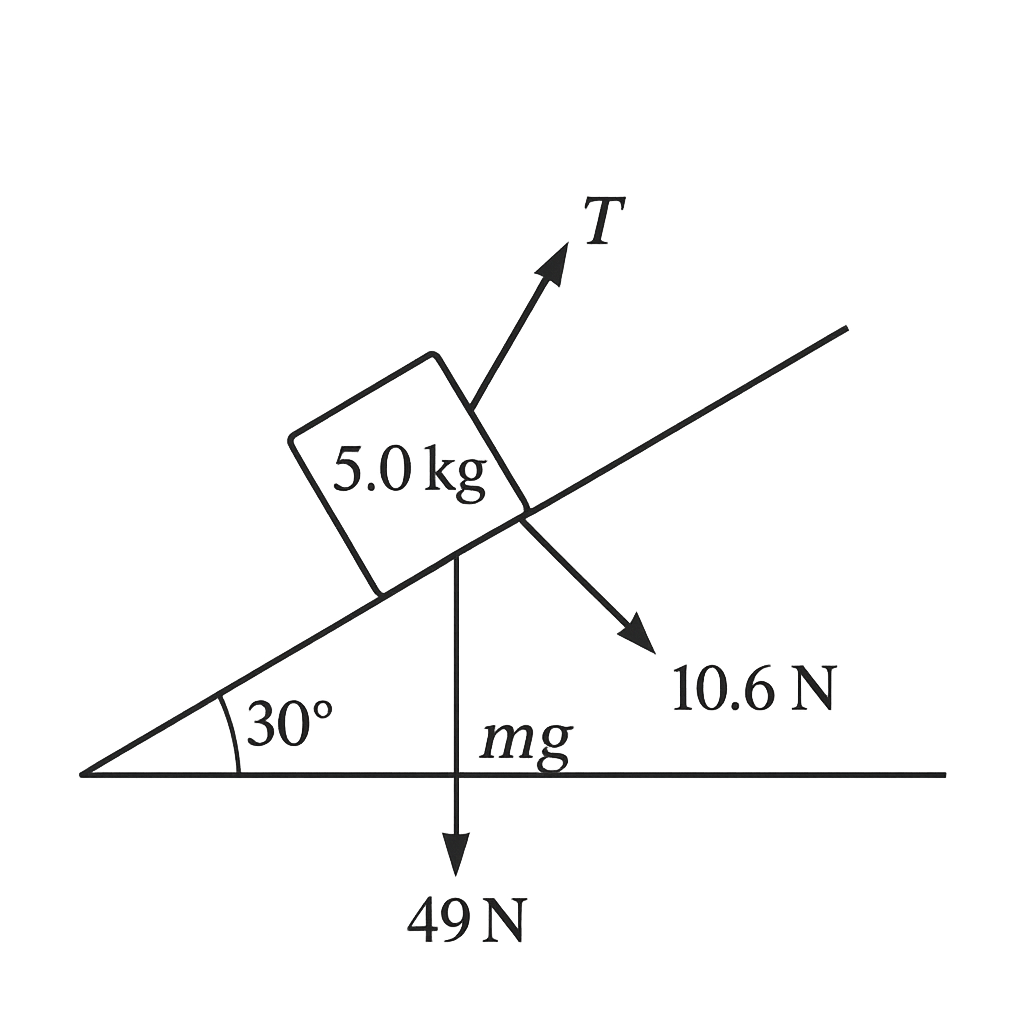
A block of mass \(5.0\ \text{kg}\) rests on a rough inclined plane that makes an angle of \(30^{\circ}\) with the horizontal. The coefficient of static friction between the block and the plane is \(0.25\). The block is held stationary by a rope that runs parallel to the plane and exerts a tension \(T\) up the plane. The diagram (force diagram) shows the weight, normal reaction, tension and friction forces. Determine the tension \(T\) in the rope (in newtons).
A. 20.0
B. 9.8
C. 15.0
Correct D. 13.9

Correct Answer: D

Want to see the full step-by-step solution? Unlock AI Explanation & Analytics
Question 14 View Details
A U‑shaped tube is filled with water (\(\rho = 1000\ \text{kg m}^{-3}\)). The left leg has a uniform cross‑sectional area of \(2.0\times10^{-3}\ \text{m}^{2}\) and the water level is \(0.80\ \text{m}\) above the bottom. The right leg has a uniform cross‑sectional area of \(5.0\times10^{-4}\ \text{m}^{2}\) and is closed at the top by a frictionless piston. The system is in equilibrium and the atmospheric pressure is \(1.01\times10^{5}\ \text{Pa}\). Find the mass of the piston (in kilograms).
A. 0.60
Correct B. 0.40
C. 0.80
D. 0.20

Correct Answer: B

Want to see the full step-by-step solution? Unlock AI Explanation & Analytics
Question 15 View Details
A mercury thermometer has a bulb volume of \(0.5\ \text{cm}^{3}\) and a capillary of cross‑sectional area \(0.02\ \text{mm}^{2}\). The coefficient of volume expansion of mercury is \(\beta = 1.8\times10^{-4}\ \text{°C}^{-1}\). When the temperature is increased from \(0\ ^\circ\text{C}\), the mercury column rises \(12.0\ \text{cm}\) in the capillary. Assuming the bulb volume does not change shape, calculate the temperature (in \(^\circ\text{C}\)) of the liquid.
A. 31.2
Correct B. 26.7
C. 24.5
D. 19.8

Correct Answer: B

Want to see the full step-by-step solution? Unlock AI Explanation & Analytics
Question 16 View Details
A 6.0 kg block is pulled up a 20° incline by a rope parallel to the plane. The rope tension is 30 N. A horizontal force of 15 N pushes the block into the plane. The coefficient of kinetic friction between the block and the plane is unknown. Assuming the block moves at constant speed, find the coefficient of kinetic friction \(\mu\).
A. 0.55
B. 0.70
C. 0.25
Correct D. 0.40

Correct Answer: D

Want to see the full step-by-step solution? Unlock AI Explanation & Analytics
Question 17 View Details
An atom has energy levels given by \(E_n = -\dfrac{13.6\text{ eV}}{n^2}\). An electron initially in level \(n=4\) makes two successive transitions: first to \(n=2\) and then to \(n=1\), emitting a photon each time. (a) Find the wavelength of the photon emitted in the first transition. (b) Find the total energy released in both transitions (in eV). (c) Express the frequency of the photon from the second transition as a multiple of the frequency of the first photon.
Correct A. a) 486 nm; b) 12.75 eV; c) 4 times the first frequency
B. a) 450 nm; b) 12.0 eV; c) 2 times the first frequency
C. a) 434 nm; b) 13.6 eV; c) 3 times the first frequency
D. a) 500 nm; b) 11.5 eV; c) 5 times the first frequency

Correct Answer: A

Want to see the full step-by-step solution? Unlock AI Explanation & Analytics
Question 18 View Details
A U‑tube manometer has arms of equal cross‑section. The left arm is filled with mercury (density \(\rho_{Hg}=13,600\,\text{kg m}^{-3}\)). The right arm contains water (density \(\rho_{w}=1000\,\text{kg m}^{-3}\)) up to a height of \(0.30\,\text{m}\) above the mercury-water interface. The mercury levels differ by \(0.12\,\text{m}\) (the mercury in the left arm is lower). Calculate the pressure difference between the two ends of the manometer.
A. 1.5×10^4 Pa
Correct B. 1.9×10^4 Pa
C. 2.1×10^4 Pa
D. 2.0×10^4 Pa

Correct Answer: B

Want to see the full step-by-step solution? Unlock AI Explanation & Analytics
Question 19 View Details
A converging lens has a focal length of \(f = 0.20\,\text{m}\). An object (a candle) and a screen are fixed 1.00 m apart. The lens can be placed anywhere between them to form a real image on the screen. (a) Determine the two possible positions of the lens measured from the object. (b) Find the magnification for each position. (c) State the power of the lens in dioptres.
Correct A. a) 0.276 m and 0.724 m; b) 0.38 and 2.62; c) +5 D
B. a) 0.300 m and 0.700 m; b) 0.45 and 2.22; c) +6 D
C. a) 0.250 m and 0.750 m; b) 0.33 and 3.00; c) +4 D
D. a) 0.200 m and 0.800 m; b) 0.25 and 4.00; c) +5.5 D

Correct Answer: A

Want to see the full step-by-step solution? Unlock AI Explanation & Analytics
Question 20 View Details
A 3.0 kg crate is pulled horizontally by a constant force of 60 N over a distance of 4.0 m. The floor exerts a kinetic friction force with coefficient \(\mu_k = 0.20\). The crate starts from rest. (a) Calculate the total work done by the pulling force. (b) Determine the crate's final speed. (c) Find the average power delivered by the pulling force during the motion.
A. a) 200 J; b) 13.5 m/s; c) 3.0×10^2 W
Correct B. a) 240 J; b) 12.0 m/s; c) 3.25×10^2 W
C. a) 260 J; b) 9.8 m/s; c) 3.5×10^2 W
D. a) 180 J; b) 10.0 m/s; c) 2.5×10^2 W

Correct Answer: B

Want to see the full step-by-step solution? Unlock AI Explanation & Analytics
Question 21 View Details
A rectangular conducting loop of resistance \(4\ \Omega\) has vertical sides of length \(0.05\ \text{m}\) and horizontal sides of length \(0.10\ \text{m}\). It is pulled at constant speed into a uniform magnetic field of magnitude \(0.8\ \text{T}\) that is directed into the page. When the loop is half inside the field, the magnetic force on the portion of the loop that is within the field is measured to be \(0.020\ \text{N}\). Assuming the induced current is clockwise, determine the speed of the loop in \(\text{m s}^{-1}\).
Correct A. 50
B. 25
C. 75
D. 100

Correct Answer: A

Want to see the full step-by-step solution? Unlock AI Explanation & Analytics
Question 22 View Details
A stretched string of length \(1.20\ \text{m}\) and linear mass density \(5.0\times10^{-3}\ \text{kg m}^{-1}\) is fixed at both ends. When the tension in the string is increased by \(30\ \text{N}\), the fundamental frequency rises by \(10\%\). Determine the original tension in the string (in newtons, to three significant figures).
Correct A. 143
B. 160
C. 200
D. 120

Correct Answer: A

Want to see the full step-by-step solution? Unlock AI Explanation & Analytics
Question 23 View Details
One mole of an ideal gas is initially at \(300\ \text{K}\) and \(100\ \text{kPa}\) in a cylinder with a movable piston. The gas is heated at constant volume until its temperature reaches \(450\ \text{K}\). It then expands at constant pressure until its volume is twice the original volume. Calculate the total work done by the gas during the entire process (in joules, to three significant figures).
A. 2.10e3
B. 1.75e3
Correct C. 2.49e3
D. 3.00e3

Correct Answer: C

Want to see the full step-by-step solution? Unlock AI Explanation & Analytics
Question 24 View Details
A boat can travel at \(4.0\ \text{m s}^{-1}\) in still water. A river flows at \(3.0\ \text{m s}^{-1}\) perpendicular to the intended direction of crossing. If the boat heads directly across the river, find (a) the magnitude of its resultant speed relative to the ground and (b) the angle downstream that its path makes with the direction straight across the river (to one decimal place).
A. 4.0 m/s, 45.0°
B. 3.5 m/s, 60.0°
C. 5.5 m/s, 30.0°
Correct D. 5.0 m/s, 36.9°

Correct Answer: D

Want to see the full step-by-step solution? Unlock AI Explanation & Analytics
Question 25 View Details
A battery of unknown emf \(E\) and internal resistance \(r\) is connected to an external resistor. When a \(6\ \Omega\) resistor is attached, the current measured is \(1.00\ \text{A}\). When a \(12\ \Omega\) resistor is attached, the power dissipated in the resistor is \(4.50\ \text{W}\). Determine the emf of the battery (in volts, to two decimal places) and its internal resistance (in ohms, to two decimal places).
A. 10.20 V, 2.80 Ω
Correct B. 9.48 V, 3.48 Ω
C. 9.48 V, 2.00 Ω
D. 8.00 V, 4.00 Ω

Correct Answer: B

Want to see the full step-by-step solution? Unlock AI Explanation & Analytics

Master the Exam!

You've seen a preview, but there are thousands more questions plus AI tutor to break down complex solutions.

Unlock Full Access Available for Android & Windows
Help others prepare! Share this practice hub:
Chat with Support