igcse model questions vol1 2017 chemistry | Objective

Prepare for your exams with igcse model questions vol1 questions? Reviewing past/model questions is one of the most effective ways to guarantee a high score. This practice hub features authentic 2017 chemistry (Objective) questions designed to simulate the real exam environment.

Practice these randomly selected questions to test your readiness.

Question 1 View Details
A 2.00 g sample of a hydrocarbon containing only carbon and hydrogen is burnt completely in excess oxygen, producing 6.29 g of \(\mathrm{CO_2}\) and 2.57 g of \(\mathrm{H_2O}\). The molar mass of the hydrocarbon is known to be \(56\ \text{g mol}^{-1}\). Determine its molecular formula.
A. C₃H₆
B. C₆H₁₂
C. C₅H₁₀
Correct D. C₄H₈

Correct Answer: D

Want to see the full step-by-step solution? Unlock AI Explanation & Analytics
Question 2 View Details
A mixture of ethanol (\(\mathrm{C_2H_5OH}\)) and 2‑propanol (\(\mathrm{C_3H_7OH}\)) is oxidised with excess \(\mathrm{Na_2Cr_2O_7/H_2SO_4}\). The oxidation produces \(5.00\ \text{g}\) of acetic acid (\(\mathrm{CH_3COOH}\)) and \(4.20\ \text{g}\) of acetone (\(\mathrm{CH_3COCH_3}\)). Assuming 100 % conversion, calculate the mass of each alcohol present in the original mixture.
A. Ethanol: 5.00 g; 2‑propanol: 3.19 g
B. Ethanol: 2.50 g; 2‑propanol: 5.65 g
Correct C. Ethanol: 3.84 g; 2‑propanol: 4.35 g
D. Ethanol: 4.20 g; 2‑propanol: 3.99 g

Correct Answer: C

Want to see the full step-by-step solution? Unlock AI Explanation & Analytics
Question 3 View Details
The vapour pressure of a liquid is \(0.12\ \text{atm}\) at \(298\ \text{K}\) and \(0.25\ \text{atm}\) at \(308\ \text{K}\). Using the Clausius-Clapeyron equation, calculate the enthalpy of vapourisation \(\Delta H_{\text{vap}}\) in \(\text{kJ mol}^{-1}\). (Take \(R = 8.314\ \text{J mol}^{-1}\text{K}^{-1}\)).
Correct A. 56 kJ mol⁻¹
B. 48 kJ mol⁻¹
C. 70 kJ mol⁻¹
D. 62 kJ mol⁻¹

Correct Answer: A

Want to see the full step-by-step solution? Unlock AI Explanation & Analytics
Question 4 View Details
Calcium carbonate (\(\mathrm{CaCO_3}\)) weighing \(5.00\ \text{g}\) reacts with excess hydrochloric acid according to \(\mathrm{CaCO_3 + 2HCl \rightarrow CaCl_2 + CO_2 + H_2O}\). The carbon dioxide produced is collected over water at \(25^{\circ}\text{C}\) and a total pressure of \(750\ \text{mmHg}\). The volume of gas collected is \(1.20\ \text{L}\). (Water vapour pressure at \(25^{\circ}\text{C}\) is \(23.8\ \text{mmHg}\)). Calculate the percent yield of \(\mathrm{CO_2}\).
A. 85.2 %
Correct B. 93.8 %
C. 101.3 %
D. 78.5 %

Correct Answer: B

Want to see the full step-by-step solution? Unlock AI Explanation & Analytics
Question 5 View Details
An element X is in Group 2 and Period 4 of the periodic table and has an atomic mass of about \(40.1\ \text{u}\). Identify the element and give its chemical symbol.
A. K
B. Sr
C. Mg
Correct D. Ca

Correct Answer: D

Want to see the full step-by-step solution? Unlock AI Explanation & Analytics
Question 6 View Details
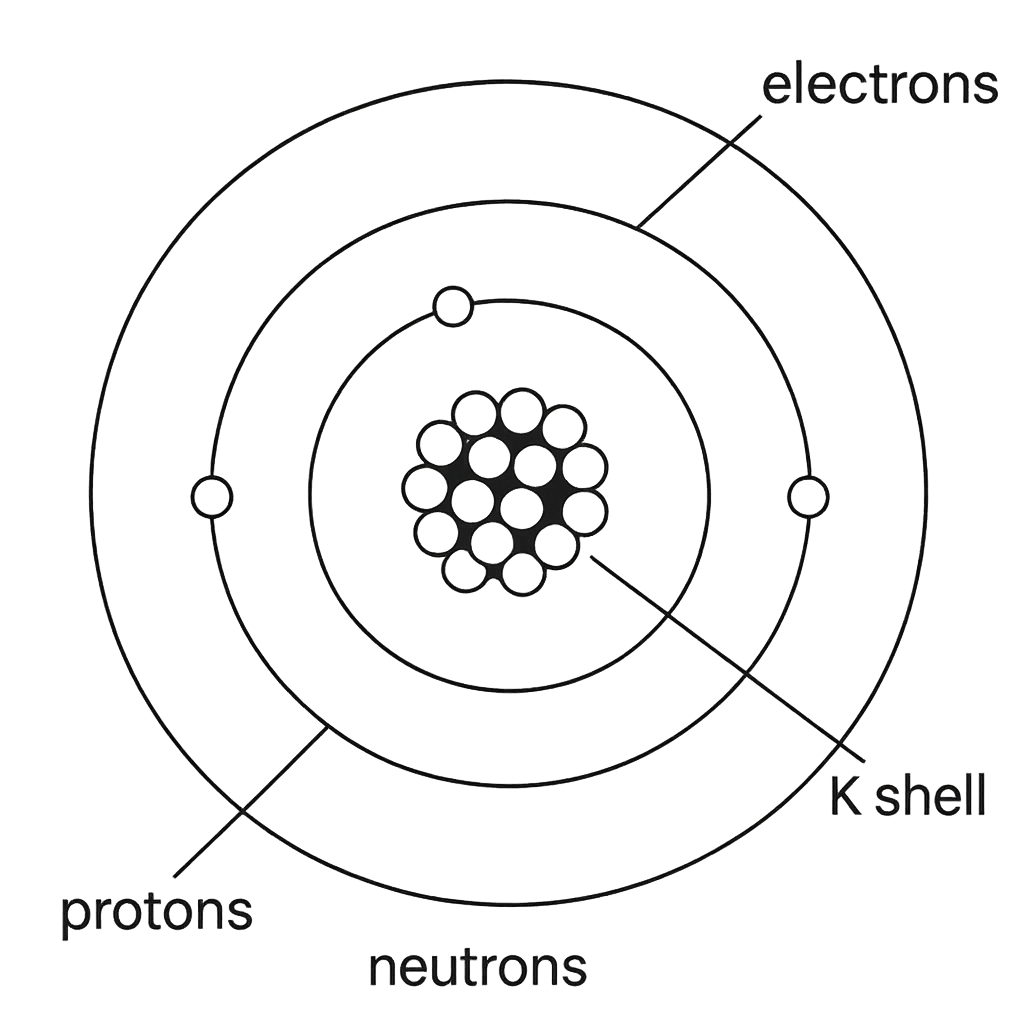
The diagram shows an atom with 11 protons, 12 neutrons and 11 electrons arranged in shells as follows: 2 electrons in the first shell, 8 in the second and 1 in the third. Identify the element (symbol), write its atomic number, mass number and give the isotope notation.
A. ^{22}_{11}Na
Correct B. ^{23}_{11}Na
C. ^{24}_{11}Na
D. ^{23}_{12}Mg

Correct Answer: B

Want to see the full step-by-step solution? Unlock AI Explanation & Analytics
Question 7 View Details
A river receives an effluent that initially contains 0.5 mg L⁻¹ of pesticide X. The pesticide degrades by first‑order kinetics with a half‑life of 12 days. After 3 days the water mixes with a clean tributary that dilutes the concentration to 60 % of its value at that moment. (a) Calculate the concentration of X after the 3 days and the dilution. (b) The safe limit for X is 0.05 mg L⁻¹. By what percentage must the concentration be further reduced to meet the limit?
Correct A. 0.25 mg L⁻¹; additional 80 % reduction
B. 0.35 mg L⁻¹; additional 75 % reduction
C. 0.20 mg L⁻¹; additional 60 % reduction
D. 0.30 mg L⁻¹; additional 70 % reduction

Correct Answer: A

Want to see the full step-by-step solution? Unlock AI Explanation & Analytics
Question 8 View Details
The solubility of potassium nitrate (KNO₃) is 31.6 g per 100 mL of water at 20 °C and 246 g per 100 mL at 100 °C. How hot must 200 mL of water be to dissolve 150 g of KNO₃, assuming solubility varies linearly with temperature between these two points?
A. 52 °C
B. 28 °C
C. 44 °C
Correct D. 36 °C

Correct Answer: D

Want to see the full step-by-step solution? Unlock AI Explanation & Analytics
Question 9 View Details
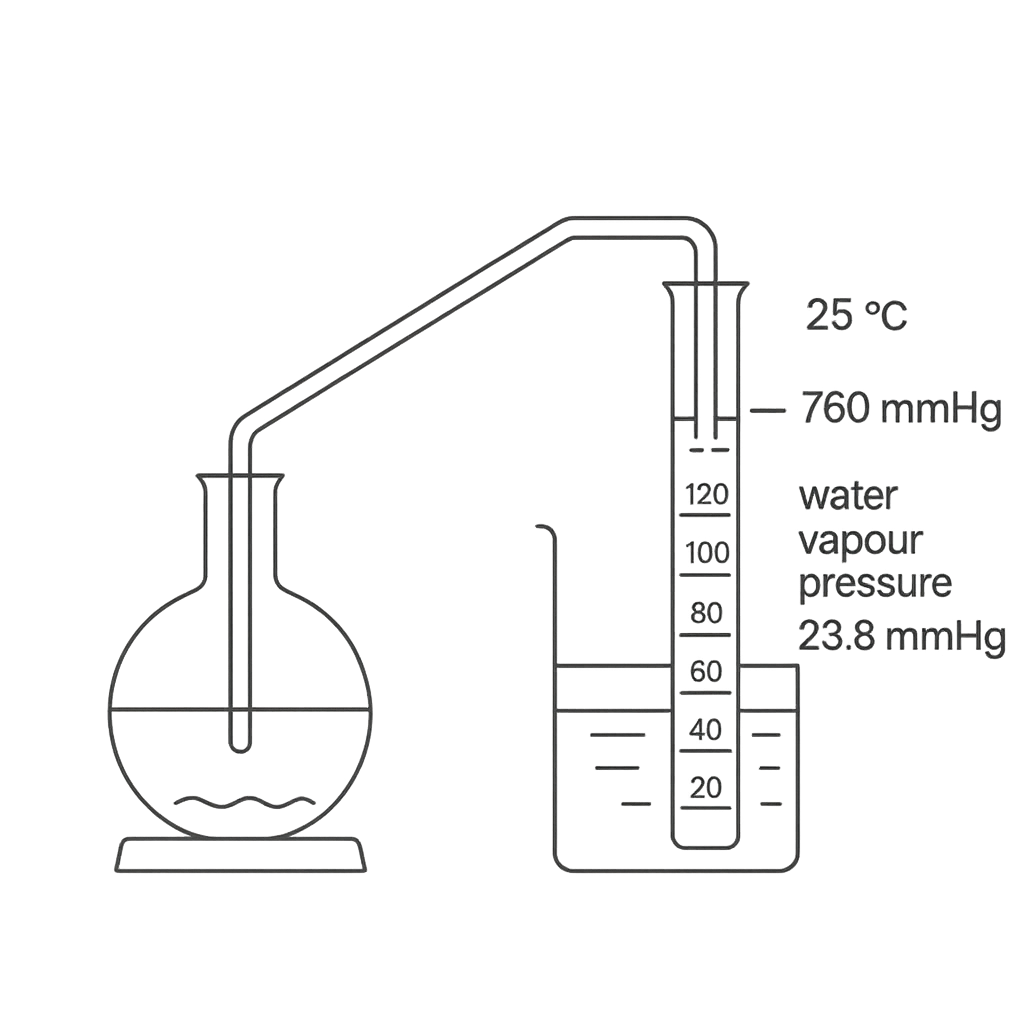
A gas collection over water apparatus shows that 125 mL of gas is collected at 25 °C and a total pressure of 760 mmHg. The vapour pressure of water at 25 °C is 23.8 mmHg. Using the ideal‑gas equation, calculate the amount of gas (in moles) collected.
A. 5.12×10⁻³ mol
B. 5.00×10⁻³ mol
Correct C. 4.95×10⁻³ mol
D. 4.75×10⁻³ mol

Correct Answer: C

Want to see the full step-by-step solution? Unlock AI Explanation & Analytics
Question 10 View Details
In acidic solution the reaction between potassium permanganate (KMnO₄) and iron(II) sulfate (FeSO₄) is: \(\text{MnO}_4^- + \text{Fe}^{2+} + \text{H}^+ \rightarrow \text{Mn}^{2+} + \text{Fe}^{3+} + \text{H}_2\text{O}\). (a) Balance the redox equation. (b) If 2.00 g of KMnO₄ reacts completely, calculate the mass of Fe³⁺ produced.
A. 4.12 g
Correct B. 3.53 g
C. 5.67 g
D. 2.00 g

Correct Answer: B

Want to see the full step-by-step solution? Unlock AI Explanation & Analytics
Question 11 View Details
A sample of 2‑methyl‑1‑butene (\( \mathrm{CH_2=C(CH_3)CH_2CH_3} \)) is treated with excess bromine in carbon tetrachloride. The resulting dibromo product is then mixed with aqueous NaOH solution. Identify the major organic product formed and give its IUPAC name.
A. 1-bromo-2-methyl-1-butanol
B. 2-bromo-3-methyl-1-butanol
Correct C. 2-bromo-2-methyl-1-butanol
D. 2-bromo-2-methyl-2-butanol

Correct Answer: C

Want to see the full step-by-step solution? Unlock AI Explanation & Analytics
Question 12 View Details
The standard enthalpy change for formation of solid NaCl from its elements is \(-411\ \text{kJ mol}^{-1}\). The following data are given: sublimation of Na(s) \(+108\ \text{kJ mol}^{-1}\); first ionisation energy of Na \(+496\ \text{kJ mol}^{-1}\); bond dissociation energy of \(\mathrm{Cl_2(g)}\) \(242\ \text{kJ mol}^{-1}\); electron affinity of Cl \(-349\ \text{kJ mol}^{-1}\). Using a Born-Haber cycle, calculate the magnitude of the lattice energy of NaCl(s) in kJ mol\(^{-1}\).
Correct A. 787
B. 845
C. 658
D. 712

Correct Answer: A

Want to see the full step-by-step solution? Unlock AI Explanation & Analytics
Question 13 View Details
A 250.0 mL solution of 0.20 M benzoic acid (\(K_a = 6.3 \times 10^{-5}\)) is titrated with 0.10 M NaOH. (a) What volume of NaOH is required to reach the equivalence point? (b) What is the pH of the solution at the equivalence point? Give the pH to two decimal places.
A. 475 mL, 9.00
Correct B. 500 mL, 8.51
C. 550 mL, 8.75
D. 400 mL, 8.00

Correct Answer: B

Want to see the full step-by-step solution? Unlock AI Explanation & Analytics
Question 14 View Details
A 5.00 g sample of calcium carbonate is reacted with excess hydrochloric acid. The carbon dioxide produced is collected over water at 25 °C and 760 mm Hg, and the volume of gas collected is 1.20 L. Given the vapour pressure of water at 25 °C is 23.8 mm Hg, calculate the percent yield of CO₂. Give your answer as a whole‑number percentage.
Correct A. 95
B. 102
C. 78
D. 85

Correct Answer: A

Want to see the full step-by-step solution? Unlock AI Explanation & Analytics
Question 15 View Details
Four chlorinated hydrocarbons have the following molecular formulas: (i) CH₃Cl, (ii) CH₂Cl₂, (iii) CHCl₃, (iv) CCl₄. Rank them in order of increasing boiling point and briefly explain the trend in terms of intermolecular forces and molecular polarity.
A. CH₃Cl < CHCl₃ < CH₂Cl₂ < CCl₄
B. CH₂Cl₂ < CH₃Cl < CHCl₃ < CCl₄
C. CH₃Cl < CH₂Cl₂ < CCl₄ < CHCl₃
Correct D. CH₃Cl < CH₂Cl₂ < CHCl₃ < CCl₄

Correct Answer: D

Want to see the full step-by-step solution? Unlock AI Explanation & Analytics
Question 16 View Details
A 50 g sample of ice at \(-10^{\circ}\text{C}\) is heated with \(25000\ \text{J}\) of energy. The specific heat capacity of ice is \(2.1\ \text{J g}^{-1}\text{°C}^{-1}\), the latent heat of fusion of ice is \(334\ \text{J g}^{-1}\), and the specific heat capacity of liquid water is \(4.18\ \text{J g}^{-1}\text{°C}^{-1}\). Assuming no heat loss to the surroundings, what is the final temperature of the water after all the energy has been supplied? Give your answer to one decimal place.
Correct A. 34.7 °C
B. 20.0 °C
C. 30.0 °C
D. 40.0 °C

Correct Answer: A

Want to see the full step-by-step solution? Unlock AI Explanation & Analytics
Question 17 View Details
The solubility of silver chloride (\(\text{AgCl}\)) in pure water at \(25^{\circ}\text{C}\) is \(1.3\times10^{-5}\ \text{mol L}^{-1}\). In a solution that already contains \(0.010\ \text{mol L}^{-1}\) sodium chloride (\(\text{NaCl}\)), calculate the solubility of \(\text{AgCl}\) at the same temperature. Assume the solubility product \(K_{sp}\) of \(\text{AgCl}\) remains constant.
A. 5.0×10⁻⁹ mol L⁻¹
B. 2.5×10⁻⁸ mol L⁻¹
Correct C. 1.7×10⁻⁸ mol L⁻¹
D. 1.3×10⁻⁵ mol L⁻¹

Correct Answer: C

Want to see the full step-by-step solution? Unlock AI Explanation & Analytics
Question 18 View Details
An element X has two naturally occurring isotopes. Isotope A has a mass number of 35 and an isotopic abundance of \(75\%\). Isotope B has a mass number of 37 and an isotopic abundance of \(25\%\). Calculate the average atomic mass of element X.
Correct A. 35.5 amu
B. 35.0 amu
C. 35.75 amu
D. 36.0 amu

Correct Answer: A

Want to see the full step-by-step solution? Unlock AI Explanation & Analytics
Question 19 View Details
The standard enthalpies of formation at \(25^{\circ}\text{C}\) are: \(\Delta H_f^{\circ}(\text{C}_3\text{H}_8(g)) = -104.7\ \text{kJ mol}^{-1}\), \(\Delta H_f^{\circ}(\text{CO}_2(g)) = -393.5\ \text{kJ mol}^{-1}\), \(\Delta H_f^{\circ}(\text{H}_2\text{O}(l)) = -285.8\ \text{kJ mol}^{-1}\). Using these data, calculate the standard enthalpy change for the combustion of one mole of propane (\(\text{C}_3\text{H}_8\)) in oxygen to give carbon dioxide and liquid water. Write the balanced equation first, then give \(\Delta H_{comb}^{\circ}\) in \(\text{kJ mol}^{-1}\).
A. -2300 kJ mol⁻¹
B. -2100 kJ mol⁻¹
Correct C. -2219 kJ mol⁻¹
D. -2000 kJ mol⁻¹

Correct Answer: C

Want to see the full step-by-step solution? Unlock AI Explanation & Analytics
Question 20 View Details
A sample of \(2.00\ \text{g}\) of chlorine gas (\(\text{Cl}_2\)) is collected over water at \(25^{\circ}\text{C}\) and a total pressure of \(760\ \text{mmHg}\). The vapour pressure of water at this temperature is \(23.8\ \text{mmHg}\).\n\n(a) Calculate the volume of dry \(\text{Cl}_2\) gas collected, assuming ideal behaviour.\n\n(b) The dry chlorine gas is then reacted with excess sodium metal according to \(\text{Cl}_2 + 2\text{Na} \rightarrow 2\text{NaCl}\). Determine the theoretical mass of sodium chloride that can be formed.\n\n(c) If the actual mass of sodium chloride obtained after the reaction is \(2.80\ \text{g}\), calculate the percentage yield of the reaction.
A. (a) 0.68 L; (b) 3.10 g; (c) 80 % (to nearest percent)
B. (a) 0.65 L; (b) 3.00 g; (c) 78 % (to nearest percent)
C. (a) 0.78 L; (b) 3.45 g; (c) 92 % (to nearest percent)
Correct D. (a) 0.71 L; (b) 3.30 g; (c) 85 % (to nearest percent)

Correct Answer: D

Want to see the full step-by-step solution? Unlock AI Explanation & Analytics
Question 21 View Details
A 100.0 mL sample of a weak monoprotic acid HA is titrated with 0.100 M NaOH. The initial pH of the acid solution is 3.00. After the addition of 25.0 mL of the NaOH solution, the pH becomes 5.00. Assuming the acid dissociates only as HA \(\rightleftharpoons\) H⁺ + A⁻, calculate the acid dissociation constant \(K_a\) of HA. Give your answer in scientific notation to two significant figures.
A. 3.2×10⁻⁵
B. 2.5×10⁻⁴
C. 8.0×10⁻⁶
Correct D. 1.6×10⁻⁵

Correct Answer: D

Want to see the full step-by-step solution? Unlock AI Explanation & Analytics
Question 22 View Details
The gas X₂ reacts with excess O₂ according to the equation \(X_2 + 3 O_2 \rightleftharpoons 2 XO_3\). At 298 K the equilibrium constant for the reverse reaction \(2 XO_3 \rightleftharpoons X_2 + 3 O_2\) is \(K_c = 2.5 \times 10^{-4}\). In a 2.00 L sealed container, 0.200 mol of X₂ and 0.600 mol of O₂ are placed and allowed to reach equilibrium. (a) Calculate the equilibrium concentration of XO₃ (in mol L⁻¹). (b) The molar mass of XO₃ is 80 g mol⁻¹. From this information, identify the element X.
A. Equilibrium [XO₃] = 0.200 M; X is chlorine (Cl)
B. Equilibrium [XO₃] = 0.090 M; X is nitrogen (N)
C. Equilibrium [XO₃] = 0.120 M; X is phosphorus (P)
Correct D. Equilibrium [XO₃] = 0.156 M; X is sulfur (S)

Correct Answer: D

Want to see the full step-by-step solution? Unlock AI Explanation & Analytics
Question 23 View Details
A galvanic cell is constructed with a zinc electrode immersed in 0.010 M ZnSO₄ solution and a copper electrode immersed in a CuSO₄ solution of unknown concentration. The standard cell potential for the reaction Zn|Zn²⁺ || Cu²⁺|Cu is \(E^\circ = 1.10\) V. At 25 °C the measured cell potential is 0.96 V. (a) Determine the concentration of Cu²⁺ in the copper half‑cell. (b) If 0.500 L of this Cu²⁺ solution is electrolysed for 2.00 h at a constant current of 0.250 A, calculate the mass of copper deposited on the copper electrode.
Correct A. [Cu²⁺] ≈ 1.9×10⁻⁷ M; mass of Cu deposited ≈ 0.59 g
B. [Cu²⁺] ≈ 2.1×10⁻⁷ M; mass of Cu deposited ≈ 0.30 g
C. [Cu²⁺] ≈ 5.0×10⁻⁸ M; mass of Cu deposited ≈ 0.78 g
D. [Cu²⁺] ≈ 3.2×10⁻⁶ M; mass of Cu deposited ≈ 0.45 g

Correct Answer: A

Want to see the full step-by-step solution? Unlock AI Explanation & Analytics
Question 24 View Details
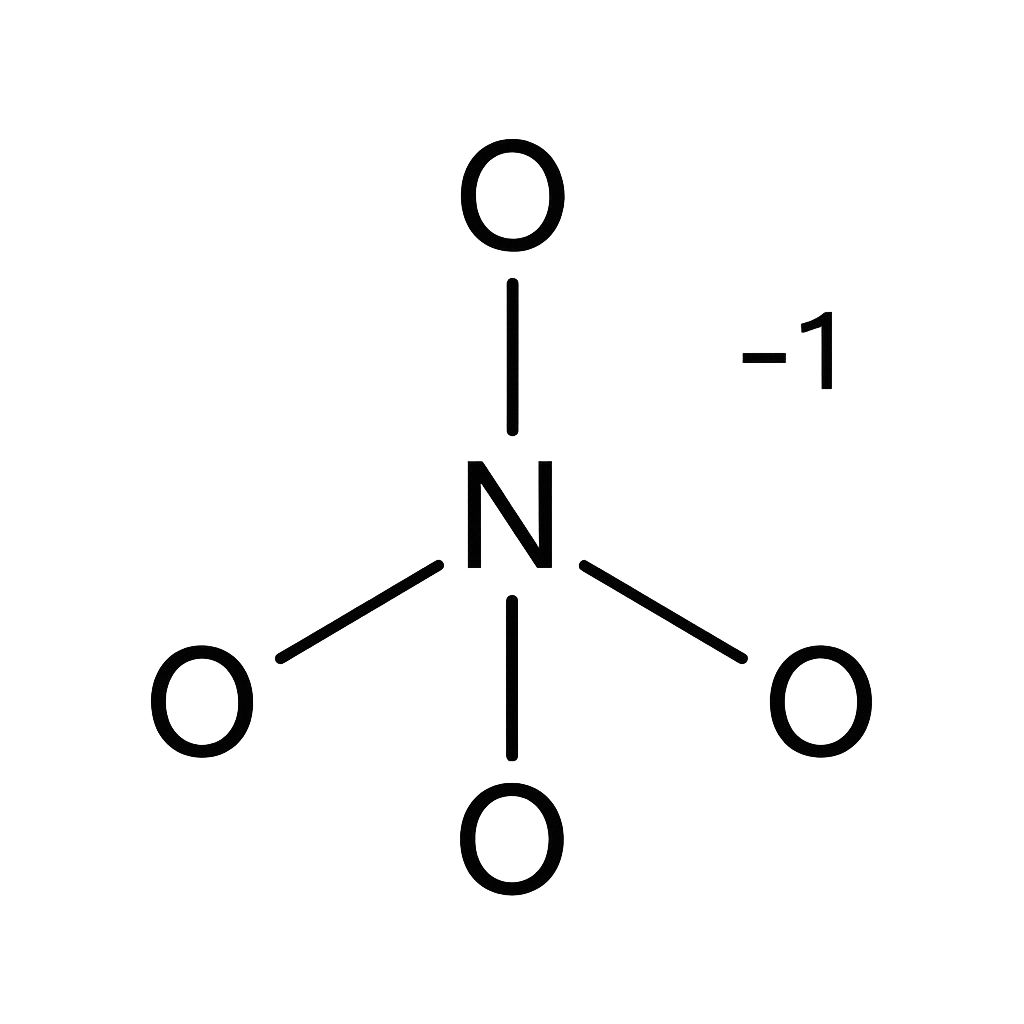
The diagram shows the Lewis structure of the nitrate ion (NO₃⁻) with one N=O double bond and two N-O single bonds. Using this structure, (a) calculate the formal charge on the nitrogen atom and on each oxygen atom, (b) state the hybridisation of the nitrogen atom, and (c) give the average bond order of the N-O bonds.
A. N: 0; double‑bond O: -1; each single‑bond O: -1; N is sp² hybridised; average N-O bond order = 1.00
Correct B. N: +1; double‑bond O: 0; each single‑bond O: -1; N is sp³ hybridised; average N-O bond order = 1.33
C. N: -1; double‑bond O: +1; each single‑bond O: 0; N is sp³d hybridised; average N-O bond order = 1.25
D. N: +2; double‑bond O: +1; each single‑bond O: -2; N is sp hybridised; average N-O bond order = 1.50

Correct Answer: B

Want to see the full step-by-step solution? Unlock AI Explanation & Analytics
Question 25 View Details
Given the standard reduction potentials: \(\mathrm{Fe^{3+} + e^- \rightarrow Fe^{2+}}\) \(E^\circ = +0.771\) V and \(\mathrm{Cu^{2+} + 2e^- \rightarrow Cu}\) \(E^\circ = +0.340\) V. A galvanic cell is set up with a 0.010 M Fe³⁺ solution in the left half‑cell and a 0.010 M Cu²⁺ solution with a copper electrode in the right half‑cell. (a) Write the overall cell reaction, (b) calculate the standard cell potential \(E^\circ_{\text{cell}}\), and (c) determine the equilibrium constant \(K\) for the cell reaction at 25 °C.
A. Overall: 2 Fe³⁺ + Cu → 2 Fe²⁺ + Cu²⁺; E°cell = 0.111 V; K ≈ 5×10⁴
Correct B. Overall: 2 Fe³⁺ + Cu → 2 Fe²⁺ + Cu²⁺; E°cell = 0.431 V; K ≈ 3×10¹⁴
C. Overall: Fe³⁺ + Cu → Fe²⁺ + Cu²⁺; E°cell = 0.431 V; K ≈ 3×10¹⁴
D. Overall: 2 Fe³⁺ + Cu → 2 Fe²⁺ + Cu²⁺; E°cell = 0.431 V; K ≈ 1×10⁸

Correct Answer: B

Want to see the full step-by-step solution? Unlock AI Explanation & Analytics

Master the Exam!

You've seen a preview, but there are thousands more questions plus AI tutor to break down complex solutions.

Unlock Full Access Available for Android & Windows
Help others prepare! Share this practice hub:
Chat with Support