gce model questions vol1 2025 physics | Objective

Prepare for your exams with gce model questions vol1 questions? Reviewing past/model questions is one of the most effective ways to guarantee a high score. This practice hub features authentic 2025 physics (Objective) questions designed to simulate the real exam environment.

Practice these randomly selected questions to test your readiness.

Question 1 View Details
An isotope X decays to a radioactive daughter Y, which subsequently decays to a stable nuclide Z. The half‑life of X is 10 min and that of Y is 40 min. A 1.00 g sample of pure X (molar mass 240 g mol\(^{-1}\)) is prepared at time \(t=0\).\n\n(a) Determine the time after the start at which the activity of Y is maximum.\n(b) Calculate the maximum activity of Y in becquerels (Bq). (Take Avogadro's number \(N_A = 6.022\times10^{23}\) mol\(^{-1}\).)
A. t_max = 1.20×10^3 s; A_max ≈ 3.9×10^{17} Bq
B. t_max = 1.60×10^3 s; A_max ≈ 5.0×10^{17} Bq
Correct C. t_max = 1.60×10^3 s; A_max ≈ 4.6×10^{17} Bq
D. t_max = 2.00×10^3 s; A_max ≈ 5.2×10^{17} Bq

Correct Answer: C

Want to see the full step-by-step solution? Unlock AI Explanation & Analytics
Question 2 View Details
A 5.0 kg block rests on a plane inclined at \(30^{\circ}\) to the horizontal. The coefficient of kinetic friction between the block and the plane is \(\mu_k = 0.20\). The block is attached by a light, inextensible rope over a frictionless pulley to a hanging mass \(M\). The system is released from rest.\n\nWhat is the minimum value of \(M\) (in kilograms, to three significant figures) that will cause the block to accelerate up the incline?
Correct A. 3.37 kg
B. 4.12 kg
C. 2.85 kg
D. 3.00 kg

Correct Answer: A

Want to see the full step-by-step solution? Unlock AI Explanation & Analytics
Question 3 View Details
A simple gear train consists of four gears. Gear A (driving) has 20 teeth and rotates at 1200 rpm. It meshes with gear B (driven) which has 40 teeth. Gear B is fixed on the same shaft as gear C (idler) having 30 teeth; gear C meshes with gear D (output) which has 60 teeth. Each mesh operates with an efficiency of 90 %.\n\n(i) Find the angular speed of gear D in revolutions per minute.\n(ii) If the input power to gear A is 150 W, determine the power delivered by gear D.
A. ω_D = 250 rpm; output power = 1.10×10^2 W
Correct B. ω_D = 300 rpm; output power = 1.22×10^2 W
C. ω_D = 350 rpm; output power = 1.35×10^2 W
D. ω_D = 300 rpm; output power = 1.00×10^2 W

Correct Answer: B

Want to see the full step-by-step solution? Unlock AI Explanation & Analytics
Question 4 View Details
An electron in a hydrogen atom makes a transition from the \(n=5\) level to the \(n=2\) level, emitting a photon.\n\n(a) Calculate the wavelength of the emitted photon (in nanometres, to three significant figures).\n(b) The photon is then absorbed by another hydrogen atom, causing the ejection of its electron with a kinetic energy of \(2.0\;\text{eV}\). Determine the magnetic field at the centre of the electron's orbit in the original atom (the \(n=4\) orbit) and the magnetic moment of the electron in that orbit, expressing the magnetic moment as a multiple of the Bohr magneton \(\mu_B = 9.274\times10^{-24}\;\text{J\,T}^{-1}\). (Use \(a_0 = 5.29\times10^{-11}\;\text{m}\), \(v_1 = 2.19\times10^{6}\;\text{m\,s}^{-1}\), \(\mu_0 = 4\pi\times10^{-7}\;\text{H\,m}^{-1}\), and \(e = 1.602\times10^{-19}\;\text{C}\).)
Correct A. λ = 435 nm; B ≈ 1.23×10^{-2} T; μ ≈ 3.7×10^{-23} J T^{-1} ≈ 4.0 μ_B
B. λ = 460 nm; B ≈ 1.35×10^{-2} T; μ ≈ 4.0×10^{-23} J T^{-1} ≈ 4.3 μ_B
C. λ = 410 nm; B ≈ 1.10×10^{-2} T; μ ≈ 3.5×10^{-23} J T^{-1} ≈ 3.8 μ_B
D. λ = 435 nm; B ≈ 1.50×10^{-2} T; μ ≈ 3.7×10^{-23} J T^{-1} ≈ 4.0 μ_B

Correct Answer: A

Want to see the full step-by-step solution? Unlock AI Explanation & Analytics
Question 5 View Details
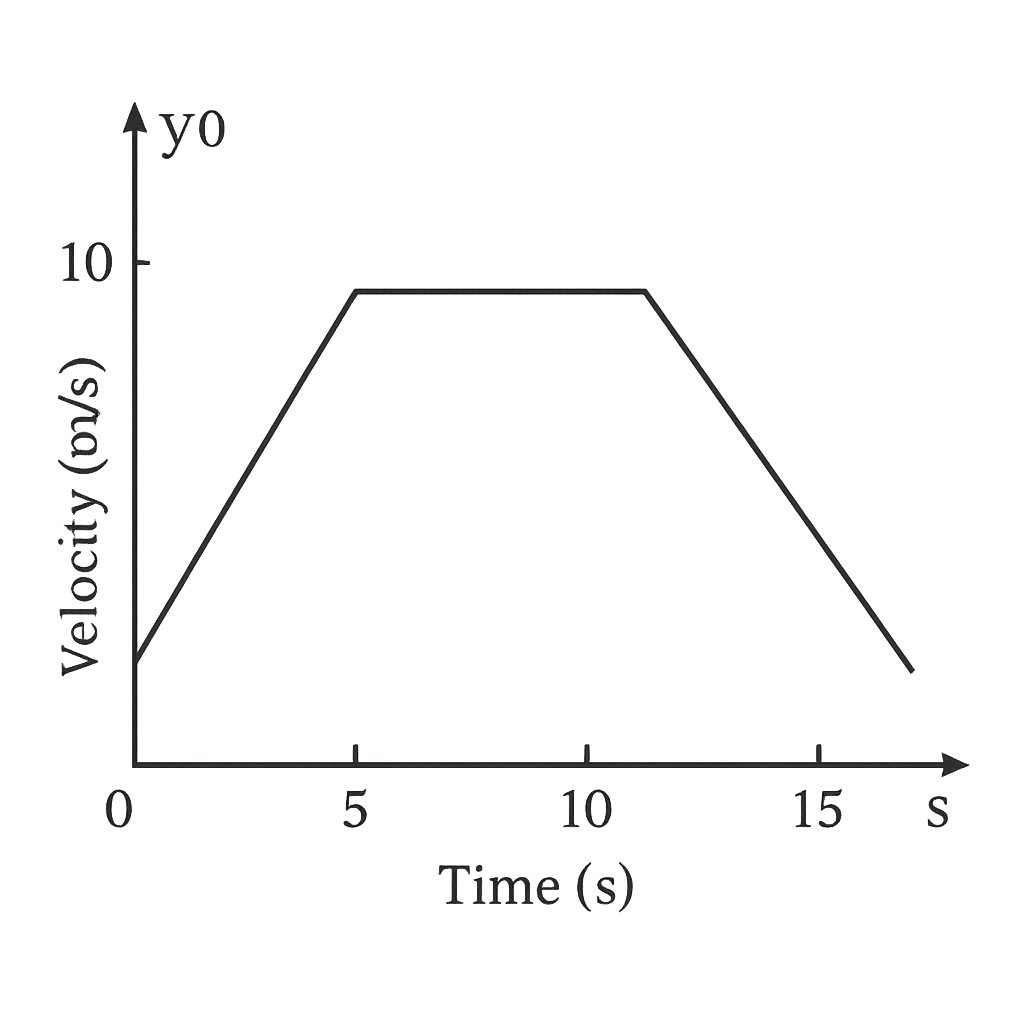
An object moves according to the velocity‑time diagram described below. The diagram shows three consecutive linear segments:\n\n* from \(t = 0\) s to \(t = 5\) s, the velocity increases uniformly from 0 to \(10\;\text{m\,s}^{-1}\);\n* from \(t = 5\) s to \(t = 15\) s, the velocity remains constant at \(10\;\text{m\,s}^{-1}\);\n* from \(t = 15\) s to \(t = 18.\overline{3}\) s, the velocity decreases uniformly to 0.\n\nUsing the diagram, calculate the total distance travelled by the object during the whole motion (in metres, to three significant figures).
A. 1.20×10^2 m
Correct B. 1.42×10^2 m
C. 1.42×10^1 m
D. 1.55×10^2 m

Correct Answer: B

Want to see the full step-by-step solution? Unlock AI Explanation & Analytics
Question 6 View Details
Two point charges, \(+q\) and \(-2q\), are fixed on a straight line a distance \(d\) apart. Determine the distance from the \(+q\) charge at which the net electric field is zero. State also on which side of this point the field points.
A. d(2\sqrt{2}+1)
Correct B. d(\sqrt{2}+1)
C. d(\sqrt{2}-1)
D. d(2+\sqrt{2})

Correct Answer: B

Want to see the full step-by-step solution? Unlock AI Explanation & Analytics
Question 7 View Details
A point charge \(q = 2.0\,\mu\text{C}\) is held a distance \(a = 5.0\,\text{cm}\) from an infinite grounded conducting plane. Using the method of images, calculate (a) the magnitude of the attractive force on the charge, and (b) the work required by an external agent to bring the charge from infinity to this position.
A. Force = 2.9 N, Work = 0.12 J
B. Force = 3.6 N, Work = 0.25 J
Correct C. Force = 3.6 N, Work = 0.18 J
D. Force = 4.5 N, Work = 0.25 J

Correct Answer: C

Want to see the full step-by-step solution? Unlock AI Explanation & Analytics
Question 8 View Details
A 1.00‑mol sample of a mono‑atomic ideal gas is initially at \(300\,\text{K}\) and \(100\,\text{kPa}\) in a sealed container. The gas is first heated at constant volume until its pressure reaches \(250\,\text{kPa}\). It then expands isothermally at the new temperature until its volume is twice the original volume. Calculate the total heat added to the gas during the whole process. Give your answer in kilojoules to three significant figures.
Correct A. 9.94 kJ
B. 12.3 kJ
C. 8.94 kJ
D. 10.5 kJ

Correct Answer: A

Want to see the full step-by-step solution? Unlock AI Explanation & Analytics
Question 9 View Details
A length is measured as \(12.3\,\text{cm}\) with an absolute uncertainty of \(\pm 0.2\,\text{cm}\). Express this measurement in metres, including its uncertainty.
Correct A. 0.123 \pm 0.002 m
B. 0.124 \pm 0.002 m
C. 0.123 \pm 0.003 m
D. 0.122 \pm 0.002 m

Correct Answer: A

Want to see the full step-by-step solution? Unlock AI Explanation & Analytics
Question 10 View Details
A rectangular conducting loop of width \(w = 0.10\,\text{m}\) and length \(l = 0.30\,\text{m}\) moves at a constant speed \(v = 2.0\,\text{m s}^{-1}\) into a uniform magnetic field \(B = 0.5\,\text{T}\) directed into the page. The loop has a total resistance of \(0.20\,\Omega\). When the loop is positioned so that exactly half of its width has entered the field, determine (a) the magnitude of the induced emf, (b) the magnitude of the magnetic force acting on the loop, and (c) the mechanical power that must be supplied to keep the loop moving at constant speed at that instant.
A. emf = 0.15 V, force = 0.1125 N (opposing motion), power = 0.225 W
B. emf = 0.45 V, force = 0.3375 N (opposing motion), power = 0.675 W
Correct C. emf = 0.30 V, force = 0.225 N (opposing motion), power = 0.45 W
D. emf = 0.30 V, force = 0.075 N (opposing motion), power = 0.150 W

Correct Answer: C

Want to see the full step-by-step solution? Unlock AI Explanation & Analytics
Question 11 View Details
A sample contains a radioactive isotope A that decays with a half‑life of 5 min. In each decay, 70 % of the nuclei transform into a detectable daughter B, while the remaining 30 % become an undetectable daughter C. After 20 min the measured activity due to B is \(5.0\times10^{3}\ \text{s}^{-1}\). Assuming the decay constant remains unchanged, calculate the initial number of nuclei of isotope A present in the sample. Give your answer as an integer (rounded to the nearest whole number).
Correct A. 4.95×10^7
B. 5.60×10^7
C. 3.12×10^7
D. 2.48×10^7

Correct Answer: A

Want to see the full step-by-step solution? Unlock AI Explanation & Analytics
Question 12 View Details
A horizontal cylindrical pipe of length 1 m carries hot water at an inner temperature of \(80^{\circ}\text{C}\). The pipe wall consists of an inner steel layer (thermal conductivity \(k_{1}=45\ \text{W\,m}^{-1}\text{K}^{-1}\), thickness \(0.005\ \text{m}\)) and an outer insulation layer (thermal conductivity \(k_{2}=0.06\ \text{W\,m}^{-1}\text{K}^{-1}\), thickness \(0.020\ \text{m}\)). The outer surface is exposed to still air at \(20^{\circ}\text{C}\) with a convective heat‑transfer coefficient \(h=15\ \text{W\,m}^{-2}\text{K}^{-1}\). The inner radius of the steel tube is \(0.050\ \text{m}\). Determine the rate of heat loss from the pipe per metre length (in watts, to two significant figures).
Correct A. 62
B. 48
C. 90
D. 75

Correct Answer: A

Want to see the full step-by-step solution? Unlock AI Explanation & Analytics
Question 13 View Details
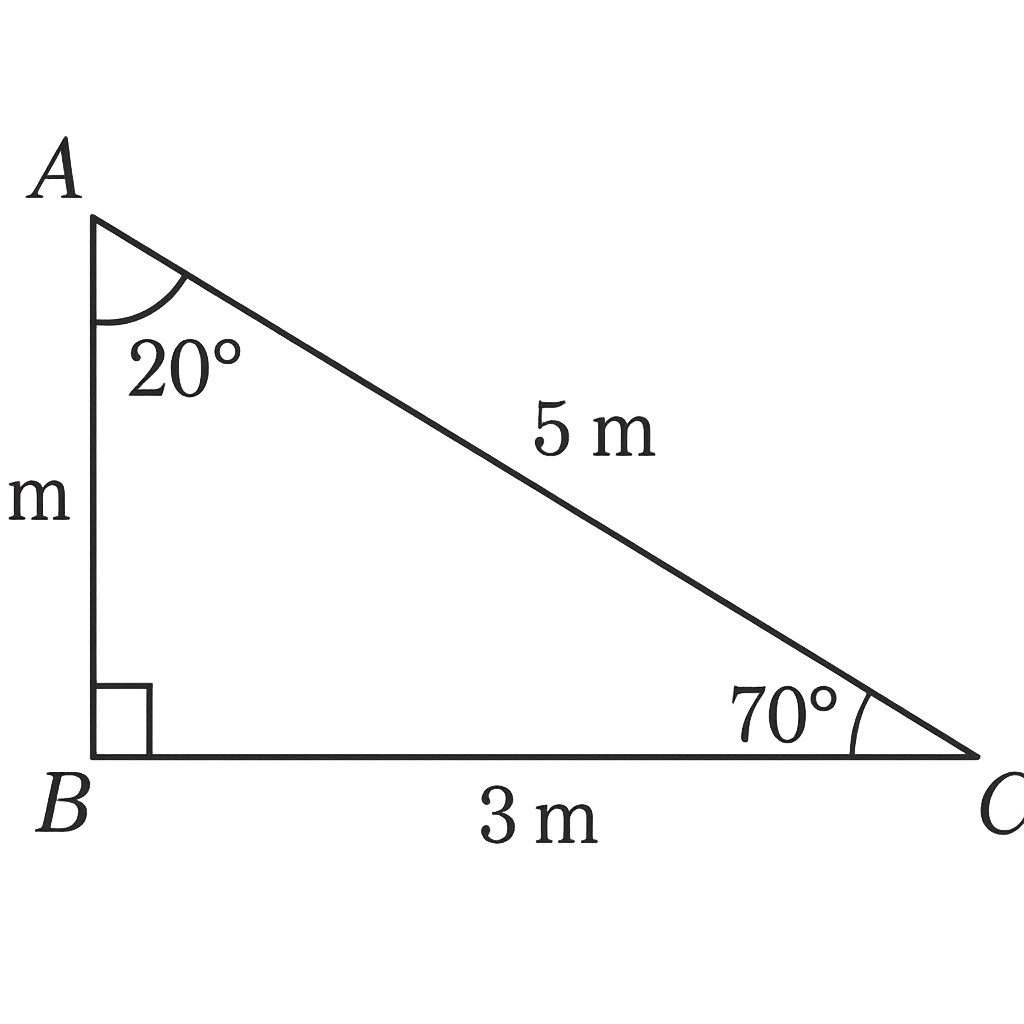
The diagram shows a smooth inclined plane making an angle of \(20^{\circ}\) with the horizontal. The length of the incline is \(5.0\ \text{m}\). A block of mass \(3.0\ \text{kg}\) starts from rest at the top (point A) and slides down the plane. The coefficient of kinetic friction between the block and the plane is \(\mu_{k}=0.15\). Point D lies \(3.0\ \text{m}\) down the incline from A (as indicated on the diagram). Determine the instantaneous power supplied by the component of the block's weight parallel to the plane when the block reaches point D. Give your answer in watts, to two significant figures.
A. 40
Correct B. 35
C. 20
D. 45

Correct Answer: B

Want to see the full step-by-step solution? Unlock AI Explanation & Analytics
Question 14 View Details
Two forces act on a particle in the horizontal plane. Force \(F_{1}=40\ \text{N}\) is directed \(30^{\circ}\) north of east, and force \(F_{2}=50\ \text{N}\) is directed \(120^{\circ}\) anticlockwise from east. A third force \(F_{3}\) is applied to keep the particle in equilibrium. Determine the magnitude of \(F_{3}\) (in newtons, to two significant figures) and the angle (in degrees anticlockwise from east) at which it must act.
A. 70 N at 250°
B. 80 N at 240°
Correct C. 64 N at 261°
D. 55 N at 270°

Correct Answer: C

Want to see the full step-by-step solution? Unlock AI Explanation & Analytics
Question 15 View Details
A stretched string of length \(L=1.20\ \text{m}\) has a linear mass density \(\mu =5.0\times10^{-3}\ \text{kg\,m}^{-1}\) and is fixed at both ends. Its fundamental frequency is \(120\ \text{Hz}\). The tension in the string is then increased, raising the fundamental frequency to \(150\ \text{Hz}\). Calculate the new tension in the string (in newtons, to three significant figures).
Correct A. 648
B. 540
C. 500
D. 720

Correct Answer: A

Want to see the full step-by-step solution? Unlock AI Explanation & Analytics
Question 16 View Details
A candle and a screen are fixed 40 cm apart. A converging lens is placed somewhere between them so that a real image of the candle is formed on the screen and the image is twice the height of the candle. Determine the focal length of the lens.
Correct A. 80/9 cm
B. 8/9 cm
C. 9/8 cm
D. 80/3 cm

Correct Answer: A

Want to see the full step-by-step solution? Unlock AI Explanation & Analytics
Question 17 View Details
A vertical piston‑cylinder arrangement has a cross‑sectional area of \(2.0\times10^{-3}\,\text{m}^{2}\). The piston is held by a spring of force constant \(k = 200\ \text{N m}^{-1}\). Initially the spring is compressed by \(0.05\ \text{m}\) and the gas beneath the piston occupies a volume of \(4.0\times10^{-4}\ \text{m}^{3}\) at a temperature of \(300\ \text{K}\). The external atmospheric pressure is \(101.3\ \text{kPa}\). The gas is heated to \(350\ \text{K}\) while the piston is free to move. Find the final compression of the spring (in metres).
A. 0.0058 m
Correct B. 0.0068 m
C. 0.0086 m
D. 0.0060 m

Correct Answer: B

Want to see the full step-by-step solution? Unlock AI Explanation & Analytics
Question 18 View Details
A source emits sound of frequency \(800\ \text{Hz}\) and moves directly towards a stationary observer at \(20\ \text{m s}^{-1}\). At the same time a second identical source, fixed in the laboratory, also emits \(800\ \text{Hz}\) sound, while the observer moves directly away from it at \(10\ \text{m s}^{-1}\). The speed of sound in air is \(340\ \text{m s}^{-1}\). What beat frequency does the observer hear?
A. 90 Hz
Correct B. 74 Hz
C. 80 Hz
D. 68 Hz

Correct Answer: B

Want to see the full step-by-step solution? Unlock AI Explanation & Analytics
Question 19 View Details
A car starts from rest and accelerates uniformly to a speed of \(20\ \text{m s}^{-1}\) in \(5\ \text{s}\). It then travels at this constant speed for \(10\ \text{s}\) before decelerating uniformly to rest in \(4\ \text{s}\). Calculate the total distance travelled by the car.
Correct A. 290 m
B. 310 m
C. 340 m
D. 250 m

Correct Answer: A

Want to see the full step-by-step solution? Unlock AI Explanation & Analytics
Question 20 View Details
A thin film of oil (refractive index \(n = 1.45\)) coats water (refractive index \(1.33\)). Light of wavelength \(600\ \text{nm}\) in vacuum is incident normally from air onto the oil film and the reflected light shows a bright fringe due to constructive interference. Determine the minimum non‑zero thickness of the oil film that will produce a dark fringe for light of wavelength \(500\ \text{nm}\) (also in vacuum) reflected from the same film. Assume a phase change of \(\pi\) occurs when light reflects from a medium of higher refractive index.
A. 4.9×10^{-7} m
B. 5.2×10^{-6} m
Correct C. 5.2×10^{-7} m
D. 5.8×10^{-7} m

Correct Answer: C

Want to see the full step-by-step solution? Unlock AI Explanation & Analytics
Question 21 View Details
A sealed container holds an ideal gas at an initial pressure of \(1.0\ \text{atm}\) and a volume of \(2.0\ \text{L}\). After heating, the pressure rises to \(2.5\ \text{atm}\) while the volume expands to \(3.0\ \text{L}\), and the temperature becomes \(350\ \text{K}\). Assuming the amount of gas remains constant, calculate the initial temperature of the gas in degrees Celsius.
A. -120.5
B. -200.0
C. -150.0
Correct D. -179.8

Correct Answer: D

Want to see the full step-by-step solution? Unlock AI Explanation & Analytics
Question 22 View Details
A force of \(30\ \text{N}\) acts due east. A second force of \(40\ \text{N}\) acts north‑east, making a \(45^{\circ}\) angle with the east direction. Determine the magnitude of the resultant force.
A. 62.1
B. 70.2
Correct C. 64.8
D. 55.3

Correct Answer: C

Want to see the full step-by-step solution? Unlock AI Explanation & Analytics
Question 23 View Details
A rectangular block has dimensions \(12.5\ \text{cm}\) (length), \(8.0\ \text{cm}\) (width) and \(3.75\ \text{cm}\) (height). Its density is \(2.65\ \text{g\,cm}^{-3}\). Find the mass of the block in grams, giving your answer to three significant figures.
A. 1.02e3
Correct B. 9.94e2
C. 1.10e3
D. 9.50e2

Correct Answer: B

Want to see the full step-by-step solution? Unlock AI Explanation & Analytics
Question 24 View Details
A converging lens forms a real image of a candle on a screen. The distance between the candle and the screen is \(120\ \text{cm}\). The lens is positioned so that the image distance is twice the object distance. Calculate the focal length of the lens in centimeters and state its optical power in dioptres (to two decimal places).
A. 24.00 cm, 4.17 D
B. 30.00 cm, 3.33 D
Correct C. 26.67 cm, 3.75 D
D. 22.22 cm, 4.50 D

Correct Answer: C

Want to see the full step-by-step solution? Unlock AI Explanation & Analytics
Question 25 View Details
An electron in a hydrogen atom makes a transition from the \(n=5\) level to the \(n=2\) level, emitting a photon. The rest wavelength of this photon is calculated from the Rydberg formula. Because the source is moving away from the observer, the observed wavelength is \(440\ \text{nm}\) instead of the rest wavelength.\n\n(a) Determine the rest wavelength of the photon (in nanometres) using the Rydberg constant \(R=1.097\times10^{7}\ \text{m}^{-1}\).\n(b) Using the non‑relativistic Doppler shift formula \(\lambda_{\text{obs}}=\lambda_{0}(1+v/c)\), find the speed \(v\) of the source as a fraction of the speed of light \(c\).\n(c) Calculate the kinetic energy of the moving hydrogen atom (mass \(1.673\times10^{-27}\ \text{kg}\)) in joules, expressing the result in scientific notation to two significant figures.
A. 438 nm; v/c = 0.0138; KE = 1.4e-14 J
Correct B. 434 nm; v/c = 0.0138; KE = 1.4e-14 J
C. 434 nm; v/c = 0.0138; KE = 1.6e-14 J
D. 434 nm; v/c = 0.0150; KE = 1.4e-14 J

Correct Answer: B

Want to see the full step-by-step solution? Unlock AI Explanation & Analytics

Master the Exam!

You've seen a preview, but there are thousands more questions plus AI tutor to break down complex solutions.

Unlock Full Access Available for Android & Windows
Help others prepare! Share this practice hub:
Chat with Support