gce model questions vol1 2025 chemistry | Essay

Prepare for your exams with gce model questions vol1 questions? Reviewing past/model questions is one of the most effective ways to guarantee a high score. This practice hub features authentic 2025 chemistry (Essay) questions designed to simulate the real exam environment.

Practice these randomly selected questions to test your readiness.
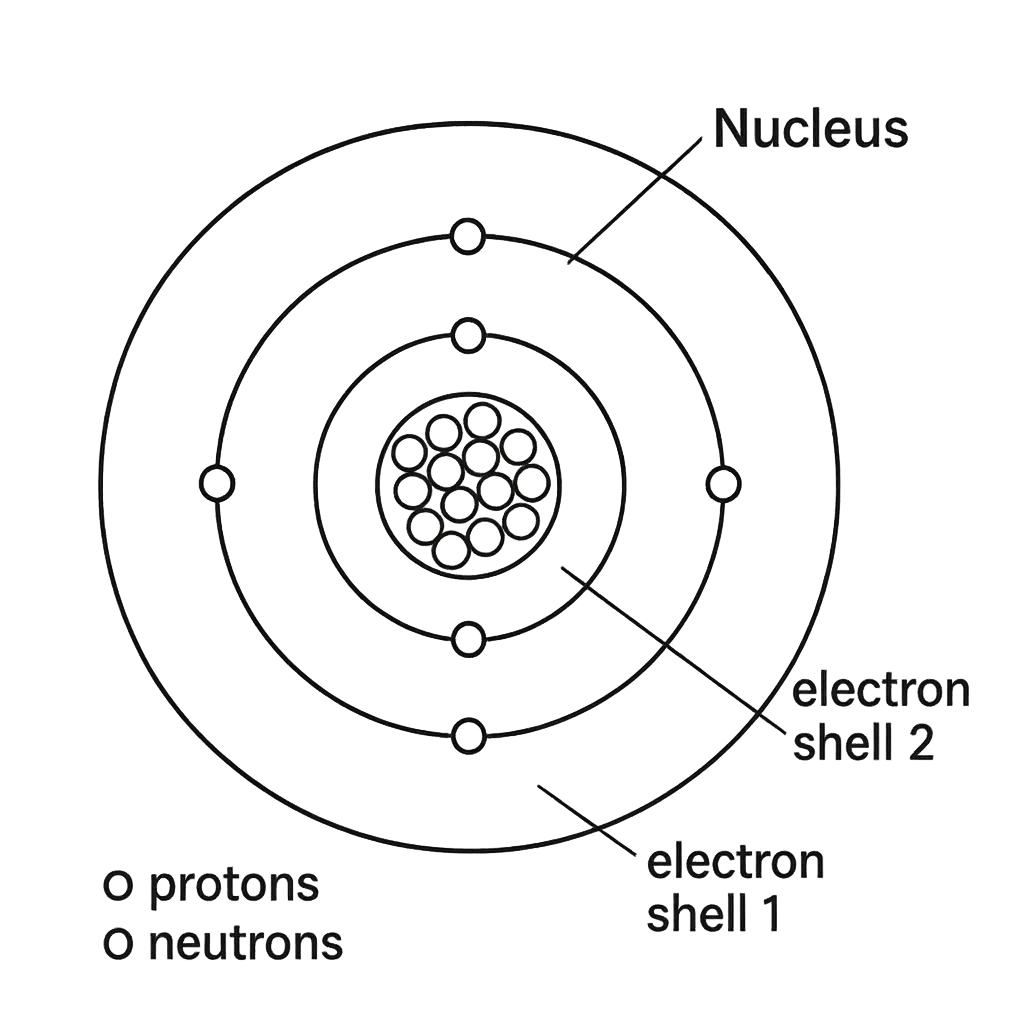
Question 1 View Details
The diagram shows a simplified Bohr model of an unknown element X.
Question Parts
(a)
Identify the element (provide its name and chemical symbol).
(b)
Write the mass number of the most abundant isotope of X shown in the diagram.
(c)
State the ground‑state electron configuration of X using the Aufbau principle (write in the form 1s² 2s² 2p⁶ …).
(d)
X forms a mono‑atomic cation X⁺ by loss of one electron. Assuming the radius of the neutral atom is 140 pm and that the effective nuclear charge increases by 0.5 units for each electron removed, estimate the ionic radius of X⁺ using the proportionality r ∝ 1/Z_eff.
Detailed Essay Solution & Marking Scheme Available

Get the step-by-step mathematical proofs, key points required by examiners, and a comprehensive breakdown from our AI Tutor.
Question 2 View Details
The diagram shows a coordination complex. The central atom is labelled "M" and is surrounded tetrahedrally by four identical ligands each labelled "L". Each ligand is an ammonia molecule (NH₃). A sulphate ion (SO₄²⁻) and a water molecule (H₂O) are shown as counter‑ions attached to the complex. The following information is given: - The metal atom M belongs to period 4 of the periodic table. - In this complex the metal exhibits a +2 oxidation state. - The atomic radius of M is 128 pm. - Standard atomic masses (g mol⁻¹) are: Cu = 63.55, N = 14.01, H = 1.008, O = 16.00, S = 32.07. Using the diagram and the data above, answer the questions that follow.
Question Parts
(a)
Identify the element represented by M. Justify your choice using the period, oxidation state and atomic radius information.
(b)
Write the electron configuration of the metal atom in its ground state and in the +2 oxidation state present in the complex.
(c)
Calculate the molar mass of the complex [Cu(NH₃)₄]SO₄·H₂O. Show all steps.
(d)
Using crystal‑field theory for a tetrahedral complex, determine the number of unpaired electrons on the metal centre and state whether the complex is paramagnetic or diamagnetic. Explain your reasoning.
(e)
Discuss how the position of copper in the periodic table influences (i) its common oxidation states and (ii) the typical colour observed for its coordination complexes.
Detailed Essay Solution & Marking Scheme Available

Get the step-by-step mathematical proofs, key points required by examiners, and a comprehensive breakdown from our AI Tutor.

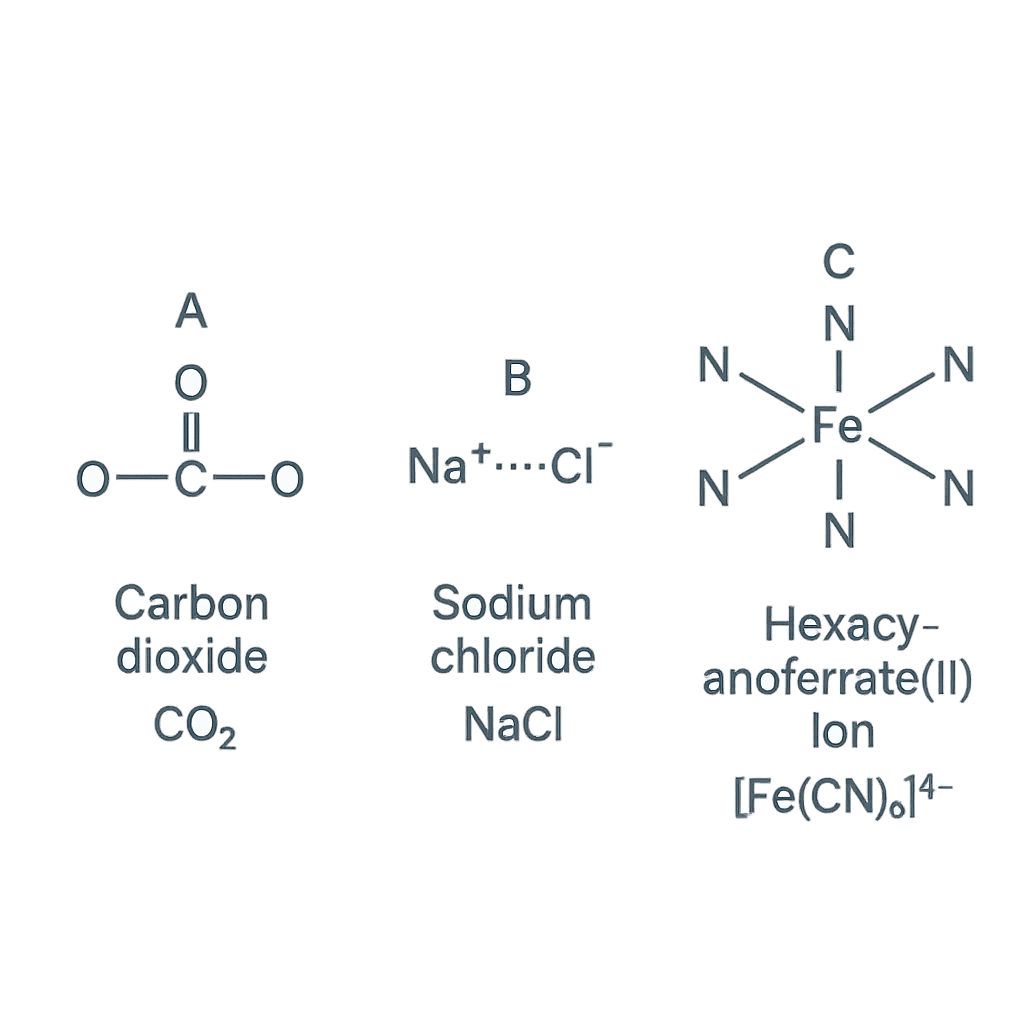
Question 3 View Details
The labelled diagram shows three different chemical species: (A) carbon dioxide, CO₂, with a central carbon atom double‑bonded to two oxygen atoms. (B) sodium chloride, NaCl, represented as a Na⁺ cation adjacent to a Cl⁻ anion with a dotted ionic bond. (C) the octahedral complex ion [Fe(CN)₆]⁴⁻, where a central Fe atom is surrounded by six cyanide ligands (C≡N).
Question Parts
(a)
Identify the type of bond present in each of the three species (A), (B) and (C). State the bond order or nature for each bond you mention.
(b)
State the molecular geometry of each species and give a brief justification based on VSEPR or crystal‑field considerations.
(c)
Discuss the polarity of each species and the consequences for their physical properties (solubility, melting point, etc.).
(d)
For the complex ion [Fe(CN)₆]⁴⁻, determine the oxidation state of the central Fe atom and explain how the nature of the CN⁻ ligand influences the colour of the complex.
Detailed Essay Solution & Marking Scheme Available

Get the step-by-step mathematical proofs, key points required by examiners, and a comprehensive breakdown from our AI Tutor.

Question 4 View Details
The structural diagram of an organic compound is shown in the illustration. The diagram depicts a straight chain of six carbon atoms (C1–C6). Each of the first five carbon atoms (C1–C5) is bonded to a single hydroxyl group (–OH). The sixth carbon atom (C6) is bonded to a –CH2OH group, i.e., it is attached to a hydroxyl group and two hydrogen atoms. The molar mass of the compound is given as 180 g·mol⁻¹.
Question Parts
(a)
From the structural diagram, determine the empirical formula of the compound.
(b)
Using the empirical formula obtained in part (a) and the given molar mass (180 g·mol⁻¹), calculate the molecular formula of the compound.
(c)
Calculate the percentage by mass of carbon, hydrogen and oxygen in the compound.
(d)
A 2.50 g sample of the compound is completely combusted in excess oxygen.
() Write the balanced chemical equation for the combustion of the compound.
() Calculate the volume of CO₂ produced at STP.
Detailed Essay Solution & Marking Scheme Available

Get the step-by-step mathematical proofs, key points required by examiners, and a comprehensive breakdown from our AI Tutor.

Question 5 View Details
A sample of aluminium metal weighing 4.50 g is reacted with an excess of aqueous copper(II) sulfate solution. The balanced chemical equation for the reaction is: 2 Al(s) + 3 CuSO₄(aq) → Al₂(SO₄)₃(aq) + 3 Cu(s)
Question Parts
(a)
Identify the limiting reagent and calculate the theoretical mass of copper that can be produced.
(b)
After filtration, 5.10 g of copper is recovered. Calculate the percentage yield of copper.
(c)
The recovered copper is subsequently dissolved in nitric acid and crystallised as copper(II) nitrate, giving 4.80 g of crystals. Discuss possible reasons for the loss in mass between the filtered copper and the final crystals.
Detailed Essay Solution & Marking Scheme Available

Get the step-by-step mathematical proofs, key points required by examiners, and a comprehensive breakdown from our AI Tutor.

Question 6 View Details
A 2.00 g sample of a non‑volatile solute is dissolved in 100.0 g of water. The freezing point of the resulting solution is observed to be –0.52 °C.
Question Parts
(a)
Calculate the molar mass of the solute using the freezing point depression data. (K_f for water = 1.86 °C·kg·mol⁻¹.)
(b)
The solution is then heated and the temperature at which its vapour pressure reaches 100 kPa is recorded as 78.0 °C. Given that the normal boiling point of pure water is 100 °C at 101.3 kPa, explain qualitatively how the presence of the solute affects the boiling point and vapour pressure.
(c)
Sketch a qualitative heating curve for the solution, indicating the positions of the freezing point, boiling point, and any phase changes. Comment on how the curve differs from that of pure water.
Detailed Essay Solution & Marking Scheme Available

Get the step-by-step mathematical proofs, key points required by examiners, and a comprehensive breakdown from our AI Tutor.

Question 7 View Details
A student prepares a buffer solution by dissolving 0.20 mol of acetic acid (CH₃COOH, Ka = 1.8 × 10⁻⁵) and 0.15 mol of sodium acetate (CH₃COONa) in enough water to make 1.00 L of solution.
Question Parts
(a)
Write the net ionic equation for the dissociation of acetic acid in water.
(b)
Calculate the pH of the buffer solution prepared above. State any assumptions you make.
(c)
Explain qualitatively what will happen to the pH if 0.05 mol of HCl is added to the buffer, and then calculate the new pH after the addition.
Detailed Essay Solution & Marking Scheme Available

Get the step-by-step mathematical proofs, key points required by examiners, and a comprehensive breakdown from our AI Tutor.

Question 8 View Details
Calcium fluoride, CaF₂, is a sparingly soluble salt with a solubility product Ksp = 1.46 × 10⁻¹⁰ at 25 °C.
Question Parts
(a)
Write the expression for the solubility product of CaF₂.
(b)
Calculate the molar solubility (s) of CaF₂ in pure water at 25 °C.
(c)
A solution is prepared by dissolving 0.10 mol of NaF in 1.00 L of water. Determine the maximum amount (in grams) of CaF₂ that can be added to this solution before precipitation of CaF₂ begins.
(d)
The solution is now heated to 35 °C, at which temperature the Ksp of CaF₂ increases to 2.5 × 10⁻¹⁰. Assuming the solution remains saturated with respect to CaF₂, answer the following:
Detailed Essay Solution & Marking Scheme Available

Get the step-by-step mathematical proofs, key points required by examiners, and a comprehensive breakdown from our AI Tutor.

Question 9 View Details
Manganese(VII) oxide ions (MnO₄⁻) are used to oxidise ferrous ions (Fe²⁺) in an acidic medium. A 25.0 cm³ sample of an aqueous Fe²⁺ solution contains exactly 0.0100 mol of Fe²⁺. The titration is performed with a standard potassium permanganate solution of concentration 0.0200 mol dm⁻³.
Question Parts
(a)
State the oxidation number of manganese in MnO₄⁻ and of iron in Fe²⁺.
(b)
Write the balanced half‑reaction for the reduction of MnO₄⁻ in acidic solution and the balanced half‑reaction for the oxidation of Fe²⁺.
(c)
Combine the half‑reactions to give the overall balanced redox equation for the titration.
(d)
Calculate the volume of the 0.0200 mol dm⁻³ KMnO₄ solution required to titrate the 0.0100 mol of Fe²⁺ completely.
(e)
Explain why the titration must be carried out in an acidic medium.
Detailed Essay Solution & Marking Scheme Available

Get the step-by-step mathematical proofs, key points required by examiners, and a comprehensive breakdown from our AI Tutor.

Question 10 View Details
A galvanic cell is constructed using a copper electrode immersed in 0.10 M Cu²⁺ solution and a silver electrode immersed in 0.010 M Ag⁺ solution. The standard reduction potentials are E°(Cu²⁺/Cu) = +0.34 V and E°(Ag⁺/Ag) = +0.80 V at 25 °C.
Question Parts
(a)
Write the cell notation for the described cell.
(b)
State the overall cell reaction and calculate the standard cell potential, E°cell.
(c)
Using the Nernst equation at 25 °C, calculate the cell potential when [Cu²⁺] = 0.10 M and [Ag⁺] = 0.010 M.
(d)
If the concentration of Cu²⁺ is increased to 1.0 M while [Ag⁺] remains 0.010 M, predict qualitatively how the cell potential changes and justify your answer.
Detailed Essay Solution & Marking Scheme Available

Get the step-by-step mathematical proofs, key points required by examiners, and a comprehensive breakdown from our AI Tutor.

Master the Exam!

You've seen a preview, but there are thousands more questions plus AI tutor to break down complex solutions.

Unlock Full Access Available for Android & Windows
Help others prepare! Share this practice hub:
Chat with Support