gce model questions vol1 2025 agricultural_science | Objective

Prepare for your exams with gce model questions vol1 questions? Reviewing past/model questions is one of the most effective ways to guarantee a high score. This practice hub features authentic 2025 agricultural_science (Objective) questions designed to simulate the real exam environment.

Practice these randomly selected questions to test your readiness.

Question 1 View Details
A rectangular field of 12 ha has a length of 400 m. A tractor equipped with a plough of nominal width 0.75 m experiences a 10 % overlap between successive passes. The tractor moves at 5 km h^{-1} and the overall field efficiency (including turning) is 80 %. Assuming the plough is operated at the effective width throughout, calculate the total time, in hours (to one decimal place), required to plough the whole field.
A. 40.2
Correct B. 44.5
C. 48.7
D. 52.0

Correct Answer: B

Want to see the full step-by-step solution? Unlock AI Explanation & Analytics
Question 2 View Details
A 50‑ha pine plantation is stocked at 800 trees ha^{-1}. Each tree has an initial DBH of 25 cm and a height of 20 m. The mean annual increment in timber volume is 2.5 m³ ha^{-1} yr^{-1}. The rotation age is 30 yr. After final harvest, at least 15 % of the original basal area must remain on site to protect the soil. The volume of an individual tree can be estimated by V = 0.00005·DBH^{2}·height (with DBH in cm and height in m). Determine the total volume of timber (in m³, rounded to the nearest whole number) that can be sustainably harvested from the whole plantation at the end of the rotation.
A. 22100
Correct B. 24438
C. 20000
D. 26000

Correct Answer: B

Want to see the full step-by-step solution? Unlock AI Explanation & Analytics
Question 3 View Details
A fish pond is initially stocked with 10 000 fish. The population follows logistic growth with intrinsic rate r = 0.4\,yr^{-1} and carrying capacity K = 50\,000 fish. Each year, 5 % of the fish die from disease, and a constant number H of fish are harvested. The manager requires that the population never falls below 8 000 fish. What is the greatest integer value of H (fish per year) that can be harvested indefinitely while satisfying this constraint?
A. 2200
B. 2100
Correct C. 2153
D. 1999

Correct Answer: C

Want to see the full step-by-step solution? Unlock AI Explanation & Analytics
Question 4 View Details
A farmer cultivates maize on a 5‑ha field. The yield response to nitrogen fertilizer (N, in kg ha^{-1}) is described by Y = 2 + 0.04N - 0.0002N^{2} tonnes ha^{-1} (valid for 0 \le N \le 200). Maize sells for ₦150 kg^{-1}. Nitrogen fertilizer costs ₦30 kg^{-1}, and other costs are fixed at ₦20 000 ha^{-1}. Determine the nitrogen rate (kg ha^{-1}, rounded to the nearest whole number) that maximises profit per hectare, and state the maximum profit (in ₦, rounded to the nearest whole number).
Correct A. 100; 577000
B. 110; 590000
C. 80; 540000
D. 90; 560000

Correct Answer: A

Want to see the full step-by-step solution? Unlock AI Explanation & Analytics
Question 5 View Details
A motor‑driven sprayer must deliver a flow of 12 L min^{-1} at a pressure of 2 bar. The pump efficiency is 70 % and the engine mechanical efficiency is 85 %. Diesel fuel has an energy content of 38 MJ L^{-1}. Calculate the minimum volume of diesel (in litres, to four decimal places) that must be consumed per hour to operate the sprayer at the required rate.
Correct A. 0.0064
B. 0.0102
C. 0.0085
D. 0.0048

Correct Answer: A

Want to see the full step-by-step solution? Unlock AI Explanation & Analytics
Question 6 View Details
A farmer wishes to prepare a \(5\)‑hectare field using a rotary tiller that is \(0.6\) m wide and can travel at \(5\) km h\(^{-1}\). The farmer wants the field ready in \(6\) hours. (i) Assuming each tiller works continuously with no overlap, calculate the minimum number of tillers required. (ii) If each tiller costs ₦250 000 and the farmer's budget is ₦600 000, state whether the plan is feasible. (iii) If the plan is not feasible, determine the maximum area (in hectares) that can be prepared within the \(6\)-hour limit using the number of tillers that can be purchased.
A. 2 tillers required; feasible within budget; with 2 tillers the maximum area that can be prepared in 6 h is 4.8 ha.
Correct B. 3 tillers required; not feasible within budget; with 2 tillers the maximum area that can be prepared in 6 h is 3.6 ha.
C. 4 tillers required; not feasible within budget; with 3 tillers the maximum area that can be prepared in 6 h is 5.4 ha.
D. 3 tillers required; feasible within budget; with 3 tillers the maximum area that can be prepared in 6 h is 5.4 ha.

Correct Answer: B

Want to see the full step-by-step solution? Unlock AI Explanation & Analytics
Question 7 View Details
A diesel tractor rated at \(50\) kW consumes \(0.25\) L kWh⁻¹ at full load. When pulling a plough it operates at \(70\)% of its rated power for \(4\) hours. Diesel costs ₦180 per litre. (i) Calculate the total fuel used and its cost. (ii) If the plough covers \(12\) ha in that time, find the average fuel cost per hectare. (iii) A newer tractor of the same power consumes only \(0.20\) L kWh⁻¹ at the same load. Determine the percentage reduction in fuel cost per hectare when the newer tractor is used.
A. Fuel used: 40 L; total cost: ₦7 200; cost per hectare: ₦600. With the newer tractor cost per hectare falls to ₦480, a 20 % reduction.
B. Fuel used: 28 L; total cost: ₦5 040; cost per hectare: ₦420. With the newer tractor cost per hectare falls to ₦336, a 20 % reduction.
C. Fuel used: 35 L; total cost: ₦6 300; cost per hectare: ₦525. With the newer tractor cost per hectare falls to ₦450, a 14 % reduction.
Correct D. Fuel used: 35 L; total cost: ₦6 300; cost per hectare: ₦525. With the newer tractor cost per hectare falls to ₦420, a 20 % reduction.

Correct Answer: D

Want to see the full step-by-step solution? Unlock AI Explanation & Analytics
Question 8 View Details
A rabbit farm keeps two breeds. Breed A gains \(30\) g day⁻¹ and has a feed conversion ratio (FCR) of \(3.5\) kg feed kg⁻¹ gain. Breed B gains \(45\) g day⁻¹ with an FCR of \(4.2\). The farm has \(200\) kg of feed available each day. (i) Determine the maximum number of rabbits of each breed that could be reared alone without exceeding the daily feed supply. (ii) Assuming the farmer wants to maximise total daily weight gain, find the optimal mix of the two breeds and the resulting total daily gain (in kg).
Correct A. Maximum if only Breed A: 1 904 rabbits; maximum if only Breed B: 1 058 rabbits. Optimal mix: 1 904 Breed A rabbits and 0 Breed B rabbits, giving a total daily weight gain of 57.12 kg.
B. Maximum if only Breed A: 1 904 rabbits; maximum if only Breed B: 1 058 rabbits. Optimal mix: 1 000 Breed A rabbits and 500 Breed B rabbits, giving a total daily weight gain of 52.50 kg.
C. Maximum if only Breed A: 1 800 rabbits; maximum if only Breed B: 1 200 rabbits. Optimal mix: 1 200 Breed B rabbits and 0 Breed A rabbits, giving a total daily weight gain of 54.00 kg.
D. Maximum if only Breed A: 2 000 rabbits; maximum if only Breed B: 950 rabbits. Optimal mix: 1 500 Breed A rabbits and 300 Breed B rabbits, giving a total daily weight gain of 60.45 kg.

Correct Answer: A

Want to see the full step-by-step solution? Unlock AI Explanation & Analytics
Question 9 View Details
A farmer harvests \(5\) tonnes of maize with an initial moisture content of \(25\)% (wet basis). The target moisture for safe storage is \(13\)% (wet basis). The dryer operates at a constant temperature of \(60\)°C and the instantaneous drying rate (kg h⁻¹) follows \(R = 0.8\sqrt{M_i - M_f}\), where \(M_i\) is the current moisture percentage and \(M_f = 13\) is the target moisture. Assuming moisture declines uniformly from \(25\)% to \(13\)% and the rate updates continuously, estimate the total drying time required. If the dryer can run a maximum of \(12\) hours per day, determine the minimum number of days needed to dry the whole batch.
Correct A. Approximately 475 hours of drying time, which corresponds to a minimum of 40 days when the dryer can operate 12 hours per day.
B. Approximately 350 hours of drying time, which corresponds to a minimum of 30 days when the dryer can operate 12 hours per day.
C. Approximately 600 hours of drying time, which corresponds to a minimum of 50 days when the dryer can operate 12 hours per day.
D. Approximately 475 hours of drying time, which corresponds to a minimum of 35 days when the dryer can operate 12 hours per day.

Correct Answer: A

Want to see the full step-by-step solution? Unlock AI Explanation & Analytics
Question 10 View Details
An agricultural extension programme aims to promote a new high‑yielding maize variety to a maximum of \(200\) smallholder farms over three years. Adoption follows the logistic model \(A(t)=\frac{K}{1+e^{-r(t-t_0)}}\) where \(K=200\) is the ceiling, \(r\) the intrinsic adoption rate and \(t_0\) the inflection year (50 % adoption). Pilot data show \(30\) farms adopted after year 1 and \(80\) farms after year 2. (i) Determine the values of \(r\) and \(t_0\). (ii) Predict the number of adopters at the end of year 3. (iii) Each adopting farm yields an extra \(1.5\) tonnes of maize valued at ₦150 000 per tonne. Calculate the total additional economic benefit at year 3 and state whether it meets a target benefit of ₦30 000 000.
A. r ≈ 1.60 yr⁻¹, t₀ ≈ 2.80 yr; predicted adopters at year 3 ≈ 158 farms; total additional benefit ≈ ₦35.6 million, which exceeds the ₦30 million target.
B. r ≈ 1.10 yr⁻¹, t₀ ≈ 2.00 yr; predicted adopters at year 3 ≈ 125 farms; total additional benefit ≈ ₦28.1 million, which does not meet the ₦30 million target.
Correct C. r ≈ 1.33 yr⁻¹, t₀ ≈ 2.31 yr; predicted adopters at year 3 ≈ 143 farms; total additional benefit ≈ ₦32.2 million, which exceeds the ₦30 million target.
D. r ≈ 0.85 yr⁻¹, t₀ ≈ 1.90 yr; predicted adopters at year 3 ≈ 110 farms; total additional benefit ≈ ₦24.9 million, which does not meet the ₦30 million target.

Correct Answer: C

Want to see the full step-by-step solution? Unlock AI Explanation & Analytics
Question 11 View Details
A field has a soil pH of 5.5. The farmer wants to raise the pH to 6.5. The soil's buffer capacity is 0.5 pH units per tonne of agricultural lime applied per hectare. How many tonnes of lime are required per hectare?
Correct A. 2
B. 3
C. 1
D. 4

Correct Answer: A

Want to see the full step-by-step solution? Unlock AI Explanation & Analytics
Question 12 View Details
A poultry farmer keeps 120 broiler chickens for 6 weeks. Each bird requires 150 g of protein and 3000 kcal of metabolizable energy per day. The feed available contains 12 % protein and provides 2800 kcal per kilogram. Determine the minimum amount of feed (in kilograms) that must be given to each bird per day, and then calculate the total feed required for the whole flock over the entire 6‑week period.
A. 7200
Correct B. 6300
C. 5400
D. 6600

Correct Answer: B

Want to see the full step-by-step solution? Unlock AI Explanation & Analytics
Question 13 View Details
A farmer intends to cultivate maize on 5 ha. The one‑time fixed cost is ₦250 000 per hectare. Variable costs are ₦80 000 per hectare in the first year and increase by 5 % each subsequent year. Expected yield is 3.5 t per hectare. The market price is ₦100 000 per tonne in the first year and rises by 8 % annually. Assuming no other costs, after how many whole years will the cumulative profit exceed ₦3 000 000?
Correct A. 3
B. 5
C. 4
D. 2

Correct Answer: A

Want to see the full step-by-step solution? Unlock AI Explanation & Analytics
Question 14 View Details
In a 2‑ha wheat field, a fungal disease initially infects 8 % of the plants. Each week a fungicide is applied that kills 60 % of the infected plants, but new infections arise at a rate of 5 % of the remaining healthy plants. Using a recurrence relation, determine after how many weeks the disease incidence will fall below 2 %.
A. The incidence falls below 2 % after 9 weeks.
B. The incidence never falls below 2 % (it stabilises at about 6.5 %).
Correct C. The incidence never falls below 2 % (it stabilises at about 8.1 %).
D. The incidence falls below 2 % after 4 weeks.

Correct Answer: C

Want to see the full step-by-step solution? Unlock AI Explanation & Analytics
Question 15 View Details
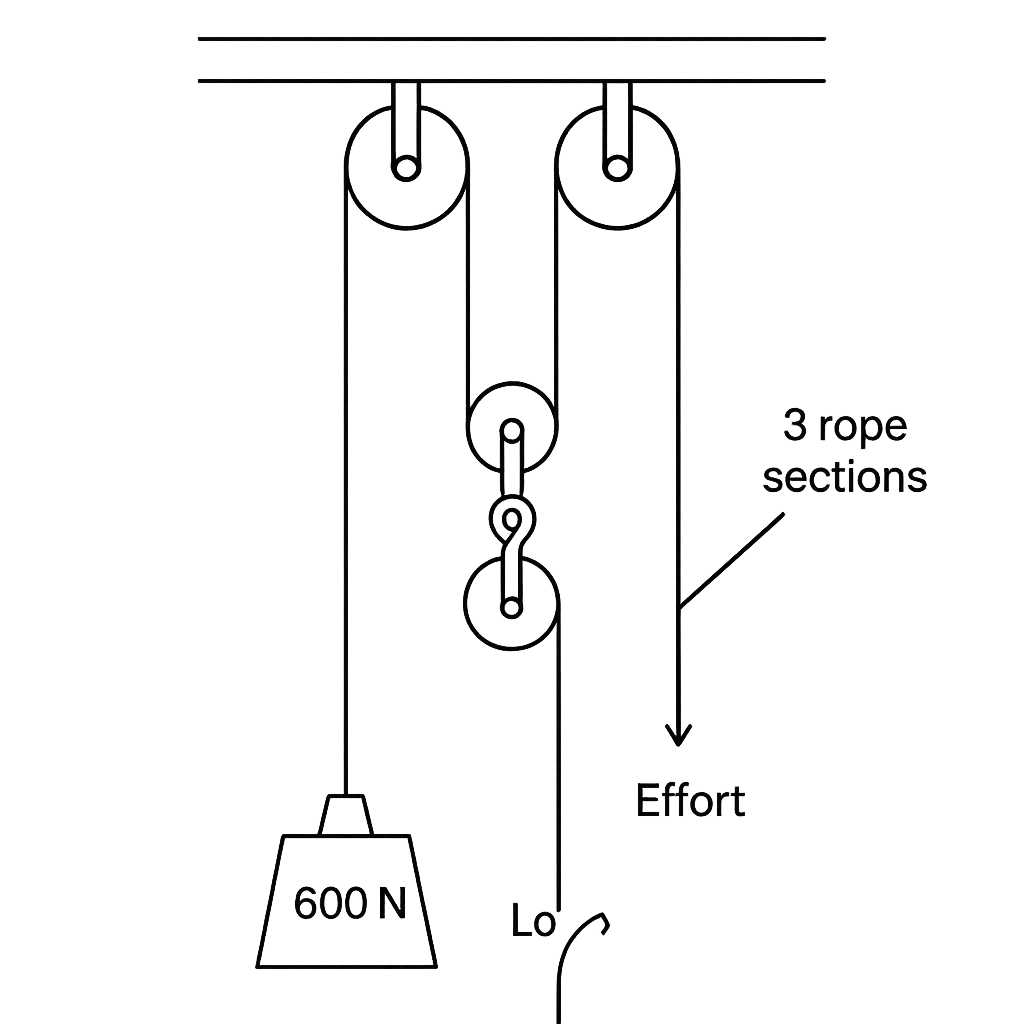
The diagram shows a block‑and‑tackle system consisting of two fixed pulleys mounted on a ceiling and one movable pulley attached to a load of 600 N. The rope passes over the fixed pulleys and under the movable pulley, forming three supporting rope sections. The system operates with an overall efficiency of 85 %. What is the magnitude of the effort force that must be applied to the free end of the rope to hold the load stationary?
A. 220
B. 250
Correct C. 235.3
D. 200

Correct Answer: C

Want to see the full step-by-step solution? Unlock AI Explanation & Analytics
Question 16 View Details
Consider a plantation of a fast‑growing timber species covering 100 ha. Each hectare is initially stocked with 80 trees of average DBH 10 cm. The volume (m³) of a single tree can be estimated by \(V = 0.0001\,\text{DBH}^{2.5}\). DBH increases linearly by 0.5 cm each year. The timber price is N 150 per m³ and the cost of re‑planting after a clear‑cut is N 2000 per ha. Using a discount rate of 5 % per annum, determine the rotation age (in whole years) that maximises the net present value per hectare. Assume the whole stand is harvested at the end of the rotation.
A. 32
B. 35
C. 28
Correct D. 30

Correct Answer: D

Want to see the full step-by-step solution? Unlock AI Explanation & Analytics
Question 17 View Details
An 5‑ha wheat field initially has a rust incidence of 20 %. A fungicide reduces the current incidence by 60 % each time it is applied. Each application costs N 150 per ha. An infected plant loses 0.8 kg of grain; the market price of wheat is N 0.5 per kg. The farmer can apply the fungicide at most twice during the season. Should the farmer apply the fungicide twice, and what is the resulting change in profit for the whole 5‑ha farm compared with doing nothing? Give your answer as "Yes, profit increases by N xxxx" or "No, profit decreases by N xxxx".
A. No, profit decreases by N 300
B. Yes, profit increases by N 1500
C. Yes, profit increases by N 2100
Correct D. Yes, profit increases by N 1860

Correct Answer: D

Want to see the full step-by-step solution? Unlock AI Explanation & Analytics
Question 18 View Details
A dairy farm incurs fixed overheads of N 5000 per month. The variable cost per cow per month (feed, health, etc.) is N 120. Each cow yields an average of 20 L of milk per day, sold at N 0.45 per litre. How many cows are required to break even for the month? Give the smallest whole number of cows.
A. 40
Correct B. 34
C. 33
D. 35

Correct Answer: B

Want to see the full step-by-step solution? Unlock AI Explanation & Analytics
Question 19 View Details
Broiler chickens are reared for 42 days. For the first 21 days they are fed Feed A (cost N 0.30 kg⁻¹, 3000 kcal kg⁻¹, 20 % protein); for the remaining 21 days they are fed Feed B (cost N 0.25 kg⁻¹, 3200 kcal kg⁻¹, 18 % protein). Each bird requires 300 kcal and 0.2 g protein per day. At slaughter the average live weight is 2.2 kg, sold at N 1.20 kg⁻¹. Ignoring all other costs, calculate (a) the total feed cost per bird (to two decimal places) and (b) the net profit per bird (to two decimal places).
A. Feed cost N 0.98; profit N 1.70
B. Feed cost N 1.20; profit N 1.40
Correct C. Feed cost N 1.12; profit N 1.52
D. Feed cost N 1.05; profit N 1.60

Correct Answer: C

Want to see the full step-by-step solution? Unlock AI Explanation & Analytics
Question 20 View Details
Field operations require the following labour‑day inputs per hectare: ploughing 2 days, sowing 1.5 days, harvesting 2.5 days. The farm cultivates 8 ha of wheat (which needs ploughing, sowing and harvesting) and 5 ha of barley (which needs only ploughing and harvesting). The farm has 30 labour‑days available each week and plans to complete all operations within 4 weeks. Can the farm finish all work in the allotted time? Answer "Yes, with xx spare labour‑days" or "No, short of xx labour‑days".
Correct A. Yes, with 49.5 spare labour-days
B. Yes, with 39.5 spare labour-days
C. Yes, with 59.5 spare labour-days
D. No, short of 9.5 labour-days

Correct Answer: A

Want to see the full step-by-step solution? Unlock AI Explanation & Analytics
Question 21 View Details
A wheat farm has a total cost function \(TC = 0.02Q^{2} + 5Q + 100\) (in Naira) where \(Q\) is the output in tonnes. The market demand price is given by \(P = 200 - 0.1Q\) (Naira per tonne). Determine the output level that maximizes profit and calculate the maximum profit.
Correct A. Output = 812.5 tonnes; Maximum profit = 79,118.75 Naira
B. Output = 750 tonnes; Maximum profit = 70,000 Naira
C. Output = 800 tonnes; Maximum profit = 78,000 Naira
D. Output = 850 tonnes; Maximum profit = 80,500 Naira

Correct Answer: A

Want to see the full step-by-step solution? Unlock AI Explanation & Analytics
Question 22 View Details
A fish population follows logistic growth \(\frac{dN}{dt}= rN\left(1-\frac{N}{K}\right)\) with intrinsic rate \(r = 0.5\) yr⁻¹ and carrying capacity \(K = 200{,}000\) tonnes. Harvest follows \(H = cEN\) where catchability \(c = 0.0001\) tonne per boat‑day and effort \(E\) is measured in boat‑days per year. Determine the effort that gives the maximum sustainable yield (MSY) and compute that yield.
A. Effort = 2,500 boat‑days/year; MSY = 22,500 tonnes/year
B. Effort = 2,000 boat‑days/year; MSY = 20,000 tonnes/year
C. Effort = 3,000 boat‑days/year; MSY = 30,000 tonnes/year
Correct D. Effort = 2,500 boat‑days/year; MSY = 25,000 tonnes/year

Correct Answer: D

Want to see the full step-by-step solution? Unlock AI Explanation & Analytics
Question 23 View Details
For a maize field of 5 ha, the economic injury level (EIL) for stem borer is given by \(EIL = \frac{C}{V\times D\times K}\). The cost of pesticide per hectare is \(C = 1{,}200\) Naira, market price of maize is \(V = 15\) Naira kg⁻¹, each borer causes a loss of \(D = 0.8\) kg ha⁻¹, and pesticide efficacy is \(K = 0.75\).\n\n(a) Calculate the threshold pest density (pests ha⁻¹) at which control is justified.\n(b) If the observed density is 150 pests ha⁻¹, determine the net monetary benefit per hectare of applying the pesticide.
A. EIL ≈ 150 pests/ha; Net benefit = 120 Naira/ha
Correct B. EIL ≈ 133 pests/ha; Net benefit = 150 Naira/ha
C. EIL ≈ 100 pests/ha; Net benefit = 160 Naira/ha
D. EIL ≈ 115 pests/ha; Net benefit = 140 Naira/ha

Correct Answer: B

Want to see the full step-by-step solution? Unlock AI Explanation & Analytics
Question 24 View Details
The diffusion of a new agricultural extension technology among farmers can be modelled by the Bass model: \(f(t) = \bigl(p + q\,\frac{Y(t)}{M}\bigr)\bigl(M - Y(t)\bigr)\), where \(p\) is the coefficient of innovation, \(q\) the coefficient of imitation, \(M\) the total market potential, and \(Y(t)\) the cumulative adopters at the end of year \(t\). Given \(p = 0.02\), \(q = 0.38\), \(M = 10{,}000\) farmers, and \(Y(3) = 2{,}500\) farmers, estimate: (a) the number of new adopters in year 4, and (b) the cumulative adoption percentage at the end of year 4.
Correct A. New adopters ≈ 863; Cumulative adoption ≈ 3,363 farmers (33.6 %)
B. New adopters ≈ 750; Cumulative adoption ≈ 3,200 farmers (32.0 %)
C. New adopters ≈ 800; Cumulative adoption ≈ 3,100 farmers (31.0 %)
D. New adopters ≈ 950; Cumulative adoption ≈ 3,500 farmers (35.0 %)

Correct Answer: A

Want to see the full step-by-step solution? Unlock AI Explanation & Analytics
Question 25 View Details
A farmer applies 120 kg of nitrogen fertilizer per hectare. Of the applied nitrogen, 20 % is taken up by the crop, 30 % is lost by leaching, and 25 % is volatilised. How many kilograms of nitrogen remain in the soil after one growing season?
A. 36 kg N ha⁻¹
Correct B. 30 kg N ha⁻¹
C. 54 kg N ha⁻¹
D. 24 kg N ha⁻¹

Correct Answer: B

Want to see the full step-by-step solution? Unlock AI Explanation & Analytics

Master the Exam!

You've seen a preview, but there are thousands more questions plus AI tutor to break down complex solutions.

Unlock Full Access Available for Android & Windows
Help others prepare! Share this practice hub:
Chat with Support