gce model questions vol1 2025 agricultural_science | Essay

Prepare for your exams with gce model questions vol1 questions? Reviewing past/model questions is one of the most effective ways to guarantee a high score. This practice hub features authentic 2025 agricultural_science (Essay) questions designed to simulate the real exam environment.

Practice these randomly selected questions to test your readiness.

Question 1 View Details
A mixed‑cropping farm in the savanna zone has recently been converted to a continuous monoculture of maize. Using your knowledge of agricultural ecology, answer the following.
Question Parts
(a)
Explain how ecological succession in a fallow field contributes to soil fertility before the land is replanted.
(b)
Discuss three ways in which intercropping can enhance ecosystem services on a farm.
(c)
Evaluate the likely ecological consequences of converting the mixed‑cropping system to intensive monoculture of maize, considering soil structure, pest dynamics and carbon sequestration.
Detailed Essay Solution & Marking Scheme Available

Get the step-by-step mathematical proofs, key points required by examiners, and a comprehensive breakdown from our AI Tutor.
Question 2 View Details
A student carries out a laboratory experiment to determine the field capacity of a loamy soil sample using the apparatus shown.
Question Parts
(a)
Describe the step‑by‑step procedure the student should follow to obtain a reliable measurement of field capacity, including how to ensure the soil reaches field capacity before the final weighing.
(b)
The following data were recorded: - Dry weight of soil: 250 g - Weight of soil after saturation (immediately after water addition): 420 g - Weight of soil after 30 min drainage (field capacity): 380 g Calculate the field capacity of the soil expressed as a percentage of its total water‑holding capacity (the difference between saturated weight and dry weight).
(c)
Identify two possible sources of error in this experiment and suggest a method to minimise each error.
(d)
Explain how the field capacity value you obtained would influence irrigation scheduling for a maize crop in a semi‑arid region.
Detailed Essay Solution & Marking Scheme Available

Get the step-by-step mathematical proofs, key points required by examiners, and a comprehensive breakdown from our AI Tutor.

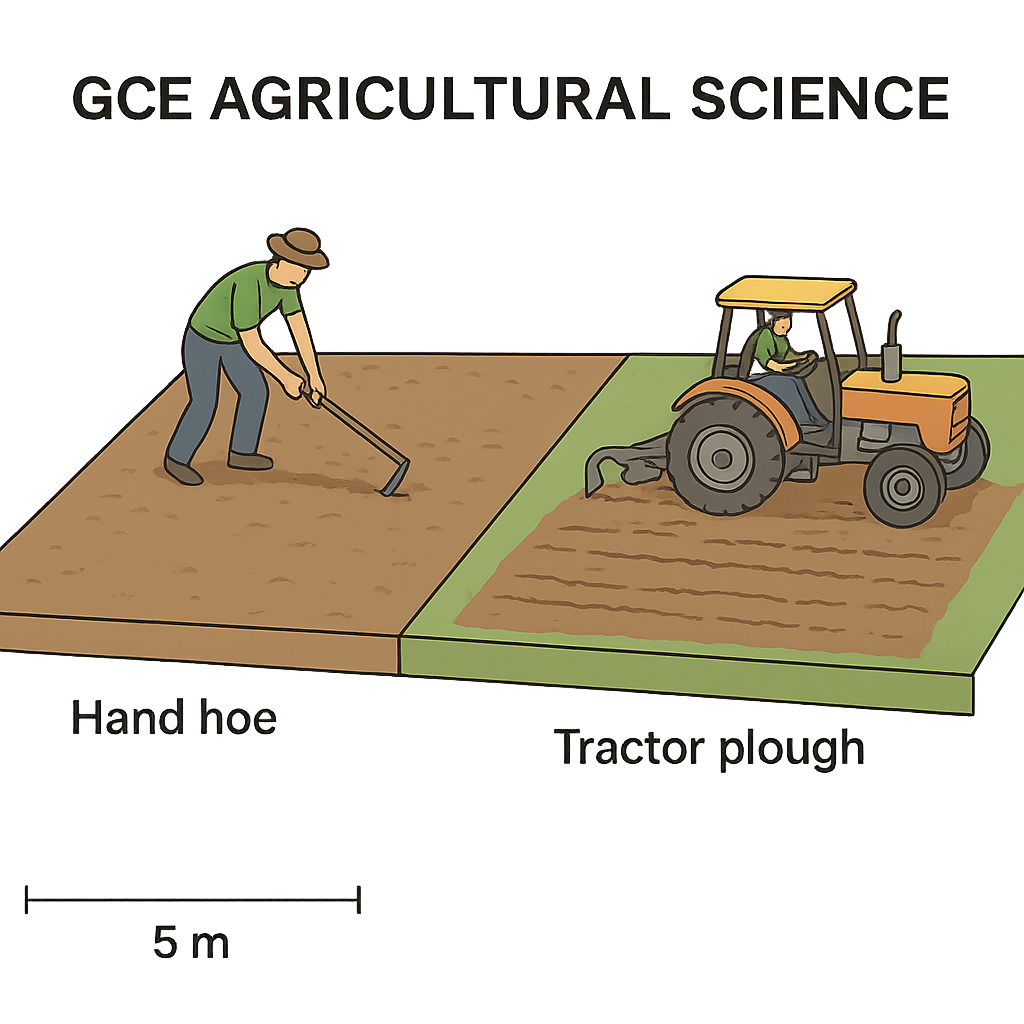
Question 3 View Details
A rectangular farm plot of 20 m × 10 m is divided into two equal sections. In the left section a farmer tills the soil using a hand hoe, while in the right section a small tractor equipped with a plough tills the soil. The depth of tillage is 15 cm for the hand hoe and 20 cm for the tractor plough. The plot is level and the soil type is loamy.
Question Parts
(a)
Explain the agronomic advantages of using a mechanical plough over a hand hoe for soil preparation in this context.
(b)
If the hand hoe tills soil at a rate of 0.5 m² per minute and the tractor plough tills at 2.5 m² per minute, calculate the time (in minutes) saved when the right‑hand section is tilled with the tractor instead of the hand hoe. Each section has an area of 100 m².
(c)
Assume the labour cost is ₦200 per hour and the fuel cost for operating the tractor is ₦150 per hour. Determine the net monetary saving (in ₦) when the right‑hand section is tilled with the tractor instead of the hand hoe.
Detailed Essay Solution & Marking Scheme Available

Get the step-by-step mathematical proofs, key points required by examiners, and a comprehensive breakdown from our AI Tutor.

Question 4 View Details
A wheat field of 2 ha produces a total grain yield of 12 tonnes. Two different post‑harvest methods are available: 1. A combine harvester that harvests and threshes simultaneously at a capacity of 5 tonnes per hour (fuel cost ₦300 per hour). 2. Manual harvesting using sickles at 2 tonnes per hour (labour cost ₦250 per hour) followed by threshing on a stationary threshing machine that processes 2 tonnes per hour (labour cost ₦250 per hour).
Question Parts
(a)
Discuss how the use of a combine harvester can affect post‑harvest losses compared with the manual method.
(b)
Calculate the total time required (in hours) to harvest and thresh the whole 12‑tonne yield using: (i) only the combine harvester; (ii) the manual method (harvest then thresh).
(c)
Using the cost data provided, determine the total monetary cost (in ₦) for each method and state which method is more economical.
Detailed Essay Solution & Marking Scheme Available

Get the step-by-step mathematical proofs, key points required by examiners, and a comprehensive breakdown from our AI Tutor.

Question 5 View Details
A farmer intends to establish a 2‑hectare field for a mixed cropping system involving maize and cowpea. The farmer plans to allocate 1.2 ha to maize and the remaining 0.8 ha to cowpea. The recommended plant population is 60 000 plants ha⁻¹ for maize and 250 000 plants ha⁻¹ for cowpea. Expected yields under good management are 5.0 t ha⁻¹ for maize and 1.2 t ha⁻¹ for cowpea. The farmer anticipates a 12 % loss in maize due to stem borer and an 8 % loss in cowpea due to pod borer. Market prices are ₦120 000 per tonne of maize and ₦180 000 per tonne of cowpea. Input costs are ₦45 000 ha⁻¹ for land preparation, ₦55 000 ha⁻¹ for fertiliser and ₦30 000 ha⁻¹ for pest control (applied to each crop separately).
Question Parts
(a)
Calculate the total number of maize plants and cowpea plants to be sown.
(b)
Estimate the net marketable yield (after the specified pest losses) for each crop in tonnes.
(c)
Compute the gross income from each crop and the total gross income for the whole field.
(d)
Determine the total variable cost for the 2 ha field and the net profit (gross income – total cost). Comment on the profitability of the proposed mixed crop system.
Detailed Essay Solution & Marking Scheme Available

Get the step-by-step mathematical proofs, key points required by examiners, and a comprehensive breakdown from our AI Tutor.

Question 6 View Details
A smallholder keeps a dairy herd of 20 milking cows. The average lactation length is 305 days and the average daily milk yield per cow is 15 L. The farmer wishes to improve the herd’s genetic merit by introducing a breeding programme that uses artificial insemination (AI) with a bull that has an 8 % higher milk‑yield potential. The cost of AI per service is ₦2 500 and each cow requires on average 1.2 services per successful conception. Feed cost is ₦120 per litre of milk produced (including concentrate and roughage). The price of milk is ₦180 per litre. Veterinary and other overhead costs amount to ₦150 000 per year.
Question Parts
(a)
Calculate the total annual milk production of the herd before the breeding programme.
(b)
Estimate the expected increase in total milk production after the programme, assuming the 8 % genetic gain is fully expressed across the herd.
Detailed Essay Solution & Marking Scheme Available

Get the step-by-step mathematical proofs, key points required by examiners, and a comprehensive breakdown from our AI Tutor.

Question 7 View Details
A farmer in the northern region of Nigeria cultivates maize on a 2‑hectare field. During the early rainy season, the farmer observes extensive leaf shredding and whorl damage. Laboratory scouting reports indicate the presence of two insect pests that are known to attack maize in this zone.
Question Parts
(a)
Identify two major insect pests that commonly affect maize in the northern region of Nigeria and describe the key stages of their life cycles that are relevant to field damage.
(b)
Initial scouting counted 2 000 individuals of the dominant pest per hectare. The population multiplies by a factor of 1.8 each week. The economic threshold for action is 5 000 individuals per hectare. Calculate after how many whole weeks the pest population will exceed the economic threshold on a per‑hectare basis.
(c)
Recommend an integrated pest management (IPM) plan for the farmer. In your answer include: (i) one cultural control measure, (ii) one biological control agent, (iii) a chemical control option. For the chemical control, the recommended pesticide is to be applied at 2.5 L of a 0.05 % active‑ingredient (AI) solution per hectare. The cost of the ready‑to‑use solution is ₦120 per litre and pure AI costs ₦15 per millilitre. Calculate the total volume of solution, the total volume of pure AI required for the whole 2‑ha field, and the total cost of the chemical control.
Detailed Essay Solution & Marking Scheme Available

Get the step-by-step mathematical proofs, key points required by examiners, and a comprehensive breakdown from our AI Tutor.

Question 8 View Details
An orchard of 5 ha of orange trees in southwestern Nigeria has recently shown sudden wilting, yellowing of leaves and premature fruit drop on several trees. Laboratory analysis of leaf samples isolated a fungus that produces conidia 5–7 µm long. The disease is known to be spread by wind‑borne spores and by contaminated pruning tools.
Question Parts
(a)
Name the disease most likely responsible for the observed symptoms and explain how each component of the disease triangle (host, pathogen, environment) contributes to its development in this orchard.
(b)
Assuming each infected tree can, on average, infect 1.5 new trees per week (through wind‑borne spores and contaminated tools), and that the orchard initially has 4 infected trees, determine after how many whole weeks at least 90 % of the orchard will be infected. The orchard density is 100 trees per hectare.
Detailed Essay Solution & Marking Scheme Available

Get the step-by-step mathematical proofs, key points required by examiners, and a comprehensive breakdown from our AI Tutor.

Question 9 View Details
A mixed livestock farm in northern Nigeria keeps a herd of 200 dairy cattle. Over the past year the farm recorded an incidence of Bovine Viral Diarrhoea (BVD) of 12 % among the herd. Infected cows produced on average 15 % less milk than healthy cows. The average daily milk yield of a healthy cow is 20 L. The market price of milk is ₦150 per litre.
Question Parts
(a)
Identify three major viral diseases of cattle that occur in Nigeria. For each disease state the causative agent and list at least two characteristic clinical signs.
(b)
For Bovine Viral Diarrhoea, describe its transmission cycle, emphasising the role of persistently infected (PI) animals. Recommend two practical control measures that are feasible for small‑holder dairy farms.
(c)
Using the data supplied, calculate the total annual milk loss (in litres) attributable to BVD in the herd. Show all steps of your calculation.
(d)
Estimate the monetary loss from the reduced milk production over a 365‑day year, using the given milk price. Briefly discuss how such losses affect the farm’s profitability and suggest one management practice that could mitigate the impact.
Detailed Essay Solution & Marking Scheme Available

Get the step-by-step mathematical proofs, key points required by examiners, and a comprehensive breakdown from our AI Tutor.

Question 10 View Details
A smallholder in the middle belt of Nigeria operates a mixed farm that cultivates maize and soybean on 2 ha each and rears 30 chickens and 10 goats. The following data apply:
Question Parts
(a)
Compute the gross margin for each enterprise (maize, soybean, poultry and goat) ignoring fixed overheads. Show all calculations.
(b)
Determine the overall farm gross margin by adding the margins of the four enterprises.
Detailed Essay Solution & Marking Scheme Available

Get the step-by-step mathematical proofs, key points required by examiners, and a comprehensive breakdown from our AI Tutor.

Master the Exam!

You've seen a preview, but there are thousands more questions plus AI tutor to break down complex solutions.

Unlock Full Access Available for Android & Windows
Help others prepare! Share this practice hub:
Chat with Support