gce model questions vol1 2024 physics | Objective

Prepare for your exams with gce model questions vol1 questions? Reviewing past/model questions is one of the most effective ways to guarantee a high score. This practice hub features authentic 2024 physics (Objective) questions designed to simulate the real exam environment.

Practice these randomly selected questions to test your readiness.

Question 1 View Details
A sample contains \(1.0\times10^{6}\) atoms of a radioactive isotope X‑60. X‑60 decays by \(\beta^{-}\) emission to Y‑60 with a half‑life of \(2.5\ \text{min}\) and releases \(1.2\ \text{MeV}\) per decay. The daughter Y‑60 subsequently decays by \(\alpha\) emission to stable Z‑56 with a half‑life of \(5\ \text{min}\) and releases \(4.5\ \text{MeV}\) per decay. Assuming the decays occur sequentially, calculate the total energy released (in joules) from all decays that have taken place after exactly \(10\ \text{min}\).
Correct A. 5.86×10⁻⁷ J
B. 4.12×10⁻⁷ J
C. 5.86×10⁻⁶ J
D. 6.45×10⁻⁷ J

Correct Answer: A

Want to see the full step-by-step solution? Unlock AI Explanation & Analytics
Question 2 View Details
A circular coil (coil 1) of radius \(0.10\ \text{m}\) with \(N_1=200\) turns carries a sinusoidal current \(I_1(t)=I_0\sin(\omega t)\) where \(I_0=5\ \text{A}\) and \(\omega=100\ \text{rad\,s}^{-1}\). A second single‑turn circular coil (coil 2) of radius \(0.05\ \text{m}\) is placed coaxially at a distance \(d=0.15\ \text{m}\) from coil 1. The mutual inductance between the coils is \(M=1.2\times10^{-5}\ \text{H}\). Coil 2 has a resistance \(R=0.8\ \Omega\). Determine (a) the maximum induced current in coil 2 and (b) the average power dissipated in coil 2 over one full cycle.
A. Maximum current = 7.5 mA; average power = 3.5×10⁻⁵ W
Correct B. Maximum current = 7.5 mA; average power = 2.3×10⁻⁵ W
C. Maximum current = 8.1 mA; average power = 2.9×10⁻⁵ W
D. Maximum current = 6.2 mA; average power = 1.8×10⁻⁵ W

Correct Answer: B

Want to see the full step-by-step solution? Unlock AI Explanation & Analytics
Question 3 View Details
Three identical point charges \(q=1\ \mu\text{C}\) are placed at the vertices of a triangle whose perimeter is fixed at \(P=0.30\ \text{m}\). Determine the shape of the triangle that minimises the total electrostatic potential energy of the system and calculate that minimum energy.
A. Isosceles triangle (base 0.12 m, equal sides 0.09 m); minimum energy ≈ 0.31 J
B. Equilateral triangle (side 0.09 m); minimum energy ≈ 0.22 J
Correct C. Equilateral triangle (side 0.10 m); minimum energy ≈ 0.27 J
D. Right‑angled triangle (legs 0.10 m, hypotenuse 0.10 m); minimum energy ≈ 0.24 J

Correct Answer: C

Want to see the full step-by-step solution? Unlock AI Explanation & Analytics
Question 4 View Details
A vertical glass tube of internal cross‑section \(A=1.0\times10^{-4}\ \text{m}^{2}\) is sealed at the bottom and open at the top. The tube is placed in a water reservoir so that the open end is at the water surface. Initially a column of air of length \(L_{0}=0.08\ \text{m}\) occupies the upper part of the tube; the remaining lower part (total tube length \(0.20\ \text{m}\)) is filled with water. The air is at temperature \(T_{0}=293\ \text{K}\) and pressure equal to atmospheric pressure \(P_{\text{atm}}=1.01\times10^{5}\ \text{Pa}\). The water column therefore exerts an additional hydrostatic pressure \(\rho g h_{0}\) on the air, where \(\rho=1000\ \text{kg\,m}^{-3}\) and \(g=9.8\ \text{m\,s}^{-2}\). The air is heated uniformly to \(T_{1}=353\ \text{K}\) while the tube remains open to the reservoir (the water can move freely). Assuming the water temperature stays at \(293\ \text{K}\), determine the new length \(L_{1}\) of the air column after heating.
Correct A. L₁ ≈ 0.095 m
B. L₁ ≈ 0.065 m
C. L₁ ≈ 0.110 m
D. L₁ ≈ 0.075 m

Correct Answer: A

Want to see the full step-by-step solution? Unlock AI Explanation & Analytics
Question 5 View Details
Two narrow slits, each of width \(a=0.02\ \text{mm}\), are separated by a centre‑to‑centre distance \(d=0.30\ \text{mm}\). They are illuminated by monochromatic light of wavelength \(\lambda=600\ \text{nm}\). A converging lens of focal length \(f=0.5\ \text{m}\) is placed after the slits so that the interference‑diffraction pattern is observed in the focal plane of the lens. Find the linear separation between the two outermost bright fringes that are still visible within the central single‑slit diffraction envelope.
A. 32 mm
Correct B. 28 mm
C. 24 mm
D. 20 mm

Correct Answer: B

Want to see the full step-by-step solution? Unlock AI Explanation & Analytics
Question 6 View Details
A car starts from rest, accelerates uniformly for \(5\) s reaching a speed \(v_{1}\). It then travels at this constant speed for \(10\) s, and finally decelerates uniformly to rest in \(4\) s. The total distance covered is \(300\) m. Find the magnitude of the acceleration during the first phase (in \(\text{m s}^{-2}\)), giving your answer to two decimal places.
A. 4.78 m s⁻²
B. 5.02 m s⁻²
C. 3.87 m s⁻²
Correct D. 4.14 m s⁻²

Correct Answer: D

Want to see the full step-by-step solution? Unlock AI Explanation & Analytics
Question 7 View Details
A source emits sound of unknown frequency \(f_{s}\) and moves towards a stationary observer at \(30\ \text{m s}^{-1}\). Simultaneously the observer moves away from the source at \(20\ \text{m s}^{-1}\) along the same line. The speed of sound in air is \(340\ \text{m s}^{-1}\). The observer hears a frequency of \(660\ \text{Hz}\). Determine the emitted frequency \(f_{s}\) (in Hz) to the nearest hertz.
A. 680 Hz
Correct B. 639 Hz
C. 652 Hz
D. 620 Hz

Correct Answer: B

Want to see the full step-by-step solution? Unlock AI Explanation & Analytics
Question 8 View Details
A cyclist travels \(120\) km at a constant speed of \(20\ \text{km h}^{-1}\), stops for \(30\) minutes, and then travels another \(80\) km at \(25\ \text{km h}^{-1}\). Find the average speed for the whole journey (excluding the stop), in \(\text{km h}^{-1}\), to one decimal place.
A. 22.3 km h⁻¹
B. 19.8 km h⁻¹
Correct C. 21.7 km h⁻¹
D. 20.5 km h⁻¹

Correct Answer: C

Want to see the full step-by-step solution? Unlock AI Explanation & Analytics
Question 9 View Details
A sealed rigid container of volume \(0.020\ \text{m}^{3}\) contains air at \(300\ \text{K}\) and pressure \(1.0\times10^{5}\ \text{Pa}\). The container is placed in deep water where the external pressure is \(5.0\times10^{5}\ \text{Pa}\). The container expands uniformly by \(2\%\) under this pressure, while the temperature remains unchanged. Determine the new pressure of the air inside the container (in Pa), giving your answer in scientific notation with two significant figures.
A. 1.2×10⁵ Pa
Correct B. 9.8×10⁴ Pa
C. 8.2×10⁴ Pa
D. 1.0×10⁵ Pa

Correct Answer: B

Want to see the full step-by-step solution? Unlock AI Explanation & Analytics
Question 10 View Details
A thin prism of glass has an apex angle of \(60^{\circ}\). For monochromatic light of wavelength \(600\ \text{nm}\) the angle of minimum deviation is measured to be \(40^{\circ}\). (a) Determine the refractive index \(n\) of the glass for this wavelength. (b) The same prism is used with light of wavelength \(450\ \text{nm}\). The dispersion of the glass follows Cauchy's formula \(n(\lambda)=A+\frac{B}{\lambda^{2}}\) where \(B=1.0\times10^{4}\ \text{nm}^{2}\). Using the value of \(A\) found from part (a), calculate the angle of minimum deviation for the \(450\ \text{nm}\) light, giving your answer to the nearest degree.
A. (a) 1.45 (b) 38°
Correct B. (a) 1.53 (b) 42°
C. (a) 1.50 (b) 40°
D. (a) 1.60 (b) 45°

Correct Answer: B

Want to see the full step-by-step solution? Unlock AI Explanation & Analytics
Question 11 View Details
An isolated hydrogen atom is initially excited from the ground state (n=1) to the n=5 level. It then decays to the ground state by emitting two photons: the first photon corresponds to the transition \(5\rightarrow3\) and the second to \(3\rightarrow1\). The second photon is incident on a clean metal surface and ejects electrons with a measured stopping potential of \(2.0\ \text{V}\). Given that the energy of a level \(n\) in hydrogen is \(E_n = -\dfrac{13.6\ \text{eV}}{n^{2}}\), determine the work function of the metal (in eV) to three significant figures.
A. 8.3 eV
B. 11.2 eV
Correct C. 10.1 eV
D. 9.5 eV

Correct Answer: C

Want to see the full step-by-step solution? Unlock AI Explanation & Analytics
Question 12 View Details
A car travels at a constant speed of \(72\ \text{km h}^{-1}\) for a time of \(2\ \text{min}\ 30\ \text{s}\). Calculate the distance covered in metres, expressed to three significant figures.
Correct A. 3.00×10^3 m
B. 2.70×10^3 m
C. 3.30×10^3 m
D. 2.5×10^3 m

Correct Answer: A

Want to see the full step-by-step solution? Unlock AI Explanation & Analytics
Question 13 View Details
The motion diagram shows the successive positions of a particle recorded at equal time intervals of \(0.5\ \text{s}\). The separations between successive positions are \(2\ \text{m}\), \(4\ \text{m}\) and \(6\ \text{m}\). Assuming the motion is uniformly accelerated, determine the magnitude of the particle's acceleration.
A. 12 m/s^2
B. 16 m/s^2
Correct C. 8 m/s^2
D. 4 m/s^2

Correct Answer: C

Want to see the full step-by-step solution? Unlock AI Explanation & Analytics
Question 14 View Details
A source emits sound of frequency \(f = 500\ \text{Hz}\) in air at an initial temperature of \(20^{\circ}\text{C}\). An observer moves directly towards the source with speed \(v_o = 10\ \text{m s}^{-1}\). During the 5‑second observation the air temperature rises uniformly to \(30^{\circ}\text{C}\). The speed of sound in air varies with temperature as \(v = 331 + 0.6\,T\) (with \(v\) in \(\text{m s}^{-1}\) and \(T\) in \(^{\circ}\text{C}\)). Assuming the temperature change is linear, find the frequency heard by the observer at the end of the 5 s period. Give your answer to the nearest hertz.
A. 500 Hz
B. 520 Hz
C. 515 Hz
Correct D. 514 Hz

Correct Answer: D

Want to see the full step-by-step solution? Unlock AI Explanation & Analytics
Question 15 View Details
A boat can row at a speed of \(3.0\ \text{m s}^{-1}\) relative to still water. It attempts to cross a river that is \(200\ \text{m}\) wide and flows downstream at \(2.0\ \text{m s}^{-1}\). The boat heads directly across the river (perpendicular to the banks). Determine (a) the resultant speed of the boat relative to the ground, and (b) the angle downstream from the straight‑across direction that the boat's actual path makes. Give the speed to three significant figures and the angle to the nearest degree.
A. 3.5 m\/s, 30° downstream
B. 3.0 m\/s, 0° downstream
C. 4.0 m\/s, 45° downstream
Correct D. 3.61 m/s, 34° downstream

Correct Answer: D

Want to see the full step-by-step solution? Unlock AI Explanation & Analytics
Question 16 View Details
Two loudspeakers, A and B, are placed 30 m apart on a straight line. A listener walks along the line from A towards B at a speed of \(5\;\text{m\,s}^{-1}\). Speaker A is stationary, while speaker B is also stationary. The listener hears a beat frequency of \(4\;\text{Hz}\) between the sounds from the two speakers. The speed of sound in air is \(340\;\text{m\,s}^{-1}\) and the average of the two original frequencies emitted by the speakers is \(500\;\text{Hz}\). Determine the difference between the original frequencies of the two speakers (in hertz, to one decimal place).
Correct A. 10.7 Hz
B. 14.1 Hz
C. 8.3 Hz
D. 12.5 Hz

Correct Answer: A

Want to see the full step-by-step solution? Unlock AI Explanation & Analytics
Question 17 View Details
A block slides down a rough inclined plane that makes an angle of \(30^{\circ}\) with the horizontal. The block starts from rest at a point 5 m up the slope and reaches the bottom with a speed of \(4.0\;\text{m\,s}^{-1}\). The coefficient of kinetic friction between the block and the plane is constant. Take \(g = 9.8\;\text{m\,s}^{-2}\). Determine the coefficient of kinetic friction \(\mu_k\) (to two significant figures).
Correct A. 0.39
B. 0.45
C. 0.31
D. 0.52

Correct Answer: A

Want to see the full step-by-step solution? Unlock AI Explanation & Analytics
Question 18 View Details
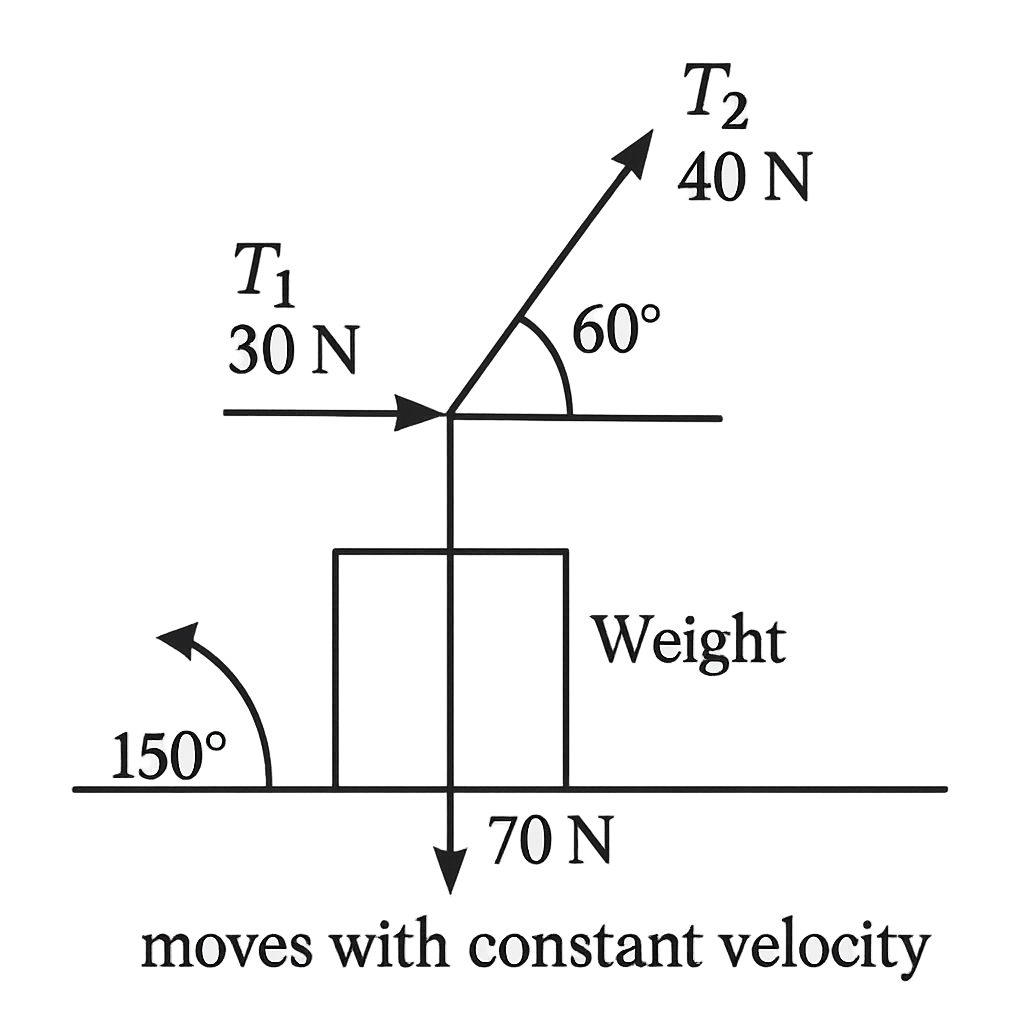
Refer to the force diagram of a block on a smooth horizontal surface. The block is acted on by four forces: a horizontal pull \(T_{1}=30\;\text{N}\) to the right, a pull \(T_{2}=40\;\text{N}\) directed \(60^{\circ}\) above the horizontal, the weight of the block \(W=70\;\text{N}\) acting vertically downward, and an unknown force \(F\) acting at an angle of \(150^{\circ}\) measured anticlockwise from the positive x‑axis. The block moves with constant velocity. Determine the magnitude of the unknown force \(F\) (in newtons, to one decimal place).
Correct A. 57.7 N
B. 50.0 N
C. 65.2 N
D. 73.1 N

Correct Answer: A

Want to see the full step-by-step solution? Unlock AI Explanation & Analytics
Question 19 View Details
Two thin converging lenses L\(_1\) and L\(_2\) are placed coaxially with a separation of \(12\;\text{cm}\). An object 30 cm tall is placed \(40\;\text{cm}\) to the left of L\(_1\). The final image formed by L\(_2\) is real, inverted and \(45\;\text{cm}\) tall, located \(20\;\text{cm}\) to the right of L\(_2\). Determine the focal length of L\(_2\) (in centimetres, to one decimal place).
Correct A. 2.6 cm
B. 4.8 cm
C. 3.2 cm
D. 1.5 cm

Correct Answer: A

Want to see the full step-by-step solution? Unlock AI Explanation & Analytics
Question 20 View Details
A metal rod of mass \(150\;\text{g}\) is heated to \(120^{\circ}\text{C}\) and then placed into an insulated container that holds \(200\;\text{g}\) of water at \(20^{\circ}\text{C}\). The container itself has a heat capacity of \(50\;\text{J\,°C}^{-1}\) and is initially at \(20^{\circ}\text{C}\). After the system reaches thermal equilibrium the temperature is \(30^{\circ}\text{C}\). Assuming no heat loss to the surroundings, determine the specific heat capacity of the metal rod (in \(\text{J\,g}^{-1}\text{°C}^{-1}\), to two decimal places).
A. 0.90 J·g⁻¹·°C⁻¹
B. 0.55 J·g⁻¹·°C⁻¹
C. 0.78 J·g⁻¹·°C⁻¹
Correct D. 0.66 J·g⁻¹·°C⁻¹

Correct Answer: D

Want to see the full step-by-step solution? Unlock AI Explanation & Analytics
Question 21 View Details
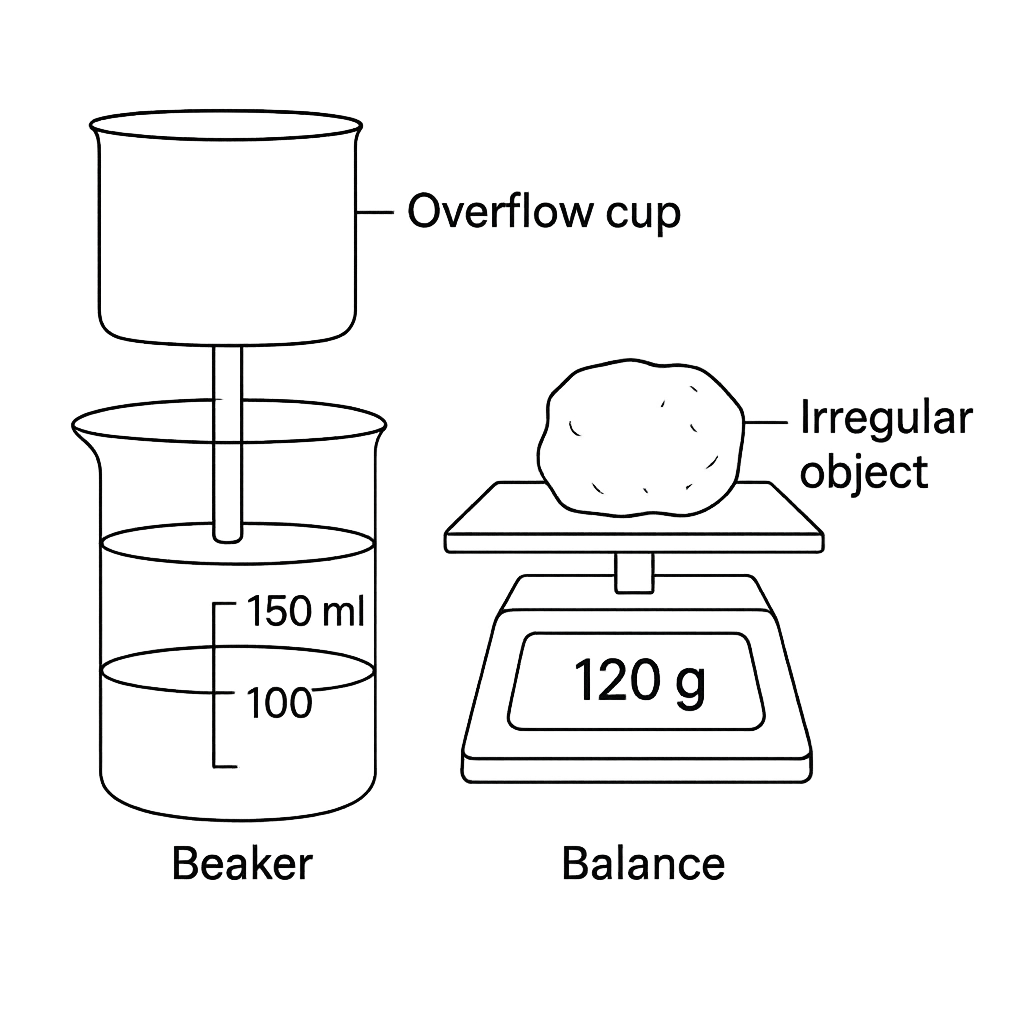
The diagram shows a beaker initially containing (150.0\ \text{mL}\) of water. After the irregular solid object is fully submerged, the water level rises to (165.0\ \text{mL}\). The mass of the object measured on a balance is (120.0\ \text{g}\). Calculate the density of the object in \(\text{g\ cm}^{-3}\).
A. 9.2
B. 6.8
C. 7.5
Correct D. 8.0

Correct Answer: D

Want to see the full step-by-step solution? Unlock AI Explanation & Analytics
Question 22 View Details
A car travels a distance of \(90\ \text{km}\) in \(1\ \text{h}\ 45\ \text{min}\). Determine its average speed in metres per second \(\text{m\ s}^{-1}\).
A. 13.5
B. 15.0
Correct C. 14.3
D. 12.8

Correct Answer: C

Want to see the full step-by-step solution? Unlock AI Explanation & Analytics
Question 23 View Details
A \(2.0\ \text{kg}\) block is pulled up a \(30^{\circ}\) incline of length \(5.0\ \text{m}\) by a constant horizontal force of \(15\ \text{N}\). The coefficient of kinetic friction between the block and the plane is \(0.20\). The block is moved the full length in \(4.0\ \text{s}\). Calculate (i) the work done by the horizontal force and (ii) the average power supplied by this force.
A. 55.0 J, 13.8 W
B. 75.0 J, 18.8 W
C. 37.5 J, 9.4 W
Correct D. 65.0 J, 16.2 W

Correct Answer: D

Want to see the full step-by-step solution? Unlock AI Explanation & Analytics
Question 24 View Details
A hydrogen atom makes a transition from the \(n=5\) to the \(n=2\) energy level, emitting a photon. The source of the photon is moving away from an observer at a speed of \(3.0\times10^{5}\ \text{m\ s}^{-1}\). (i) Calculate the wavelength of the photon emitted in the atom's rest frame. (ii) Determine the wavelength observed by the stationary observer, assuming the non‑relativistic Doppler shift approximation.
A. 435.2 nm, 436 nm
B. 432.9 nm, 433 nm
Correct C. 433.7 nm, 434 nm
D. 434.5 nm, 435 nm

Correct Answer: C

Want to see the full step-by-step solution? Unlock AI Explanation & Analytics
Question 25 View Details
A 12 V ideal battery has an internal resistance \(r\) and is connected to a variable external load resistor \(R\). The circuit is adjusted so that the load receives the maximum possible power of \(9\ \text{W}\). (i) Find the value of the internal resistance \(r\) (in ohms). (ii) At this condition, calculate the efficiency of the circuit as a percentage.
A. 8 Ω, 33%
Correct B. 4 Ω, 50%
C. 2 Ω, 25%
D. 6 Ω, 75%

Correct Answer: B

Want to see the full step-by-step solution? Unlock AI Explanation & Analytics

Master the Exam!

You've seen a preview, but there are thousands more questions plus AI tutor to break down complex solutions.

Unlock Full Access Available for Android & Windows
Help others prepare! Share this practice hub:
Chat with Support