gce model questions vol1 2024 chemistry | Objective

Prepare for your exams with gce model questions vol1 questions? Reviewing past/model questions is one of the most effective ways to guarantee a high score. This practice hub features authentic 2024 chemistry (Objective) questions designed to simulate the real exam environment.

Practice these randomly selected questions to test your readiness.

Question 1 View Details
A 0.500 g sample of \(\mathrm{FeSO_4\cdot7H_2O}\) (M = 278.01 g mol⁻¹) is dissolved in 250 cm³ of water to give a \(\mathrm{Fe^{2+}}\) solution. Exactly 25.0 cm³ of this solution is titrated with an acidified potassium‑permanganate solution. The titration reaches the endpoint after 30.0 cm³ of the permanganate solution. The permanganate solution was prepared by dissolving \(x\) g of \(\mathrm{KMnO_4}\) (M = 158.04 g mol⁻¹) in 500 cm³ of water. Calculate \(x\).
A. 0.0095 g
Correct B. 0.095 g
C. 0.85 g
D. 0.15 g

Correct Answer: B

Want to see the full step-by-step solution? Unlock AI Explanation & Analytics
Question 2 View Details
A 10.0 g sample of a mixture of ethanol (\(\mathrm{C_2H_5OH}\), M = 46.07 g mol⁻¹) and 2‑propanol (\(\mathrm{C_3H_7OH}\), M = 60.10 g mol⁻¹) is oxidised completely by excess acidified potassium dichromate. The oxidation consumes 29.4 g of \(\mathrm{K_2Cr_2O_7}\) (M = 294.19 g mol⁻¹). The masses of the oxidation products obtained are 0.66 g of acetic acid (\(\mathrm{CH_3COOH}\), M = 60.05 g mol⁻¹) and 9.2 g of acetone (\(\mathrm{CH_3COCH_3}\), M = 58.08 g mol⁻¹). Determine the mass of ethanol present in the original mixture.
A. 0.45 g
B. 0.35 g
Correct C. 0.51 g
D. 0.60 g

Correct Answer: C

Want to see the full step-by-step solution? Unlock AI Explanation & Analytics
Question 3 View Details
The enthalpy of sublimation of graphite to gaseous carbon atoms at 298 K is 716 kJ mol⁻¹. The enthalpy change for the conversion of graphite to diamond at the same temperature is +1.9 kJ mol⁻¹ (diamond is less stable). Assuming that each carbon atom in diamond is tetrahedrally bonded to four neighbours and that all C-C bonds have the same energy, calculate the average C-C bond energy in diamond (in kJ mol⁻¹).
A. 375 kJ mol⁻¹
Correct B. 359 kJ mol⁻¹
C. 350 kJ mol⁻¹
D. 400 kJ mol⁻¹

Correct Answer: B

Want to see the full step-by-step solution? Unlock AI Explanation & Analytics
Question 4 View Details
A 10.0 g sample of a straight‑chain alkane \(\mathrm{C_nH_{2n+2}}\) is cracked over a catalyst to give ethene (\(\mathrm{C_2H_4}\)) and a second alkane that contains the remaining carbon atoms. The mass of ethene obtained is 2.00 g. Assuming the cracking reaction proceeds as \(\mathrm{C_nH_{2n+2}\rightarrow C_2H_4 + C_{n-2}H_{2n-2}}\), determine the value of \(n\) for the original alkane.
Correct A. 10
B. 8
C. 14
D. 12

Correct Answer: A

Want to see the full step-by-step solution? Unlock AI Explanation & Analytics
Question 5 View Details
The standard enthalpy of combustion of a hydrocarbon \(\mathrm{C_5H_8}\) at 298 K is -3 200 kJ mol⁻¹. The standard enthalpies of formation of \(\mathrm{CO_2(g)}\) and \(\mathrm{H_2O(l)}\) are -393.5 kJ mol⁻¹ and -285.8 kJ mol⁻¹ respectively, and that of \(\mathrm{H_2(g)}\) is 0 kJ mol⁻¹. Using these data, calculate the standard enthalpy change for the complete hydrogenation of \(\mathrm{C_5H_8}\) to the saturated alkane \(\mathrm{C_5H_{12}}\) (pentane). Give your answer in kJ mol⁻¹ (negative sign indicates exothermic).
A. -190 kJ mol⁻¹
B. -250 kJ mol⁻¹
Correct C. -235 kJ mol⁻¹
D. -210 kJ mol⁻¹

Correct Answer: C

Want to see the full step-by-step solution? Unlock AI Explanation & Analytics
Question 6 View Details
When 2‑methyl‑2‑butene (\(CH_3C(CH_3)=CHCH_3\)) is treated with excess HBr in the presence of peroxide, two possible brominated products can be formed. Identify the major product and give a brief explanation for its predominance.
A. 3‑bromo‑3‑methylbutane
B. 1‑bromo‑2‑methylbutane
C. 2‑bromo‑2‑methylbutane
Correct D. 3‑bromo‑2‑methylbutane

Correct Answer: D

Want to see the full step-by-step solution? Unlock AI Explanation & Analytics
Question 7 View Details
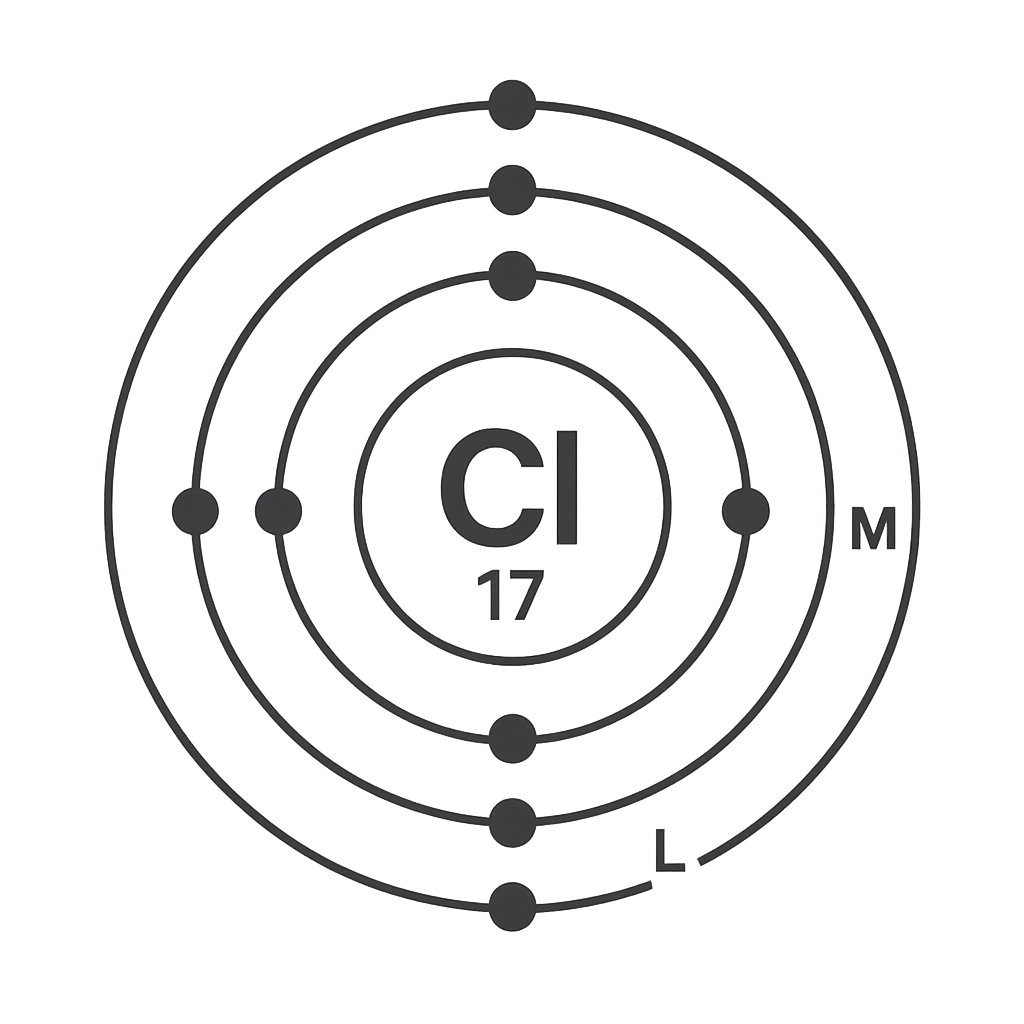
The diagram shows a chlorine atom with its nucleus labelled ‘Cl', atomic number 17, and electron shells containing 2, 8 and 7 electrons respectively. Using this information, write the electron configuration of chlorine in noble‑gas notation.
A. [Ne] 3s^2 3p^6
B. [Ne] 3s^1 3p^6
Correct C. [Ne] 3s^2 3p^5
D. [Ne] 3s^2 3p^4

Correct Answer: C

Want to see the full step-by-step solution? Unlock AI Explanation & Analytics
Question 8 View Details
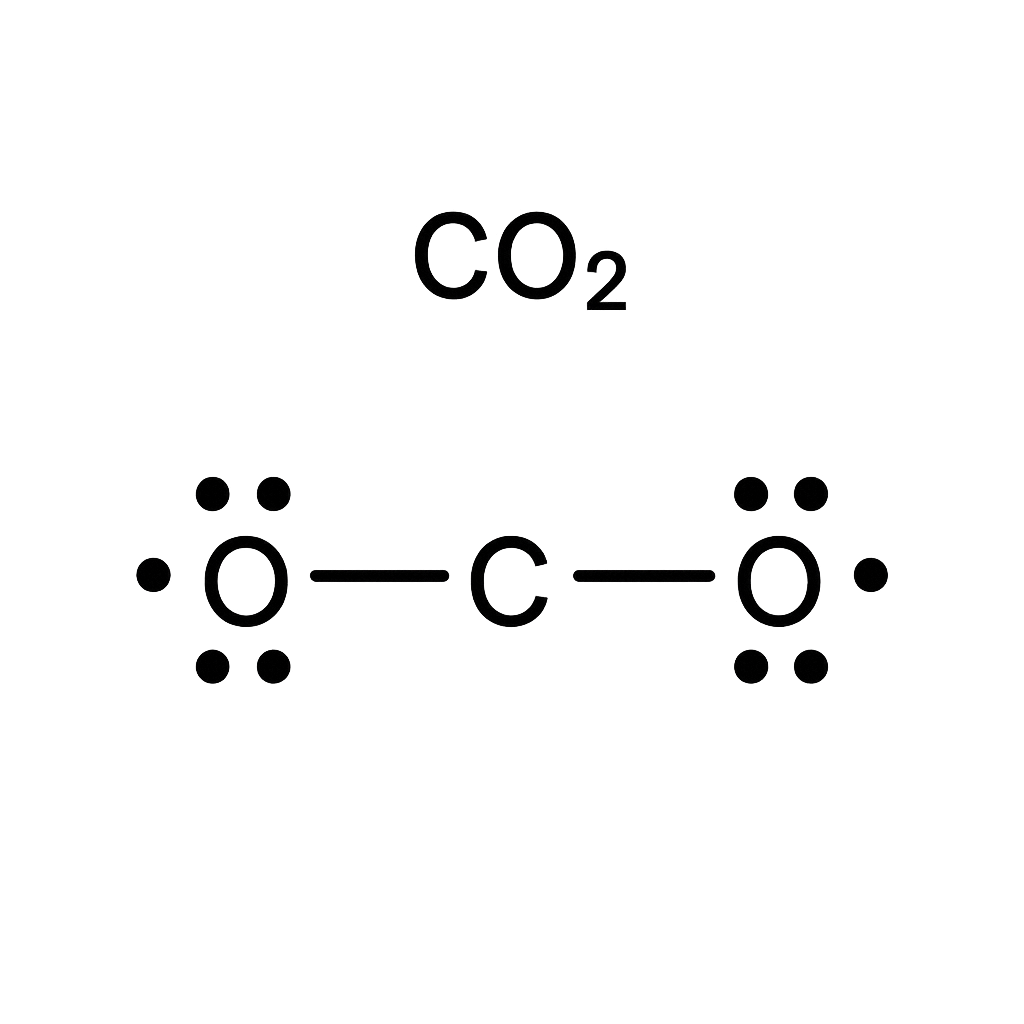
The diagram depicts the Lewis structure of carbon dioxide, showing a central carbon atom double‑bonded to two oxygen atoms and no lone pairs on carbon. From this structure, state the hybridisation of the carbon atom and the O-C-O bond angle.
A. sp3; 180°
Correct B. sp; 180°
C. sp; 109.5°
D. sp2; 120°

Correct Answer: B

Want to see the full step-by-step solution? Unlock AI Explanation & Analytics
Question 9 View Details
An unknown dicarboxylic acid (A) has molecular formula \(C_5H_8O_4\) and is a colour‑less solid that melts at \(70\ ^\circ\text{C}\). When treated with excess oxalyl chloride, it forms a cyclic anhydride (B) that shows a strong IR absorption at \(1800\ \text{cm}^{-1}\). (i) Identify acid A. (ii) If \(2.00\ \text{g}\) of A is reacted with excess oxalyl chloride, calculate the mass of anhydride B obtained (molar mass of B = \(144\ \text{g mol}^{-1}\)).
A. A is malonic acid (propanedioic acid); mass of B = 1.73 g
Correct B. A is glutaric acid (pentanedioic acid); mass of B = 2.18 g
C. A is succinic acid (butanedioic acid); mass of B = 1.96 g
D. A is adipic acid (hexanedioic acid); mass of B = 2.40 g

Correct Answer: B

Want to see the full step-by-step solution? Unlock AI Explanation & Analytics
Question 10 View Details
Silver chloride (\(AgCl\)) has a solubility product \(K_{sp}=1.8\times10^{-10}\) at \(25\ ^\circ\text{C}\). (a) Calculate its molar solubility in pure water. (b) In a solution that already contains \(0.010\ \text{M}\) NaCl, determine the solubility of \(AgCl\). (c) If the chloride concentration is increased to \(0.050\ \text{M}\) (for example by adding HCl), what is the new solubility? (d) Explain qualitatively how adding a soluble salt that provides a common cation (e.g., \(AgNO_3\)) would affect the solubility of \(AgCl\).
A. (a) 2.00×10⁻⁵ M; (b) 9.0×10⁻⁹ M; (c) 1.8×10⁻⁹ M; (d) solubility increases due to the common‑ion effect.
Correct B. (a) 1.34×10⁻⁵ M; (b) 1.8×10⁻⁸ M; (c) 3.6×10⁻⁹ M; (d) solubility decreases due to the common‑ion effect.
C. (a) 1.00×10⁻⁵ M; (b) 3.6×10⁻⁸ M; (c) 7.2×10⁻⁹ M; (d) solubility remains the same because the common ion has no effect.
D. (a) 1.34×10⁻⁴ M; (b) 1.8×10⁻⁶ M; (c) 3.6×10⁻⁷ M; (d) solubility decreases because adding Ag⁺ shifts equilibrium to the left.

Correct Answer: B

Want to see the full step-by-step solution? Unlock AI Explanation & Analytics
Question 11 View Details
The ground‑state electron configuration of the element with atomic number (Z = 24) is required. How many unpaired electrons does a neutral atom of this element have in its ground state?
A. 5
Correct B. 6
C. 7
D. 4

Correct Answer: B

Want to see the full step-by-step solution? Unlock AI Explanation & Analytics
Question 12 View Details
A 25.0 cm³ sample of an aqueous solution containing ferrous ions, Fe²⁺, is titrated with 0.100 mol dm⁻³ potassium permanganate solution in acidic medium. The endpoint is reached after 18.5 cm³ of KMnO₄ solution has been added. Calculate the concentration of Fe²⁺ in the original solution (in mol dm⁻³).
A. 0.300
B. 0.185
C. 0.740
Correct D. 0.370

Correct Answer: D

Want to see the full step-by-step solution? Unlock AI Explanation & Analytics
Question 13 View Details
Among the elements sodium (Na), magnesium (Mg) and aluminium (Al), which one has the highest first ionisation energy?
A. Al
Correct B. Mg
C. Ca
D. Na

Correct Answer: B

Want to see the full step-by-step solution? Unlock AI Explanation & Analytics
Question 14 View Details
What is the approximate H-O-H bond angle in a water molecule, expressed in degrees?
Correct A. 104.5
B. 109.5
C. 90
D. 120

Correct Answer: A

Want to see the full step-by-step solution? Unlock AI Explanation & Analytics
Question 15 View Details
A copper(II) sulfate solution is electrolysed using a constant current of 2.00 A for 30.0 minutes. At the cathode copper metal is deposited. Assuming 100 % current efficiency, calculate the mass of copper deposited (in grams, to three significant figures).
A. 1.59
Correct B. 1.19
C. 0.79
D. 2.38

Correct Answer: B

Want to see the full step-by-step solution? Unlock AI Explanation & Analytics
Question 16 View Details
A sample of aluminium metal (15.0 g) is reacted with chlorine gas at 1 atm and 25 °C. The chlorine is supplied as 10.0 L of gas at these conditions. The reaction is: \(2\,\mathrm{Al} + 3\,\mathrm{Cl_2} \rightarrow 2\,\mathrm{AlCl_3}\). (i) Determine the theoretical mass of aluminium chloride that can be formed. (ii) If 30.0 g of \(\mathrm{AlCl_3}\) are actually obtained, calculate the percent yield.
Correct A. Theoretical mass = 36.3 g; percent yield = 82.6 %
B. Theoretical mass = 36.3 g; percent yield = 75.0 %
C. Theoretical mass = 30.0 g; percent yield = 100 %
D. Theoretical mass = 45.0 g; percent yield = 66.7 %

Correct Answer: A

Want to see the full step-by-step solution? Unlock AI Explanation & Analytics
Question 17 View Details
An element is described as follows: it belongs to period 3, its most stable oxidation state is -1, it is a non‑metal, and it has the highest electronegativity among the elements in its period. Identify the element.
A. Sulfur
B. Phosphorus
C. Argon
Correct D. Chlorine

Correct Answer: D

Want to see the full step-by-step solution? Unlock AI Explanation & Analytics
Question 18 View Details
Liquid A has a molar enthalpy of vaporisation \(\Delta H_{\text{vap}} = 30\ \text{kJ mol}^{-1}\). Its vapour pressure at 298 K is 0.40 atm. Using the Clausius-Clapeyron equation, estimate the normal boiling point of liquid A (the temperature at which its vapour pressure equals 1 atm). Give your answer in °C (to one decimal place).
A. 52.3
Correct B. 49.2
C. 45.6
D. 61.0

Correct Answer: B

Want to see the full step-by-step solution? Unlock AI Explanation & Analytics
Question 19 View Details
A mixture of two isomeric alcohols, 1‑propanol (\(\mathrm{CH_3CH_2CH_2OH}\)) and 2‑propanol (\(\mathrm{CH_3CHOHCH_3}\)), is completely oxidised by acidified potassium dichromate. The oxidation products are propanal and acetone respectively. After the reaction, 12.0 g of propanal and 10.5 g of acetone are isolated. (i) Determine the mass of each alcohol present in the original mixture. (ii) Calculate the mass percent of 1‑propanol in the mixture.
A. 1‑propanol = 12.0 g; 2‑propanol = 11.3 g; mass percent of 1‑propanol = 51.5 %
B. 1‑propanol = 11.5 g; 2‑propanol = 11.8 g; mass percent of 1‑propanol = 49.3 %
C. 1‑propanol = 13.0 g; 2‑propanol = 10.3 g; mass percent of 1‑propanol = 55.8 %
Correct D. 1‑propanol = 12.4 g; 2‑propanol = 10.9 g; mass percent of 1‑propanol = 53.4 %

Correct Answer: D

Want to see the full step-by-step solution? Unlock AI Explanation & Analytics
Question 20 View Details
0.500 mol of sodium carbonate (\(\mathrm{Na_2CO_3}\)) is dissolved in enough water to make 1.00 L of solution. Excess hydrochloric acid is added, and the carbon dioxide produced is collected over water at 25 °C and a total pressure of 760 mm Hg. The volume of gas collected is 11.2 L. (i) Calculate the moles of dry \(\mathrm{CO_2}\) collected. (ii) What percentage of the original sodium carbonate has reacted?
Correct A. Moles of CO₂ = 0.443 mol; percentage reacted = 88.5 %
B. Moles of CO₂ = 0.500 mol; percentage reacted = 100 %
C. Moles of CO₂ = 0.457 mol; percentage reacted = 91.4 %
D. Moles of CO₂ = 0.400 mol; percentage reacted = 80.0 %

Correct Answer: A

Want to see the full step-by-step solution? Unlock AI Explanation & Analytics
Question 21 View Details
An unknown metal M forms a galvanic cell with the half‑reaction \(\mathrm{M(s) | M^{2+} (1.0\;M) || Ag^{+} (0.010\;M) | Ag(s)}\). At 298 K the measured cell emf is \(0.34\;\text{V}\). (Standard reduction potential \(E^\circ_{\mathrm{Ag^{+}/Ag}} = +0.7996\;\text{V}\).)\n\n(a) Determine the standard reduction potential \(E^\circ_{\mathrm{M^{2+}/M}}\) and identify the metal from the list \{ Zn, Fe, Cu, Pb \}.\n\n(b) If \(25.0\;\text{mL}\) of \(0.10\;\text{M}\) \(\mathrm{Ag^{+}}\) solution is allowed to react in the cell (100 % current efficiency), calculate the mass of metallic silver deposited (to three significant figures).
A. Iron, 0.270 g
Correct B. Copper, 0.270 g
C. Copper, 0.300 g
D. Zinc, 0.270 g

Correct Answer: B

Want to see the full step-by-step solution? Unlock AI Explanation & Analytics
Question 22 View Details
The dissociation of a weak carboxylic acid HA has a standard equilibrium constant \(K_a = 1.0\times10^{-5}\) at \(298\;\text{K}\). When the temperature is raised to \(318\;\text{K}\) the pH of a \(0.10\;\text{M}\) solution of HA changes from 3.00 to 2.80. Assuming the enthalpy change \(\Delta H^\circ\) for the dissociation is temperature‑independent over this range, calculate \(\Delta H^\circ\) in kJ mol\(^{-1}\) (to two significant figures).
A. 30 kJ mol⁻¹
B. 25 kJ mol⁻¹
Correct C. 37 kJ mol⁻¹
D. 45 kJ mol⁻¹

Correct Answer: C

Want to see the full step-by-step solution? Unlock AI Explanation & Analytics
Question 23 View Details
A galvanic cell is constructed with a zinc electrode immersed in a \(\mathrm{Zn^{2+}}\) solution of concentration \(0.010\;\text{M}\) and a copper electrode immersed in a \(\mathrm{Cu^{2+}}\) solution of unknown concentration. At \(298\;\text{K}\) the cell emf is measured as \(1.05\;\text{V}\). (Standard potentials: \(E^\circ_{\mathrm{Zn^{2+}/Zn}} = -0.76\;\text{V}\), \(E^\circ_{\mathrm{Cu^{2+}/Cu}} = +0.34\;\text{V}\).)\n\n(a) Calculate the concentration of \(\mathrm{Cu^{2+}}\) in the copper half‑cell.\n\n(b) If a charge of \(0.500\;\text{C}\) passes through the cell, determine the mass of zinc that is deposited on the zinc electrode (to three significant figures).
A. 1.0×10⁻⁴ M, 3.38×10⁻⁴ g
B. 4.0×10⁻⁴ M, 8.45×10⁻⁵ g
C. 2.5×10⁻⁴ M, 2.00×10⁻⁴ g
Correct D. 2.0×10⁻⁴ M, 1.69×10⁻⁴ g

Correct Answer: D

Want to see the full step-by-step solution? Unlock AI Explanation & Analytics
Question 24 View Details
Using the Born-Lande equation\n\n\[\nU = -\frac{N_A M z^+ z^- e^2}{4\pi\varepsilon_0 r_0}\left(1-\frac{1}{n}\right)\n\]\n\nestimate the lattice energy of solid NaCl. Given: Madelung constant \(M = 1.7476\), ionic charges \(|z^+| = |z^-| = 1\), inter‑ionic distance \(r_0 = 2.82\;\text{Å}\), Born exponent \(n = 9\), and \(e^2/(4\pi\varepsilon_0) = 2.307\times10^{-28}\;\text{J·m}\).\n\nThen, using a Born‑Haber cycle, calculate the enthalpy of solution \(\Delta H_{\text{sol}}\) for NaCl, given the following data (all per mole): sublimation of Na(s) \(+108\;\text{kJ}\), ionisation energy of Na \(+496\;\text{kJ}\), half the bond dissociation energy of \(\mathrm{Cl_2}\) \(+121\;\text{kJ}\), hydration enthalpies \(\Delta H_{\text{hyd}}(\mathrm{Na^+}) = -406\;\text{kJ}\), \(\Delta H_{\text{hyd}}(\mathrm{Cl^-}) = -363\;\text{kJ}\). Assume the lattice energy you calculated is the only other term. Provide both the lattice energy (in kJ mol\(^{-1}\)) and \(\Delta H_{\text{sol}}\) (in kJ mol\(^{-1}\)).
A. Lattice energy ≈ -700 kJ mol⁻¹; ΔH_sol ≈ +800 kJ mol⁻¹
Correct B. Lattice energy ≈ -765 kJ mol⁻¹; ΔH_sol ≈ +720 kJ mol⁻¹
C. Lattice energy ≈ -850 kJ mol⁻¹; ΔH_sol ≈ +650 kJ mol⁻¹
D. Lattice energy ≈ -765 kJ mol⁻¹; ΔH_sol ≈ +600 kJ mol⁻¹

Correct Answer: B

Want to see the full step-by-step solution? Unlock AI Explanation & Analytics
Question 25 View Details
The compound \(\mathrm{C_6H_5CH=CHCH_3}\) (β‑methylstyrene) is subjected to ozonolysis followed by reductive work‑up.\n\n(a) Write the structures of the two organic products formed.\n\n(b) If \(5.00\;\text{g}\) of the alkene (molar mass \(118\;\text{g mol}^{-1}\)) is completely converted and the yield is 100 %, calculate the mass of phenylacetaldehyde obtained (to three significant figures).
A. Phenylacetaldehyde (C₈H₈O) and formaldehyde (CH₂O); 5.08 g phenylacetaldehyde
B. Phenylacetaldehyde (C₈H₈O) and acetaldehyde (CH₃CHO); 4.56 g phenylacetaldehyde
Correct C. Phenylacetaldehyde (C₈H₈O) and acetaldehyde (CH₃CHO); 5.08 g phenylacetaldehyde
D. Benzaldehyde (C₇H₆O) and acetaldehyde (CH₃CHO); 5.08 g phenylacetaldehyde

Correct Answer: C

Want to see the full step-by-step solution? Unlock AI Explanation & Analytics

Master the Exam!

You've seen a preview, but there are thousands more questions plus AI tutor to break down complex solutions.

Unlock Full Access Available for Android & Windows
Help others prepare! Share this practice hub:
Chat with Support