gce model questions vol1 2024 agricultural_science | Objective

Prepare for your exams with gce model questions vol1 questions? Reviewing past/model questions is one of the most effective ways to guarantee a high score. This practice hub features authentic 2024 agricultural_science (Objective) questions designed to simulate the real exam environment.

Practice these randomly selected questions to test your readiness.

Question 1 View Details
A farm has fixed costs of \(150{,}000\) ₦ per year and a variable cost of \(20{,}000\) ₦ per hectare. The expected yield is \(5\) tonnes per hectare and the market price is \(30{,}000\) ₦ per tonne. The farmer wants a profit of at least \(200{,}000\) ₦. How many whole hectares must be cultivated?
A. 5 hectares
B. 2 hectares
C. 4 hectares
Correct D. 3 hectares

Correct Answer: D

Want to see the full step-by-step solution? Unlock AI Explanation & Analytics
Question 2 View Details
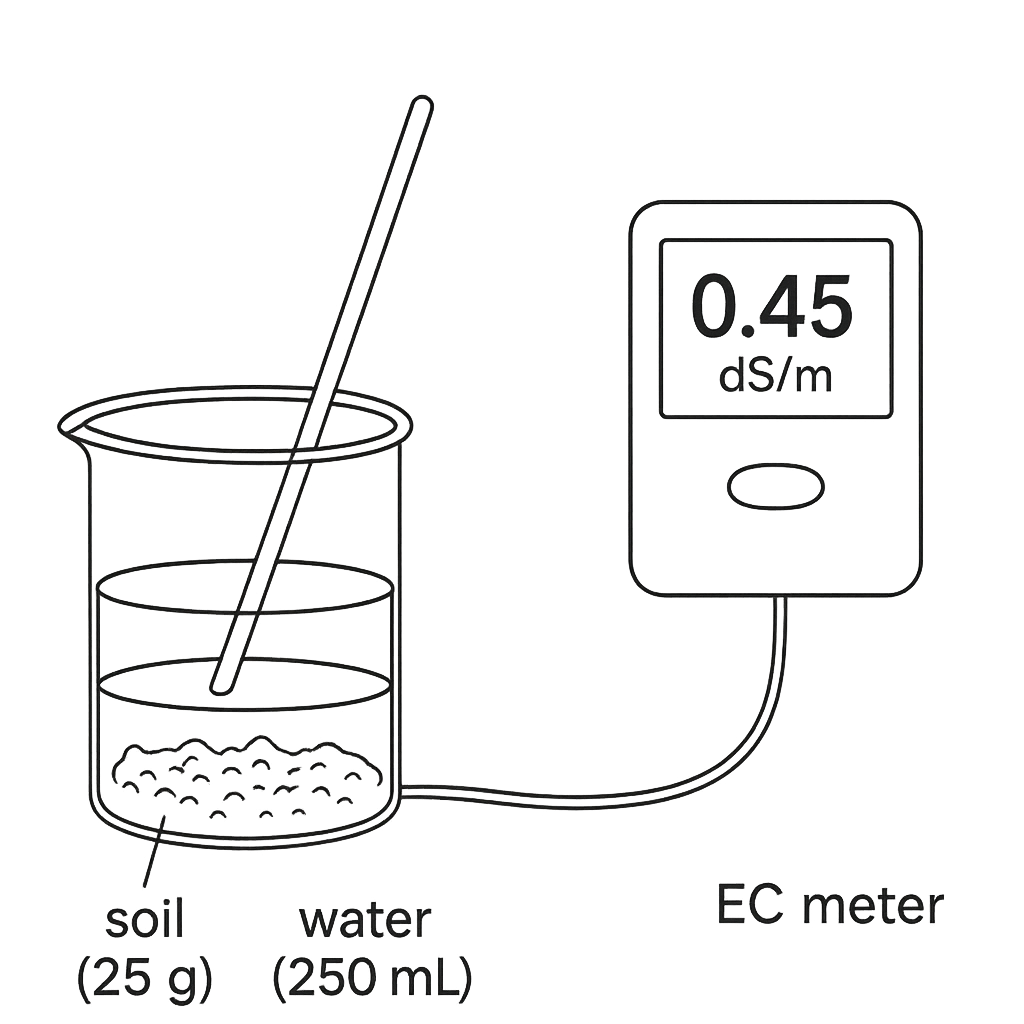
In the laboratory setup shown, a student mixes \(25\) g of air‑dried soil with \(250\) mL of distilled water in a beaker, shakes for 30 min and lets the mixture settle. The electrical conductivity (EC) of the clear supernatant is measured as \(0.45\) dS m\(^{-1}\). The EC of the soil paste is known to be \(1.3\) times the EC of the supernatant. What is the EC of the soil paste (in dS m\(^{-1}\))?
A. 0.650 dS\/m
B. 0.525 dS\/m
C. 0.720 dS\/m
Correct D. 0.585 dS/m

Correct Answer: D

Want to see the full step-by-step solution? Unlock AI Explanation & Analytics
Question 3 View Details
A farmer aims for a maize yield of at least \(6\) t ha\(^{-1}\). Yield responds linearly to total nitrogen available according to \( Y = 2 + 0.04N \) where \(Y\) is yield (t ha\(^{-1}\)) and \(N\) is total nitrogen (kg ha\(^{-1}\)). The soil already supplies \(30\) kg ha\(^{-1}\) of nitrogen. Fertiliser can only be bought in packets of \(25\) kg ha\(^{-1}\). What is the minimum amount of nitrogen fertiliser (kg ha\(^{-1}\)) the farmer must apply to meet the target yield, and what is the total cost if fertiliser costs \(120\) ₦ per kg?
Correct A. 75 kg/ha fertiliser, costing ₦9,000
B. 100 kg/ha fertiliser, costing ₦12,000
C. 25 kg/ha fertiliser, costing ₦3,000
D. 50 kg/ha fertiliser, costing ₦6,000

Correct Answer: A

Want to see the full step-by-step solution? Unlock AI Explanation & Analytics
Question 4 View Details
A field study compared two farms over six months. Farm A, which used a vaccination programme, recorded \(12\) cases of bacterial pneumonia among \(200\) cattle. Farm B, which did not vaccinate, recorded \(30\) cases among \(180\) cattle. Calculate the relative risk of disease for unvaccinated cattle compared with vaccinated cattle, and state what the value indicates about the effectiveness of the vaccine.
Correct A. Relative risk ≈ 2.8; unvaccinated cattle are about 2.8 times more likely to get the disease, indicating the vaccine is effective.
B. Relative risk ≈ 0.8; unvaccinated cattle are slightly less likely to get the disease, which would incorrectly imply the vaccine is harmful.
C. Relative risk ≈ 3.5; unvaccinated cattle are about 3.5 times more likely to get the disease, overstating the vaccine's effectiveness.
D. Relative risk ≈ 1.5; unvaccinated cattle are about 1.5 times more likely to get the disease, suggesting a modest vaccine benefit.

Correct Answer: A

Want to see the full step-by-step solution? Unlock AI Explanation & Analytics
Question 5 View Details
A tomato farmer produces \(5{,}000\) kg of tomatoes. The market price is \(150\) ₦ kg\(^{-1}\). The total cost function is \( C = 200{,}000 + 20Q \) where \(Q\) is the quantity produced (kg). The price elasticity of demand for tomatoes is \(-0.5\). Assuming a linear approximation, the farmer considers changing the price by an amount \(\Delta P\) (which may be positive or negative). Using the elasticity, the change in quantity sold is approximated by \( \frac{\Delta Q}{Q_0} = \varepsilon \frac{\Delta P}{P_0} \) where \(Q_0 = 5{,}000\) kg and \(P_0 = 150\) ₦ kg\(^{-1}\). Determine the price change \(\Delta P\) that maximises profit and compute the resulting maximum profit (to the nearest Naira).
A. Increase price by ₦70 per kg (new price ₦220/kg); maximum profit ≈ ₦560,000
B. Decrease price by ₦30 per kg (new price ₦120/kg); maximum profit ≈ ₦540,300
C. Increase price by ₦100 per kg (new price ₦250/kg); maximum profit ≈ ₦580,200
Correct D. Increase price by ₦85 per kg (new price ₦235/kg); maximum profit ≈ ₦570,417

Correct Answer: D

Want to see the full step-by-step solution? Unlock AI Explanation & Analytics
Question 6 View Details
A farmer harvests 10 tonnes of maize with an initial moisture content of 30 % (wet basis). The desired final moisture content for safe storage is 14 %. The drying process follows the model \( \frac{dw}{dt}= -k\,(w-12) \) where \(w\) is the moisture content in % and the ambient moisture is 12 % (wet basis). The rate constant \(k\) is \(0.05\,\text{h}^{-1}\). Determine (a) the time required to reach the target moisture content, and (b) the mass of water removed (in tonnes).
A. 44.0 hours, 2.10 tonnes of water removed
Correct B. 44.0 hours, 1.86 tonnes of water removed
C. 48.0 hours, 2.00 tonnes of water removed
D. 40.0 hours, 1.70 tonnes of water removed

Correct Answer: B

Want to see the full step-by-step solution? Unlock AI Explanation & Analytics
Question 7 View Details
A herd of 200 goats is at risk from a contagious disease with a basic reproduction number \(R_0=2.5\). The available vaccine has an efficacy of 80 %. Ten percent of the goats already possess natural immunity. What is the minimum number of goats that must be vaccinated to ensure the effective reproduction number falls below 1?
A. 120 goats
B. 140 goats
Correct C. 130 goats
D. 150 goats

Correct Answer: C

Want to see the full step-by-step solution? Unlock AI Explanation & Analytics
Question 8 View Details
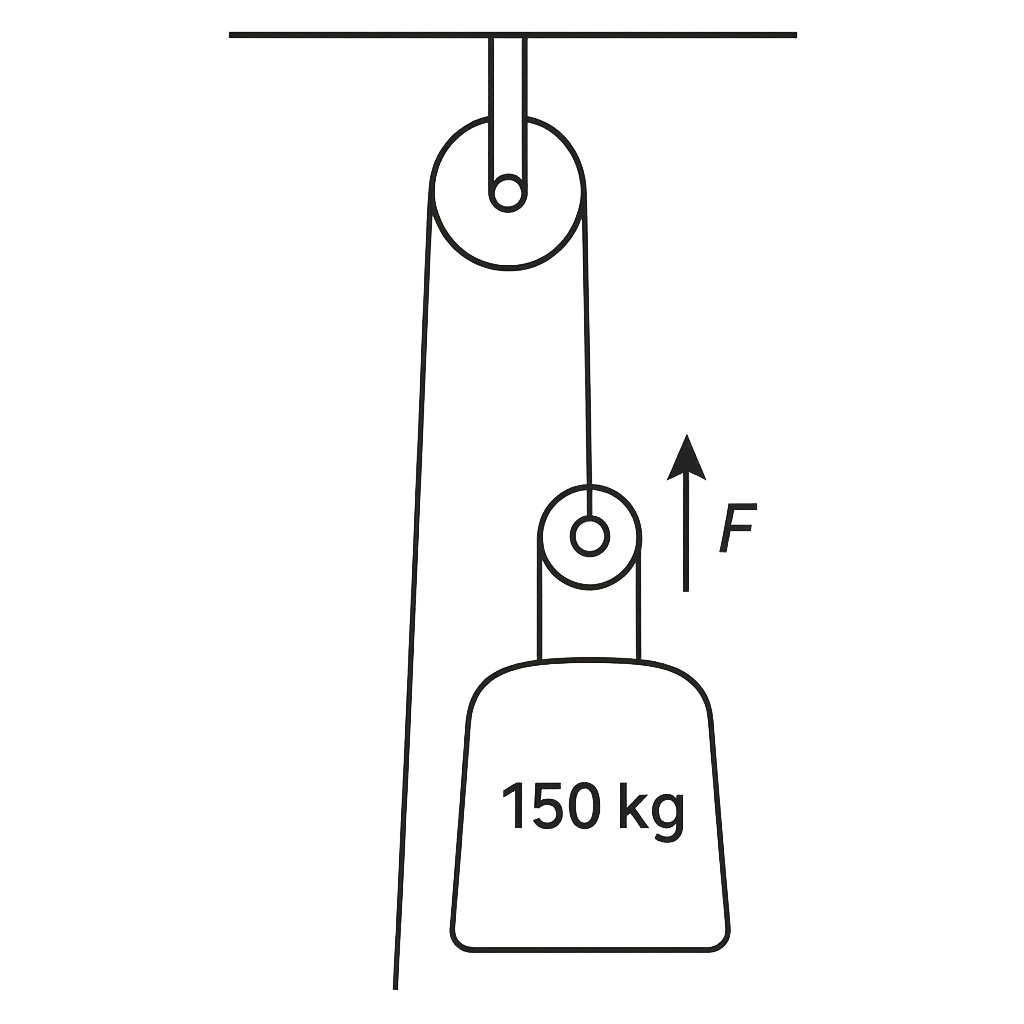
The diagram shows a simple block‑and‑tackle system consisting of one fixed pulley and one movable pulley used to lift a sack of mass 150 kg. The free end of the rope is pulled vertically with a force \(F\).\n(a) Determine the minimum pulling force required to start lifting the sack (i.e., to overcome its weight).\n(b) If the farmer applies a pulling force of 1200 N, calculate the upward acceleration of the sack.
A. Minimum force ≈ 736 N; acceleration ≈ 4.0 m\/s² upward
Correct B. Minimum force ≈ 736 N; acceleration ≈ 6.2 m/s² upward
C. Minimum force ≈ 800 N; acceleration ≈ 5.0 m\/s² upward
D. Minimum force ≈ 600 N; acceleration ≈ 7.5 m\/s² upward

Correct Answer: B

Want to see the full step-by-step solution? Unlock AI Explanation & Analytics
Question 9 View Details
A farmer plans to cultivate 5 ha of wheat. Expected yield is 4 t ha⁻¹. Variable cost is ₦150 000 per tonne produced and fixed overhead is ₦200 000. The expected market price is ₦250 000 per tonne. There is a 10 % chance of a drought that reduces the total yield by 30 % while costs remain unchanged. Calculate the expected profit and state whether the enterprise is financially viable (profit > 0).
Correct A. ₦1 740 000 expected profit; venture is viable
B. ₦‑500 000 expected profit; venture is not viable
C. ₦2 500 000 expected profit; venture is viable
D. ₦1 200 000 expected profit; venture is viable

Correct Answer: A

Want to see the full step-by-step solution? Unlock AI Explanation & Analytics
Question 10 View Details
A farmer must treat a 3 ha field infested with a pest. The recommended pesticide application rate is 2.5 L ha⁻¹ of a solution that contains 0.8 % active ingredient (AI) by volume. The farmer has 25 L of pure AI.\n(a) How many millilitres of AI and how many litres of water are required to prepare the correct solution for the 3 ha field?\n(b) Using the same 0.8 % concentration, what is the maximum area (in hectares) that can be treated with the 25 L of pure AI?
A. a) 70 mL AI and 7.38 L water; b) 1100 ha can be treated
Correct B. a) 60 mL AI and 7.44 L water; b) 1250 ha can be treated
C. a) 50 mL AI and 7.45 L water; b) 1000 ha can be treated
D. a) 60 mL AI and 7.50 L water; b) 1250 ha can be treated

Correct Answer: B

Want to see the full step-by-step solution? Unlock AI Explanation & Analytics
Question 11 View Details
A maize farmer expects a potential yield of 5 t ha⁻¹. The market price of maize is N 1.8 kg⁻¹. A pesticide treatment costs N 90 ha⁻¹. A field trial showed that a pest density of 40 pests ha⁻¹ reduces the yield by 0.4 t ha⁻¹. The farmer monitors the field and finds a density of 12 pests ha⁻¹. Using the economic threshold formula \(ET = \dfrac{C}{V \times L}\), where \(C\) is the control cost per hectare, \(V\) is the market value per kilogram, and \(L\) is the loss in kilograms per pest per hectare, decide whether the farmer should apply the pesticide.
A. Apply the pesticide (the observed density is equal to the economic threshold).
Correct B. Apply the pesticide (the observed density exceeds the economic threshold).
C. Do not apply the pesticide (the cost of control exceeds the value of loss).
D. Do not apply the pesticide (the observed density is below the economic threshold).

Correct Answer: B

Want to see the full step-by-step solution? Unlock AI Explanation & Analytics
Question 12 View Details
A mixed‑cropping farm allocates 30 % of its land to a legume that fixes 50 kg N ha⁻¹ each season and the remaining 70 % to a cereal that removes 120 kg N ha⁻¹ each season. To achieve a net nitrogen balance of zero for the whole farm, how many kilograms of nitrogen fertilizer must be applied per hectare (to the cereal area) each season?
A. 68
B. 70
C. 75
Correct D. 69

Correct Answer: D

Want to see the full step-by-step solution? Unlock AI Explanation & Analytics
Question 13 View Details
An 100‑ha forest is managed for timber. At the end of a 25‑year rotation each hectare yields 120 m³ of timber. The market price of timber is N 180 m³⁻¹ and a re‑planting cost of N 2 500 ha⁻¹ is incurred at harvest. The discount rate is 6 % per annum. An alternative annual cash‑crop can generate a profit of N 5 000 ha⁻¹ each year for the same 25 years. Using the present‑value formula \(PV = \dfrac{R}{(1+r)^t}\) for a single future cash flow and \(PV_{annuity}=P\frac{1-(1+r)^{-n}}{r}\) for an annuity, determine which option gives the higher present value per hectare.
Correct A. The annual cash‑crop yields the higher present value (≈ N 63 915 ha⁻¹) compared with the timber rotation (≈ N 4 452 ha⁻¹).
B. The timber rotation yields the higher present value (≈ N 5 200 ha⁻¹) compared with the annual cash‑crop (≈ N 60 000 ha⁻¹).
C. The annual cash‑crop yields the higher present value (≈ N 58 000 ha⁻¹) compared with the timber rotation (≈ N 4 500 ha⁻¹).
D. The timber rotation yields the higher present value (≈ N 5 000 ha⁻¹) compared with the annual cash‑crop (≈ N 63 000 ha⁻¹).

Correct Answer: A

Want to see the full step-by-step solution? Unlock AI Explanation & Analytics
Question 14 View Details
A farmer needs to dry 1 000 kg of maize from 25 % to 14 % moisture (wet basis). The amount of water to be removed is therefore 110 kg. The drying rate (kg water h⁻¹) varies with the drying temperature \(T\) (°C) according to \(R = 0.5T - 5\) for \(30 \le T \le 60\). Each kilogram of water removed consumes 0.8 kWh of electricity, costing N 25 per kWh. Labour costs N 50 per hour of drying. In addition, for every degree Celsius above 45 °C a quality penalty of N 10 per kilogram of maize is incurred. Determine the integer drying temperature (°C) within the allowed range that minimises the total cost (electricity + labour + penalty).
Correct A. 45
B. 55
C. 50
D. 40

Correct Answer: A

Want to see the full step-by-step solution? Unlock AI Explanation & Analytics
Question 15 View Details
A tractor of weight 3 t must pull a 5‑t plough across a field that has a 3 % upward grade. The tractor moves at a constant speed of 5 km h⁻¹. Rolling‑resistance coefficient is 0.04, and the soil draft coefficient for the implement is 0.1 kN per tonne of implement weight. The transmission efficiency is 0.85. Using \(g = 9.81\;\text{m s}^{-2}\), calculate the minimum engine power in kilowatts required to maintain the speed.
A. 25
B. 15
Correct C. 17
D. 20

Correct Answer: C

Want to see the full step-by-step solution? Unlock AI Explanation & Analytics
Question 16 View Details
A farmer has 10 ha of land and plans a 3‑year crop sequence: Year 1 maize, Year 2 soybean (a legume), and Year 3 maize again. Maize yields 5 t ha⁻¹ and sells for $200 t⁻¹; it requires 80 kg N ha⁻¹ applied as fertilizer costing $0.5 kg⁻¹. Soybean yields 2.5 t ha⁻¹, sells for $350 t⁻¹ and fixes 30 kg N ha⁻¹, which reduces the nitrogen requirement of the subsequent maize crop. Fixed costs (land, machinery) are $12 000 per season. Should the farmer adopt the rotation or grow maize continuously for the three years, and by how much does the more profitable system increase profit?
Correct A. 700
B. 1000
C. 600
D. 800

Correct Answer: A

Want to see the full step-by-step solution? Unlock AI Explanation & Analytics
Question 17 View Details
A 15 kW tractor is to drive a rotary tiller that needs 12 kW at a PTO speed of 540 rpm. The PTO is powered through a belt drive with a pulley ratio of 3 : 1 (tractor pulley : tiller pulley). Determine (a) whether the tractor can supply the required power, (b) the torque delivered at the tiller shaft, and (c) the minimum engine pulley speed required to obtain the 540 rpm tiller speed.
A. Yes; torque ≈ 180 N·m; required engine pulley speed 1620 rpm
B. Yes; torque ≈ 212 N·m; required engine pulley speed 1500 rpm
C. No; torque ≈ 212 N·m; required engine pulley speed 1620 rpm
Correct D. Yes; torque ≈ 212 N·m; required engine pulley speed 1620 rpm

Correct Answer: D

Want to see the full step-by-step solution? Unlock AI Explanation & Analytics
Question 18 View Details
A farmer intends to grow wheat on 20 ha. Fixed costs (land, machinery) are $12 000 per season and variable costs are $150 ha⁻¹. Expected yield is 4 t ha⁻¹. The market price is uncertain: with probability 0.6 the price will be $250 t⁻¹ and with probability 0.4 it will fall to $180 t⁻¹. The farmer may buy crop‑insurance that costs 5 % of the expected revenue (based on the $250 price) and guarantees a minimum price of $200 t⁻¹. Using the expected‑value decision rule, should the farmer purchase the insurance? Show the expected profit with and without insurance.
Correct A. No; expected profit without insurance $2,760 exceeds profit with insurance $2,400
B. No; expected profit without insurance $2,600 exceeds profit with insurance $2,300
C. Yes; expected profit with insurance $2,900 exceeds profit without insurance $2,400
D. Yes; expected profit with insurance $2,800 exceeds profit without insurance $2,500

Correct Answer: A

Want to see the full step-by-step solution? Unlock AI Explanation & Analytics
Question 19 View Details
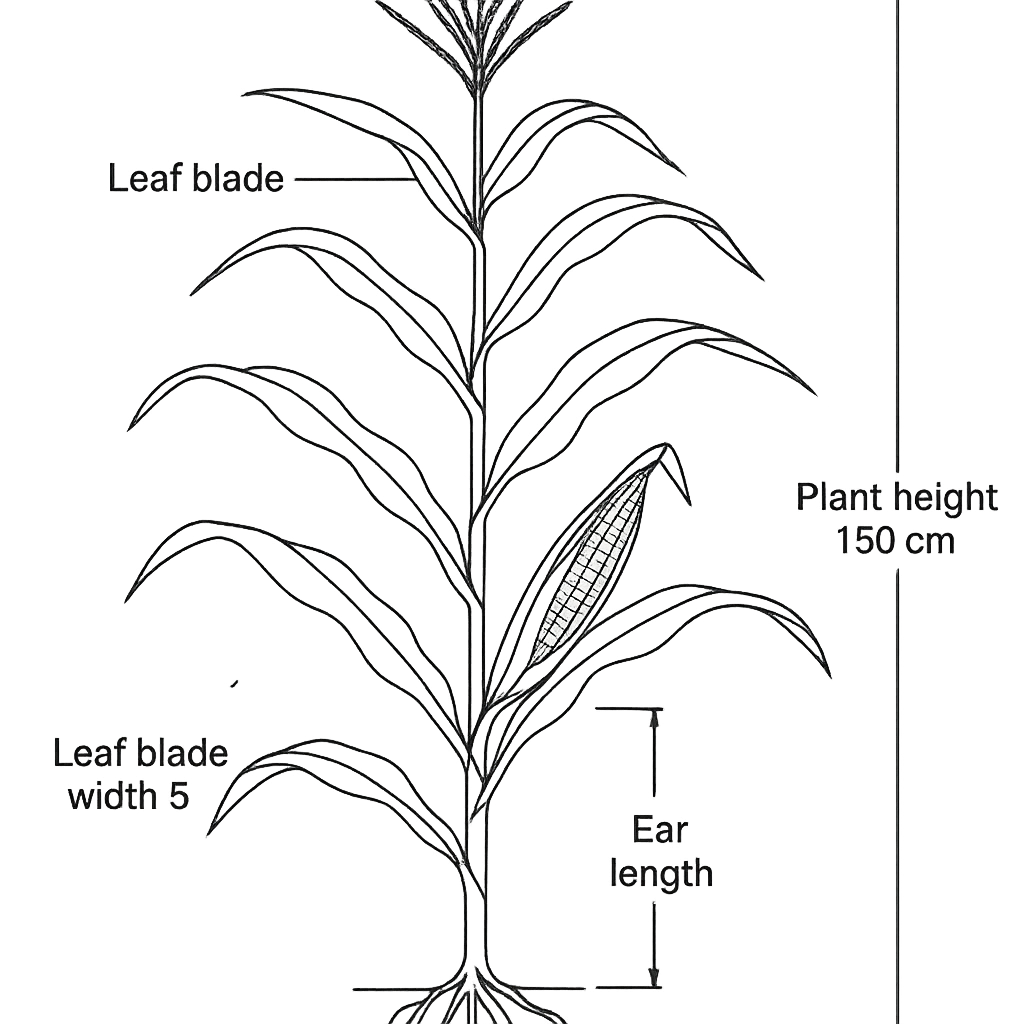
The diagram shows a mature maize plant with the following labelled dimensions: leaf blade length 30 cm, leaf blade width 5 cm, number of leaves per plant 8, plant height 150 cm, and ear length 20 cm. Using these data, calculate the total leaf area per plant and the leaf‑area index (LAI) for a stand density of 60 000 plants ha⁻¹. (LAI = total leaf area per ground area, expressed in m² leaf m⁻² ground.)
A. 0.55
B. 0.8
C. 0.65
Correct D. 0.72

Correct Answer: D

Want to see the full step-by-step solution? Unlock AI Explanation & Analytics
Question 20 View Details
An extension officer wants to promote a new drought‑resistant maize variety to a community of 200 farmers. Adoption follows Rogers' logistic diffusion model \(A(t)=\frac{K}{1+e^{-b(t-t_{0})}}\) where \(K=200\) (maximum adopters), \(b=0.4\) yr⁻¹ and \(t_{0}=3\) yr. The officer can run demonstration plots; each plot reduces \(t_{0}\) by 0.2 yr and increases \(b\) by 0.02 yr⁻¹. If five plots are established, what is the expected number of adopters after 5 years with and without the demonstrations? Which strategy yields the higher adoption after 5 years?
A. With demonstrations ≈170 adopters; without ≈140 adopters; demonstrations give about 30 more adopters
B. With demonstrations ≈158 adopters; without ≈135 adopters; demonstrations give about 23 more adopters
C. With demonstrations ≈150 adopters; without ≈130 adopters; demonstrations give about 20 more adopters
Correct D. With demonstrations ≈164 adopters; without ≈138 adopters; demonstrations give about 26 more adopters

Correct Answer: D

Want to see the full step-by-step solution? Unlock AI Explanation & Analytics
Question 21 View Details
A farmer intends to raise 120 chickens to a market weight of 2.2 kg each within 8 weeks. Each chick starts at 0.5 kg. The average daily gain (ADG) depends linearly on the protein content of the feed: at 18 % protein the ADG is 30 g day⁻¹ and at 20 % protein the ADG is 35 g day⁻¹. The feed conversion ratio (FCR) varies with protein according to \(\text{FCR}=1.8-0.05\times(\text{protein}\% -18)\). Determine the minimum protein percentage required in the feed to meet the target weight and, using that protein level, calculate the total amount of feed (in kg, rounded to the nearest kilogram) needed for the whole flock.
A. Minimum protein ≈ 17.8 % ; total feed ≈ 380 kg
Correct B. Minimum protein ≈ 18.14 % ; total feed ≈ 366 kg
C. Minimum protein ≈ 19.2 % ; total feed ≈ 400 kg
D. Minimum protein ≈ 18.6 % ; total feed ≈ 350 kg

Correct Answer: B

Want to see the full step-by-step solution? Unlock AI Explanation & Analytics
Question 22 View Details
An extension officer plans a programme to promote a new high‑yield maize variety. The cost of the programme per farmer is \(\text{₦}12{,}000\). The variety can increase yield by 1.8 t ha⁻¹. Adoption probability depends on farm size: farms ≤2 ha adopt with probability 0.6, farms >2 ha up to 5 ha adopt with probability 0.8, and farms >5 ha adopt with probability 0.5. The farmer population is distributed as follows: 30 % have ≤2 ha (average 1.5 ha), 50 % have 2-5 ha (average 3.5 ha), and 20 % have >5 ha (average 7 ha). Market price of maize is \(\text{₦}150\) per kg and variable production cost (excluding extension) is \(\text{₦}40\) per kg. Calculate the expected net benefit per farmer (revenue increase minus additional variable cost minus the programme cost) and state whether the programme is economically justified.
A. Expected net benefit ≈ ₦500,000 per farmer; programme is justified
Correct B. Expected net benefit ≈ ₦457,260 per farmer; programme is justified
C. Expected net benefit ≈ ₦-15,000 per farmer; programme is not justified
D. Expected net benefit ≈ ₦350,000 per farmer; programme is justified

Correct Answer: B

Want to see the full step-by-step solution? Unlock AI Explanation & Analytics
Question 23 View Details
A farmer harvests 10 t of cassava roots with an initial moisture content of 45 % (wet basis). The roots must be dried to a final moisture content of 12 % (wet basis). Drying can be performed in two stages: sun drying reduces moisture at 0.8 % per hour (free) for up to 24 h, and a mechanical dryer reduces moisture at 1.5 % per hour at a cost of \(\text{₦}2{,}500\) per hour. The farmer wants to minimise total drying time while keeping total drying cost ≤ \(\text{₦}150{,}000\). Determine the number of sun‑drying hours (integer) and the corresponding mechanical‑drying hours required, the total drying time, the total cost, and the final weight of the dried cassava (in tonnes, to two decimal places).
A. Sun drying = 0 h; Mechanical drying = 30 h; Total time = 30 h; Cost = ₦75,000; Final weight = 6.25 t
B. Sun drying = 2 h; Mechanical drying = 22 h; Total time = 24 h; Cost = ₦55,000; Final weight = 6.20 t
Correct C. Sun drying = 0 h; Mechanical drying = 22 h; Total time = 22 h; Cost = ₦55,000; Final weight = 6.25 t
D. Sun drying = 5 h; Mechanical drying = 20 h; Total time = 25 h; Cost = ₦50,000; Final weight = 6.30 t

Correct Answer: C

Want to see the full step-by-step solution? Unlock AI Explanation & Analytics
Question 24 View Details
A farmer monitors a 2‑ha maize field for Fall Armyworm. The economic injury level (EIL) is given by \(\text{EIL}=\dfrac{C}{V\times I\times D}\), where \(C\) is the control cost per ha (\(\text{₦}12{,}000\)), \(V\) is the market value per kg of maize (\(\text{₦}150\)), \(I\) is the injury per larva (0.02 kg larva⁻¹), and \(D\) is the proportion of the pest population killed by one spray (0.6). The farmer counts 150 larvae per ha. Determine whether the pest population exceeds the EIL and if control is justified. Also compute the expected total yield loss (in kg) for the whole field if no control is applied.
A. EIL ≈ 6,667 larvae/ha; observed 150 < EIL → control not justified; total expected loss = 8 kg
B. EIL ≈ 5,000 larvae/ha; observed 150 < EIL → control not justified; total expected loss = 6 kg
C. EIL ≈ 6,667 larvae/ha; observed 150 > EIL → control justified; total expected loss = 12 kg
Correct D. EIL ≈ 6,667 larvae/ha; observed 150 < EIL → control not justified; total expected loss = 6 kg

Correct Answer: D

Want to see the full step-by-step solution? Unlock AI Explanation & Analytics
Question 25 View Details
A hand‑operated seed drill requires a pulling force of 120 N to operate at a forward speed of 0.5 m s⁻¹. The farmer attaches a simple pulley system with an ideal mechanical advantage of 4:1, but the system loses 15 % of the input force due to friction. Calculate the actual pulling force the farmer must exert and the power delivered to the seed drill (in watts) after accounting for the friction loss. Compare this power with the original power requirement of the drill.
A. Pulling force ≈ 41.2 N; power to drill ≈ 20 W (original power was 60 W)
B. Pulling force ≈ 35.3 N; power to drill ≈ 12 W (original power was 60 W)
C. Pulling force ≈ 30 N; power to drill ≈ 15 W (original power was 60 W)
Correct D. Pulling force ≈ 35.3 N; power to drill ≈ 15 W (original power was 60 W)

Correct Answer: D

Want to see the full step-by-step solution? Unlock AI Explanation & Analytics

Master the Exam!

You've seen a preview, but there are thousands more questions plus AI tutor to break down complex solutions.

Unlock Full Access Available for Android & Windows
Help others prepare! Share this practice hub:
Chat with Support