gce model questions vol1 2023 biology | Objective

Prepare for your exams with gce model questions vol1 questions? Reviewing past/model questions is one of the most effective ways to guarantee a high score. This practice hub features authentic 2023 biology (Objective) questions designed to simulate the real exam environment.

Practice these randomly selected questions to test your readiness.
Question 1 View Details
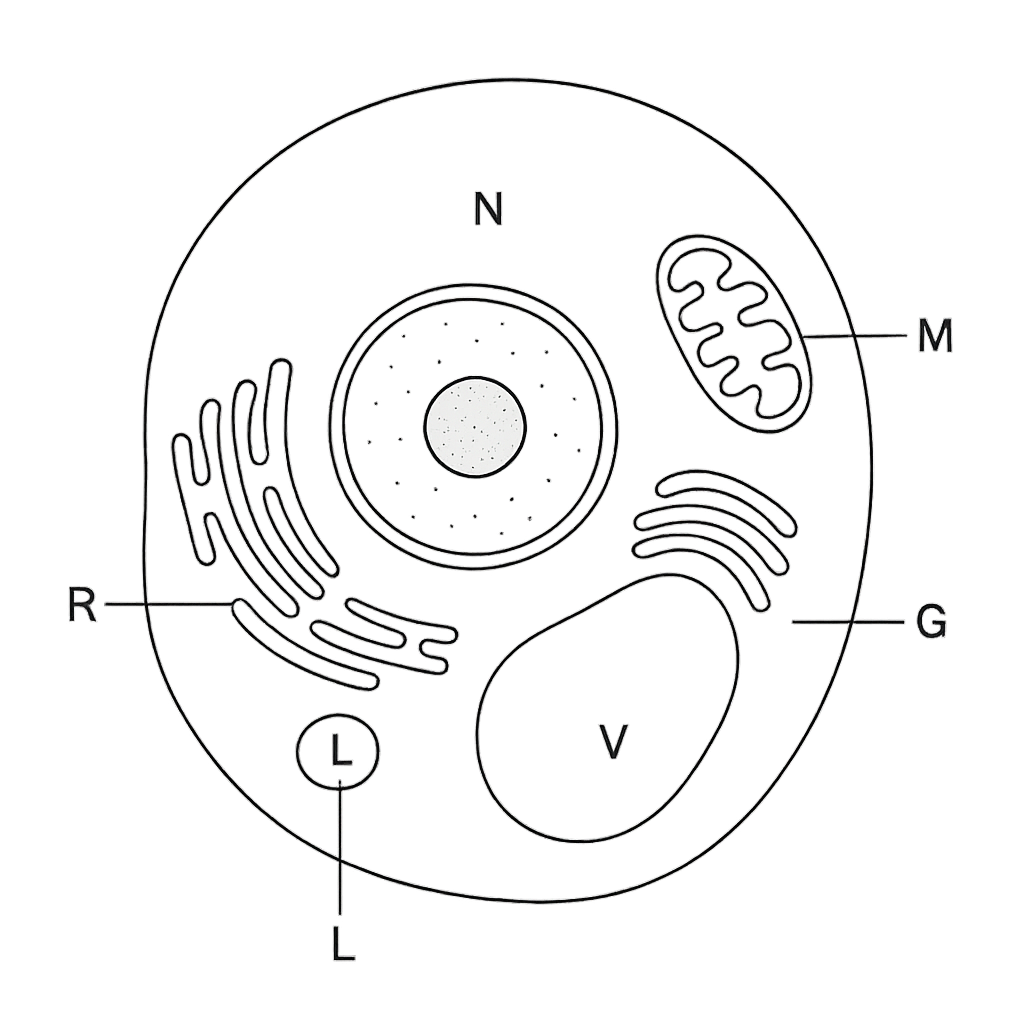
The diagram shows a typical animal cell with its major organelles labelled as follows: N (nucleus), M (mitochondrion), R (rough endoplasmic reticulum), S (smooth endoplasmic reticulum), G (Golgi apparatus), L (lysosome), V (vacuole). Which organelle is labelled M and what is its primary function in the cell?
A. Lysosome; it digests macromolecules.
B. Rough endoplasmic reticulum; it synthesizes proteins.
Correct C. Mitochondrion; it produces ATP through cellular respiration.
D. Golgi apparatus; it modifies and packages proteins.

Correct Answer: C

Want to see the full step-by-step solution? Unlock AI Explanation & Analytics
Question 2 View Details
A plant is heterozygous for two unlinked genes, genotype \(AaBb\). It self‑fertilises. What proportion of the offspring will be homozygous recessive \(aabb\)?
A. 1/4
Correct B. 1/16
C. 3/16
D. 1/8

Correct Answer: B

Want to see the full step-by-step solution? Unlock AI Explanation & Analytics
Question 3 View Details
In a study, insulin secretion rate \(R\) (units min⁻¹) in response to blood glucose concentration \(G\) (mmol L⁻¹) is given by \(R = 0.5(G-5)\) for \(G>5\) and \(R=0\) otherwise. After a meal a patient's glucose rises instantly to 12 mmol L⁻¹ and then falls at a constant rate of 1.2 mmol L⁻¹ h⁻¹ due to tissue uptake. Assuming insulin secretion adjusts instantly to the current glucose level, calculate the total insulin secreted (units) from the peak until glucose returns to the normal level of 5 mmol L⁻¹. Give your answer to two decimal places.
A. 600.00
Correct B. 612.50
C. 625.00
D. 550.00

Correct Answer: B

Want to see the full step-by-step solution? Unlock AI Explanation & Analytics
Question 4 View Details
Disease X has a basic reproduction number \(R_{0}=2.8\) and Disease Y has \(R_{0}=1.6\). A community of 10 000 people will vaccinate against each disease. The vaccine for Disease X is 85 % effective and for Disease Y is 95 % effective.\n\n(a) Calculate the minimum number of individuals that must be successfully immunised (i.e., vaccinated and protected) for each disease to achieve herd immunity.\n(b) If the community can only vaccinate 4 000 people, which disease could still cause an outbreak? Assume no natural immunity.
A. Neither disease could cause an outbreak.
Correct B. Disease X could still cause an outbreak.
C. Both diseases could still cause an outbreak.
D. Disease Y could still cause an outbreak.

Correct Answer: B

Want to see the full step-by-step solution? Unlock AI Explanation & Analytics
Question 5 View Details
A drug follows first‑order elimination with a half‑life of 6 h. It is given orally every 8 h at a dose \(D\) mg, bioavailability \(F=0.8\), and apparent volume of distribution \(V_{d}=40\) L. At steady state the peak concentration after a dose is 15 µg mL⁻¹ and the trough just before the next dose is 5 µg mL⁻¹.\n\n(a) Determine the dose \(D\) (mg) required to produce these concentrations.\n(b) If the dosing interval is changed to 12 h while keeping the same dose per administration, will the peak and trough concentrations remain within the therapeutic window of 8-12 µg mL⁻¹? Show all calculations.
A. Dose D ≈ 452 mg; the 12‑h regimen fails to stay within the therapeutic window (peak ≈11.0 µg mL⁻¹, trough ≈4.0 µg mL⁻¹).
Correct B. Dose D ≈ 452 mg; the 12‑h regimen fails to stay within the therapeutic window (peak ≈12.05 µg mL⁻¹, trough ≈3.01 µg mL⁻¹).
C. Dose D ≈ 380 mg; the 12‑h regimen stays within the therapeutic window (peak ≈10.2 µg mL⁻¹, trough ≈7.8 µg mL⁻¹).
D. Dose D ≈ 520 mg; the 12‑h regimen fails to stay within the therapeutic window (peak ≈13.5 µg mL⁻¹, trough ≈2.5 µg mL⁻¹).

Correct Answer: B

Want to see the full step-by-step solution? Unlock AI Explanation & Analytics
Question 6 View Details
A population of a short‑lived insect is divided into three age classes: juveniles (0-1 yr), sub‑adults (1-2 yr) and adults (2-3 yr). The probability of surviving from one class to the next is 0.5 for juveniles and 0.7 for sub‑adults, while adults survive to the next year with probability 0.9 (which is not needed for the calculation). The average number of female offspring produced per individual is 0 for juveniles, 1.2 for sub‑adults and 2.5 for adults. (i) Calculate the net reproductive rate \(R_{0}\). (ii) State whether the population is expected to increase or decrease. (iii) Calculate the generation time \(G\) (in years) using \(G=\frac{\sum x\,l_{x}m_{x}}{R_{0}}\) where \(x\) is the age (in years) of the reproductive class.
A. R₀ = 1.80 (≈1.795), population increasing, G ≈ 1.30 yr
B. R₀ = 0.95 (≈0.952), population decreasing, G ≈ 1.70 yr
C. R₀ = 1.20 (≈1.195), population decreasing, G ≈ 1.45 yr
Correct D. R₀ = 1.48 (≈1.475), population increasing, G ≈ 1.59 yr

Correct Answer: D

Want to see the full step-by-step solution? Unlock AI Explanation & Analytics
Question 7 View Details
After a standard glucose load, a subject's blood glucose concentration follows the exponential decay model \[ C(t)=C_{0}\,e^{-kt}+C_{\text{bas}} , \] where \(C_{\text{bas}}=5\ \text{mmol\ L}^{-1}\) is the basal concentration and \(C_{0}\) is the excess above baseline at \(t=0\). The measured concentration is 9 mmol L\(^{-1}\) at \(t=0\) and 7 mmol L\(^{-1}\) at \(t=30\ \text{min}\). (i) Determine the decay constant \(k\) (in \(\text{min}^{-1}\)). (ii) Calculate the time (in minutes) required for the concentration to fall to within 0.2 mmol L\(^{-1}\) of the basal level.
A. k ≈ 0.0300 min⁻¹; time ≈ 110 min
Correct B. k ≈ 0.0231 min⁻¹; time ≈ 130 min
C. k ≈ 0.0231 min⁻¹; time ≈ 100 min
D. k ≈ 0.0185 min⁻¹; time ≈ 150 min

Correct Answer: B

Want to see the full step-by-step solution? Unlock AI Explanation & Analytics
Question 8 View Details
A diploid human somatic cell (2n = 46) is examined. (i) Before DNA replication (i.e., in G₁ phase), how many chromosomes and how many chromatids are present? (ii) Immediately after DNA replication (i.e., in G₂ phase) but before mitosis begins, how many chromosomes and how many chromatids are present?
A. G₁: 46 chromosomes, 92 chromatids; G₂: 46 chromosomes, 92 chromatids
Correct B. G₁: 46 chromosomes, 46 chromatids; G₂: 46 chromosomes, 92 chromatids
C. G₁: 46 chromosomes, 46 chromatids; G₂: 92 chromosomes, 92 chromatids
D. G₁: 23 chromosomes, 46 chromatids; G₂: 46 chromosomes, 92 chromatids

Correct Answer: B

Want to see the full step-by-step solution? Unlock AI Explanation & Analytics
Question 9 View Details
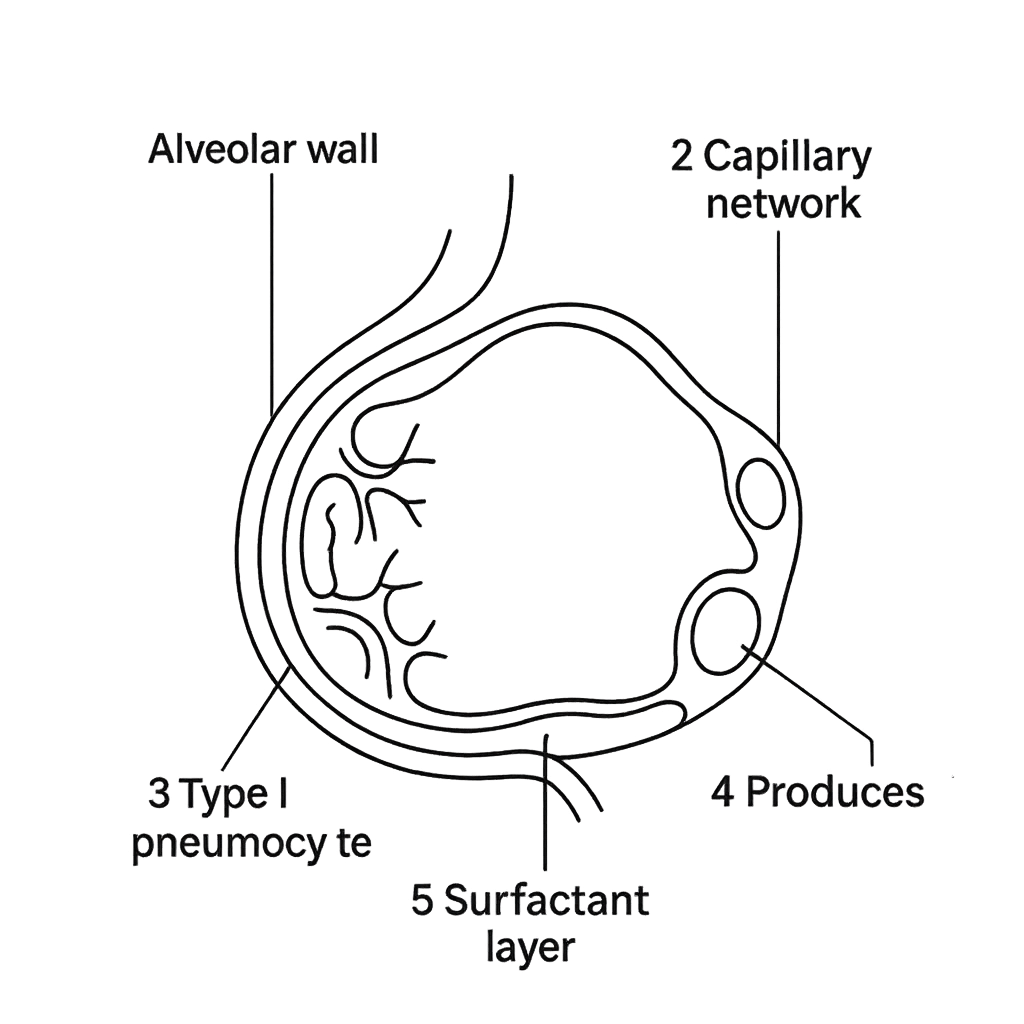
The diagram of an alveolus is labelled as follows: 1 Alveolar wall, 2 Capillary network, 3 Type I pneumocyte, 4 Type II pneumocyte, 5 Surfactant layer. (i) Which labelled structure is primarily responsible for reducing surface tension in the alveolus? (ii) The surface tension of the alveolar fluid is \(0.07\ \text{N\ m}^{-1}\) when no surfactant is present and \(0.02\ \text{N\ m}^{-1}\) when surfactant is present. Approximating the alveolus as a sphere of radius \(0.10\ \text{mm}\), calculate the factor by which the mechanical work required to inflate the alveolus is reduced by the presence of surfactant. (Assume work ≈ surface tension × surface area.)
A. Structure 5 (surfactant layer); work reduced to ≈0.57 × the original (≈57 % of the work)
Correct B. Structure 4 (type II pneumocyte); work reduced to ≈0.29 × the original (≈29 % of the work)
C. Structure 4 (type II pneumocyte); work reduced to ≈0.50 × the original (≈50 % of the work)
D. Structure 3 (type I pneumocyte); work reduced to ≈0.29 × the original (≈29 % of the work)

Correct Answer: B

Want to see the full step-by-step solution? Unlock AI Explanation & Analytics
Question 10 View Details
Which cellular organelle is the main site of protein synthesis, and how can you recognise it in an electron micrograph?
A. Mitochondrion - seen as dense 20‑30 nm granules, often adjacent to the plasma membrane
Correct B. Ribosome - seen as dense 20‑30 nm granules, either free in cytoplasm or on rough ER
C. Lysosome - seen as dense 20‑30 nm granules, scattered throughout the cytoplasm
D. Golgi apparatus - seen as stacked 20‑30 nm cisternae, located near the nucleus

Correct Answer: B

Want to see the full step-by-step solution? Unlock AI Explanation & Analytics
Question 11 View Details
In the regulation of blood calcium, parathyroid hormone (PTH) raises plasma calcium by 0.4 mmol L(^{-1}) for each unit of hormone secreted, while calcitonin lowers plasma calcium by 0.3 mmol L(^{-1}) for each unit secreted. Under normal conditions the body secretes 1 unit of PTH and 1 unit of calcitonin, giving a net change of +0.1 mmol L(^{-1}). If a disease causes PTH secretion to increase to 1.5 units and calcitonin secretion to fall to 0.6 units, what is the resulting change in plasma calcium concentration compared with the normal state?
A. 0.24 mmol L(^{-1}) increase
Correct B. 0.32 mmol L(^{-1}) increase
C. 0.42 mmol L(^{-1}) increase
D. 0.28 mmol L(^{-1}) increase

Correct Answer: B

Want to see the full step-by-step solution? Unlock AI Explanation & Analytics
Question 12 View Details
A patient's plasma glucose concentration is 5 mmol L(^{-1}). Normally the glomerular filtration rate (GFR) is 120 mL min(^{-1}) and 99 % of the filtered glucose is re‑absorbed, so virtually no glucose appears in the urine. In a renal disorder the GFR falls to 90 mL min(^{-1}) and the tubular re‑absorption efficiency drops to 95 %. Calculate the amount of glucose excreted in the urine per minute (in mmol min(^{-1})).
A. 0.03 mmol min(^{-1})
B. 22.5 mmol min(^{-1})
Correct C. 0.0225 mmol min(^{-1})
D. 0.0045 mmol min(^{-1})

Correct Answer: C

Want to see the full step-by-step solution? Unlock AI Explanation & Analytics
Question 13 View Details
A newly discovered unicellular organism shows the following characteristics: (i) it possesses membrane‑bound organelles, (ii) its cell wall is composed of chitin, (iii) it reproduces by budding, (iv) it stores glycogen as an energy reserve, and (v) it contains mitochondria. Using these traits, classify the organism to the correct domain, kingdom and, where possible, phylum.
Correct A. Domain Eukarya; Kingdom Fungi; Phylum Ascomycota
B. Domain Eukarya; Kingdom Protista; Phylum Ascomycota
C. Domain Bacteria; Kingdom Fungi; Phylum Ascomycota
D. Domain Eukarya; Kingdom Fungi; Phylum Basidiomycota

Correct Answer: A

Want to see the full step-by-step solution? Unlock AI Explanation & Analytics
Question 14 View Details
In a 30‑day menstrual cycle the follicular phase lasts on average 14 days and the luteal phase 16 days. An LH surge, which precedes ovulation by 34-36 hours, is detected at 22:00 on day 13. Determine the earliest and latest possible times of ovulation (give the day and clock‑time).
A. Between 09:00 and 11:00 on day 14
B. Between 12:00 and 14:00 on day 16
Correct C. Between 08:00 and 10:00 on day 15
D. Between 06:00 and 08:00 on day 15

Correct Answer: C

Want to see the full step-by-step solution? Unlock AI Explanation & Analytics
Question 15 View Details
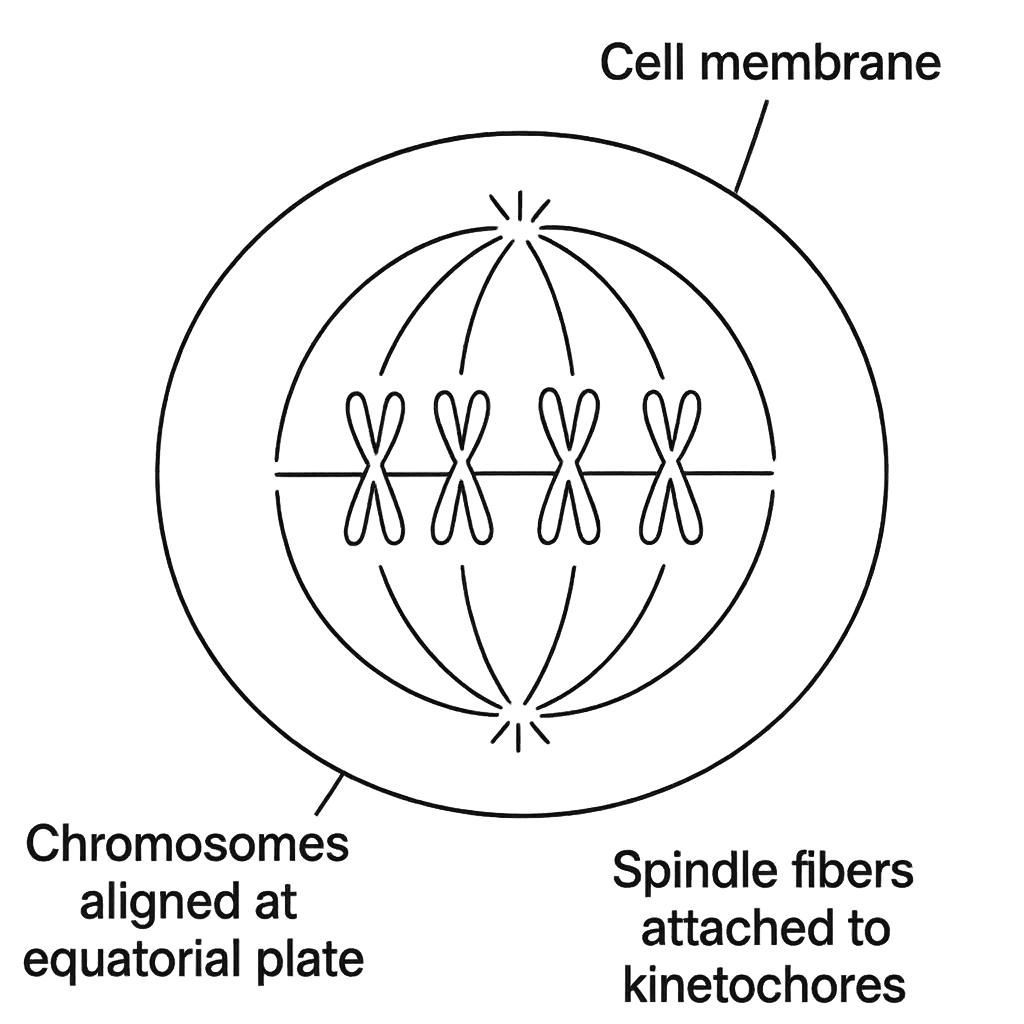
The diagram shows a somatic cell undergoing mitosis. Identify the stage of mitosis depicted.
A. Anaphase
B. Prophase
Correct C. Metaphase
D. Telophase

Correct Answer: C

Want to see the full step-by-step solution? Unlock AI Explanation & Analytics
Question 16 View Details
A resting adult consumes 250 mL of O₂ per minute at STP. Assuming complete aerobic oxidation of glucose \(\mathrm{C_6H_{12}O_6 + 6\,O_2 \rightarrow 6\,CO_2 + 6\,H_2O}\), calculate (a) the number of glucose molecules metabolised in one hour, and (b) the volume of CO₂ produced at STP in that hour.
Correct A. (a) ≈ 6.7 × 10²² glucose molecules per hour; (b) 15 L CO₂ at STP per hour.
B. (a) ≈ 6.7 × 10²³ glucose molecules per hour; (b) 150 L CO₂ at STP per hour.
C. (a) ≈ 5.0 × 10²² glucose molecules per hour; (b) 12 L CO₂ at STP per hour.
D. (a) ≈ 8.2 × 10²² glucose molecules per hour; (b) 18 L CO₂ at STP per hour.

Correct Answer: A

Want to see the full step-by-step solution? Unlock AI Explanation & Analytics
Question 17 View Details
In a batch bacterial culture the initial inoculum is \(1 \times 10^{3}\) cells. After 2 h the cell count is \(8 \times 10^{4}\) cells. (a) Assuming exponential growth during this period, determine the generation time in minutes. (b) How many generations occurred in the first 2 h? (c) If the carrying capacity of the culture is \(5 \times 10^{8}\) cells and growth ceases once this number is reached, estimate the time (in hours) required to reach the carrying capacity. (d) What is the total number of cells present after 10 h under these conditions?
A. Generation time ≈ 15 min; generations in first 2 h ≈ 8.0; time to reach \(5\times10^{8}\) cells ≈ 5.0 h; cells after 10 h = \(5\times10^{8}\).
Correct B. Generation time ≈ 19 min; generations in first 2 h ≈ 6.3; time to reach \(5\times10^{8}\) cells ≈ 6.0 h; cells after 10 h = \(5\times10^{8}\).
C. Generation time ≈ 22 min; generations in first 2 h ≈ 6.0; time to reach \(5\times10^{8}\) cells ≈ 6.8 h; cells after 10 h = \(5\times10^{8}\).
D. Generation time ≈ 25 min; generations in first 2 h ≈ 5.0; time to reach \(5\times10^{8}\) cells ≈ 7.5 h; cells after 10 h = \(5\times10^{8}\).

Correct Answer: B

Want to see the full step-by-step solution? Unlock AI Explanation & Analytics
Question 18 View Details
During intense exercise a muscle cell produces \(2.5 \times 10^{9}\) ATP per minute. Seventy percent of the ATP is supplied by anaerobic glycolysis (2 ATP per glucose) and the remaining thirty percent by aerobic respiration (38 ATP per glucose). Calculate (a) the rate of glucose consumption from each pathway in molecules per minute, and (b) the rate of O₂ consumption (in molecules per minute) associated with the aerobic pathway.
A. (a) Anaerobic glucose ≈ 8.00 × 10⁸ molecules min⁻¹; aerobic glucose ≈ 1.50 × 10⁷ molecules min⁻¹. (b) O₂ consumption ≈ 1.00 × 10⁸ molecules min⁻¹ (≈1.0×10⁻¹⁶ mol min⁻¹).
Correct B. (a) Anaerobic glucose ≈ 8.75 × 10⁸ molecules min⁻¹; aerobic glucose ≈ 1.97 × 10⁷ molecules min⁻¹. (b) O₂ consumption ≈ 1.18 × 10⁸ molecules min⁻¹ (≈1.2×10⁻¹⁶ mol min⁻¹).
C. (a) Anaerobic glucose ≈ 7.50 × 10⁸ molecules min⁻¹; aerobic glucose ≈ 2.00 × 10⁷ molecules min⁻¹. (b) O₂ consumption ≈ 9.00 × 10⁷ molecules min⁻¹ (≈9×10⁻¹⁷ mol min⁻¹).
D. (a) Anaerobic glucose ≈ 1.00 × 10⁹ molecules min⁻¹; aerobic glucose ≈ 2.50 × 10⁷ molecules min⁻¹. (b) O₂ consumption ≈ 1.50 × 10⁸ molecules min⁻¹ (≈1.5×10⁻¹⁶ mol min⁻¹).

Correct Answer: B

Want to see the full step-by-step solution? Unlock AI Explanation & Analytics
Question 19 View Details
A bacterial population of \(1 \times 10^{8}\) cells is exposed to an antibiotic. The spontaneous mutation rate that confers resistance is \(1 \times 10^{-8}\) per cell division. Each cell divides once per hour and the culture is maintained for 24 h. (a) Estimate the expected number of resistant mutants after 24 h. (b) Assuming a Poisson distribution, give the probability that at least one resistant mutant is present after 24 h. (c) If a subculture of \(1 \times 10^{6}\) cells is taken from the 24‑h culture, what is the probability that this subculture contains at least one resistant cell?
A. (a) ≈ 3.2 × 10⁷ resistant mutants; (b) probability ≈ 0.99 (≈99 %); (c) probability ≈ 0.02 (≈2 %).
B. (a) ≈ 2.4 × 10⁶ resistant mutants; (b) probability ≈ 0.95 (≈95 %); (c) probability ≈ 0.05 (≈5 %).
Correct C. (a) ≈ 1.68 × 10⁷ resistant mutants; (b) probability ≈ 1 (≈100 %); (c) probability ≈ 0.01 (≈1 %).
D. (a) ≈ 5.0 × 10⁶ resistant mutants; (b) probability ≈ 0.90 (≈90 %); (c) probability ≈ 0.001 (≈0.1 %).

Correct Answer: C

Want to see the full step-by-step solution? Unlock AI Explanation & Analytics
Question 20 View Details
In a subject the plasma flow to the kidneys is 600 mL min⁻¹ and the filtration fraction is 0.20. Plasma glucose concentration is 5 mmol L⁻¹. Normally, 99 % of the filtered glucose is re‑absorbed in the proximal tubule. A drug reduces the re‑absorption efficiency to 95 %. Calculate (a) the glomerular filtration rate (GFR), (b) the amount of glucose excreted per minute (mmol min⁻¹) after the drug is administered, and (c) the percentage increase in glucose excretion compared with the normal situation.
A. (a) GFR = 120 mL min⁻¹ (0.12 L min⁻¹); (b) glucose excreted = 0.05 mmol min⁻¹; (c) excretion increases by 800 % compared with normal.
Correct B. (a) GFR = 120 mL min⁻¹ (0.12 L min⁻¹); (b) glucose excreted = 0.03 mmol min⁻¹; (c) excretion increases by 400 % compared with normal.
C. (a) GFR = 100 mL min⁻¹ (0.10 L min⁻¹); (b) glucose excreted = 0.02 mmol min⁻¹; (c) excretion increases by 300 % compared with normal.
D. (a) GFR = 150 mL min⁻¹ (0.15 L min⁻¹); (b) glucose excreted = 0.04 mmol min⁻¹; (c) excretion increases by 500 % compared with normal.

Correct Answer: B

Want to see the full step-by-step solution? Unlock AI Explanation & Analytics
Question 21 View Details
Two spherical animal cells differ only in radius. Cell A has a radius of \(5\ \mu\text{m}\) and Cell B has a radius of \(10\ \mu\text{m}\). The time required for a small solute to diffuse across a cell is proportional to the square of the cell's radius. Which cell will reach diffusion equilibrium faster, and by what factor does its diffusion time compare to the other cell?
Correct A. Cell A diffuses faster; its diffusion time is one‑fourth that of Cell B.
B. Cell A diffuses faster; its diffusion time is one‑half that of Cell B.
C. Cell B diffuses faster; its diffusion time is one‑fourth that of Cell A.
D. Cell B diffuses faster; its diffusion time is one‑half that of Cell A.

Correct Answer: A

Want to see the full step-by-step solution? Unlock AI Explanation & Analytics
Question 22 View Details
A person consumes a meal containing 60 g of carbohydrate. Each gram of carbohydrate raises blood glucose concentration by \(4\ \text{mg\,dL}^{-1}\). The individual then injects 2 units of rapid‑acting insulin; each unit lowers blood glucose by \(50\ \text{mg\,dL}^{-1}\). Assuming no other glucose sources or losses, what is the net change in blood glucose concentration after the meal and insulin injection?
A. A decrease of 40 mg dL⁻¹.
B. An increase of 100 mg dL⁻¹.
Correct C. An increase of 140 mg dL⁻¹.
D. No net change in blood glucose concentration.

Correct Answer: C

Want to see the full step-by-step solution? Unlock AI Explanation & Analytics
Question 23 View Details
An isolated lake covers an area of \(2\ \text{km}^2\). Solar irradiance provides \(1.5\ \text{MJ\,m}^{-2}\) of energy each day. Primary production in the lake converts \(5\%\) of the incident solar energy into phytoplankton biomass (assume an energy content of \(20\ \text{MJ\,kg}^{-1}\) for the biomass). Energy is transferred to the next trophic level (zooplankton) with an efficiency of \(10\%\), and from zooplankton to fish with the same efficiency. Fish require \(2\%\) of their body mass per day as food, and the energy content of fish tissue is also \(20\ \text{MJ\,kg}^{-1}\). Estimate the maximum sustainable fish biomass (in kilograms) that the lake can support.
Correct A. Approximately \(3.8\times10^{3}\) kg of fish.
B. Approximately \(5.6\times10^{2}\) kg of fish.
C. Approximately \(1.2\times10^{4}\) kg of fish.
D. Approximately \(9.3\times10^{3}\) kg of fish.

Correct Answer: A

Want to see the full step-by-step solution? Unlock AI Explanation & Analytics
Question 24 View Details
A cell membrane is \(5\ \text{nm}\) thick and has a permeability coefficient for glucose of \(P = 1.2 \times 10^{-5}\ \text{cm\,s}^{-1}\). The external glucose concentration is \(5\ \text{mM}\) and the internal concentration is \(1\ \text{mM}\). The cell has a total membrane surface area of \(1 \times 10^{-5}\ \text{cm}^{2}\). (i) Calculate the net molar flux of glucose across the membrane (in \(\text{mol\,min}^{-1}\)). (ii) If the cell's metabolic demand for glucose is \(2 \times 10^{-12}\ \text{mol\,min}^{-1}\), does passive diffusion meet this demand?
A. Flux ≈ 1.5×10⁻¹³ mol min⁻¹; this is below the required 2×10⁻¹² mol min⁻¹, so passive diffusion is insufficient.
Correct B. Flux ≈ 2.9×10⁻¹⁴ mol min⁻¹; this is far below the required 2×10⁻¹² mol min⁻¹, so passive diffusion is insufficient.
C. Flux ≈ 2.9×10⁻¹⁴ mol min⁻¹; this exceeds the required 2×10⁻¹² mol min⁻¹, indicating diffusion is more than enough.
D. Flux ≈ 4.0×10⁻¹⁴ mol min⁻¹; this meets the required 2×10⁻¹² mol min⁻¹, so passive diffusion is sufficient.

Correct Answer: B

Want to see the full step-by-step solution? Unlock AI Explanation & Analytics
Question 25 View Details
In a plant, two genes A and B are located on the same chromosome and are linked with a recombination frequency of \(15\%\). The parental (cis) arrangement in a heterozygous individual is \(AB/ab\). This plant is crossed with a homozygous recessive \(ab/ab\) individual. What is the probability (as a percentage) that an offspring will have the genotype \(A a b b\) (i.e., possess the dominant allele A but be recessive at gene B)?
A. 5 %
B. 42.5 %
C. 15 %
Correct D. 7.5 %

Correct Answer: D

Want to see the full step-by-step solution? Unlock AI Explanation & Analytics

Master the Exam!

You've seen a preview, but there are thousands more questions plus AI tutor to break down complex solutions.

Unlock Full Access Available for Android & Windows
Help others prepare! Share this practice hub:
Chat with Support