gce model questions vol1 2023 agricultural_science | Objective

Prepare for your exams with gce model questions vol1 questions? Reviewing past/model questions is one of the most effective ways to guarantee a high score. This practice hub features authentic 2023 agricultural_science (Objective) questions designed to simulate the real exam environment.

Practice these randomly selected questions to test your readiness.

Question 1 View Details
A farmer keeps \(200\) cattle. In a recent disease outbreak, \(15\%\) of the herd showed fever, \(8\%\) showed nasal discharge, and \(5\%\) showed both fever and nasal discharge. A vaccine that is \(85\%\) effective is administered to all cattle that showed no symptoms. How many cattle are expected to remain susceptible after vaccination?
A. 26
B. 24
C. 30
Correct D. 25

Correct Answer: D

Want to see the full step-by-step solution? Unlock AI Explanation & Analytics
Question 2 View Details
A goat weighing \(45\) kg is diagnosed with anemia. The recommended treatment is oxytetracycline at \(10\) mg per kg body weight per day for \(5\) days. Because the goat has reduced renal function, only \(80\%\) of the administered dose is bioavailable. What total amount of oxytetracycline (in mg) must be given over the whole treatment to achieve the required effective dose?
A. 2250
Correct B. 2813
C. 2800
D. 3000

Correct Answer: B

Want to see the full step-by-step solution? Unlock AI Explanation & Analytics
Question 3 View Details
An extension officer plans to introduce a new high‑yield maize variety to \(12\) villages, each containing \(150\) smallholder farmers. The programme includes two‑day training workshops costing N\(200\) per farmer for materials and N\(5{,}000\) per village for venue and logistics. A radio campaign costing a flat N\(120{,}000\) will reach all villages. The expected increase in yield is \(1.2\) tonnes per farmer, valued at N\(150\) per tonne. The officer has a budget of N\(500{,}000\).\n\n(i) Is the programme financially viable under these conditions?\n(ii) If not, what is the maximum number of villages that can be included while staying within the budget and still achieving a positive net benefit?
A. 250000
B. 150000
Correct C. 0
D. 50000

Correct Answer: C

Want to see the full step-by-step solution? Unlock AI Explanation & Analytics
Question 4 View Details
A poultry farm has \(800\) broiler chickens that are to be reared to a market weight of \(2.2\) kg each. The target average daily gain is \(55\) g per bird and the desired feed conversion ratio (FCR) is \(1.7\) kg feed per kg weight gain. The feed mixture contains \(22\%\) protein; its digestibility is \(85\%\), and each kilogram of feed must provide at least \(180\) g of digestible protein.\n\nCalculate the total amount of feed (in kg) required for the entire flock to reach market weight, and state whether the protein specification is satisfied.
Correct A. 2992
B. 2800
C. 3100
D. 3500

Correct Answer: A

Want to see the full step-by-step solution? Unlock AI Explanation & Analytics
Question 5 View Details
A farmer cultivates \(10\) ha of wheat. Variable costs are N\(45{,}000\) per ha and fixed costs are N\(12{,}000\) per ha. Expected yield is \(4.5\) tonnes per ha. The current market price is N\(16{,}000\) per tonne. The government offers a subsidy of N\(20\) per tonne on the first \(30\) tonnes produced.\n\n(a) Calculate the farmer's profit with and without the subsidy.\n(b) Determine the minimum market price per tonne required to achieve a profit of at least N\(150{,}000\) after the subsidy is applied.
A. Profit without subsidy: N140,000; profit with subsidy: N140,600; minimum price: N15,500 per tonne
Correct B. Profit without subsidy: N150,000; profit with subsidy: N150,600; minimum price: N15,988 per tonne
C. Profit without subsidy: N155,000; profit with subsidy: N155,600; minimum price: N15,800 per tonne
D. Profit without subsidy: N150,000; profit with subsidy: N151,200; minimum price: N16,200 per tonne

Correct Answer: B

Want to see the full step-by-step solution? Unlock AI Explanation & Analytics
Question 6 View Details
A farmer raises broiler chickens to a market weight of \(2.0\) kg per bird. Each bird gains weight at an average daily gain of \(50\) g and the feed conversion ratio (FCR) is \(1.8\) kg feed per kg gain. Feed costs N100 per kg, and the market price of live weight is N250 per kg. Fixed overheads amount to N30 per bird. The farmer has \(500\) kg of feed available. Assuming all birds are raised to the target weight, what is the total profit the farmer can obtain from this batch?
A. N15 290
Correct B. N15 180
C. N17 040
D. N14 860

Correct Answer: B

Want to see the full step-by-step solution? Unlock AI Explanation & Analytics
Question 7 View Details
A farmer has \(10\) ha of land to allocate between wheat and maize. Wheat yields \(3\) t ha⁻¹ and sells for N120 kg⁻¹; maize yields \(2.5\) t ha⁻¹ and sells for N80 kg⁻¹. The variable cost per hectare for wheat is \(N15\,000 + N5\,000\,x\), where \(x\) is the number of hectares planted to wheat; for maize the variable cost per hectare is \(N12\,000 + N4\,000\,y\), where \(y\) is the number of hectares planted to maize. Fixed costs are N50 000. Let \(x\) denote hectares of wheat (so \(y = 10 - x\)). Determine the value of \(x\) that maximises profit and compute the maximum profit.
A. Allocate about 8.5 ha to wheat and 1.5 ha to maize; maximum profit ≈ N2 400 000
B. Allocate about 7.0 ha to wheat and 3.0 ha to maize; maximum profit ≈ N2 600 000
C. Allocate about 10 ha to wheat and 0 ha to maize; maximum profit ≈ N2 300 000
Correct D. Allocate about 9.1 ha to wheat and 0.9 ha to maize; maximum profit ≈ N2 532 748

Correct Answer: D

Want to see the full step-by-step solution? Unlock AI Explanation & Analytics
Question 8 View Details
In a poultry flock a contagious disease has a transmission coefficient \(\beta = 0.8\) per day and an average infectious period of \(5\) days. The disease‑induced mortality proportion is \(0.2\) (mortality does not affect transmission).\n(a) Calculate the basic reproduction number \(R_{0}\).\n(b) Determine the minimum proportion of the flock that must be immunised with a perfect vaccine to reduce the effective reproduction number below 1.\n(c) If only 60 % of the birds can be vaccinated, will an outbreak be prevented?
A. R₀ = 3; at least 75 % must be vaccinated; 60 % vaccination is insufficient - outbreak not prevented
B. R₀ = 4; at least 70 % must be vaccinated; 60 % vaccination is sufficient - outbreak prevented
Correct C. R₀ = 4; at least 75 % must be vaccinated; 60 % vaccination is insufficient - outbreak not prevented
D. R₀ = 5; at least 80 % must be vaccinated; 60 % vaccination is insufficient - outbreak not prevented

Correct Answer: C

Want to see the full step-by-step solution? Unlock AI Explanation & Analytics
Question 9 View Details
The volume of a stand of a fast‑growing tree species follows the logistic model \[ V(t) = \frac{K}{1 + a e^{-rt}} \] where \(V\) is the standing volume in m³ ha⁻¹, \(K = 200\) m³ ha⁻¹, \(r = 0.08\) yr⁻¹ and at time \(t = 0\) the volume is \(20\) m³ ha⁻¹.\n(a) Determine the constant \(a\).\n(b) Using the logistic growth, the maximum sustainable annual harvest per hectare (the maximum constant harvest that can be taken indefinitely) occurs at half the carrying capacity. Calculate this maximum sustainable harvest \(H_{max}\) in m³ ha⁻¹ yr⁻¹.
A. a = 10; maximum sustainable harvest Hₘₐₓ = 4 m³ ha⁻¹ yr⁻¹
Correct B. a = 9; maximum sustainable harvest Hₘₐₓ = 4 m³ ha⁻¹ yr⁻¹
C. a = 8; maximum sustainable harvest Hₘₐₓ = 5 m³ ha⁻¹ yr⁻¹
D. a = 9; maximum sustainable harvest Hₘₐₓ = 3 m³ ha⁻¹ yr⁻¹

Correct Answer: B

Want to see the full step-by-step solution? Unlock AI Explanation & Analytics
Question 10 View Details
A rectangular field measures \(120\) m in length and \(80\) m in width. To reduce nutrient runoff, a vegetative buffer strip must be established along the entire length of one side of the field. The width of the buffer strip must be 5 % of the field length. What is the area of the buffer strip in square metres?
A. 540 m²
B. 480 m²
C. 600 m²
Correct D. 720 m²

Correct Answer: D

Want to see the full step-by-step solution? Unlock AI Explanation & Analytics
Question 11 View Details
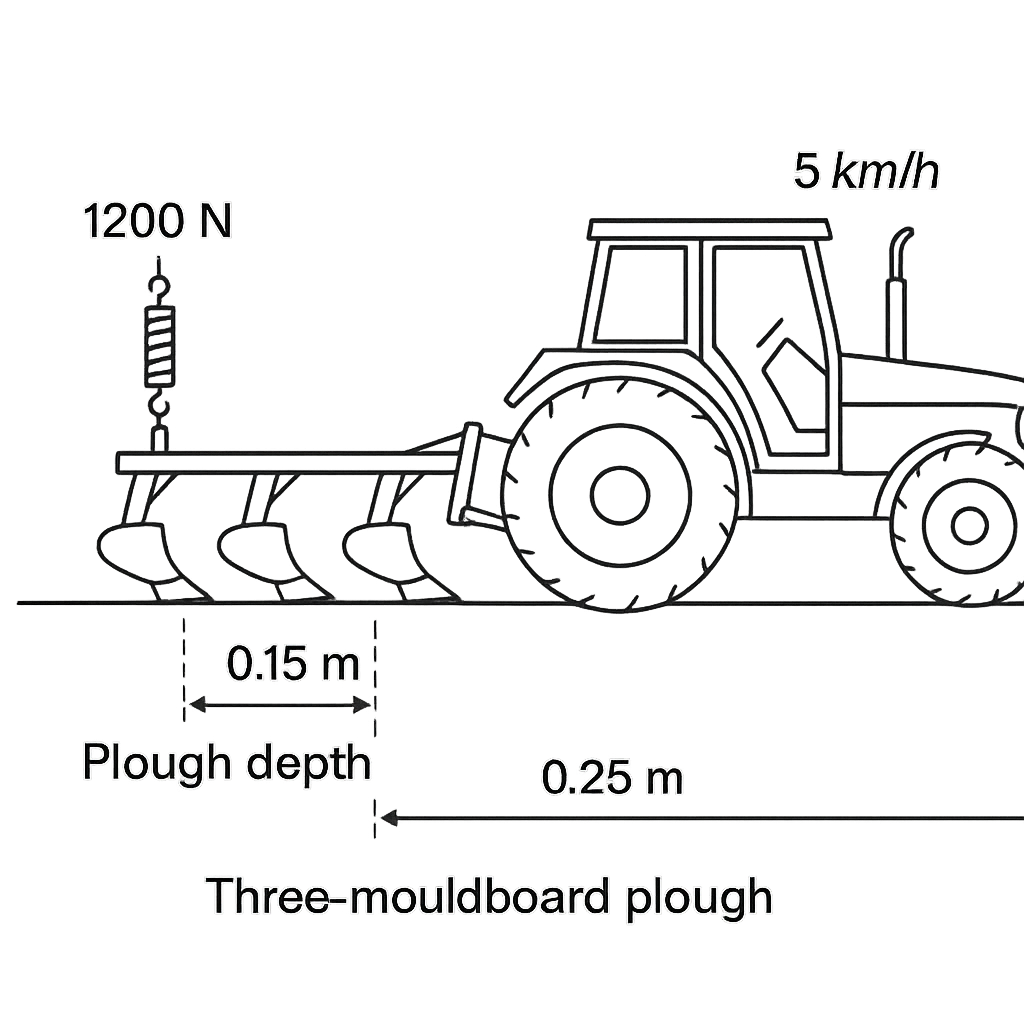
A three‑mouldboard plough has a total effective width of 0.9 m. When the plough depth is set to 0.15 m, a spring‑scale attached to the drawbar reads 1200 N. Assume that draft force varies directly with both plough depth and total width. The tractor moves at 5 km h^{-1} and the power transmission efficiency from the engine to the drawbar is 80 %. What minimum engine power, in kilowatts (kW), is required to operate the plough at a depth of 0.25 m?
A. 2.8 kW
B. 5.0 kW
Correct C. 3.5 kW
D. 4.2 kW

Correct Answer: C

Want to see the full step-by-step solution? Unlock AI Explanation & Analytics
Question 12 View Details
A dairy farmer feeds each cow a mixture of two concentrates. Feed A provides 12 MJ of metabolizable energy and 200 g of crude protein per kilogram and costs £0.20 kg^{-1}. Feed B provides 10 MJ of metabolizable energy and 250 g of crude protein per kilogram and costs £0.30 kg^{-1}. Each cow must receive at least 30 MJ of energy and 1.5 kg of protein per day. Determine the least‑cost combination of Feed A and Feed B (in kilograms of each feed) that meets the nutritional requirements.
A. 8.0 kg Feed A and 0 kg Feed B
B. 6.0 kg Feed A and 0.5 kg Feed B
C. 5.0 kg Feed A and 2.0 kg Feed B
Correct D. 7.5 kg Feed A and 0 kg Feed B

Correct Answer: D

Want to see the full step-by-step solution? Unlock AI Explanation & Analytics
Question 13 View Details
A batch of 10 000 kg of maize kernels is harvested at an initial moisture content of 20 % (wet basis). The desired final moisture content is 12 % (wet basis). The drying process follows the first‑order model \( \frac{dM}{dt}=k\,(M-M_e) \) where \(M\) is the moisture content expressed as kilograms of water per kilogram of dry matter, \(M_e\) is the equilibrium moisture content, and \(k = 1.0\times10^{-3}\ \text{s}^{-1}\). At the drying air conditions (30 °C, 30 % relative humidity) the equilibrium moisture content is \(M_e = 0.05\ \text{kg water kg}^{-1}\text{dry matter}\). Determine the time required, in minutes, to reduce the moisture content from the initial level to the target level.
A. 20 minutes
B. 16 minutes
Correct C. 14 minutes
D. 12 minutes

Correct Answer: C

Want to see the full step-by-step solution? Unlock AI Explanation & Analytics
Question 14 View Details
A soil has a porosity of 0.48. The volumetric water content at field capacity is 0.30 and at the permanent wilting point is 0.12. For a soil layer 1 m deep, calculate the available water capacity (AWC) in millimetres.
A. 210 mm
B. 150 mm
Correct C. 180 mm
D. 240 mm

Correct Answer: C

Want to see the full step-by-step solution? Unlock AI Explanation & Analytics
Question 15 View Details
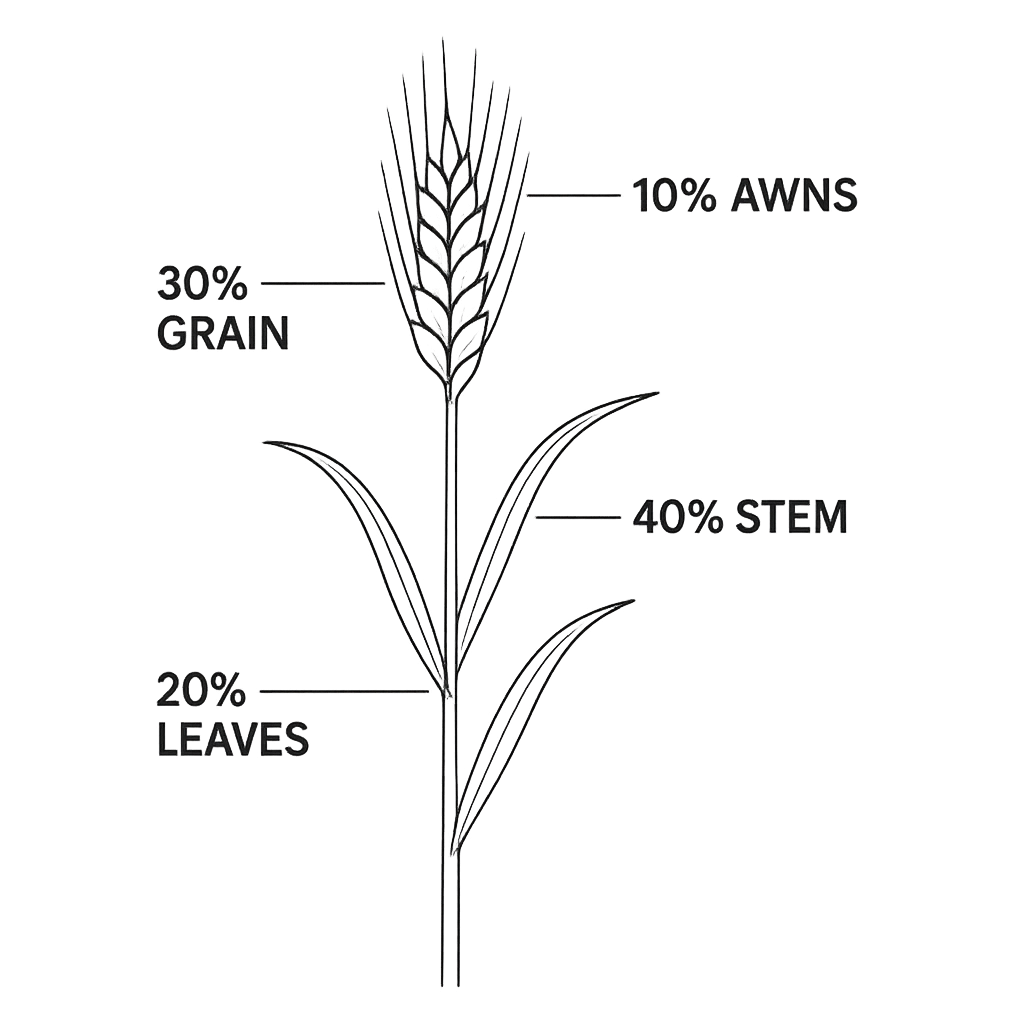
The diagram shows a mature wheat plant. The total above‑ground dry matter per plant is 120 g, distributed as follows: 30 % in the grain (ear), 40 % in the stem, 20 % in the leaves and 10 % in the awns. The field is sown at a density of 250 000 plants ha^{-1}. Calculate (a) the grain dry‑matter yield per hectare in tonnes, and (b) the harvest index (grain dry matter / total above‑ground dry matter).
A. 9.5 tonnes per hectare; harvest index 0.32
B. 8.5 tonnes per hectare; harvest index 0.28
C. 7 tonnes per hectare; harvest index 0.25
Correct D. 9 tonnes per hectare; harvest index 0.30

Correct Answer: D

Want to see the full step-by-step solution? Unlock AI Explanation & Analytics
Question 16 View Details
A batch of mangoes is stored in a ventilated chamber. The respiration rate of the fruit, \(R\) (mg CO\(_2\) kg\(^{-1}\) h\(^{-1}\)), varies linearly with temperature according to \(R = 0.1T + 5\), where \(T\) is the storage temperature in °C. Moisture loss per day, \(M\) (kg water kg\(^{-1}\) fruit day\(^{-1}\)), is related to respiration by \(M = 0.001R\). The farmer wants the total weight loss after 7 days to be less than 5 % of the initial fruit weight. Determine the highest whole‑degree temperature (°C) at which the fruit may be stored.
Correct A. 21
B. 22
C. 20
D. 23

Correct Answer: A

Want to see the full step-by-step solution? Unlock AI Explanation & Analytics
Question 17 View Details
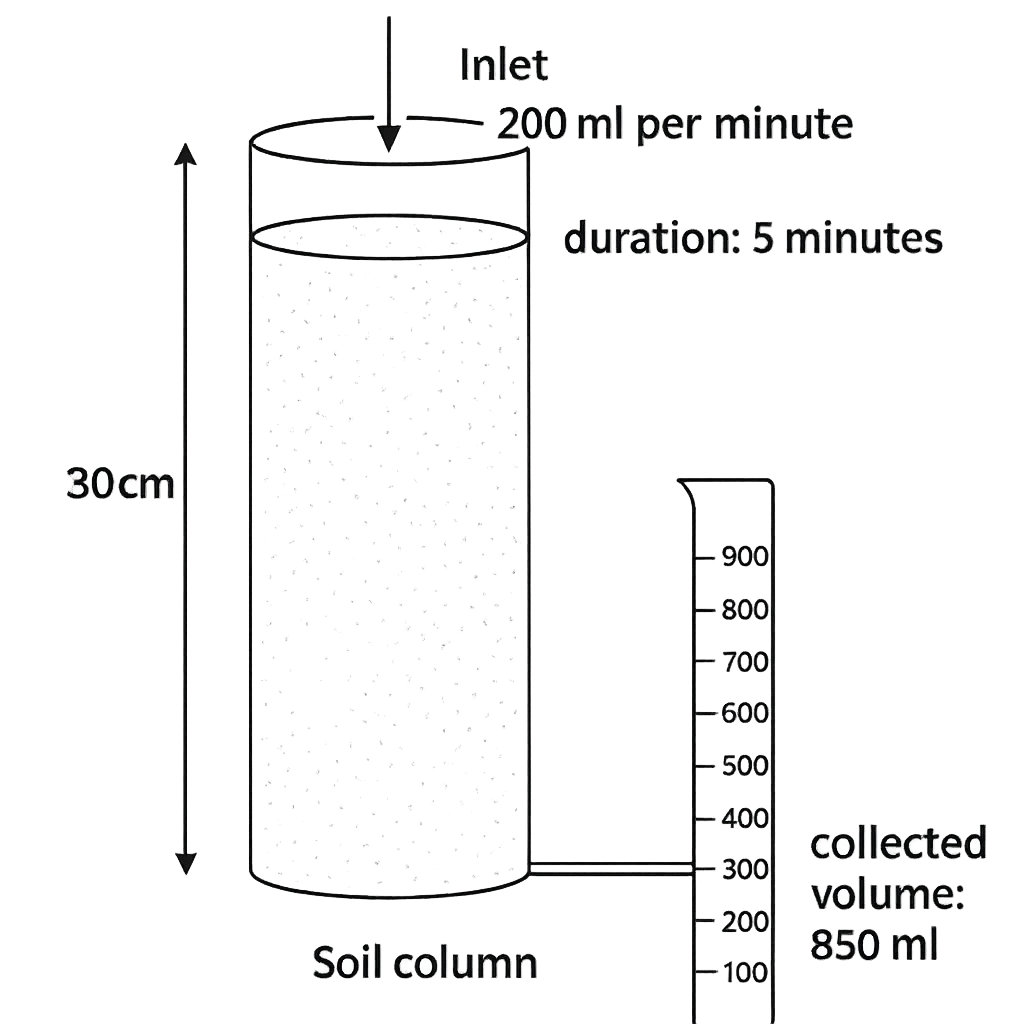
From the diagram of the soil column experiment, water is introduced at the top at a constant rate of 200 ml min\(^{-1}\) for 5 minutes. After drainage, the graduated cylinder at the bottom contains 850 ml of water that has passed through the soil. Calculate the percentage of the added water that was retained in the soil column.
A. 25
B. 20
C. 10
Correct D. 15

Correct Answer: D

Want to see the full step-by-step solution? Unlock AI Explanation & Analytics
Question 18 View Details
An expected wheat yield without disease is 3.5 t ha\(^{-1}\). If disease X is left untreated, it reduces yield by 12 %. A fungicide costs ₦1 500 ha\(^{-1}\) and reduces the disease effect to 3 % of the untreated level. The market price of wheat is ₦250 kg\(^{-1}\). Calculate the net monetary benefit per hectare of applying the fungicide.
A. 77500
Correct B. 100350
C. 87350
D. 101850

Correct Answer: B

Want to see the full step-by-step solution? Unlock AI Explanation & Analytics
Question 19 View Details
The field is a square 2 km on a side, centred on the initial infection point. The disease spreads radially at 0.8 km month\(^{-1}\). A barrier treatment creates a protected zone extending 1 km beyond the treated area, preventing further spread. If the farmer treats a circular area of radius \(r\) km around the centre at the start of month 1, what is the minimum value of \(r\) (to two decimal places) that ensures the disease does not reach any part of the field after 3 months?
A. 0.52
B. 0.45
Correct C. 0.41
D. 0.38

Correct Answer: C

Want to see the full step-by-step solution? Unlock AI Explanation & Analytics
Question 20 View Details
A hand‑operated seed drill uses a class‑2 lever. The effort arm is 0.75 m and the load arm is 0.25 m. The seed hopper weighs 120 N (mass 12 kg). (a) What is the minimum effort force required to lift the hopper? (b) If the farmer applies a constant effort of 200 N, what upward acceleration does the hopper experience, assuming the system is frictionless?
A. 30 N; 14.2 m/s^2
B. 120 N; 6.7 m/s^2
Correct C. 40 N; 40 m/s^2
D. 360 N; -4.4 m/s^2

Correct Answer: C

Want to see the full step-by-step solution? Unlock AI Explanation & Analytics
Question 21 View Details
A farmer intends to apply nitrogen fertilizer at a rate of \(120\) kg N per hectare to a field of \(2.5\) ha. The fertilizer contains \(30\)% nitrogen by weight. How many kilograms of this fertilizer must be purchased?
A. 1100
Correct B. 1000
C. 900
D. 1200

Correct Answer: B

Want to see the full step-by-step solution? Unlock AI Explanation & Analytics
Question 22 View Details
A maize farmer plants rows \(75\) cm apart and spaces the seeds \(25\) cm apart within each row. The field area is \(1.2\) ha. If \(5\)% of the seeds are lost during sowing, how many seeds should be prepared for planting?
A. 65000
Correct B. 67369
C. 60000
D. 70000

Correct Answer: B

Want to see the full step-by-step solution? Unlock AI Explanation & Analytics
Question 23 View Details
In a grassland ecosystem, the gross primary productivity (GPP) is measured as \(1500\) g C m\(^{-2}\) yr\(^{-1}\) and the autotrophic respiration is \(600\) g C m\(^{-2}\) yr\(^{-1}\). What is the net primary productivity (NPP) in the same units?
A. 600
B. 2100
Correct C. 900
D. 1500

Correct Answer: C

Want to see the full step-by-step solution? Unlock AI Explanation & Analytics
Question 24 View Details
A dairy farm has fixed annual costs of \(\text{₦}500\,000\) and a variable cost of \(\text{₦}120\) per litre of milk produced. Milk is sold at \(\text{₦}200\) per litre. What is the minimum number of litres of milk that must be sold each year to achieve a profit of at least \(\text{₦}150\,000\)?
A. 7500
B. 9000
Correct C. 8125
D. 10000

Correct Answer: C

Want to see the full step-by-step solution? Unlock AI Explanation & Analytics
Question 25 View Details
A tractor must pull a plough weighing \(2.5\) kN up a \(5\)% gradient at a constant speed of \(4\) km h\(^{-1}\). The rolling resistance coefficient is \(0.02\) (rolling resistance = coefficient × weight). Ignoring other losses, calculate the minimum power the tractor must develop, in kilowatts (kW). Give your answer to two decimal places.
A. 0.30
B. 0.15
Correct C. 0.20
D. 0.25

Correct Answer: C

Want to see the full step-by-step solution? Unlock AI Explanation & Analytics

Master the Exam!

You've seen a preview, but there are thousands more questions plus AI tutor to break down complex solutions.

Unlock Full Access Available for Android & Windows
Help others prepare! Share this practice hub:
Chat with Support