gce model questions vol1 2023 agricultural_science | Essay

Prepare for your exams with gce model questions vol1 questions? Reviewing past/model questions is one of the most effective ways to guarantee a high score. This practice hub features authentic 2023 agricultural_science (Essay) questions designed to simulate the real exam environment.

Practice these randomly selected questions to test your readiness.

Question 1 View Details
Discuss the role of biodiversity in maintaining the productivity and sustainability of an agricultural ecosystem in Nigeria.
Question Parts
(a)
Define biodiversity in the context of agriculture.
(b)
Explain two ways in which biodiversity contributes to soil fertility.
(c)
Evaluate the impact of monoculture on biodiversity and suggest two management practices that can enhance biodiversity on farms.
Detailed Essay Solution & Marking Scheme Available

Get the step-by-step mathematical proofs, key points required by examiners, and a comprehensive breakdown from our AI Tutor.
Question 2 View Details
A soil texture analysis is to be carried out using the hydrometer method. The laboratory set‑up is shown in the diagram.
Question Parts
(a)
State the principle behind the hydrometer method for determining soil texture.
(b)
Outline the step‑by‑step procedure to determine the percentages of sand, silt and clay, mentioning any calculations that must be performed.
Detailed Essay Solution & Marking Scheme Available

Get the step-by-step mathematical proofs, key points required by examiners, and a comprehensive breakdown from our AI Tutor.

Question 3 View Details
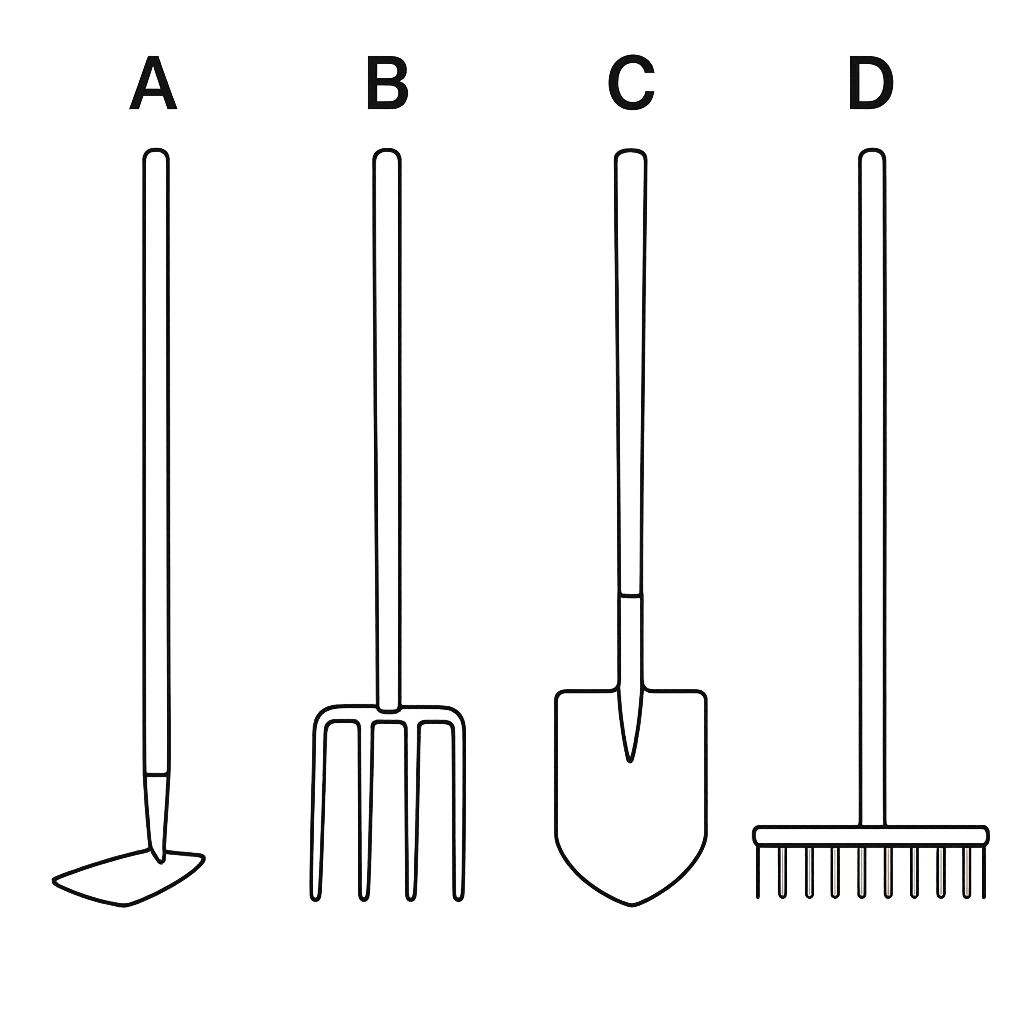
A farmer is preparing a small vegetable garden of 0.5 ha. The farmer has a set of hand tools shown in the diagram.
Question Parts
(a)
Identify which tool is most suitable for breaking compacted soil and justify your choice.
(b)
The garden rake (label D) has tines 40 cm long and the spacing between adjacent tines is 5 cm. If the farmer makes a single sweep across a row that is 10 m long, estimate the area of soil surface that can be cleared in that sweep. Show all reasoning.
(c)
The spade (label C) has a blade width of 20 cm. Assuming each scoop moves the soil to a depth of 15 cm, calculate how many scoops are required to turn over a soil volume of 0.10 m³. Explain each step.
Detailed Essay Solution & Marking Scheme Available

Get the step-by-step mathematical proofs, key points required by examiners, and a comprehensive breakdown from our AI Tutor.

Question 4 View Details
A small farm uses a 20‑horsepower (hp) tractor to operate a single‑bottom plough as shown in the diagram.
Question Parts
(a)
Given a soil resistance of 150 N per metre of plough width and a plough width of 1.2 m, calculate the draw‑bar pull required to pull the plough at a steady speed of 5 km h⁻¹. Show all steps.
Detailed Essay Solution & Marking Scheme Available

Get the step-by-step mathematical proofs, key points required by examiners, and a comprehensive breakdown from our AI Tutor.

Question 5 View Details
A farmer intends to increase the yield of maize on a 2‑hectare field by improving plant population, applying nitrogen fertilizer and practising crop rotation with a legume.
Question Parts
(a)
The recommended spacing for maize is 75 cm between rows and 25 cm between plants within a row. Calculate the optimum plant population per hectare and the total number of plants required for the whole 2‑ha field.
(b)
A soil test shows that the field currently contains 20 kg of available nitrogen per hectare. The target nitrogen requirement for the intended maize crop is 120 kg N ha⁻¹. The farmer plans to use urea (46 % N by weight). Determine the amount of urea (in kilograms) that must be applied per hectare and for the whole 2‑ha field.
(c)
Explain three agronomic advantages of rotating maize with a leguminous crop such as cowpea, focusing on soil fertility, pest/disease management and farm income.
Detailed Essay Solution & Marking Scheme Available

Get the step-by-step mathematical proofs, key points required by examiners, and a comprehensive breakdown from our AI Tutor.

Question 6 View Details
A smallholder dairy farm keeps 20 lactating cows. Each cow produces an average of 22 L of milk per day. The cows are fed a concentrate mix (30 % crude protein, CP) and grass silage (8 % CP). Each cow receives 4 kg of concentrate daily and is allowed 12 kg of silage (dry matter) per day. The daily CP requirement of a lactating cow is 3.2 kg.
Question Parts
(a)
Calculate the total amount of crude protein supplied by the concentrate feed to the herd each day.
(b)
Determine the amount of crude protein contributed by the silage to each cow and to the whole herd per day.
(c)
Based on the cows’ total CP requirement, state the daily CP deficit for the herd and recommend an appropriate protein supplement, specifying the quantity required if soybean meal (44 % CP) is used.
(d)
Discuss how mastitis can affect milk yield, milk composition and the farm’s profitability.
Detailed Essay Solution & Marking Scheme Available

Get the step-by-step mathematical proofs, key points required by examiners, and a comprehensive breakdown from our AI Tutor.

Question 7 View Details
A farmer in the savanna zone cultivates maize on a 2.5 ha field. Over the past month the farmer has observed several symptoms on the leaves, including ragged feeding holes on the leaf margins and a white, cotton‑like growth on the undersides of leaves.
Question Parts
(a)
Identify two major insect pests that commonly attack maize in this region and describe one distinguishing symptom for each.
(b)
For the pest you identified in part (a) that shows ragged feeding holes, outline its life cycle, highlighting the stage most susceptible to control measures.
(c)
Propose an integrated pest management (IPM) strategy for the pest chosen in part (b), including cultural, biological and chemical control options. Justify the sequence of measures.
(d)
The farmer intends to apply a synthetic insecticide that contains 250 g of active ingredient per litre. The recommended dose is 0.5 ml per square metre per application. Calculate the volume of insecticide required for the whole field for one application, and discuss two safety precautions the farmer should observe when handling the insecticide.
Detailed Essay Solution & Marking Scheme Available

Get the step-by-step mathematical proofs, key points required by examiners, and a comprehensive breakdown from our AI Tutor.

Question 8 View Details
A horticulturalist growing tomatoes in a greenhouse reports that several plants show wilting, yellowing of lower leaves, and a brown discoloration in the vascular tissue of the stem.
Question Parts
(a)
Identify the most likely disease and the causal pathogen, providing two pieces of evidence from the symptoms described.
(b)
Explain the disease cycle of the pathogen, emphasizing the role of environmental conditions in the greenhouse that favour its spread.
(c)
Using the data collected over four weeks, calculate the percentage increase in disease incidence from week 1 to week 4. Data: Week 1 – 5 infected plants out of 80; Week 2 – 12 infected; Week 3 – 20 infected; Week 4 – 35 infected.
Detailed Essay Solution & Marking Scheme Available

Get the step-by-step mathematical proofs, key points required by examiners, and a comprehensive breakdown from our AI Tutor.

Question 9 View Details
A mixed herd of cattle and sheep on a commercial farm in northern Nigeria has shown the following clinical signs over the past two weeks: sudden onset of fever, vesicular lesions on the mouth, tongue and interdigital spaces, loss of appetite and lameness. Morbidity in the herd is about 70 % while mortality is 5 %. The disease appears to spread rapidly among animals that share the same feeding and watering points. The farm manager reports that the last vaccination against this disease was carried out 18 months ago. The basic reproduction number (R₀) for the disease under typical farm conditions is estimated to be 5. Answer the following:
Question Parts
(a)
Identify the disease most likely responsible for the outbreak and give two key clinical features that support your identification.
(b)
Describe the epidemiological cycle of this disease, highlighting the main modes of transmission and the role of carriers.
(c)
Using the given R₀ value, calculate the minimum proportion of the herd that must be immunised (vaccinated) to achieve herd immunity. Show your working.
(d)
Propose three practical control measures that the farmer could implement immediately to curb the outbreak, and briefly justify each measure.
Detailed Essay Solution & Marking Scheme Available

Get the step-by-step mathematical proofs, key points required by examiners, and a comprehensive breakdown from our AI Tutor.

Question 10 View Details
A farmer in the middle belt region of Nigeria operates a mixed farm with both crop production and livestock rearing. The farm has a total of 5 ha of arable land. The farmer wishes to allocate part of the land to maize (Zea mays) and the remainder to a small ruminant enterprise consisting of 20 goats. Each goat requires 0.2 ha of grazing/pasture land per year. The expected average daily weight gain for each goat is 15 kg, and the market price for goat meat is ₦250 per kg. Maize yields an average of 4 t ha⁻¹ and the current market price for maize is ₦1 500 per tonne. The following cost data apply (all values in Nigerian Naira, ₦): - Fixed costs (independent of land use): land preparation ₦30 000, labour ₦20 000, veterinary services ₦10 000. - Variable costs per hectare for maize: seed ₦200, fertilizer ₦500. - Variable cost per goat per year: feed ₦5 000. - Overhead (administrative) cost is 5 % of the total of fixed and variable costs. Answer the following: a) Determine the maximum area (in hectares) that can be allocated to the goat enterprise without exceeding the total land available. b) Using the land allocation from part (a), calculate the total expected annual gross revenue from both maize and goats. c) Compute the total annual cost (including fixed, variable and overhead costs) for the farm based on the land allocation in part (a). d) Calculate the net profit for the year. e) If the farmer wishes to achieve a net profit of at least ₦150 000, determine the minimum price per tonne of maize that must be obtained, assuming all other parameters remain unchanged. Provide all working steps and clearly state any assumptions made.
Question Parts
(a)
Determine the maximum area (in hectares) that can be allocated to the goat enterprise without exceeding the total land available.
(b)
Using the land allocation from part (a), calculate the total expected annual gross revenue from both maize and goats.
(c)
Compute the total annual cost (including fixed, variable and overhead costs) for the farm based on the land allocation in part (a).
(d)
Calculate the net profit for the year.
(e)
If the farmer wishes to achieve a net profit of at least ₦150 000, determine the minimum price per tonne of maize that must be obtained, assuming all other parameters remain unchanged.
Detailed Essay Solution & Marking Scheme Available

Get the step-by-step mathematical proofs, key points required by examiners, and a comprehensive breakdown from our AI Tutor.

Master the Exam!

You've seen a preview, but there are thousands more questions plus AI tutor to break down complex solutions.

Unlock Full Access Available for Android & Windows
Help others prepare! Share this practice hub:
Chat with Support