gce model questions vol1 2022 physics | Objective

Prepare for your exams with gce model questions vol1 questions? Reviewing past/model questions is one of the most effective ways to guarantee a high score. This practice hub features authentic 2022 physics (Objective) questions designed to simulate the real exam environment.

Practice these randomly selected questions to test your readiness.

Question 1 View Details
A motor drives a small pulley of radius \(0.10\) m rotating at an angular speed of \(120\) rad s\(^{-1}\). A rope is wound on this pulley and passes over a larger pulley of radius \(0.30\) m that is attached to a load weighing \(200\) N. Assuming the system operates at \(90\) % efficiency, calculate the electrical power that must be supplied to the motor (in kilowatts, to two decimal places).
A. 1.95 kW
Correct B. 2.67 kW
C. 3.12 kW
D. 2.10 kW

Correct Answer: B

Want to see the full step-by-step solution? Unlock AI Explanation & Analytics
Question 2 View Details
A vertical cylinder contains \(0.5\) mol of an ideal gas at \(300\) K and an initial pressure of \(100\) kPa. The piston has a cross‑sectional area of \(0.02\) m\(^2\). A mass of \(50\) kg is gently placed on the piston and the gas is allowed to compress isothermally. Determine the final volume of the gas (in cubic metres, to three significant figures).
A. 0.0083 m³
B. 0.0125 m³
Correct C. 0.0100 m³
D. 0.0150 m³

Correct Answer: C

Want to see the full step-by-step solution? Unlock AI Explanation & Analytics
Question 3 View Details
A block of mass \(8\) kg rests on a rough inclined plane that makes an angle of \(25^{\circ}\) with the horizontal. The coefficient of static friction between the block and the plane is \(0.30\). A horizontal force \(F\) is applied to the block, pushing it up the plane. Find the minimum magnitude of \(F\) (in newtons, to two significant figures) required to start moving the block up the incline.
A. 85 N
Correct B. 70 N
C. 100 N
D. 55 N

Correct Answer: B

Want to see the full step-by-step solution? Unlock AI Explanation & Analytics
Question 4 View Details
A car travels a distance of 150 km in a time of 2 h 15 min. Calculate the average speed of the car in metres per second, correct to three significant figures.
A. 15.0 m/s
B. 22.2 m/s
C. 20.0 m/s
Correct D. 18.5 m/s

Correct Answer: D

Want to see the full step-by-step solution? Unlock AI Explanation & Analytics
Question 5 View Details
A string fixed at both ends has a linear mass density of \(5.0\times10^{-3}\,\text{kg m}^{-1}\) and is under a tension of 80 N. The distance between two adjacent nodes of a standing wave on the string is 0.15 m. The string is vibrating in its third harmonic. (a) Determine the frequency of this vibration (in hertz, to the nearest whole number). (b) If the tension is increased by 20 % while all other conditions remain unchanged, what is the new frequency of the third harmonic (in hertz, to the nearest whole number)?
A. a) 430 Hz; b) 470 Hz
Correct B. a) 422 Hz; b) 462 Hz
C. a) 410 Hz; b) 452 Hz
D. a) 398 Hz; b) 438 Hz

Correct Answer: B

Want to see the full step-by-step solution? Unlock AI Explanation & Analytics
Question 6 View Details
Two point charges are placed on the x‑axis. A charge \(q_{1}=+5\,\mu\text{C}\) is at the origin and a charge \(q_{2}=-3\,\mu\text{C}\) is at \(x=0.12\,\text{m}\). Determine the point on the x‑axis (to the right of both charges) where the net electric field is zero. Then calculate the electric potential at that point relative to infinity. Give the position (in metres, measured from the origin) and the potential (in volts, to two significant figures).
A. x = 0.600 m; V ≈ 1.5×10⁴ V
B. x = 0.432 m; V ≈ 2.1×10⁴ V
C. x = 0.480 m; V ≈ 2.3×10⁴ V
Correct D. x = 0.532 m; V ≈ 1.9×10⁴ V

Correct Answer: D

Want to see the full step-by-step solution? Unlock AI Explanation & Analytics
Question 7 View Details
A hydrogen atom in its ground state absorbs a photon of wavelength \(90\,\text{nm}\). (a) Identify the principal quantum number \(n\) of the excited state reached. (b) If instead the atom absorbs a photon of wavelength \(70\,\text{nm}\), the electron is ejected. Calculate the kinetic energy of the ejected electron in electron‑volts. (c) The free electron then passes through a uniform electric field that accelerates it through a potential difference of \(5\,\text{V}\). Determine its final speed in metres per second (give two significant figures).
Correct A. n = 5; K = 4.13 eV; final speed ≈ 1.8×10⁶ m/s
B. n = 4; K = 3.90 eV; final speed ≈ 1.6×10⁶ m/s
C. n = 5; K = 5.00 eV; final speed ≈ 2.0×10⁶ m/s
D. n = 6; K = 4.50 eV; final speed ≈ 1.9×10⁶ m/s

Correct Answer: A

Want to see the full step-by-step solution? Unlock AI Explanation & Analytics
Question 8 View Details
A battery of emf \(E\) V and internal resistance \(r\) Ω supplies a resistor of \(10\,\Omega\) and a current of \(2.0\,\text{A}\) flows. When the external resistor is changed to \(20\,\Omega\) the current becomes \(1.5\,\text{A}\). (a) Determine the emf \(E\) and the internal resistance \(r\). (b) If a load resistor of \(15\,\Omega\) is now connected, calculate the efficiency of the circuit (useful power delivered to the load divided by the total power supplied by the battery) and give the terminal voltage across the load.
A. E = 55 V; r = 25 Ω; efficiency ≈ 38 %; terminal voltage ≈ 23.1 V
Correct B. E = 60 V; r = 20 Ω; efficiency ≈ 43 %; terminal voltage ≈ 25.7 V
C. E = 60 V; r = 30 Ω; efficiency ≈ 35 %; terminal voltage ≈ 22.0 V
D. E = 70 V; r = 15 Ω; efficiency ≈ 50 %; terminal voltage ≈ 28.5 V

Correct Answer: B

Want to see the full step-by-step solution? Unlock AI Explanation & Analytics
Question 9 View Details
In a double‑slit experiment the slit separation is \(d = 0.25\,\text{mm}\). When monochromatic light of wavelength \(\lambda_{1}=550\,\text{nm}\) is used, the distance between the central bright fringe and the fourth bright fringe on the screen is measured to be \(11.0\,\text{mm}\). Determine the distance \(L\) between the slits and the screen.
A. L ≈ 2.10 m
Correct B. L ≈ 1.25 m
C. L ≈ 0.95 m
D. L ≈ 1.60 m

Correct Answer: B

Want to see the full step-by-step solution? Unlock AI Explanation & Analytics
Question 10 View Details
A displacement of magnitude \(5\,\text{m}\) is directed \(30^{\circ}\) north of east. A second displacement of magnitude \(8\,\text{m}\) is directed \(45^{\circ}\) south of east. Find the magnitude of the resultant displacement (give to two significant figures).
Correct A. 10.5 m
B. 7.8 m
C. 12.3 m
D. 9.2 m

Correct Answer: A

Want to see the full step-by-step solution? Unlock AI Explanation & Analytics
Question 11 View Details
A battery of emf \(E = 12.0\ \text{V}\) and internal resistance \(r\) supplies a load resistor \(R\). The terminal voltage across the load is measured to be \(V = 9.0\ \text{V}\) and the power delivered to the load is \(P = 27.0\ \text{W}\). Determine the internal resistance \(r\) of the battery. Give your answer in ohms.
A. 4.0
B. 0.2
C. 3.0
Correct D. 1.0

Correct Answer: D

Want to see the full step-by-step solution? Unlock AI Explanation & Analytics
Question 12 View Details
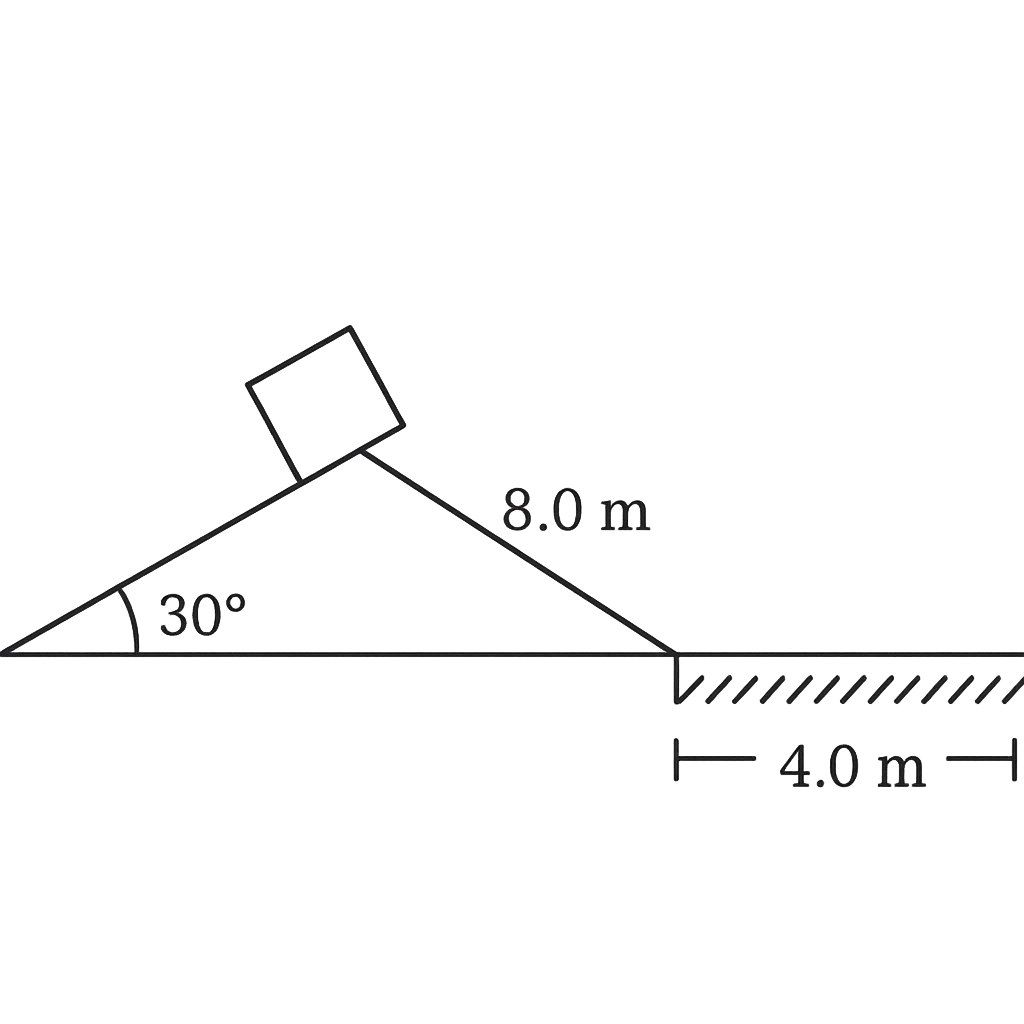
A block of mass \(5.0\ \text{kg}\) starts from rest at the top of a smooth incline that is \(8.0\ \text{m}\) long and makes an angle of \(30^{\circ}\) with the horizontal. At the bottom of the incline the block reaches a rough horizontal surface of length \(4.0\ \text{m}\) where the coefficient of kinetic friction is \(\mu_{k} = 0.20\). The block just comes to rest at the far end of the rough surface. Calculate the work done by the friction force on the block while it moves over the rough surface. State your answer in joules (negative sign indicates that friction does negative work).
A. -78.4
B. -19.6
C. -49.0
Correct D. -39.2

Correct Answer: D

Want to see the full step-by-step solution? Unlock AI Explanation & Analytics
Question 13 View Details
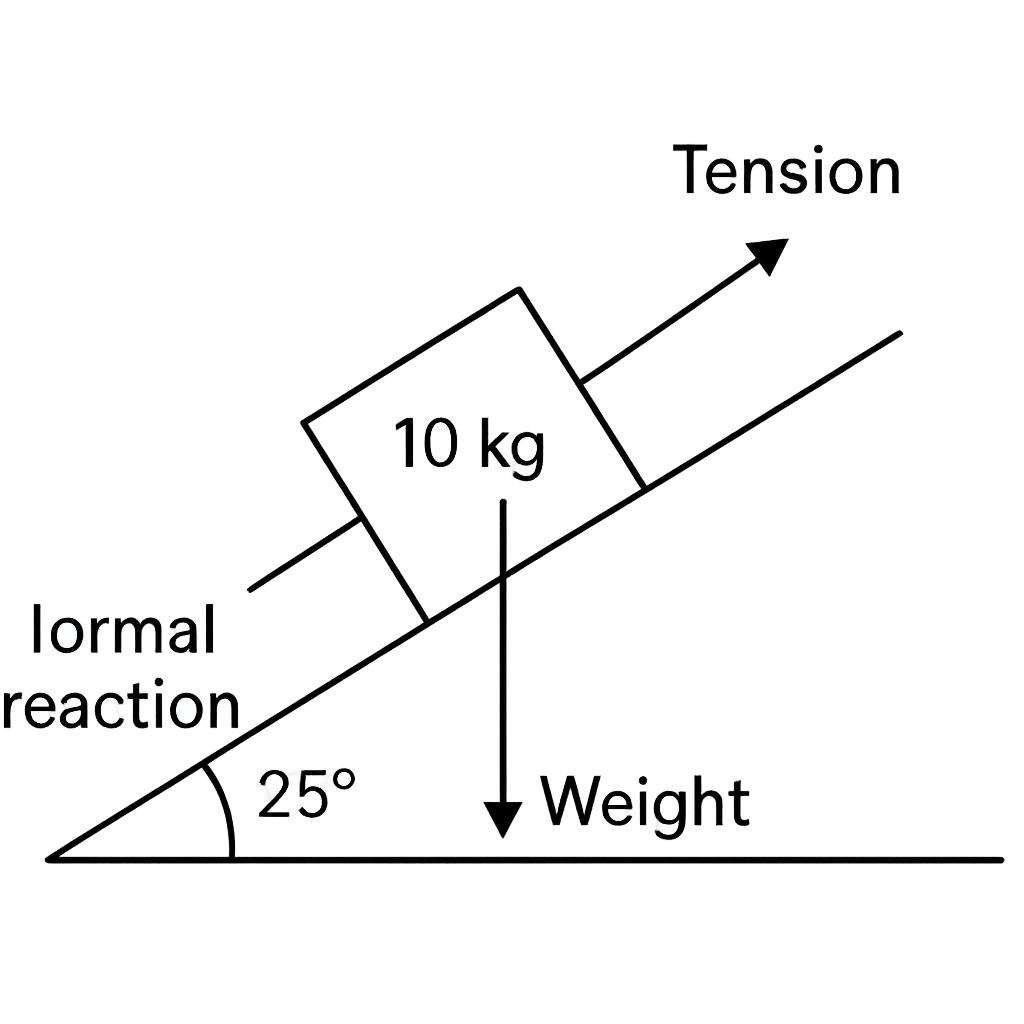
A \(10\ \text{kg}\) block rests on a rough incline that makes an angle of \(25^{\circ}\) with the horizontal. The coefficient of static friction between the block and the plane is \(\mu_{s} = 0.15\). The block is held in equilibrium by a rope that pulls parallel to the incline upward. Determine the tension in the rope. Give your answer in newtons.
A. 31.2
Correct B. 28.1
C. 24.5
D. 35.0

Correct Answer: B

Want to see the full step-by-step solution? Unlock AI Explanation & Analytics
Question 14 View Details
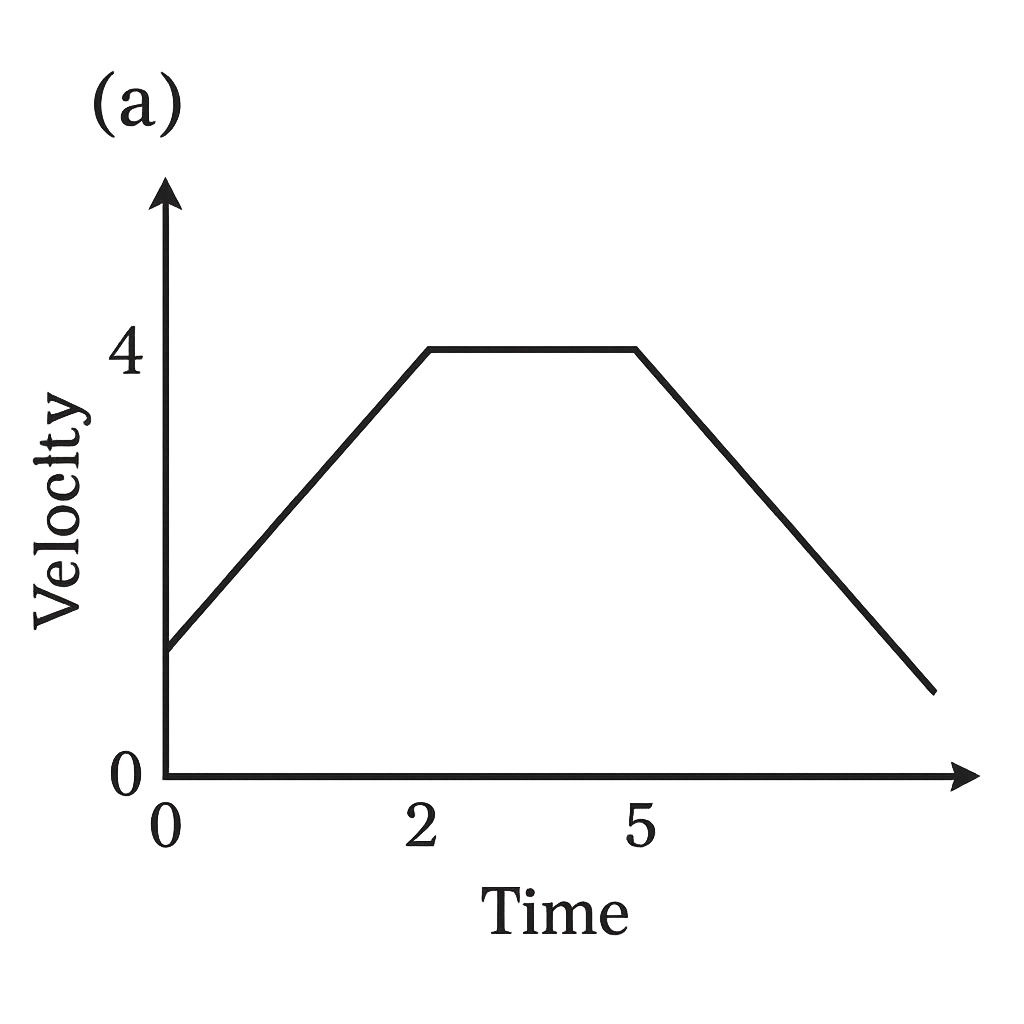
A particle moves such that its velocity-time graph consists of three consecutive linear segments: from \(t = 0\) to \(t = 2\ \text{s}\) the velocity increases uniformly from \(0\) to \(4\ \text{m s}^{-1}\); from \(t = 2\) to \(t = 5\ \text{s}\) the velocity remains constant at \(4\ \text{m s}^{-1}\); from \(t = 5\) to \(t = 7\ \text{s}\) the velocity decreases uniformly to \(0\). Find the total distance travelled by the particle during the 7‑second interval. Give your answer in metres.
A. 22
Correct B. 20
C. 18
D. 24

Correct Answer: B

Want to see the full step-by-step solution? Unlock AI Explanation & Analytics
Question 15 View Details
In an insulated container, \(200\ \text{g}\) of water at \(80^{\circ}\text{C}\) is mixed with \(300\ \text{g}\) of water at \(20^{\circ}\text{C}\). After the mixture reaches thermal equilibrium, \(50\ \text{g}\) of ice at \(0^{\circ}\text{C}\) is added and melts completely. Assuming no heat loss to the surroundings and using \(c_{\text{water}} = 4186\ \text{J kg}^{-1}\text{K}^{-1}\) and the latent heat of fusion of ice \(L_{f} = 334\ \text{kJ kg}^{-1}\), determine the final temperature of the system. Give your answer in degrees Celsius (to the nearest whole number).
A. 38
B. 41
Correct C. 33
D. 27

Correct Answer: C

Want to see the full step-by-step solution? Unlock AI Explanation & Analytics
Question 16 View Details
A 5.0 kg block is released from rest at the top of a 30° smooth incline that is 8.0 m long. The coefficient of kinetic friction between the block and the incline is 0.20. At the bottom of the incline the block compresses a horizontal spring of unknown force constant k until it momentarily comes to rest after a compression of 0.10 m. (a) Determine the value of k required for the block to stop after the given compression. (b) Calculate the average power dissipated by friction during the block's travel down the incline.
A. k ≈ 1.8×10⁴ N m⁻¹; average frictional power ≈ 45 W
B. k ≈ 3.2×10⁴ N m⁻¹; average frictional power ≈ 20 W
C. k ≈ 2.6×10⁴ N m⁻¹; average frictional power ≈ 15 W
Correct D. k ≈ 2.6×10⁴ N m⁻¹; average frictional power ≈ 30 W

Correct Answer: D

Want to see the full step-by-step solution? Unlock AI Explanation & Analytics
Question 17 View Details
Two point charges lie on the x‑axis. A charge \(q_1 = +8\,\mu\text{C}\) is at the origin and a charge \(q_2 = -2\,\mu\text{C}\) is at \(x = 0.12\,\text{m}\). (a) Find the point on the perpendicular bisector of the line joining the charges at which the magnitude of the resultant electric field is a minimum. Give the coordinates of this point. (b) Determine the electric potential difference between this point and the point \((0.20\,\text{m},0)\) on the x‑axis. (c) A test charge of \(5.0\,\mu\text{C}\) is moved quasistatically from the point found in (a) to the point \((0.20\,\text{m},0)\). Calculate the work done by the external agent in this process.
A. (a) (0.04 m, 0); (b) ΔV = -5.2×10⁵ V; (c) work ≈ 2.5 J (positive, done by external agent)
Correct B. (a) (0.06 m, 0); (b) ΔV = -7.6×10⁵ V; (c) work ≈ 3.8 J (positive, done by external agent)
C. (a) (0.06 m, 0); (b) ΔV = -9.1×10⁵ V; (c) work ≈ 5.0 J (positive, done by external agent)
D. (a) (0.08 m, 0); (b) ΔV = -7.6×10⁵ V; (c) work ≈ 3.8 J (negative, done by external agent)

Correct Answer: B

Want to see the full step-by-step solution? Unlock AI Explanation & Analytics
Question 18 View Details
A candle is placed 0.20 m to the left of a converging lens L₁ whose focal length is 0.12 m. L₁ forms a real image of the candle. A second converging lens L₂ with focal length 0.08 m is positioned 0.35 m to the right of L₁. (a) Find the position of the image formed by L₁ and state whether it is real or virtual. (b) Using the image from L₁ as the object for L₂, determine the final image distance from L₂ and state its nature (real/virtual, erect/inverted). (c) Calculate the overall linear magnification of the two‑lens system.
A. (a) 0.25 m right of L₁, real; (b) 0.150 m left of L₂, virtual (overall inverted); (c) overall magnification ≈ -3.5
Correct B. (a) 0.30 m right of L₁, real; (b) 0.133 m left of L₂, virtual (overall inverted); (c) overall magnification ≈ -4.0
C. (a) 0.18 m left of L₁, virtual; (b) 0.133 m left of L₂, real (overall inverted); (c) overall magnification ≈ -5.0
D. (a) 0.30 m right of L₁, real; (b) 0.200 m right of L₂, real (overall upright); (c) overall magnification ≈ -2.0

Correct Answer: B

Want to see the full step-by-step solution? Unlock AI Explanation & Analytics
Question 19 View Details
A diffraction grating has 5000 lines cm⁻¹. Monochromatic light of unknown wavelength produces a second‑order maximum at an angle of \(30^{\circ}\). (a) Find the wavelength of the light. (b) The grating is replaced by one with 6000 lines cm⁻¹. Calculate the angular separation between the second‑order maxima for the original wavelength and for a wavelength that is 5 % longer. (c) What is the minimum number of illuminated slits required for the grating to resolve these two wavelengths in the second order?
A. (a) 520 nm; (b) ≈ 2.5° separation; (c) minimum 12 illuminated slits
B. (a) 480 nm; (b) ≈ 1.8° separation; (c) minimum 8 illuminated slits
Correct C. (a) 500 nm; (b) ≈ 2.2° separation; (c) minimum 10 illuminated slits
D. (a) 500 nm; (b) ≈ 3.0° separation; (c) minimum 15 illuminated slits

Correct Answer: C

Want to see the full step-by-step solution? Unlock AI Explanation & Analytics
Question 20 View Details
Water flows steadily through a horizontal pipe that tapers from a diameter of 0.20 m at the wide end to 0.10 m at the narrow end over a length of 2.0 m. The volumetric flow rate is \(0.015\,\text{m}^{3}\text{s}^{-1}\). Assume incompressible, inviscid flow. (a) Using Bernoulli's equation, calculate the pressure difference between the wide and narrow sections of the pipe. (b) If the pressure at the wide end is maintained 150 kPa above atmospheric pressure, determine the power that must be supplied by a pump to sustain the flow.
A. (a) ≈ 2.5 kPa pressure drop (wide → narrow); (b) pump power ≈ 3.1 kW
Correct B. (a) ≈ 1.7 kPa pressure drop (wide → narrow); (b) pump power ≈ 2.3 kW
C. (a) ≈ 4.0 kPa pressure drop (wide → narrow); (b) pump power ≈ 5.0 kW
D. (a) ≈ 0.9 kPa pressure drop (wide → narrow); (b) pump power ≈ 1.5 kW

Correct Answer: B

Want to see the full step-by-step solution? Unlock AI Explanation & Analytics
Question 21 View Details
A car travels 150 km in 2 h 30 min. Calculate its average speed in metres per second (\(\text{m s}^{-1}\)).
A. 20.0 m s⁻¹
B. 13.9 m s⁻¹
Correct C. 16.7 m s⁻¹
D. 18.3 m s⁻¹

Correct Answer: C

Want to see the full step-by-step solution? Unlock AI Explanation & Analytics
Question 22 View Details
Two forces act on a point: \(5\ \text{N}\) directed east and \(12\ \text{N}\) directed north. Determine the magnitude of the resultant force and the angle it makes east of north.
A. 13 N, 45.0° east of north
B. 15 N, 22.6° east of north
Correct C. 13 N, 22.6° east of north
D. 13 N, 30.0° east of north

Correct Answer: C

Want to see the full step-by-step solution? Unlock AI Explanation & Analytics
Question 23 View Details
A block of mass \(8\ \text{kg}\) rests on a plane inclined at \(30^{\circ}\) to the horizontal. The coefficient of kinetic friction between the block and the plane is \(0.20\). A rope pulls the block up the plane parallel to the surface. What tension must the rope exert so that the block moves up the plane at constant speed? (Take \(g = 9.8\ \text{m s}^{-2}\).)
A. 5.0×10¹ N (≈ 50 N)
B. 4.8×10¹ N (≈ 48 N)
C. 6.2×10¹ N (≈ 62 N)
Correct D. 5.3×10¹ N (≈ 53 N)

Correct Answer: D

Want to see the full step-by-step solution? Unlock AI Explanation & Analytics
Question 24 View Details
200 g of water at \(80^{\circ}\text{C}\) is mixed with 300 g of water at \(20^{\circ}\text{C}\) in an insulated container. During mixing, 5 % of the total heat exchanged is lost to the surroundings. Assuming the specific heat capacity of water is \(4.186\ \text{J g}^{-1}\text{K}^{-1}\), find the final equilibrium temperature of the mixture (in °C, to one decimal place).
A. 50.2 °C
B. 45.9 °C
C. 38.7 °C
Correct D. 43.3 °C

Correct Answer: D

Want to see the full step-by-step solution? Unlock AI Explanation & Analytics
Question 25 View Details
A 2.0 g sample of a radioactive isotope X (atomic mass \(240\ \text{u}\); \(1\ \text{u}=1.6605\times10^{-27}\ \text{kg}\)) decays by \(\alpha\)-emission with a half‑life of \(4.0\ \text{h}\). Each disintegration releases \(5.0\ \text{MeV}\) of energy. (a) Calculate the initial activity of the sample in becquerels (Bq). (b) After \(12\ \text{h}\), what fraction of the original mass remains? (c) Determine the total energy released up to that time in joules.
A. (a) 2.4×10^16 Bq; (b) 1/2 (50 %); (c) 3.5×10^8 J
B. (a) 1.2×10^17 Bq; (b) 1/4 (25 %); (c) 1.8×10^9 J
C. (a) 3.0×10^17 Bq; (b) 1/16 (6.25 %); (c) 5.0×10^9 J
Correct D. (a) 2.4×10^17 Bq; (b) 1/8 (12.5 %); (c) 3.5×10^9 J

Correct Answer: D

Want to see the full step-by-step solution? Unlock AI Explanation & Analytics

Master the Exam!

You've seen a preview, but there are thousands more questions plus AI tutor to break down complex solutions.

Unlock Full Access Available for Android & Windows
Help others prepare! Share this practice hub:
Chat with Support