gce model questions vol1 2022 mathematics | Essay

Prepare for your exams with gce model questions vol1 questions? Reviewing past/model questions is one of the most effective ways to guarantee a high score. This practice hub features authentic 2022 mathematics (Essay) questions designed to simulate the real exam environment.

Practice these randomly selected questions to test your readiness.

Question 1 View Details
A positive integer N satisfies the following conditions: - N is divisible by each of 2, 3, 4, 5 and 6; - N is not divisible by 7; - The sum of the digits of N is 9. Using these conditions, answer the following.
Question Parts
(a)
Find the smallest possible value of N.
(b)
State the prime factorisation of this N and verify that it is divisible by 60.
Detailed Essay Solution & Marking Scheme Available

Get the step-by-step mathematical proofs, key points required by examiners, and a comprehensive breakdown from our AI Tutor.
Question 2 View Details
A retailer buys a batch of electronic gadgets at a uniform cost price. Each gadget is sold at a profit of 25 % on its cost price. During a promotional sale, the retailer offers a discount of 20 % on the selling price of each gadget. (a) Determine the overall percentage profit or loss made on each gadget relative to its original cost price after the discount. (b) Express the final selling price as a fraction and as a decimal of the original cost price.
Question Parts
(a)
Determine the overall percentage profit or loss made on each gadget relative to its original cost price after the discount.
(b)
Express the final selling price as a fraction and as a decimal of the original cost price.
Detailed Essay Solution & Marking Scheme Available

Get the step-by-step mathematical proofs, key points required by examiners, and a comprehensive breakdown from our AI Tutor.

Question 3 View Details
A positive real number \(x\) satisfies the equation \(2^{\log_{2} x}=\dfrac{8}{\sqrt{x}}\).
Question Parts
(a)
Find the value of \(x\).
(b)
Using the value of \(x\) found in part (a), evaluate \(\log_{2}(x^{3}) - 3\log_{2}\sqrt{x}\).
Detailed Essay Solution & Marking Scheme Available

Get the step-by-step mathematical proofs, key points required by examiners, and a comprehensive breakdown from our AI Tutor.

Question 4 View Details
In a senior secondary school, a total of 120 students were surveyed about the subjects they study. The data collected are as follows: - 70 students study Mathematics (M). - 65 students study Physics (P). - 55 students study Chemistry (C). - 35 students study both Mathematics and Physics. - 30 students study both Mathematics and Chemistry. - 20 students study both Physics and Chemistry. - 8 students study none of the three subjects. The information is represented in the Venn diagram provided. Using this information, answer the following:
Question Parts
(a)
Determine the number of students who study all three subjects.
(b)
How many students study exactly two of the three subjects?
(c)
Find the number of students who study only Mathematics.
Detailed Essay Solution & Marking Scheme Available

Get the step-by-step mathematical proofs, key points required by examiners, and a comprehensive breakdown from our AI Tutor.

Question 5 View Details
Consider the algebraic expression E = (3x - 2)(2x + k) \- (x^2 \- 5x + 6). You are required to manipulate and evaluate this expression as described in the following parts.
Question Parts
(a)
Expand the product (3x \- 2)(2x + k) and simplify the whole expression E, writing the result in the form ax^2 + bx + c.
(b)
It is given that the coefficient of x in the simplified expression obtained in part (a) is 16. Find the value of k.
(c)
Using the value of k found in part (b), evaluate E when x = 2.
Detailed Essay Solution & Marking Scheme Available

Get the step-by-step mathematical proofs, key points required by examiners, and a comprehensive breakdown from our AI Tutor.

Question 6 View Details
A mobile phone retailer sells two models, Model A and Model B. The profit earned on each Model A phone is ₦1,500 more than the profit on each Model B phone. In a particular month the retailer sold a total of 240 phones and earned a total profit of ₦720,000. It is also known that the number of Model A phones sold was twice the number of Model B phones sold.
Question Parts
(a)
Form a system of linear equations that represents the information given. Use the symbols A for the number of Model A phones sold, B for the number of Model B phones sold and p for the profit (in Naira) on each Model B phone.
Detailed Essay Solution & Marking Scheme Available

Get the step-by-step mathematical proofs, key points required by examiners, and a comprehensive breakdown from our AI Tutor.

Question 7 View Details
A farmer wishes to fence a rectangular field such that the length is 5 metres more than twice the width. The total area of the field is 150 square metres.
Question Parts
(a)
Form the quadratic equation that represents the relationship between the length and the width of the field.
(b)
Solve the quadratic equation to find the possible dimensions of the field. State which solution is physically meaningful.
(c)
The farmer is considering increasing the area by k square metres while keeping the same relationship between length and width. (i) Express the new quadratic equation in terms of k. (ii) Determine the range of k for which the field dimensions remain real numbers.
(d)
If the farmer wishes the field to become a square, find the value of k that would make the length equal to the width. Verify that this k lies within the range found in part (c).
Detailed Essay Solution & Marking Scheme Available

Get the step-by-step mathematical proofs, key points required by examiners, and a comprehensive breakdown from our AI Tutor.

Question 8 View Details
A chemical reaction rate R (mol L⁻¹ s⁻¹) varies with temperature T (°C) according to R = (T² – 12T + 35) / (T – 5). The reaction is considered safe only when the rate does not exceed 4 mol L⁻¹ s⁻¹.
Question Parts
(a)
Write the inequality that represents the safety condition for the reaction rate.
(b)
Bring all terms to one side, simplify the inequality and factorise the numerator.
(c)
Solve the inequality, stating any restrictions on T, and give the solution set in interval notation.
Detailed Essay Solution & Marking Scheme Available

Get the step-by-step mathematical proofs, key points required by examiners, and a comprehensive breakdown from our AI Tutor.

Question 9 View Details
The sum of the first n terms of a sequence is given by \(S_n = 3n^{2}+2n\).
Question Parts
(a)
Obtain an expression for the nth term \(t_n\) of the sequence.
(b)
Find the value of the 10th term \(t_{10}\).
(c)
Determine the smallest positive integer \(n\) for which \(t_n = 100\).
(d)
Calculate the sum of the terms from the 5th to the 15th inclusive.
Detailed Essay Solution & Marking Scheme Available

Get the step-by-step mathematical proofs, key points required by examiners, and a comprehensive breakdown from our AI Tutor.

Question 10 View Details
A quantity \(y\) varies directly as \(x\) and inversely as the square of \((z-2)\).
Question Parts
(a)
When \(x = 5\) and \(z = 4\), the value of \(y\) is 12. Determine the constant of variation \(k\).
(b)
Using the constant found in part (a), calculate \(y\) when \(x = 8\) and \(z = 5\).
(c)
If the original values \(x\) and \(z\) are changed to \(3x\) and \(z+3\) respectively, express the new value \(y'\) in terms of the original \(y\).
Detailed Essay Solution & Marking Scheme Available

Get the step-by-step mathematical proofs, key points required by examiners, and a comprehensive breakdown from our AI Tutor.

Question 11 View Details
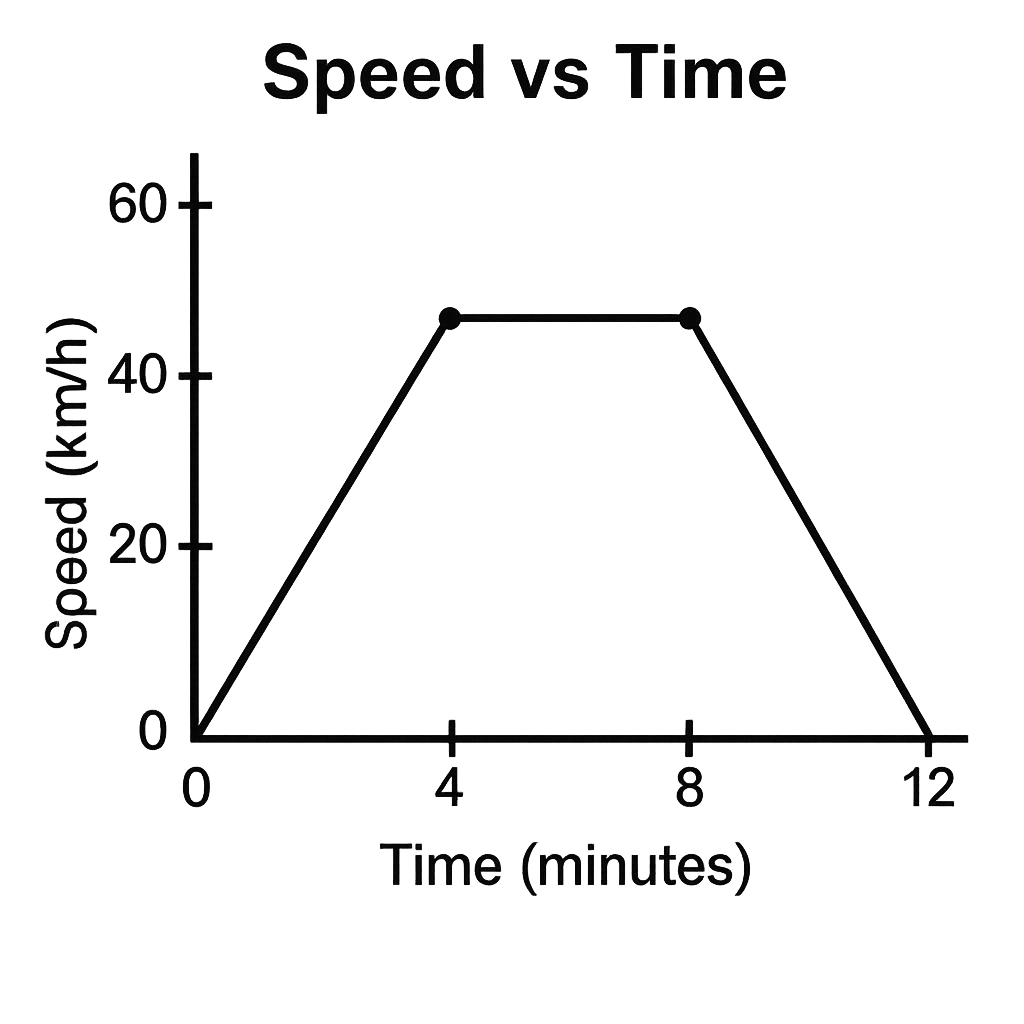
The graph below shows the speed (km/h) of a car over a time interval of 0 to 12 minutes.
Question Parts
(a)
Determine the average speed of the car over the 12‑minute interval.
(b)
Calculate the total distance travelled by the car in kilometres.
(c)
If the car had travelled at a constant speed equal to the average speed for the whole 12 minutes, would the distance covered be more or less than the actual distance? State the difference in kilometres.
Detailed Essay Solution & Marking Scheme Available

Get the step-by-step mathematical proofs, key points required by examiners, and a comprehensive breakdown from our AI Tutor.

Question 12 View Details
In the diagram, triangle ABC is a non‑right triangle. Angle A measures 40°, angle B measures 70°, and side AB is 12 cm. Point D lies on side BC such that BD : DC = 1 : 2. The triangle is drawn on a coordinate plane with point A at the origin and side AB lying on the positive x‑axis.
Question Parts
(a)
Determine the lengths of sides AC and BC. Give your answers to two decimal places.
(b)
Using the placement described, find the coordinates of points A, B and C. Give coordinates to two decimal places.
(c)
Find the equation of the line CD in the form y = mx + c, correct to two decimal places.
(d)
Calculate the length of AD. Give your answer to two decimal places.
(e)
Find the area of triangle ABD. Give your answer to two decimal places.
Detailed Essay Solution & Marking Scheme Available

Get the step-by-step mathematical proofs, key points required by examiners, and a comprehensive breakdown from our AI Tutor.

Question 13 View Details
A solid is formed as follows: - A right‑circular cylinder of radius 5 cm and height 12 cm stands on its base. - A right‑circular cone of the same radius (5 cm) and height 12 cm is removed from the top of the cylinder, the base of the cone coinciding with the top face of the cylinder. - A rectangular prism of length 8 cm, width 5 cm and height 6 cm is attached to the side of the cylinder. One of its 5 cm × 6 cm faces is flush with the cylindrical surface from the base (z = 0) up to z = 6 cm. All dimensions are shown in the accompanying illustration. Using the information above, answer the following:
Question Parts
(a)
Calculate the total volume of the composite solid. Give your answer in exact form and to two decimal places.
Detailed Essay Solution & Marking Scheme Available

Get the step-by-step mathematical proofs, key points required by examiners, and a comprehensive breakdown from our AI Tutor.

Master the Exam!

You've seen a preview, but there are thousands more questions plus AI tutor to break down complex solutions.

Unlock Full Access Available for Android & Windows
Help others prepare! Share this practice hub:
Chat with Support