gce model questions vol1 2022 biology | Objective

Prepare for your exams with gce model questions vol1 questions? Reviewing past/model questions is one of the most effective ways to guarantee a high score. This practice hub features authentic 2022 biology (Objective) questions designed to simulate the real exam environment.

Practice these randomly selected questions to test your readiness.

Question 1 View Details
A desert mammal is approximated as a sphere and a desert reptile as a right circular cylinder. Both have the same body volume of \(4000\ \text{cm}^3\). The cylinder's length is twice its radius. Assuming heat loss is proportional to total surface area, which animal has the greater potential heat loss? Show your calculations.
A. the mammal (spherical body) has the greater potential heat loss
B. both animals have equal potential heat loss
C. heat loss cannot be determined from the given information
Correct D. the reptile (cylindrical body) has the greater potential heat loss

Correct Answer: D

Want to see the full step-by-step solution? Unlock AI Explanation & Analytics
Question 2 View Details
A kidney receives renal plasma flow of \(600\ \text{mL min}^{-1}\). The filtration fraction is \(0.20\). Plasma glucose concentration is \(12\ \text{mmol L}^{-1}\). Glucose is filtered at the glomerulus, then reabsorbed sequentially: 99 % in the proximal tubule, 90 % of the remaining in the loop of Henle, and 80 % of the remaining in the distal tubule. Assuming no glucose is secreted, calculate the net amount of glucose excreted per minute (in mmol).
Correct A. 2.9×10⁻⁴ mmol min⁻¹
B. 3.0×10⁻⁴ mmol min⁻¹
C. 2.9×10⁻⁵ mmol min⁻¹
D. 2.9×10⁻³ mmol min⁻¹

Correct Answer: A

Want to see the full step-by-step solution? Unlock AI Explanation & Analytics
Question 3 View Details
During which phase of mitosis are the sister chromatids pulled apart to opposite poles of the cell?
A. metaphase
Correct B. anaphase
C. prophase
D. telophase

Correct Answer: B

Want to see the full step-by-step solution? Unlock AI Explanation & Analytics
Question 4 View Details
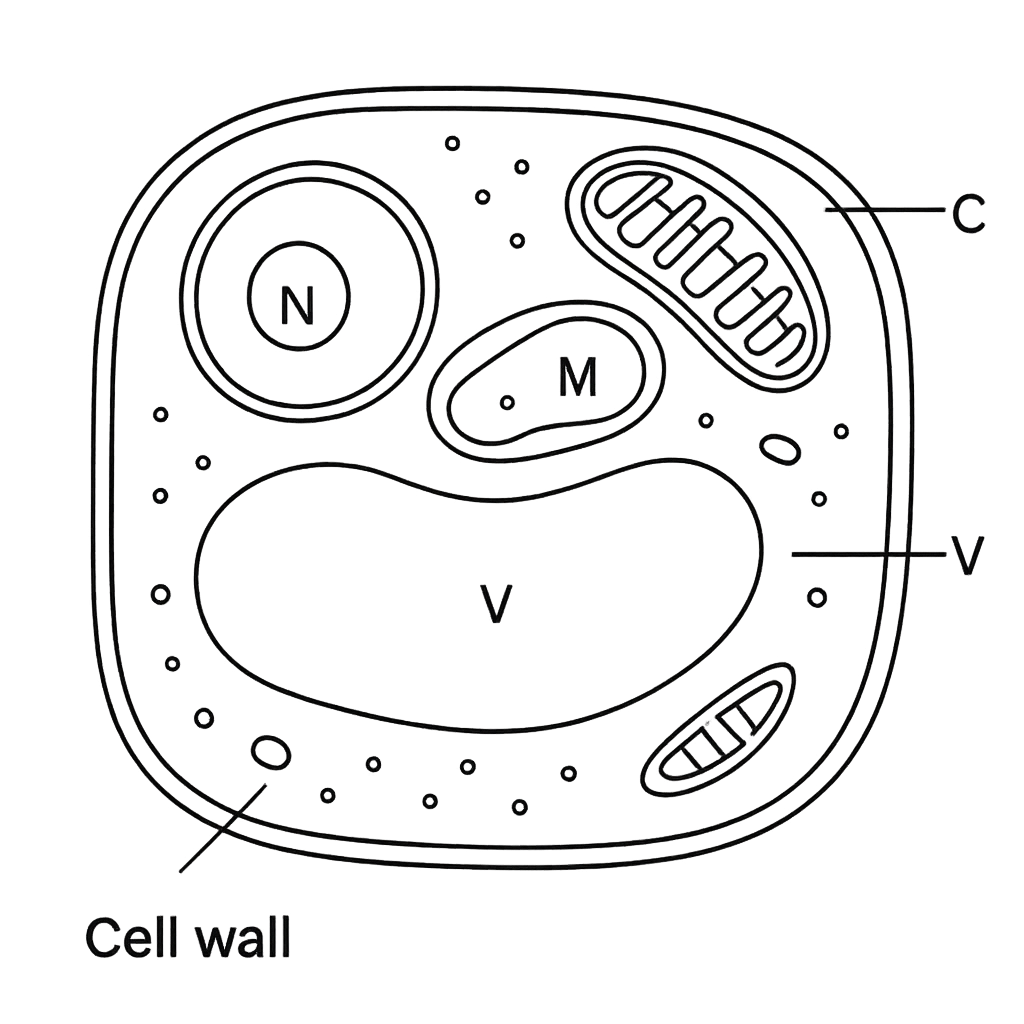
The diagram shows a typical plant cell with labelled organelles: N (nucleus), M (mitochondrion), R (ribosome), C (chloroplast), V (vacuole) and W (cell wall). Identify the organelle labelled ‘M' and state two key functions it performs. Also, indicate which organelle(s) contain their own DNA.
Correct A. M is the mitochondrion; functions: ATP production and metabolic regulation; organelles with own DNA: mitochondrion and chloroplast
B. M is the vacuole; functions: storage of nutrients and waste sequestration; organelles with own DNA: none
C. M is the ribosome; functions: protein synthesis and RNA processing; organelles with own DNA: none
D. M is the chloroplast; functions: photosynthesis and starch storage; organelles with own DNA: chloroplast

Correct Answer: A

Want to see the full step-by-step solution? Unlock AI Explanation & Analytics
Question 5 View Details
Two closely related species show a genetic divergence of 0.018 substitutions per site in a particular nuclear gene. The mutation rate for this gene is estimated at \(1.5 \times 10^{-8}\) substitutions per site per year. Assuming a molecular clock and that substitutions accumulate independently in each lineage, estimate the time since the two species diverged (in years). Two competing hypotheses propose that the divergence occurred either (A) 1 million years ago or (B) 2 million years ago. Which hypothesis is better supported by the molecular data? Show your calculations.
A. hypothesis A (≈1 million years) is better supported; estimated divergence ≈3×10⁵ years
Correct B. hypothesis A (≈1 million years) is better supported; estimated divergence ≈6×10⁵ years
C. hypothesis B (≈2 million years) is better supported; estimated divergence ≈9×10⁵ years
D. hypothesis B (≈2 million years) is better supported; estimated divergence ≈1.2×10⁶ years

Correct Answer: B

Want to see the full step-by-step solution? Unlock AI Explanation & Analytics
Question 6 View Details
A new vaccine for a contagious disease has an efficacy of 85 %. The basic reproduction number (R₀) of the pathogen in a completely susceptible population is 3.2. Using the herd‑immunity formula \(V_c = \frac{1-1/R_0}{\text{efficacy}}\), calculate the minimum proportion of the total population that must be vaccinated to prevent an outbreak. If only 60 % of the population can be vaccinated, will the outbreak be prevented?
Correct A. No - at least about 81 % must be vaccinated, which exceeds the available 60 %.
B. No - at least about 71 % must be vaccinated, which exceeds the available 60 %.
C. No - at least about 90 % must be vaccinated, which exceeds the available 60 %.
D. No - at least about 65 % must be vaccinated, which exceeds the available 60 %.

Correct Answer: A

Want to see the full step-by-step solution? Unlock AI Explanation & Analytics
Question 7 View Details
Sea‑level arterial oxygen partial pressure is 95 mmHg and the haemoglobin P₅₀ (partial pressure at 50 % saturation) is 26 mmHg. At an altitude of 3500 m the arterial PO₂ falls to 60 mmHg and a chronic increase in 2,3‑DPG raises P₅₀ by 5 mmHg. Using the Hill equation \(S = \frac{P^{n}}{P^{n}+P_{50}^{n}}\) with Hill coefficient \(n = 2.7\), calculate the arterial oxygen saturation at sea level and at altitude for the high‑altitude population, then state the percentage saturation at altitude.
A. ≈92 % arterial saturation at altitude
B. ≈78 % arterial saturation at altitude
C. ≈80 % arterial saturation at altitude
Correct D. ≈86 % arterial saturation at altitude

Correct Answer: D

Want to see the full step-by-step solution? Unlock AI Explanation & Analytics
Question 8 View Details
A desert shrub has a leaf‑area index (LAI) of 0.5. Under normal conditions its stomatal conductance is \(g_s = 0.05\) mol m⁻² s⁻¹ and the ambient vapor‑pressure deficit (VPD) is 2 kPa. Total transpiration per ground area is given by \(E_{tot}=g_s\times\text{VPD}\times\text{LAI}\). The plant can tolerate a maximum total water loss of 0.03 mol m⁻² s⁻¹. Determine the maximum proportion \(f\) by which the plant can reduce its stomatal conductance (i.e., \(g_{s,new}=f\,g_s\)) without exceeding the tolerated water loss.
Correct A. f ≤ 0.6 (i.e., conductance must be reduced to 60 % of the original)
B. f ≤ 0.5 (i.e., conductance must be reduced to 50 % of the original)
C. f ≤ 0.7 (i.e., conductance must be reduced to 70 % of the original)
D. f ≤ 0.4 (i.e., conductance must be reduced to 40 % of the original)

Correct Answer: A

Want to see the full step-by-step solution? Unlock AI Explanation & Analytics
Question 9 View Details
A fish population in a lake follows logistic growth \(\frac{dN}{dt}=rN\left(1-\frac{N}{K}\right)\) with intrinsic growth rate \(r=0.4\) yr⁻¹ and carrying capacity \(K=8000\) fish. A constant harvest removes \(H\) fish each year. Determine the maximum sustainable harvest \(H_{max}\) that still allows a non‑zero equilibrium, and give the equilibrium population size at this harvest level.
Correct A. H_{max}=800 fish per year; equilibrium population = 4000 fish
B. H_{max}=1000 fish per year; equilibrium population = 3000 fish
C. H_{max}=600 fish per year; equilibrium population = 3500 fish
D. H_{max}=800 fish per year; equilibrium population = 2000 fish

Correct Answer: A

Want to see the full step-by-step solution? Unlock AI Explanation & Analytics
Question 10 View Details
A drug diffuses across a capillary wall of thickness \(\Delta x = 0.01\) cm. The diffusion coefficient is \(D = 1.2\times10^{-5}\) cm² s⁻¹ and the concentration difference across the wall is \(\Delta C = 0.8\) mol cm⁻³.\n(a) Using Fick's first law \(J = -D\,\frac{\Delta C}{\Delta x}\), calculate the diffusive flux \(J\) in mol cm⁻² s⁻¹.\n(b) If the capillary surface area is 2 cm², how many moles of drug are transferred in one minute?
A. Flux = 9.6×10⁻⁴ mol cm⁻² s⁻¹; amount transferred in 1 min ≈ 0.230 mol
B. Flux = 1.2×10⁻³ mol cm⁻² s⁻¹; amount transferred in 1 min ≈ 0.144 mol
C. Flux = 9.6×10⁻⁵ mol cm⁻² s⁻¹; amount transferred in 1 min ≈ 0.0115 mol
Correct D. Flux = 9.6×10⁻⁴ mol cm⁻² s⁻¹; amount transferred in 1 min ≈ 0.115 mol

Correct Answer: D

Want to see the full step-by-step solution? Unlock AI Explanation & Analytics
Question 11 View Details
In a microscopic examination of a root tip, 200 cells are observed. The numbers of cells in the four stages of mitosis are: \(30\) in prophase, \(20\) in metaphase, \(10\) in anaphase and \(15\) in telophase. What proportion of the observed cells are in mitosis? Express your answer as a percentage to one decimal place.
A. 42.5%
B. 35.0%
C. 30.0%
Correct D. 37.5%

Correct Answer: D

Want to see the full step-by-step solution? Unlock AI Explanation & Analytics
Question 12 View Details
During the follicular phase of the menstrual cycle, the concentration of estradiol rises linearly from \(200\) pg/mL on day 5 to \(400\) pg/mL on day 10. Assuming the increase continues at the same rate, on which day will the concentration reach \(350\) pg/mL? Give your answer to the nearest whole day.
A. 10
B. 8
Correct C. 9
D. 7

Correct Answer: C

Want to see the full step-by-step solution? Unlock AI Explanation & Analytics
Question 13 View Details
An unknown multicellular organism is observed to have the following characteristics: (i) eukaryotic cells with cell walls composed of chitin, (ii) reproduction by spores, (iii) a filamentous mycelium formed of hyphae that are septate. Using these traits, determine the kingdom and the phylum to which the organism belongs.
Correct A. Kingdom Fungi; Phylum Ascomycota
B. Kingdom Fungi; Phylum Zygomycota
C. Kingdom Fungi; Phylum Basidiomycota
D. Kingdom Plantae; Phylum Ascomycota

Correct Answer: A

Want to see the full step-by-step solution? Unlock AI Explanation & Analytics
Question 14 View Details
A diet provides a total energy of \(2500\) kJ per day. Currently, \(55\%\) of the energy comes from carbohydrates, \(30\%\) from fats and the remainder from proteins. The individual wishes to increase the proportion of energy from proteins to \(20\%\) while keeping the total energy unchanged and keeping the fat proportion at \(30\%\). By what percentage must the carbohydrate contribution be reduced relative to its original value? Give your answer to one decimal place.
Correct A. 9.1%
B. 8.5%
C. 12.0%
D. 10.2%

Correct Answer: A

Want to see the full step-by-step solution? Unlock AI Explanation & Analytics
Question 15 View Details
Each nephron in a kidney filters plasma at a rate of \(120\) mL min\(^{-1}\). The plasma glucose concentration is \(5\) mmol L\(^{-1}\). Of the filtered glucose, \(85\%\) is reabsorbed. Calculate the amount of glucose excreted per minute (in mmol).
A. 0.15 mmol per minute
B. 0.06 mmol per minute
C. 0.12 mmol per minute
Correct D. 0.09 mmol per minute

Correct Answer: D

Want to see the full step-by-step solution? Unlock AI Explanation & Analytics
Question 16 View Details
Two species of beetles have been compared for a particular gene. A 1500‑base‑pair fragment shows 180 nucleotide differences between them. The gene evolves according to the Jukes‑Cantor model with a substitution rate of \(1 \times 10^{-8}\) per site per year. Assuming the observed differences are the result of divergence in both lineages, estimate the time (in million years) since the two species shared a common ancestor. Give your answer to one decimal place.
A. 8.1
Correct B. 6.5
C. 12.3
D. 5.2

Correct Answer: B

Want to see the full step-by-step solution? Unlock AI Explanation & Analytics
Question 17 View Details
Which organelle is the main site of phospholipid and cholesterol synthesis in animal cells?
A. golgi apparatus
Correct B. smooth endoplasmic reticulum
C. rough endoplasmic reticulum
D. mitochondrion

Correct Answer: B

Want to see the full step-by-step solution? Unlock AI Explanation & Analytics
Question 18 View Details
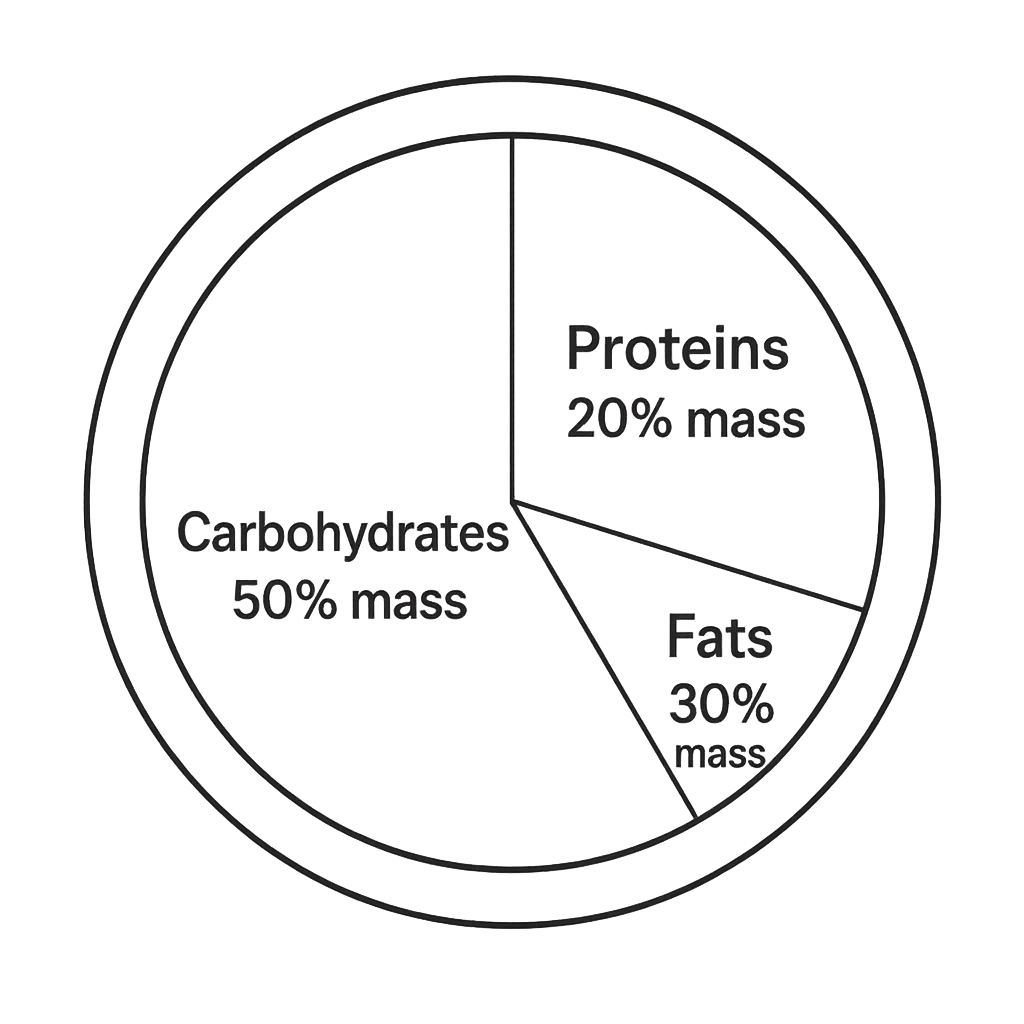
The diagram shows a plate divided into three sections representing the relative mass contributions of carbohydrates (50 %), proteins (20 %) and fats (30 %) in a typical diet. If each gram of carbohydrate or protein provides 4 kcal and each gram of fat provides 9 kcal, calculate the percentage of the total caloric intake that is supplied by proteins. Give your answer to one decimal place.
A. 13.2
B. 16.8
Correct C. 14.5
D. 12.5

Correct Answer: C

Want to see the full step-by-step solution? Unlock AI Explanation & Analytics
Question 19 View Details
A fossil record for a group of marine invertebrates shows the following number of species at successive intervals: 200 Myr ago - 12 species; 180 Myr ago - 12 species; 160 Myr ago - 30 species; 140 Myr ago - 30 species; 120 Myr ago - 55 species. Which pattern of evolutionary change does this record best illustrate?
A. gradualism
Correct B. punctuated equilibrium
C. phyletic gradualism
D. adaptive radiation

Correct Answer: B

Want to see the full step-by-step solution? Unlock AI Explanation & Analytics
Question 20 View Details
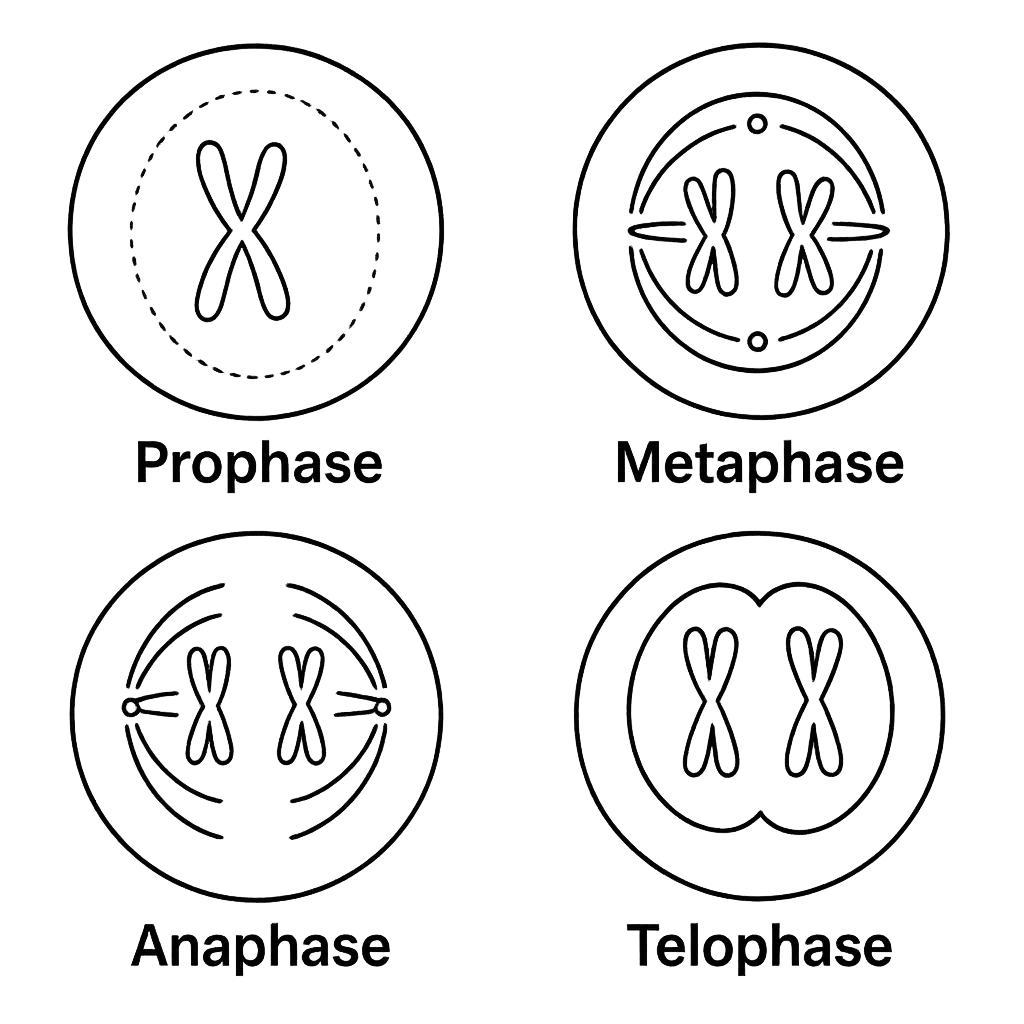
In the labelled diagram of mitosis, which stage is characterised by the separation of sister chromatids to opposite poles of the cell?
A. telophase
B. prophase
Correct C. anaphase
D. metaphase

Correct Answer: C

Want to see the full step-by-step solution? Unlock AI Explanation & Analytics
Question 21 View Details
A cell contains membrane‑bound organelles that possess their own DNA and are the site of oxidative phosphorylation. Which organelle is being described?
A. nucleus
B. chloroplast
C. ribosome
Correct D. mitochondrion

Correct Answer: D

Want to see the full step-by-step solution? Unlock AI Explanation & Analytics
Question 22 View Details
In the kidney, a solute X has a plasma concentration of 0.5 mmol L⁻¹. The glomerular filtration rate is 180 mL min⁻¹. Eighty percent of the filtered amount is reabsorbed in the proximal tubule, and ten percent of the filtered amount is secreted into the tubular fluid in the distal tubule. How many millimoles of X are excreted in the urine in one hour?
A. 2.16 mmol
Correct B. 1.62 mmol
C. 1.80 mmol
D. 1.44 mmol

Correct Answer: B

Want to see the full step-by-step solution? Unlock AI Explanation & Analytics
Question 23 View Details
A person at rest has a tidal volume of 0.5 L, a respiratory rate of 12 breaths min⁻¹ and an anatomical dead‑space volume of 0.15 L. During vigorous exercise the tidal volume rises to 1.2 L and the respiratory rate to 30 breaths min⁻¹, while dead‑space remains unchanged. By how many litres per minute does the alveolar ventilation increase during exercise?
Correct A. 27.3 L min⁻¹
B. 22.8 L min⁻¹
C. 30.5 L min⁻¹
D. 24.0 L min⁻¹

Correct Answer: A

Want to see the full step-by-step solution? Unlock AI Explanation & Analytics
Question 24 View Details
A contagious disease has a basic reproduction number \(R_0 = 3.5\). A vaccine available for this disease is 80 % effective. What proportion of the total population must be immunised with this vaccine to achieve herd immunity?
Correct A. ≈ 89 % of the population
B. ≈ 75 % of the population
C. ≈ 80 % of the population
D. ≈ 95 % of the population

Correct Answer: A

Want to see the full step-by-step solution? Unlock AI Explanation & Analytics
Question 25 View Details
A bacterial culture starts with \(5 \times 10^{5}\) cells. After 3 h the count is \(4 \times 10^{7}\) cells, and the growth is exponential.\n(a) Calculate the generation time in minutes.\n(b) An antibiotic is added that reduces the growth rate by 30 %. Assuming exponential growth continues, how many cells will be present after a further 3 h?
A. Generation time ≈ 25.0 min; final count ≈ 9.5 × 10⁸ cells
Correct B. Generation time ≈ 28.5 min; final count ≈ 8.6 × 10⁸ cells
C. Generation time ≈ 28.5 min; final count ≈ 6.4 × 10⁸ cells
D. Generation time ≈ 30.0 min; final count ≈ 7.2 × 10⁸ cells

Correct Answer: B

Want to see the full step-by-step solution? Unlock AI Explanation & Analytics

Master the Exam!

You've seen a preview, but there are thousands more questions plus AI tutor to break down complex solutions.

Unlock Full Access Available for Android & Windows
Help others prepare! Share this practice hub:
Chat with Support