gce model questions vol1 2022 agricultural_science | Objective

Prepare for your exams with gce model questions vol1 questions? Reviewing past/model questions is one of the most effective ways to guarantee a high score. This practice hub features authentic 2022 agricultural_science (Objective) questions designed to simulate the real exam environment.

Practice these randomly selected questions to test your readiness.

Question 1 View Details
A farmer grows wheat. Fixed costs are ₦150,000 per season and variable cost is ₦30,000 per tonne. Expected yield is 10 tonnes. Market price is ₦45,000 per tonne. The government offers a 10 % subsidy on the market price for the first 5 tonnes sold, after which the price reverts to the market price. Calculate the farmer's profit after the subsidy and state whether this profit exceeds 20 % of the total costs.
A. Profit = 45,000 Naira; No
B. Profit = 15,000 Naira; No
Correct C. Profit = 22,500 Naira; No
D. Profit = 100,000 Naira; Yes

Correct Answer: C

Want to see the full step-by-step solution? Unlock AI Explanation & Analytics
Question 2 View Details
In a cattle herd of 200 animals, a contagious disease has a basic reproduction number \(R_0 = 2.5\). A vaccine is 80 % effective. (a) What minimum proportion of the herd must be vaccinated to achieve herd immunity? (b) If only 120 animals can be vaccinated, will herd immunity be achieved? Give the proportion (as a decimal) and answer "Yes" or "No".
Correct A. 0.75, No
B. 0.80, Yes
C. 0.60, No
D. 0.75, Yes

Correct Answer: A

Want to see the full step-by-step solution? Unlock AI Explanation & Analytics
Question 3 View Details
A rabbit farm aims to raise the average live weight from 1.2 kg to 1.8 kg in 8 weeks. The feed conversion ratio (FCR) for the starter feed (first 4 weeks) is 3.5 kg feed per kg gain and for the finisher feed (last 4 weeks) is 3.0. Starter feed contains 12 % protein and finisher feed 16 % protein. The total protein intake for the whole batch must not exceed 4800 g. Assuming each rabbit gains weight uniformly over the two periods, what is the maximum number of rabbits that can be reared under these constraints? Give the integer number of rabbits.
A. 18
B. 20
Correct C. 17
D. 15

Correct Answer: C

Want to see the full step-by-step solution? Unlock AI Explanation & Analytics
Question 4 View Details
A tractor must pull a 3‑row combine harvester that requires a drawbar pull of 12 kN at a forward speed of 5 km h\(^{-1}\). The tractor's transmission efficiency is 85 % and drivetrain losses amount to 10 % of the engine's gross power. Determine the minimum engine power (in kW) the tractor must have. Round up to the nearest whole kW.
A. 20
B. 24
Correct C. 22
D. 26

Correct Answer: C

Want to see the full step-by-step solution? Unlock AI Explanation & Analytics
Question 5 View Details
A farmer wishes to apply a fertilizer mixture to a 5‑ha field to supply exactly 120 kg of nitrogen (N), 60 kg of phosphorus (P\(_2\)O\(_5\)) and 40 kg of potassium (K\(_2\)O). Two commercial fertilizers are available: Fertilizer X contains 20 % N, 10 % P\(_2\)O\(_5\), 5 % K\(_2\)O and costs ₦12 000 per tonne; Fertilizer Y contains 10 % N, 20 % P\(_2\)O\(_5\), 15 % K\(_2\)O and costs ₦15 000 per tonne. Determine the amounts (in tonnes, to two decimal places) of Fertilizer X and Fertilizer Y that meet the nutrient requirements at minimum total cost, allowing nutrients to meet or exceed the targets. Provide the answer as "X = … t, Y = … t".
A. X = 540.00 t, Y = 130.00 t
B. X = 560.00 t, Y = 120.00 t
Correct C. X = 560.00 t, Y = 80.00 t
D. X = 600.00 t, Y = 100.00 t

Correct Answer: C

Want to see the full step-by-step solution? Unlock AI Explanation & Analytics
Question 6 View Details
A fast‑growing plantation has its timber volume (in m³ per ha) after t years modelled by \(V(t)=0.1t^{2}\). The manager discounts future returns at 5% per annum. Assuming the timber is sold at the end of the rotation, determine the rotation age (in whole years, 0<t\le 50) that maximises the present value of the timber. Show all steps.
A. 45
Correct B. 40
C. 30
D. 35

Correct Answer: B

Want to see the full step-by-step solution? Unlock AI Explanation & Analytics
Question 7 View Details
A hand tractor is equipped with a 12 kW engine that runs at 1500 rpm. The power passes through a gearbox of overall efficiency 85 % and reduces the speed so that the rear wheels turn at 300 rpm. Each rear wheel has a radius of 0.40 m. Assuming no slip, calculate the maximum tractive force (in newtons) the tractor can develop. Show each calculation stage.
A. 900
B. 750
C. 650
Correct D. 812

Correct Answer: D

Want to see the full step-by-step solution? Unlock AI Explanation & Analytics
Question 8 View Details
In a mixed cropping system the total nitrogen input is 120 kg ha⁻¹. Of this, 60 % comes from legume fixation and 25 % from mineral fertilizer. How many kilograms of nitrogen per hectare are supplied by soil mineralisation?
A. 12
B. 24
C. 30
Correct D. 18

Correct Answer: D

Want to see the full step-by-step solution? Unlock AI Explanation & Analytics
Question 9 View Details
A broiler flock is expected to gain an average of 2.2 kg per bird over a 5‑week period. Each bird eats 40 g of a basal diet per day; the diet contains 12 % crude protein, of which 60 % is digestible. Birds require 5 g of digestible protein for every 100 g of weight gain. Determine the amount of additional digestible protein (in grams) that must be supplied per bird each day via a protein supplement (assume the supplement is 100 % digestible). Show all steps.
A. 0.20
Correct B. 0.26
C. 0.30
D. 0.40

Correct Answer: B

Want to see the full step-by-step solution? Unlock AI Explanation & Analytics
Question 10 View Details
An extension programme promotes a pest‑resistant maize variety. Adoption follows the logistic model \(A(t)=\dfrac{K}{1+e^{-b(t-t_{0})}}\) where \(K=0.80\) (maximum proportion of farmers), \(b=0.30\) yr⁻¹ and \(t_{0}=3\) yr. The total farmer population is 10 000. The programme incurs a fixed cost of £1 000 000 and a variable cost of £20 for each farmer that adopts the variety. Each adopting farmer generates a net benefit of £250 per year, realised continuously. Assuming benefits accrue from the moment of adoption and are not limited in time, after how many whole years does the cumulative net benefit become positive (i.e., break‑even)? Show the calculations used to reach the answer.
A. 4
Correct B. 2
C. 3
D. 1

Correct Answer: B

Want to see the full step-by-step solution? Unlock AI Explanation & Analytics
Question 11 View Details
Given a soil sample that contains \(40\%\) sand, \(35\%\) silt and \(25\%\) clay, determine the soil texture class according to the USDA soil texture triangle.
Correct A. loam
B. clay loam
C. sandy loam
D. silt loam

Correct Answer: A

Want to see the full step-by-step solution? Unlock AI Explanation & Analytics
Question 12 View Details
A 10‑ha maize farm has a potential yield of 4\,t\,ha\(^{-1}\) at a market price of $200\,t\(^{-1}\). A leaf‑blight disease affects 30\% of the plants and reduces the yield of infected plants by 15\%. A control measure can reduce the disease incidence to 5\% but costs $50\,ha\(^{-1}\). Assuming the yield loss is proportional to the incidence, calculate the net change in total profit (in dollars) for the whole farm if the control measure is applied compared with doing nothing.
A. -250
B. 0
Correct C. -200
D. -150

Correct Answer: C

Want to see the full step-by-step solution? Unlock AI Explanation & Analytics
Question 13 View Details
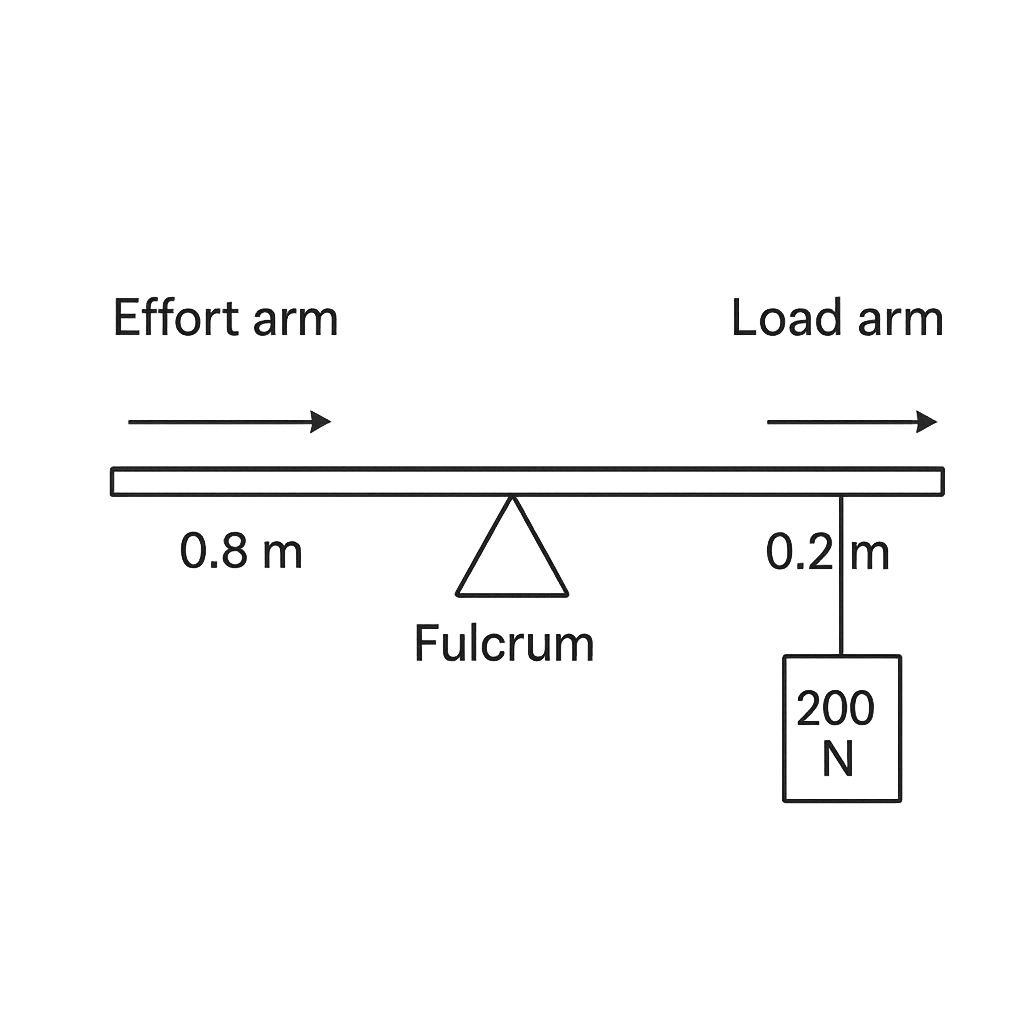
The diagram shows a first‑class lever used to lift a load. The distance from the fulcrum to the point where the effort is applied is 0.8 m, and the distance from the fulcrum to the load is 0.2 m. The load weight is 200 N. What is the minimum effort force (in newtons) required to lift the load?
A. 40
Correct B. 50
C. 60
D. 80

Correct Answer: B

Want to see the full step-by-step solution? Unlock AI Explanation & Analytics
Question 14 View Details
A farmer practices a two‑year rotation of wheat followed by soybean on a 5‑ha field. Wheat yields 3.5\,t\,ha\(^{-1}\) and removes 120\,kg\,N per tonne of grain. Soybean yields 2.8\,t\,ha\(^{-1}\), fixes 80\,kg\,N per tonne of grain and removes 30\,kg\,N per tonne of grain from the soil. To keep the soil nitrogen balance neutral over the rotation, how many kilograms of nitrogen fertilizer should be applied per hectare in the wheat year?
A. 200
B. 320
C. 240
Correct D. 280

Correct Answer: D

Want to see the full step-by-step solution? Unlock AI Explanation & Analytics
Question 15 View Details
An agricultural extension program aims to train 200 farmers. The program incurs an initial set‑up cost of $10 000 and an annual operating cost of $3 000 for each of the next three years. After the program, each farmer's net income is expected to increase by $150 per year for three years. Using a discount rate of 8 % per annum, calculate the net present value (NPV) of the program (in dollars) and state whether the NPV is positive.
A. 61800
B. 45230
Correct C. 59581
D. 57120

Correct Answer: C

Want to see the full step-by-step solution? Unlock AI Explanation & Analytics
Question 16 View Details
A farmer has \(12\) L of a pesticide concentrate that must be diluted to a \(0.8\%\) (v/v) solution before spraying. The recommended spray rate is \(2.3\) L of the prepared solution per hectare. The farmer wishes to keep at least \(5\%\) of the total prepared solution as a reserve and will only treat whole hectares. Using the entire concentrate, how many hectares can be treated and how much of the usable solution will remain after treating those hectares? Give your answer in the form "X ha, Y L".
A. 618 ha, 2.0 L
B. 620 ha, 0.9 L
Correct C. 619 ha, 1.3 L
D. 615 ha, 1.5 L

Correct Answer: C

Want to see the full step-by-step solution? Unlock AI Explanation & Analytics
Question 17 View Details
A motorised plough has a working width of \(1.2\) m. The soil draft force per metre of width is \(3000\) N m\(^{-1}\). A tractor can deliver a maximum draw‑bar power of \(3\) kW. If the tractor moves forward at \(5\) km h\(^{-1}\), can it operate the plough at that speed without exceeding the power limit? If not, calculate the maximum speed (in km h\(^{-1}\)) at which the plough can be used.
A. No; 4 km\/h
B. No; 2 km\/h
C. Yes; 5 km\/h
Correct D. No; 3 km/h

Correct Answer: D

Want to see the full step-by-step solution? Unlock AI Explanation & Analytics
Question 18 View Details
A farm has a total area of \(40\) ha. It is planted with \(10\) ha of wheat and \(15\) ha of maize. The remaining area is under a cover crop. What percentage of the farm's area is under the cover crop? Give your answer to one decimal place.
A. 35.0%
Correct B. 37.5%
C. 40.0%
D. 42.5%

Correct Answer: B

Want to see the full step-by-step solution? Unlock AI Explanation & Analytics
Question 19 View Details
The third instar of a certain crop pest is reached after the accumulation of \(150\) degree‑days above a base temperature of \(10^{\circ}\)C. Over ten consecutive days the daily mean temperatures (in °C) are: 28, 30, 32, 31, 29, 33, 34, 35, 30, 31. On which day does the pest reach the third instar? (Assume day 1 is the first temperature in the list.)
A. Day 6
Correct B. Day 8
C. Day 9
D. Day 7

Correct Answer: B

Want to see the full step-by-step solution? Unlock AI Explanation & Analytics
Question 20 View Details
Which farming practice is most effective in reducing soil erosion on sloping land? Provide the name of the practice.
Correct A. Contour ploughing
B. Terrace farming
C. Strip cropping
D. No‑till farming

Correct Answer: A

Want to see the full step-by-step solution? Unlock AI Explanation & Analytics
Question 21 View Details
An earthen pond of 2 ha with an average depth of 1.5 m is used for tilapia farming. The pond can sustainably support a maximum biomass of 0.5 kg m⁻³. Tilapia are stocked at an unknown density N fish per hectare. Each fish starts at 0.1 kg and gains weight at a constant rate of 0.02 kg per day. The culture period is 120 days. Feed conversion ratio (FCR) is 1.5 kg feed per kg weight gain, feed costs ₦150 per kg, and market price of fish is ₦500 per kg. Fixed operating costs amount to ₦200 000. Determine the greatest integer value of N (fish ha⁻¹) that satisfies both the biomass limit and yields a profit of at least ₦500 000.
A. 2500
B. 4000
Correct C. 3000
D. 3500

Correct Answer: C

Want to see the full step-by-step solution? Unlock AI Explanation & Analytics
Question 22 View Details
In a 10‑ha wheat field the current incidence of leaf rust is 20 % of the plants. The field contains 150 000 plants per hectare. Each infected plant reduces the grain yield by 0.02 kg. The expected yield without disease is 3.5 t ha⁻¹. A fungicide application costs ₦12 000 ha⁻¹ and reduces disease incidence by 75 %. The market price of wheat is ₦250 kg⁻¹. Should the farmer apply the fungicide to maximise profit? Answer "Yes" if the profit after treatment exceeds the profit without treatment, otherwise answer "No".
A. Negative
Correct B. Yes
C. Nope
D. No

Correct Answer: B

Want to see the full step-by-step solution? Unlock AI Explanation & Analytics
Question 23 View Details
A loamy soil has a bulk density of 1.3 g cm⁻³ and a porosity of 48 %. Assuming field capacity equals 50 % of the porosity, calculate the field capacity as a percentage of soil volume.
A. 48
B. 30
C. 12
Correct D. 24

Correct Answer: D

Want to see the full step-by-step solution? Unlock AI Explanation & Analytics
Question 24 View Details
A farmer cultivates 5 ha of maize and keeps a herd of dairy cows on 3 ha of pasture. Maize yields 4 t ha⁻¹ and sells for ₦300 kg⁻¹; variable cost for maize is ₦1 100 000 ha⁻¹. Each cow produces 20 L of milk per day for 150 days, sold at ₦120 L⁻¹. Feed cost per cow is ₦30 per day. Fixed overheads for the whole farm are ₦500 000. What is the minimum whole number of cows required for the farm's total profit to reach at least ₦2 000 000 for the season?
A. 4
Correct B. 6
C. 10
D. 8

Correct Answer: B

Want to see the full step-by-step solution? Unlock AI Explanation & Analytics
Question 25 View Details
In a 2‑ha tomato crop the pest Tuta absoluta has an economic injury level (EIL) of 5 % leaf‑area loss, which corresponds to 0.8 adult moths per 10 sweeps. Monitoring shows 0.5 moths per 10 sweeps. An insecticide application costs ₦25 000 ha⁻¹, reduces the pest population by 80 % and can prevent up to 4 % yield loss. The crop value is ₦200 000 ha⁻¹. Should the farmer apply the insecticide now? Answer "Yes" if the expected loss avoided exceeds the cost of treatment, otherwise answer "No".
A. Yes.
Correct B. No
C. Yes!
D. Yes

Correct Answer: B

Want to see the full step-by-step solution? Unlock AI Explanation & Analytics

Master the Exam!

You've seen a preview, but there are thousands more questions plus AI tutor to break down complex solutions.

Unlock Full Access Available for Android & Windows
Help others prepare! Share this practice hub:
Chat with Support