gce model questions vol1 2021 physics | Objective

Prepare for your exams with gce model questions vol1 questions? Reviewing past/model questions is one of the most effective ways to guarantee a high score. This practice hub features authentic 2021 physics (Objective) questions designed to simulate the real exam environment.

Practice these randomly selected questions to test your readiness.

Question 1 View Details
A tuning fork of frequency 256 Hz is placed at one end of a closed cylindrical tube that resonates at its first harmonic. At 20 °C the speed of sound in air is given by \(v = 331 + 0.6T\) m s\(^{-1}\). The tube length is adjusted so that resonance occurs. The air temperature is then raised to 40 °C while the frequency of the fork remains unchanged. To keep the tube resonating at the same harmonic, what length must the tube be set to? Give your answer in metres to three significant figures.
A. 0.361 m
Correct B. 0.347 m
C. 0.315 m
D. 0.332 m

Correct Answer: B

Want to see the full step-by-step solution? Unlock AI Explanation & Analytics
Question 2 View Details
A string fixed at both ends has a linear mass density \(\mu\) and is under tension \(T\). Its fundamental frequency is given by \(f = \frac{1}{2L}\sqrt{\frac{T}{\mu}}\). Initially the string has tension \(T_{1}\) and length \(L_{1}\) and vibrates at 120 Hz. The tension is increased by 20 % and the length is shortened by 10 % (\(\mu\) remains unchanged). What is the new fundamental frequency? Give your answer in hertz, rounded to the nearest whole number.
A. 132 Hz
B. 158 Hz
C. 124 Hz
Correct D. 146 Hz

Correct Answer: D

Want to see the full step-by-step solution? Unlock AI Explanation & Analytics
Question 3 View Details
A point source emits sound uniformly in all directions. At a distance of 30 m from the source the intensity measured is \(2.0\times10^{-6}\) W m\(^{-2}\). Assuming the source power does not change, what is the difference in sound level, in decibels, between this position and a point 60 m from the source? Give your answer to one decimal place.
A. 3.0 dB
Correct B. 6.0 dB
C. 12.0 dB
D. 9.5 dB

Correct Answer: B

Want to see the full step-by-step solution? Unlock AI Explanation & Analytics
Question 4 View Details
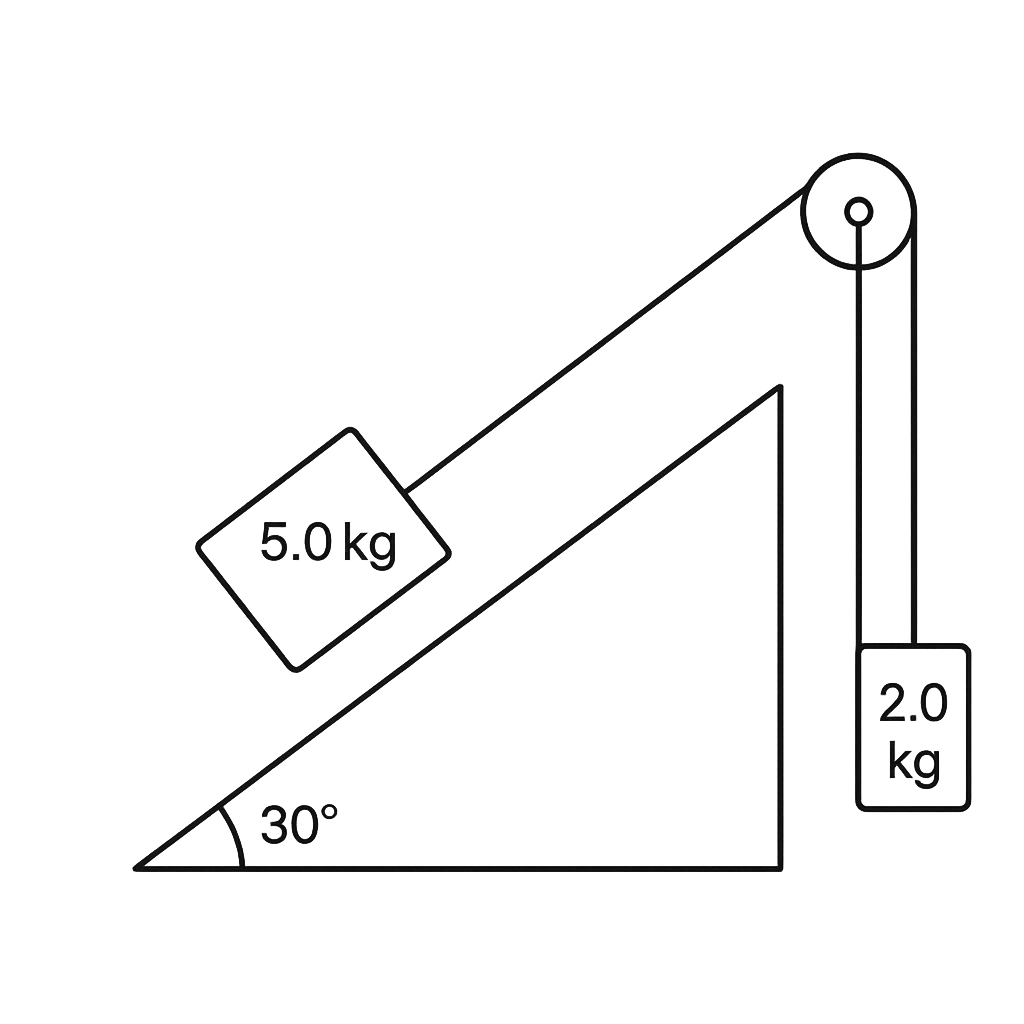
In the diagram, a smooth inclined plane makes an angle of 30° with the horizontal and has a length of 4.0 m. A block of mass 5.0 kg rests at the top of the incline. It is attached by a light inextensible string over a frictionless, mass‑less pulley at the top of the plane to a hanging mass of 2.0 kg. The system is released from rest. When the block has moved 2.0 m down the incline, what is the instantaneous power delivered by the hanging mass? Take \(g = 9.8\) m s\(^{-2}\) and give your answer in watts to two significant figures.
A. 30 W
B. 40 W
Correct C. 35 W
D. 25 W

Correct Answer: C

Want to see the full step-by-step solution? Unlock AI Explanation & Analytics
Question 5 View Details
Monochromatic light of wavelength 400 nm shines on a metal surface with work function 2.0 eV. The incident intensity is 1.0 W m\(^{-2}\). A parallel‑plate capacitor of area \(1.0\;\text{cm}^2\) and plate separation 2.0 mm is placed so that the emitted photoelectrons are collected on the opposite plate. (a) Calculate the maximum kinetic energy of the emitted electrons in electron‑volts. (b) Assuming each incident photon ejects one electron, find the saturation current produced (in amperes). (c) How long will it take for the capacitor to reach a potential difference of 100 V? Give your answer in microseconds to two significant figures.
A. Kmax = 0.95 eV; I_sat = 2.8×10⁻⁵ A; t = 1.6 µs
Correct B. Kmax = 1.10 eV; I_sat = 3.2×10⁻⁵ A; t = 1.4 µs
C. Kmax = 1.25 eV; I_sat = 3.8×10⁻⁵ A; t = 1.2 µs
D. Kmax = 0.80 eV; I_sat = 4.5×10⁻⁵ A; t = 2.0 µs

Correct Answer: B

Want to see the full step-by-step solution? Unlock AI Explanation & Analytics
Question 6 View Details
A particle moves 5 m east and then 12 m north. Find the magnitude of the resultant displacement and state its direction as an angle north of east to one decimal place.
A. 13 m, 60.0° north of east
B. 12.5 m, 67.4° north of east
Correct C. 13 m, 67.4° north of east
D. 13 m, 45.0° north of east

Correct Answer: C

Want to see the full step-by-step solution? Unlock AI Explanation & Analytics
Question 7 View Details
A square coil of 30 turns has side length \(0.20\) m and rotates in a uniform magnetic field of \(0.5\) T. Its angular displacement is \(\theta(t)=10t+2t^{2}\) (rad) for \(0\le t\le2\) s. Determine the maximum emf induced in the coil during this interval and the time at which it occurs. Give the emf to two significant figures and the time to two decimal places.
A. 11.2 V at 2.00 s
B. 10.6 V at 1.75 s
C. 9.8 V at 1.85 s
Correct D. 10.6 V at 1.93 s

Correct Answer: D

Want to see the full step-by-step solution? Unlock AI Explanation & Analytics
Question 8 View Details
A Wheatstone bridge is powered by a 10 V dc source. The four arms have resistances \(R_1=20\ \Omega\), \(R_3=30\ \Omega\) and \(R_4=40\ \Omega\). The galvanometer connecting the two junctions has resistance \(R_g=5\ \Omega\).\n(a) Find the value of \(R_2\) that balances the bridge (zero galvanometer current).\n(b) If the actual \(R_2\) is 25 \(\Omega\), calculate the current through the galvanometer. Give the current in milliamperes to two significant figures.
A. Balance R₂≈30.5 Ω; with R₂=25 Ω, I_g≈6.3 mA
B. Balance R₂≈24.0 Ω; with R₂=25 Ω, I_g≈2.1 mA
C. Balance R₂≈26.7 Ω; with R₂=25 Ω, I_g≈7.5 mA
Correct D. Balance R₂≈26.7 Ω; with R₂=25 Ω, I_g≈4.8 mA

Correct Answer: D

Want to see the full step-by-step solution? Unlock AI Explanation & Analytics
Question 9 View Details
A three‑phase induction motor runs at 1500 rev min⁻¹ and delivers a torque of 12 N·m. The line voltage is 400 V, the power factor is 0.85 lagging and the total losses amount to 1.2 kW. Determine (a) the mechanical power output, (b) the efficiency of the motor, and (c) the line current drawn. Give the efficiency as a percentage to one decimal place and the current to two decimal places.
Correct A. P_out=1.89 kW; efficiency=61.1 %; I=3.20 A
B. P_out=1.70 kW; efficiency=55.0 %; I=3.50 A
C. P_out=2.10 kW; efficiency=68.5 %; I=2.85 A
D. P_out=1.89 kW; efficiency=70.0 %; I=3.20 A

Correct Answer: A

Want to see the full step-by-step solution? Unlock AI Explanation & Analytics
Question 10 View Details
A police siren emits a sound of frequency 800 Hz. The siren is on a car moving towards a stationary observer at 30 m s⁻¹. Simultaneously the observer walks away from the car at 5 m s⁻¹. Take the speed of sound as 340 m s⁻¹. (a) Find the frequency heard by the observer. (b) If a second identical siren at rest also emits 800 Hz, what beat frequency does the observer hear? Give the answers to one decimal place.
Correct A. Observed frequency = 864.5 Hz; beat frequency = 64.5 Hz
B. Observed frequency = 870.5 Hz; beat frequency = 70.5 Hz
C. Observed frequency = 880.0 Hz; beat frequency = 80.0 Hz
D. Observed frequency = 850.0 Hz; beat frequency = 50.0 Hz

Correct Answer: A

Want to see the full step-by-step solution? Unlock AI Explanation & Analytics
Question 11 View Details
A 5.0 kg block is released from rest at the top of a 30° incline that is 3.0 m high. The coefficient of kinetic friction between the block and the incline is 0.20. At the bottom of the incline a horizontal spring of constant 800 N·m⁻¹ is attached, and the block compresses the spring until it momentarily stops. (i) Determine the maximum compression of the spring. (ii) The block is then lifted back to the top of the incline by a motor moving it up the incline at constant speed, taking 4.0 s to complete the ascent. Calculate the average power output of the motor.
Correct A. (i) 0.49 m, (ii) 3.7×10^1 W
B. (i) 0.55 m, (ii) 2.9×10^1 W
C. (i) 0.35 m, (ii) 3.1×10^1 W
D. (i) 0.62 m, (ii) 4.2×10^1 W

Correct Answer: A

Want to see the full step-by-step solution? Unlock AI Explanation & Analytics
Question 12 View Details
A hydrogen atom makes a transition from the n = 5 level to the n = 2 level, emitting a photon. The photon is then incident on a metal surface whose work function is 2.0 eV. (i) Calculate the wavelength of the emitted photon. (ii) Determine the stopping potential required to just stop the electrons emitted from the metal by this photon.
A. λ = 3.78×10⁻⁷ m, V_stop = 0.72 V
B. λ = 4.90×10⁻⁷ m, V_stop = 0.95 V
Correct C. λ = 4.34×10⁻⁷ m, V_stop = 0.86 V
D. λ = 5.12×10⁻⁷ m, V_stop = 1.12 V

Correct Answer: C

Want to see the full step-by-step solution? Unlock AI Explanation & Analytics
Question 13 View Details
Water (density 1000 kg·m⁻³) flows steadily through a horizontal pipe that narrows from a diameter of 0.10 m at point A to a diameter of 0.05 m at point B. The speed of the water at A is 2.0 m·s⁻¹ and the pressure there is 150 kPa. (i) Find the pressure at B. (ii) If a valve completely closes the pipe at B, calculate the force exerted on the valve by the water.
A. P_B = 1.35×10⁵ Pa, F = 2.60×10² N
B. P_B = 1.05×10⁵ Pa, F = 2.10×10² N
C. P_B = 9.80×10⁴ Pa, F = 2.00×10² N
Correct D. P_B = 1.20×10⁵ Pa, F = 2.35×10² N

Correct Answer: D

Want to see the full step-by-step solution? Unlock AI Explanation & Analytics
Question 14 View Details
A displacement of magnitude 30 m is directed 40° north of east, followed by a second displacement of magnitude 40 m directed 30° west of north. Determine the magnitude of the resultant displacement.
A. 5.8×10¹ m
B. 4.9×10¹ m
C. 5.0×10¹ m
Correct D. 5.4×10¹ m

Correct Answer: D

Want to see the full step-by-step solution? Unlock AI Explanation & Analytics
Question 15 View Details
A car starts from rest and travels 100 m in 5.0 s with constant acceleration. Determine the magnitude of the acceleration and the speed of the car at the end of the 5.0 s interval.
A. a = 4.0 m·s⁻², v = 20 m·s⁻¹
B. a = 6.4 m·s⁻², v = 32 m·s⁻¹
Correct C. a = 8.0 m·s⁻², v = 40 m·s⁻¹
D. a = 10.0 m·s⁻², v = 50 m·s⁻¹

Correct Answer: C

Want to see the full step-by-step solution? Unlock AI Explanation & Analytics
Question 16 View Details
A 5.0 kg block slides down a smooth 30\(^\circ\) incline of length 8.0 m, starting from rest, and reaches the bottom in 4.0 s. \(\) (i) Determine the coefficient of kinetic friction between the block and the incline. \(\) (ii) A motor then lifts the block up the same incline at a constant speed equal to the block's average speed down the incline. Calculate the power output required from the motor (in watts).
A. 72 W
B. 100 W
Correct C. 88 W
D. 80 W

Correct Answer: C

Want to see the full step-by-step solution? Unlock AI Explanation & Analytics
Question 17 View Details
A piece of wire is measured to be \(12.3\) cm long with an absolute uncertainty of \(\pm0.2\) cm. Express the length in metres together with its uncertainty, using appropriate significant figures.
A. 0.124 ± 0.002 m
B. 0.123 ± 0.001 m
Correct C. 0.123 ± 0.002 m
D. 0.122 ± 0.002 m

Correct Answer: C

Want to see the full step-by-step solution? Unlock AI Explanation & Analytics
Question 18 View Details
A converging lens of focal length \(f_{1}=0.20\) m forms a real image of a candle placed \(u_{1}=0.50\) m from the lens on a screen. A second converging lens of focal length \(f_{2}=0.10\) m is positioned \(0.05\) m behind the screen to view the image. Determine (i) the distance of the final image from the second lens and state whether it is real or virtual, and (ii) the overall magnification of the two‑lens system.
A. 0.15 m (real, on the image side); overall magnification ≈ -0.75
B. 0.12 m (real, on the image side); overall magnification ≈ -1.00
Correct C. 0.10 m (virtual, on the object side); overall magnification ≈ -1.33
D. 0.08 m (virtual, on the object side); overall magnification ≈ -2.00

Correct Answer: C

Want to see the full step-by-step solution? Unlock AI Explanation & Analytics
Question 19 View Details
A diffraction grating has 5000 lines per centimetre. It is illuminated by monochromatic light. The second‑order maximum is observed at an angle of \(30^{\circ}\). (i) Find the wavelength of the light. (ii) If the grating is rotated so that the first‑order maximum appears at \(20^{\circ}\), what is the wavelength of the light now observed?
A. 520 nm; 650 nm
B. 480 nm; 700 nm
Correct C. 500 nm; 684 nm
D. 450 nm; 720 nm

Correct Answer: C

Want to see the full step-by-step solution? Unlock AI Explanation & Analytics
Question 20 View Details
The diagram shows a particle moving in a straight line. Three successive displacement arrows, each representing a 1 s interval, are drawn in the same direction. The arrows have lengths 2 cm, 4 cm and 6 cm respectively. The scale of the diagram is 1 cm = 1 m s⁻¹. Assuming the particle moves with constant acceleration, determine the particle's average speed over the whole 3 s interval.
A. 3.33 m/s
Correct B. 2.67 m/s
C. 4.00 m/s
D. 5.33 m/s

Correct Answer: B

Want to see the full step-by-step solution? Unlock AI Explanation & Analytics
Question 21 View Details
A copper block of unknown mass \(m\) is placed into a calorimeter containing 0.5 kg of water at 20 °C. The calorimeter has a heat capacity of 50 J °C⁻¹. The initial temperature of the copper block is 150 °C. After the system reaches thermal equilibrium the temperature is 30 °C. Given the specific heat capacity of copper is 0.385 J g⁻¹ °C⁻¹ and that of water is 4.18 J g⁻¹ °C⁻¹, determine the mass of the copper block in kilograms.
A. 0.589 kg
Correct B. 0.463 kg
C. 0.412 kg
D. 0.346 kg

Correct Answer: B

Want to see the full step-by-step solution? Unlock AI Explanation & Analytics
Question 22 View Details
Three point charges are fixed in the xy‑plane: \(q_1 = +8\;\mu\text{C}\) at the origin \((0,0)\), \(q_2 = -2\;\mu\text{C}\) at \((0.12\;\text{m},0)\) and \(q_3 = +5\;\mu\text{C}\) at \((0,0.15\;\text{m})\). Determine the magnitude and direction (angle measured from the positive x‑axis) of the resultant electric field at the point \(P(0.12\;\text{m},0.15\;\text{m})\). Also give the electric potential at \(P\) relative to infinity. Use \(k = 8.99\times10^{9}\;\text{N·m}^2\text{C}^{-2}\).
Correct A. E = 4.4×10⁶ N·C⁻¹, direction 9.5° above +x‑axis; V = 6.3×10⁵ V
B. E = 5.1×10⁶ N·C⁻¹, direction 7.2° above +x‑axis; V = 7.0×10⁵ V
C. E = 3.9×10⁶ N·C⁻¹, direction 12.0° above +x‑axis; V = 5.8×10⁵ V
D. E = 4.4×10⁶ N·C⁻¹, direction 15.3° above +x‑axis; V = 6.3×10⁵ V

Correct Answer: A

Want to see the full step-by-step solution? Unlock AI Explanation & Analytics
Question 23 View Details
A pipe open at one end and closed at the other has a length of \(1.20\;\text{m}\). A standing sound wave is observed in the pipe with three nodes (including the closed end). If the speed of sound in air is \(340\;\text{m s}^{-1}\), calculate the wavelength of the wave and its frequency.
Correct A. λ = 0.96 m, f = 354 Hz
B. λ = 0.80 m, f = 425 Hz
C. λ = 0.48 m, f = 708 Hz
D. λ = 1.20 m, f = 283 Hz

Correct Answer: A

Want to see the full step-by-step solution? Unlock AI Explanation & Analytics
Question 24 View Details
A 12 V DC supply powers two resistors \(R_1\) and \(R_2\) connected in parallel. At \(20^{\circ}\text{C}\) their resistances are \(R_{1,0}=10\;\Omega\) and \(R_{2,0}=20\;\Omega\) with temperature coefficients \(\alpha_1 = 4.0\times10^{-3}\;^{\circ}\text{C}^{-1}\) and \(\alpha_2 = 1.5\times10^{-3}\;^{\circ}\text{C}^{-1}\) respectively. Both resistors heat uniformly to a common temperature \(T\) (in °C) so that their resistances become \(R_1 = R_{1,0}[1+\alpha_1(T-20)]\) and \(R_2 = R_{2,0}[1+\alpha_2(T-20)]\). Find the temperature \(T\) at which the power dissipated in \(R_1\) equals the power dissipated in \(R_2\). Then calculate the total current drawn from the supply at that temperature.
Correct A. T = 1020 °C, I_total = 0.48 A
B. T = 950 °C, I_total = 0.50 A
C. T = 820 °C, I_total = 0.55 A
D. T = 1200 °C, I_total = 0.42 A

Correct Answer: A

Want to see the full step-by-step solution? Unlock AI Explanation & Analytics
Question 25 View Details
A sealed rigid container of volume \(2.00\;\text{L}\) contains \(0.050\;\text{mol}\) of an ideal gas at \(300\;\text{K}\). The container is heated until the pressure rises to \(2.00\;\text{atm}\). (a) Determine the final temperature of the gas. (b) If instead the gas were in a flexible balloon that can expand freely while the temperature is raised to the same final temperature, what volume will the gas occupy when the external pressure remains at \(1.00\;\text{atm}\)? Use \(R = 0.0821\;\text{L·atm·K}^{-1}\text{mol}^{-1}\).
A. T = 974 K, V = 2.0 L
B. T = 600 K, V = 2.5 L
Correct C. T = 974 K, V = 4.0 L
D. T = 1200 K, V = 5.0 L

Correct Answer: C

Want to see the full step-by-step solution? Unlock AI Explanation & Analytics

Master the Exam!

You've seen a preview, but there are thousands more questions plus AI tutor to break down complex solutions.

Unlock Full Access Available for Android & Windows
Help others prepare! Share this practice hub:
Chat with Support