gce model questions vol1 2020 physics | Objective

Prepare for your exams with gce model questions vol1 questions? Reviewing past/model questions is one of the most effective ways to guarantee a high score. This practice hub features authentic 2020 physics (Objective) questions designed to simulate the real exam environment.

Practice these randomly selected questions to test your readiness.

Question 1 View Details
A block‑and‑tackle system consists of one fixed pulley and one movable pulley. An effort of \(120\ \text{N}\) is applied vertically downward, moving the rope through a distance of \(4.0\ \text{m}\). As a result the load is lifted vertically upward by \(1.0\ \text{m}\). The load has a weight of \(350\ \text{N}\). Determine the ideal mechanical advantage (IMA), the actual mechanical advantage (AMA) and the efficiency of the system (as a percentage).
A. IMA = 4, AMA = 3.00, efficiency = 80.0%
Correct B. IMA = 4, AMA = 2.92, efficiency = 72.9%
C. IMA = 3, AMA = 2.50, efficiency = 62.5%
D. IMA = 5, AMA = 3.10, efficiency = 78.0%

Correct Answer: B

Want to see the full step-by-step solution? Unlock AI Explanation & Analytics
Question 2 View Details
A sample contains \(2.00\ \text{g}\) of pure \(^{60}\mathrm{Co}\) whose half‑life is \(5.27\ \text{yr}\). After \(12\ \text{yr}\) the gamma‑ray intensity is measured. (a) Find the fraction of the original activity that remains after \(12\ \text{yr}\). (b) Express the intensity \(I\) after \(12\ \text{yr}\) as a fraction of the initial intensity \(I_{0}\). (c) The gamma rays are then passed through a lead shield of thickness \(x\) cm, where the attenuation follows \(I = I_{0}e^{-\mu x}\) with \(\mu = 0.12\ \text{cm}^{-1}\). Determine the thickness of lead required to reduce the intensity to \(10\%\) of the intensity after \(12\ \text{yr}\).
A. fraction = 0.206, I/I0 = 0.206, thickness = 30.0 cm
Correct B. fraction = 0.206, I/I0 = 0.206, thickness = 32.4 cm
C. fraction = 0.250, I/I0 = 0.250, thickness = 28.0 cm
D. fraction = 0.180, I/I0 = 0.180, thickness = 35.0 cm

Correct Answer: B

Want to see the full step-by-step solution? Unlock AI Explanation & Analytics
Question 3 View Details
Source \(S_{1}\) emits sound of frequency \(800\ \text{Hz}\) and moves directly towards a stationary observer with speed \(30\ \text{m s}^{-1}\). At the same time source \(S_{2}\) of frequency \(820\ \text{Hz}\) is fixed in position. The observer walks towards \(S_{2}\) with speed \(20\ \text{m s}^{-1}\). A large vertical wall is situated \(30\ \text{m}\) behind \(S_{2}\); the sound from \(S_{2}\) reflects off the wall before reaching the observer. The speed of sound in air is \(340\ \text{m s}^{-1}\). (a) Find the frequency heard from \(S_{1}\). (b) Find the frequency of the reflected wave from \(S_{2}\) that reaches the observer. (c) Find the beat frequency between the two sounds heard by the observer.
A. f1 = 845 Hz, f2 = 800 Hz, beat = 45 Hz
B. f1 = 890 Hz, f2 = 760 Hz, beat = 130 Hz
Correct C. f1 = 877 Hz, f2 = 772 Hz, beat = 105 Hz
D. f1 = 860 Hz, f2 = 785 Hz, beat = 75 Hz

Correct Answer: C

Want to see the full step-by-step solution? Unlock AI Explanation & Analytics
Question 4 View Details
A cylinder fitted with a movable piston contains \(0.50\ \text{mol}\) of an ideal gas at \(300\ \text{K}\) and \(1.00\ \text{atm}\). The gas is heated at constant volume to \(450\ \text{K}\). The piston is then allowed to move so that the gas expands isothermally at \(450\ \text{K}\) until its pressure falls to \(0.50\ \text{atm}\). (a) Calculate the final volume of the gas. (b) Calculate the work done by the gas during the isothermal expansion (in joules). (c) Calculate the change in internal energy of the gas for the whole process (in joules). Assume the gas is monatomic.
A. V_f = 33.0 L, W = 2.10×10^3 J, ΔU = 7.50×10^2 J
B. V_f = 39.5 L, W = 2.30×10^3 J, ΔU = 1.02×10^3 J
Correct C. V_f = 36.9 L, W = 2.06×10^3 J, ΔU = 9.35×10^2 J
D. V_f = 34.2 L, W = 1.85×10^3 J, ΔU = 8.10×10^2 J

Correct Answer: C

Want to see the full step-by-step solution? Unlock AI Explanation & Analytics
Question 5 View Details
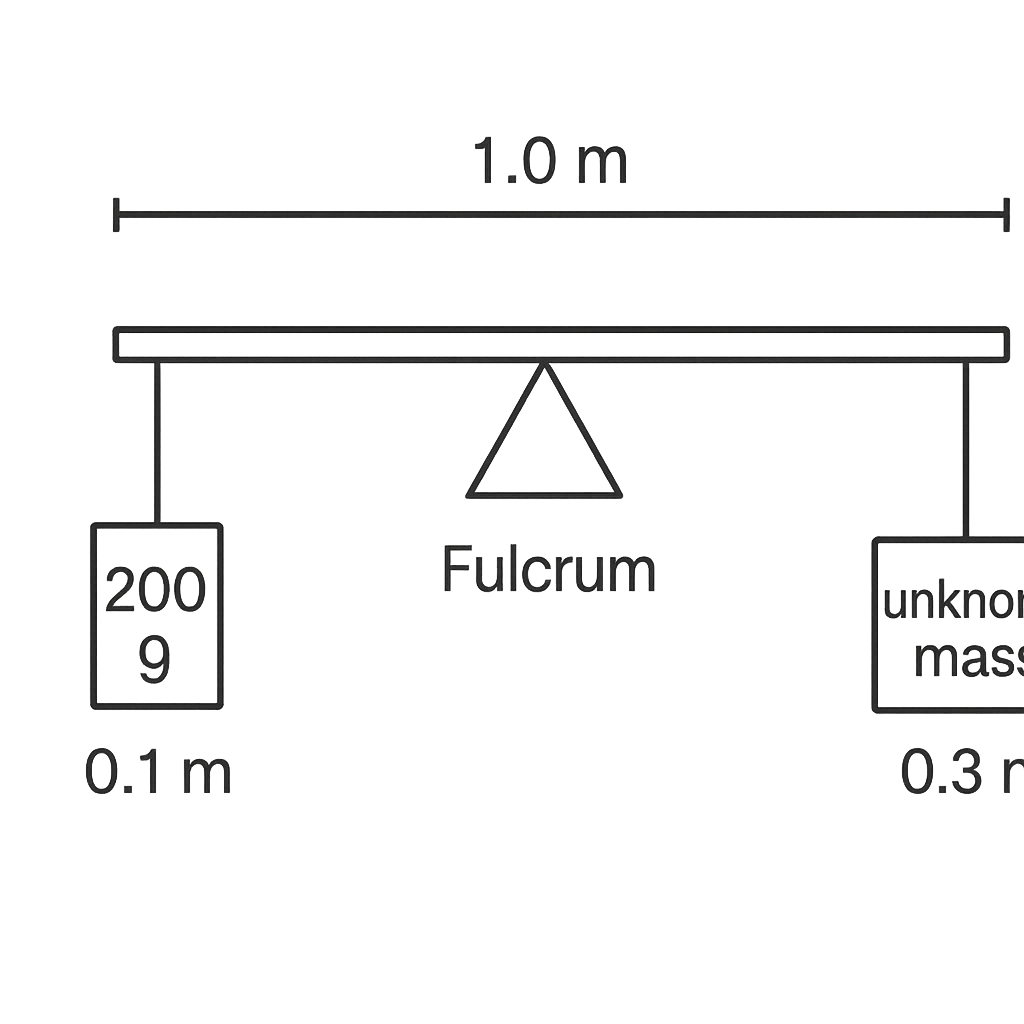
In the diagram a uniform beam of length \(1.00\ \text{m}\) is balanced on a fulcrum placed \(0.40\ \text{m}\) from the left end. A known mass of \(200\ \text{g}\) is hung \(0.10\ \text{m}\) to the left of the fulcrum. An unknown mass is hung \(0.30\ \text{m}\) to the right of the fulcrum. The system is in equilibrium. Determine the mass of the unknown object.
Correct A. 66.7 g
B. 100 g
C. 150 g
D. 33.3 g

Correct Answer: A

Want to see the full step-by-step solution? Unlock AI Explanation & Analytics
Question 6 View Details
An insulated square loop of side \(a = 0.15\ \text{m}\) and mass \(m = 0.050\ \text{kg}\) carries a current \(I\). The loop is hinged along one edge and can rotate in a vertical plane about this hinge. The loop is placed in a uniform magnetic field of magnitude \(B = 0.40\ \text{T}\) whose direction is perpendicular to the plane of the loop when the loop is in its equilibrium position (i.e., when the plane of the loop is parallel to the field). The loop is displaced by an angle \(\theta = 30^{\circ}\) from this position and released. A torsion spring attached to the hinge provides a restoring torque \(\tau_s = \kappa \theta\) with spring constant \(\kappa = 1.5\times10^{-4}\ \text{N·m·rad}^{-1}\). Determine the magnitude of the current \(I\) (in amperes, to three significant figures) required so that the magnetic torque on the loop exactly balances the combined restoring torque from the spring and the gravitational torque due to the weight of the loop acting at its centre of mass.
A. 5.12 A
B. 4.55 A
Correct C. 4.10 A
D. 3.78 A

Correct Answer: C

Want to see the full step-by-step solution? Unlock AI Explanation & Analytics
Question 7 View Details
A tuning fork produces a pure tone of frequency \(f = 1000\ \text{Hz}\). The source moves directly towards a stationary observer with speed \(v_s = 15\ \text{m s}^{-1}\). Simultaneously, the observer moves directly away from the source with speed \(v_o = 5\ \text{m s}^{-1}\). The air temperature is \(20^{\circ}\text{C}\) and a uniform wind of speed \(w = 4\ \text{m s}^{-1}\) blows from the source towards the observer, assisting the propagation of the sound. Assuming the speed of sound in still air is \(v = 331 + 0.6T\) where \(T\) is in \(^{\circ}\text{C}\), calculate the frequency heard by the observer (to the nearest hertz).
Correct A. 1030 Hz
B. 1045 Hz
C. 1005 Hz
D. 1020 Hz

Correct Answer: A

Want to see the full step-by-step solution? Unlock AI Explanation & Analytics
Question 8 View Details
A battery of emf \(\varepsilon = 24\ \text{V}\) and unknown internal resistance \(r\) is connected to a circuit as shown: a resistor \(R_1 = 4\ \Omega\) is in series with a parallel combination of a resistor \(R_2 = 6\ \Omega\) and a lamp of resistance \(R_L\). When the lamp is operating, the total current drawn from the battery is \(I = 3.0\ \text{A}\) and the lamp dissipates a power of \(12\ \text{W}\). Assuming the internal resistance is non‑zero, determine (a) the internal resistance \(r\) of the battery (in ohms, to two significant figures) and (b) the resistance \(R_L\) of the lamp (in ohms, to two significant figures).
A. r = 3 Ω, R_L = 2 Ω
B. r = 1 Ω, R_L = 4 Ω
Correct C. r = 2 Ω, R_L = 3 Ω
D. r = 2.5 Ω, R_L = 5 Ω

Correct Answer: C

Want to see the full step-by-step solution? Unlock AI Explanation & Analytics
Question 9 View Details
A ball is thrown vertically upwards from ground level with an initial speed of \(20.0\ \text{m s}^{-1}\). Neglect air resistance and take \(g = 9.8\ \text{m s}^{-2}\). Calculate the total time (in seconds, to two decimal places) that the ball remains in the air before returning to the ground.
Correct A. 4.08 s
B. 3.67 s
C. 4.90 s
D. 5.10 s

Correct Answer: A

Want to see the full step-by-step solution? Unlock AI Explanation & Analytics
Question 10 View Details
A point charge \(Q = 8.0\ \mu\text{C}\) is fixed at the origin of a coordinate system. A small isolated conducting sphere of radius \(a = 0.020\ \text{m}\) has its centre at the point \((0,0,0.050\ \text{m})\) on the positive \(z\)-axis. The sphere is initially uncharged and is allowed to reach electrostatic equilibrium. (a) Determine the magnitude of the total induced charge on the sphere (in microcoulombs, to one decimal place). (b) Find the magnitude of the electric field at point \(P\) located at \((0,0,0.10\ \text{m})\) on the same axis, expressed in scientific notation with two significant figures, and state its direction (towards or away from the origin). Use \(\varepsilon_0 = 8.85\times10^{-12}\ \text{F m}^{-1}\).
A. 2.5 µC, 2.0×10^6 N\/C away from the origin
B. 3.2 µC, 2.5×10^6 N\/C away from the origin
C. 4.0 µC, 1.0×10^6 N\/C towards the origin
Correct D. 3.2 µC, 1.4×10^6 N/C towards the origin

Correct Answer: D

Want to see the full step-by-step solution? Unlock AI Explanation & Analytics
Question 11 View Details
A U‑tube manometer contains water in the left leg and mercury in both legs. The water column in the left leg rises \(0.20\,\text{m}\) above the mercury surface in that leg. The mercury surface in the right leg is lower than that in the left leg by an unknown amount \(\Delta h\). (a) Determine \(\Delta h\). (b) If a point \(P\) is located \(0.40\,\text{m}\) below the mercury surface in the right leg, calculate the absolute pressure at \(P\), taking atmospheric pressure as \(1.0\times10^{5}\,\text{Pa}\).
A. Δh≈2.0 cm; pressure at P = 1.60×10^5 Pa
B. Δh≈1.8 cm; pressure at P = 1.70×10^5 Pa
C. Δh≈1.0 cm; pressure at P = 1.45×10^5 Pa
Correct D. Δh≈1.5 cm; pressure at P = 1.53×10^5 Pa

Correct Answer: D

Want to see the full step-by-step solution? Unlock AI Explanation & Analytics
Question 12 View Details
A block of mass \(5.0\,\text{kg}\) rests on a rough inclined plane that makes an angle of \(30^{\circ}\) with the horizontal. The coefficient of static friction between the block and the plane is \(\mu_{s}=0.30\). A horizontal force \(F\) is applied to the block (pushing up the plane). (a) Find the minimum magnitude of \(F\) required to start moving the block up the plane. (b) Using the same force \(F\) found in part (a), the block is placed on a second plane of unknown angle \(\theta\). The block is now on the verge of sliding down the plane. Determine \(\theta\).
A. F≈60 N; θ≈70°
B. F≈45 N; θ≈55°
C. F≈38 N; θ≈48°
Correct D. F≈52 N; θ≈63°

Correct Answer: D

Want to see the full step-by-step solution? Unlock AI Explanation & Analytics
Question 13 View Details
A movable pulley of negligible mass has a rim radius of \(0.20\,\text{m}\). The axle of the pulley exerts a constant resisting torque of \(5\,\text{N·m}\) due to friction. A load of mass \(40\,\text{kg}\) is attached to the pulley, and a horizontal force \(F\) is applied to the free end of the rope, pulling upward. (a) Determine the minimum magnitude of \(F\) required to lift the load at constant speed. (b) Calculate the mechanical efficiency of the system under this condition. Use \(g=9.8\,\text{m s}^{-2}\).
A. F≈2.8×10^2 N; efficiency≈95 %
Correct B. F≈2.2×10^2 N; efficiency≈89 %
C. F≈2.0×10^2 N; efficiency≈80 %
D. F≈1.6×10^2 N; efficiency≈70 %

Correct Answer: B

Want to see the full step-by-step solution? Unlock AI Explanation & Analytics
Question 14 View Details
A sealed container of volume \(V=0.020\,\text{m}^{3}\) contains \(n=0.50\) mol of an ideal gas at an initial temperature of \(300\,\text{K}\). (a) The gas is heated until its pressure doubles. Find the temperature after this heating step. (b) Keeping the temperature constant at the value found in part (a), the gas expands isothermally until its pressure returns to the original value. Determine the final volume. (c) Calculate the total change in internal energy of the gas over the whole process, assuming the gas is monatomic. Use \(R=8.314\,\text{J mol}^{-1}\text{K}^{-1}\).
A. T₂=500 K; V₂=0.015 m³; ΔU≈1.2×10³ J
Correct B. T₂=600 K; V₂=0.010 m³; ΔU≈1.9×10³ J
C. T₂=700 K; V₂=0.020 m³; ΔU≈2.5×10³ J
D. T₂=600 K; V₂=0.020 m³; ΔU≈0 J

Correct Answer: B

Want to see the full step-by-step solution? Unlock AI Explanation & Analytics
Question 15 View Details
A car travels at a constant speed of \(72\,\text{km h}^{-1}\) for \(2\) minutes \(30\) seconds. Express the distance travelled in metres, showing all unit conversions.
A. 2700 m
B. 2500 m
Correct C. 3000 m
D. 3200 m

Correct Answer: C

Want to see the full step-by-step solution? Unlock AI Explanation & Analytics
Question 16 View Details
A rectangular conducting loop of width \(l = 0.20\ \text{m}\) slides without friction on two parallel horizontal rails that are 0.20 m apart, forming a closed circuit of total resistance \(R = 4.0\ \Omega\). The rails are placed in a uniform magnetic field of magnitude \(B = 0.50\ \text{T}\) directed into the page. An external horizontal force \(F = 2.0\ \text{N}\) is applied to the moving side of the loop, keeping it moving at a constant speed \(v\).\n\n(a) Determine the speed \(v\) of the loop.\n(b) Find the magnitude of the induced current in the loop and state its direction (clockwise or anticlockwise) as seen from above.
A. v = 1.6×10^3 m s⁻¹; I = 40 A clockwise
B. v = 8.0×10^2 m s⁻¹; I = 20 A anticlockwise
C. v = 4.0×10^2 m s⁻¹; I = 10 A clockwise
Correct D. v = 8.0×10^2 m s⁻¹; I = 20 A clockwise

Correct Answer: D

Want to see the full step-by-step solution? Unlock AI Explanation & Analytics
Question 17 View Details
A long solenoid of length \(L = 0.50\ \text{m}\) and radius \(r = 0.04\ \text{m}\) has \(N = 1200\) turns. It is placed in a uniform external magnetic field \(B_{\text{ext}} = 2.0\times10^{-4}\ \text{T}\) directed opposite to the field that would be produced by the solenoid.\n\n(a) What current \(I\) must flow through the solenoid so that the net magnetic field inside the solenoid is zero?\n(b) A magnetic dipole of moment \(m = 0.030\ \text{A·m}^{2}\) is positioned at the centre of the solenoid. If the solenoid current is then switched off, the dipole is oriented perpendicular to the external field. Determine the magnitude of the torque acting on the dipole.
A. I ≈ 1.3×10⁻¹ A; τ = 1.2×10⁻⁵ N·m
B. I ≈ 3.3×10⁻² A; τ = 3.0×10⁻⁶ N·m
C. I ≈ 6.6×10⁻² A; τ = 1.2×10⁻⁵ N·m
Correct D. I ≈ 6.6×10⁻² A; τ = 6.0×10⁻⁶ N·m

Correct Answer: D

Want to see the full step-by-step solution? Unlock AI Explanation & Analytics
Question 18 View Details
Two blocks are connected by a light inextensible string over a smooth frictionless pulley. Block \(A\) (mass \(m_{A}=4.0\ \text{kg}\)) hangs vertically, while block \(B\) (mass \(m_{B}=6.0\ \text{kg}\)) rests on a horizontal table. The coefficient of kinetic friction between block \(B\) and the table is \(\mu_{k}=0.20\). A horizontal force of magnitude \(10\ \text{N}\) is applied to block \(B\) to the right. Determine (a) the magnitude of the common acceleration of the system and (b) the tension in the string.
A. a = 2.1 m s⁻²; T = 18.5 N
B. a = 3.0 m s⁻²; T = 22.0 N
Correct C. a = 3.74 m s⁻²; T = 24.2 N
D. a = 4.5 m s⁻²; T = 27.0 N

Correct Answer: C

Want to see the full step-by-step solution? Unlock AI Explanation & Analytics
Question 19 View Details
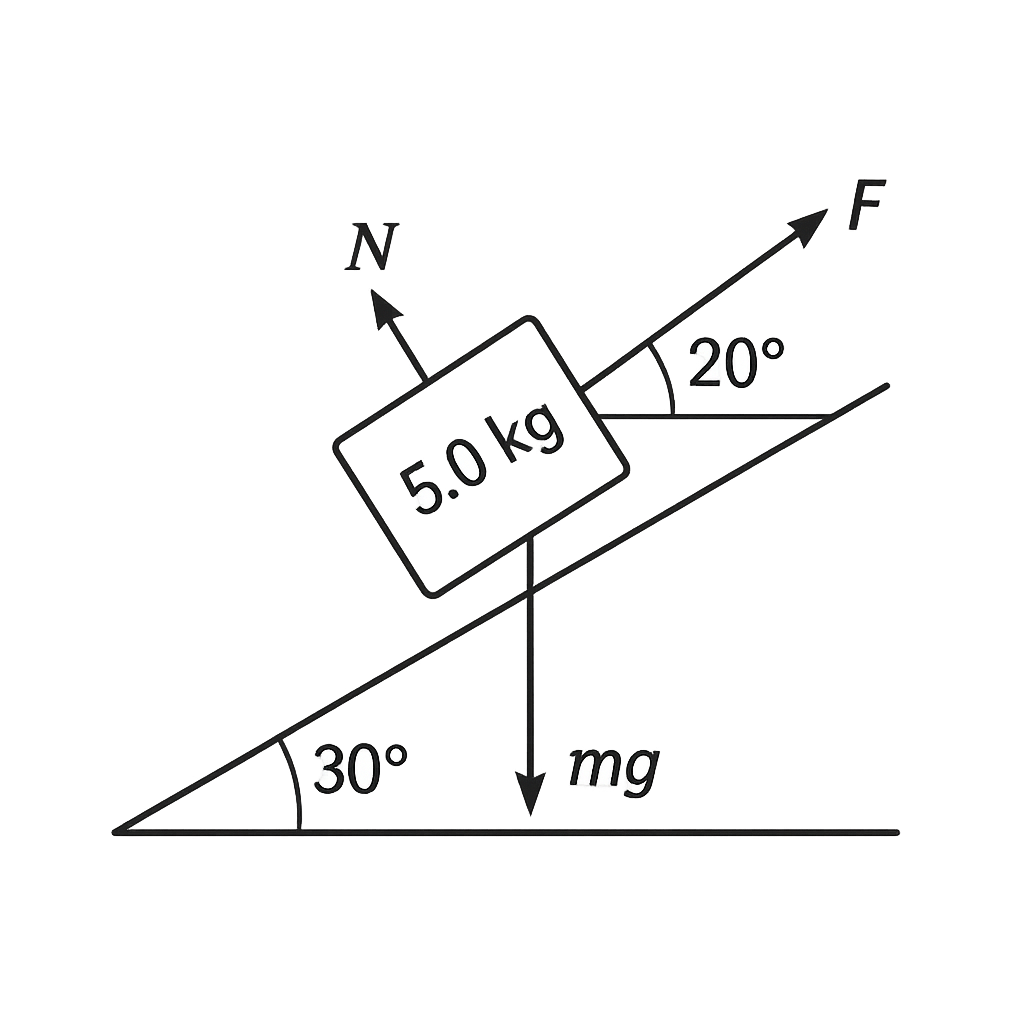
An inclined plane makes an angle of \(30^{\circ}\) with the horizontal. A block of mass \(5.0\ \text{kg}\) rests on the plane. The coefficient of static friction between the block and the plane is \(\mu_{s}=0.40\). The block is attached to a light string that is pulled with a force \(F\) acting at an angle of \(20^{\circ}\) above the plane (i.e., the string makes \(20^{\circ}\) with the surface). Using the force diagram shown, determine the minimum magnitude of \(F\) required to start the block moving up the plane.
A. F ≈ 4.0×10¹ N (≈ 40 N)
Correct B. F ≈ 5.2×10¹ N (≈ 52 N)
C. F ≈ 5.2×10⁰ N (≈ 5 N)
D. F ≈ 6.5×10¹ N (≈ 65 N)

Correct Answer: B

Want to see the full step-by-step solution? Unlock AI Explanation & Analytics
Question 20 View Details
A battery of emf \(E\) and internal resistance \(r = 0.50\ \Omega\) supplies a circuit consisting of three external resistors: \(R_{1}=5.0\ \Omega\) in one branch, and \(R_{2}=4.0\ \Omega\) and \(R_{3}=6.0\ \Omega\) in series in a second branch. The two branches are connected in parallel across the battery terminals. The current in the branch containing \(R_{1}\) is twice the current in the branch containing \(R_{2}\) and \(R_{3}\). The total power dissipated in the three external resistors is \(200\ \text{W}\). Determine the emf \(E\) of the battery.
A. E ≈ 2.0×10¹ V (≈ 20 V)
Correct B. E ≈ 2.97×10¹ V (≈ 29.7 V)
C. E ≈ 3.2×10¹ V (≈ 32 V)
D. E ≈ 2.5×10¹ V (≈ 25 V)

Correct Answer: B

Want to see the full step-by-step solution? Unlock AI Explanation & Analytics
Question 21 View Details
A vertical tube of uniform cross‑section contains a trapped gas sealed at the bottom by a frictionless piston. The gas initially has pressure \(P_{0}=150\ \text{kPa}\) and volume \(V_{0}=2.0\times10^{-3}\ \text{m}^{3}\). The tube cross‑sectional area is \(A=5.0\times10^{-5}\ \text{m}^{2}\) and the tube is open to the atmosphere (\(P_{\text{atm}}=100\ \text{kPa}\)) at the top. Water is then slowly introduced at the top, raising the water column height \(h\) above the gas. Assuming the process is isothermal and the water density is \(\rho =1000\ \text{kg m}^{-3}\), determine the final pressure of the gas after equilibrium is reached.
A. 1.95\times10^{2}\ \text{kPa} \;(\approx 195\ \text{kPa})
Correct B. 2.05\times10^{2}\ \text{kPa} \;(\approx 205\ \text{kPa})
C. 2.30\times10^{2}\ \text{kPa} \;(\approx 230\ \text{kPa})
D. 1.85\times10^{2}\ \text{kPa} \;(\approx 185\ \text{kPa})

Correct Answer: B

Want to see the full step-by-step solution? Unlock AI Explanation & Analytics
Question 22 View Details
An electron in a singly ionised helium ion (\(\text{He}^{+}\)) makes a transition from the \(n=4\) level to the \(n=2\) level, emitting a photon. Taking the nuclear mass of helium as \(M = 4.0026\ \text{u}\) (where \(1\ \text{u}=1.6605\times10^{-27}\ \text{kg}\)), calculate the wavelength of the emitted photon. Use the Rydberg constant for infinite nuclear mass \(R_{\infty}=1.097373\times10^{7}\ \text{m}^{-1}\) and the electron mass \(m_{e}=9.109\times10^{-31}\ \text{kg}\).
Correct A. 1.22\times10^{-7}\ \text{m} \;(\approx 121\ \text{nm})
B. 1.35\times10^{-7}\ \text{m} \;(\approx 135\ \text{nm})
C. 9.80\times10^{-8}\ \text{m} \;(\approx 98\ \text{nm})
D. 1.05\times10^{-7}\ \text{m} \;(\approx 105\ \text{nm})

Correct Answer: A

Want to see the full step-by-step solution? Unlock AI Explanation & Analytics
Question 23 View Details
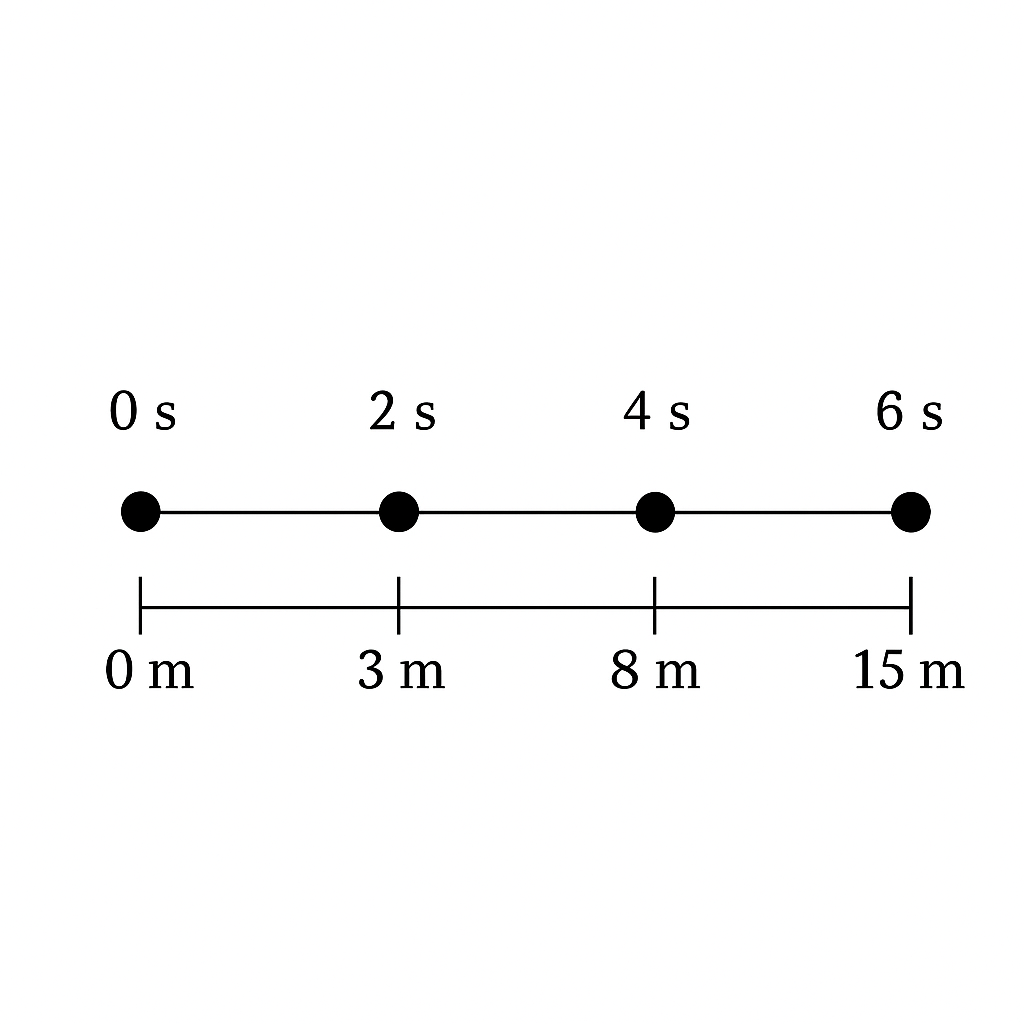
The diagram shows a particle moving in a straight line. The particle's positions are recorded at 2‑second intervals as dots. The first dot is at the origin, the second dot is 3 m to the right, the third dot is 8 m to the right, and the fourth dot is 15 m to the right of the origin. Determine the average speed of the particle over the total 6‑second interval.
A. 2.0\ \text{m s}^{-1}
Correct B. 2.5\ \text{m s}^{-1}
C. 1.5\ \text{m s}^{-1}
D. 3.0\ \text{m s}^{-1}

Correct Answer: B

Want to see the full step-by-step solution? Unlock AI Explanation & Analytics
Question 24 View Details
Electrons are accelerated through a potential difference of \(V = 200\ \text{V}\) and then directed onto a thin polycrystalline metal foil. A circular diffraction pattern is observed on a screen placed a distance \(L = 0.50\ \text{m}\) from the foil. The radius of the first‑order diffraction ring is measured to be \(R = 0.040\ \text{m}\). Assuming the diffraction satisfies Bragg's law for the first order \((n=1)\) and that the scattering angle is small so that \(\sin\theta \approx \tan\theta = R/L\), determine the lattice spacing \(d\) of the metal. Use \(h = 6.626\times10^{-34}\ \text{J s}\), \(m_{e}=9.109\times10^{-31}\ \text{kg}\), and \(e = 1.602\times10^{-19}\ \text{C}\).
A. 5.4\times10^{-9}\ \text{m} \;(\approx 5.4\ \text{nm})
B. 4.8\times10^{-10}\ \text{m} \;(\approx 0.48\ \text{nm})
Correct C. 5.4\times10^{-10}\ \text{m} \;(\approx 0.54\ \text{nm})
D. 6.2\times10^{-10}\ \text{m} \;(\approx 0.62\ \text{nm})

Correct Answer: C

Want to see the full step-by-step solution? Unlock AI Explanation & Analytics
Question 25 View Details
A block of mass \(m = 5.0\ \text{kg}\) is released from rest at the top of a rough incline that makes an angle \(\theta = 30^{\circ}\) with the horizontal. The coefficient of kinetic friction between the block and the incline is \(\mu_{k}=0.20\) and the length of the incline is \(L = 2.0\ \text{m}\). At the bottom of the incline the block contacts a horizontal spring of force constant \(k = 800\ \text{N m}^{-1}\) and compresses it until the block momentarily comes to rest. Assuming no friction on the horizontal surface, calculate (i) the speed of the block at the bottom of the incline and (ii) the maximum compression \(x\) of the spring.
A. v = 2.85\ \text{m s}^{-1},\ \ x = 0.210\ \text{m}
Correct B. v = 3.58\ \text{m s}^{-1},\ \ x = 0.283\ \text{m}
C. v = 3.12\ \text{m s}^{-1},\ \ x = 0.250\ \text{m}
D. v = 4.01\ \text{m s}^{-1},\ \ x = 0.320\ \text{m}

Correct Answer: B

Want to see the full step-by-step solution? Unlock AI Explanation & Analytics

Master the Exam!

You've seen a preview, but there are thousands more questions plus AI tutor to break down complex solutions.

Unlock Full Access Available for Android & Windows
Help others prepare! Share this practice hub:
Chat with Support