gce model questions vol1 2020 chemistry | Objective

Prepare for your exams with gce model questions vol1 questions? Reviewing past/model questions is one of the most effective ways to guarantee a high score. This practice hub features authentic 2020 chemistry (Objective) questions designed to simulate the real exam environment.

Practice these randomly selected questions to test your readiness.

Question 1 View Details
An alloy contains copper and zinc by mass in the ratio 70 % Cu and 30 % Zn. The alloy is treated with excess dilute HCl, which dissolves only the zinc as ZnCl₂. The solution is then added to excess Na₂CO₃, precipitating ZnCO₃, which is filtered, dried and heated to convert it completely to ZnO. If the final mass of ZnO obtained is 2.34 g, calculate the original mass of the alloy (to three significant figures).
Correct A. 6.27 g
B. 7.01 g
C. 6.80 g
D. 5.84 g

Correct Answer: A

Want to see the full step-by-step solution? Unlock AI Explanation & Analytics
Question 2 View Details
A galvanic cell is set up with a zinc electrode immersed in a 0.010 M Zn²⁺ solution and a copper electrode immersed in a 0.10 M Cu²⁺ solution at 25 °C. Standard reduction potentials are \(E^{\circ}(\text{Zn}^{2+}/\text{Zn}) = -0.76\ \text{V}\) and \(E^{\circ}(\text{Cu}^{2+}/\text{Cu}) = +0.34\ \text{V}\).\n\n(a) Calculate the cell EMF under these conditions using the Nernst equation.\n(b) If the cell delivers a constant current of 0.50 A for 2.0 h, how much copper (in grams) is deposited on the copper electrode?
A. EMF = 0.96 V; mass of Cu deposited = 1.05 g
B. EMF = 1.07 V; mass of Cu deposited = 0.95 g
Correct C. EMF = 1.07 V; mass of Cu deposited = 1.19 g
D. EMF = 1.12 V; mass of Cu deposited = 1.30 g

Correct Answer: C

Want to see the full step-by-step solution? Unlock AI Explanation & Analytics
Question 3 View Details
State the hybridisation of the central nitrogen atom in the nitrate ion \(\mathrm{NO_3^-}\) and give its molecular geometry.
Correct A. sp² hybridisation; trigonal planar geometry
B. sp hybridisation; linear geometry
C. sp² hybridisation; bent geometry
D. sp³ hybridisation; tetrahedral geometry

Correct Answer: A

Want to see the full step-by-step solution? Unlock AI Explanation & Analytics
Question 4 View Details
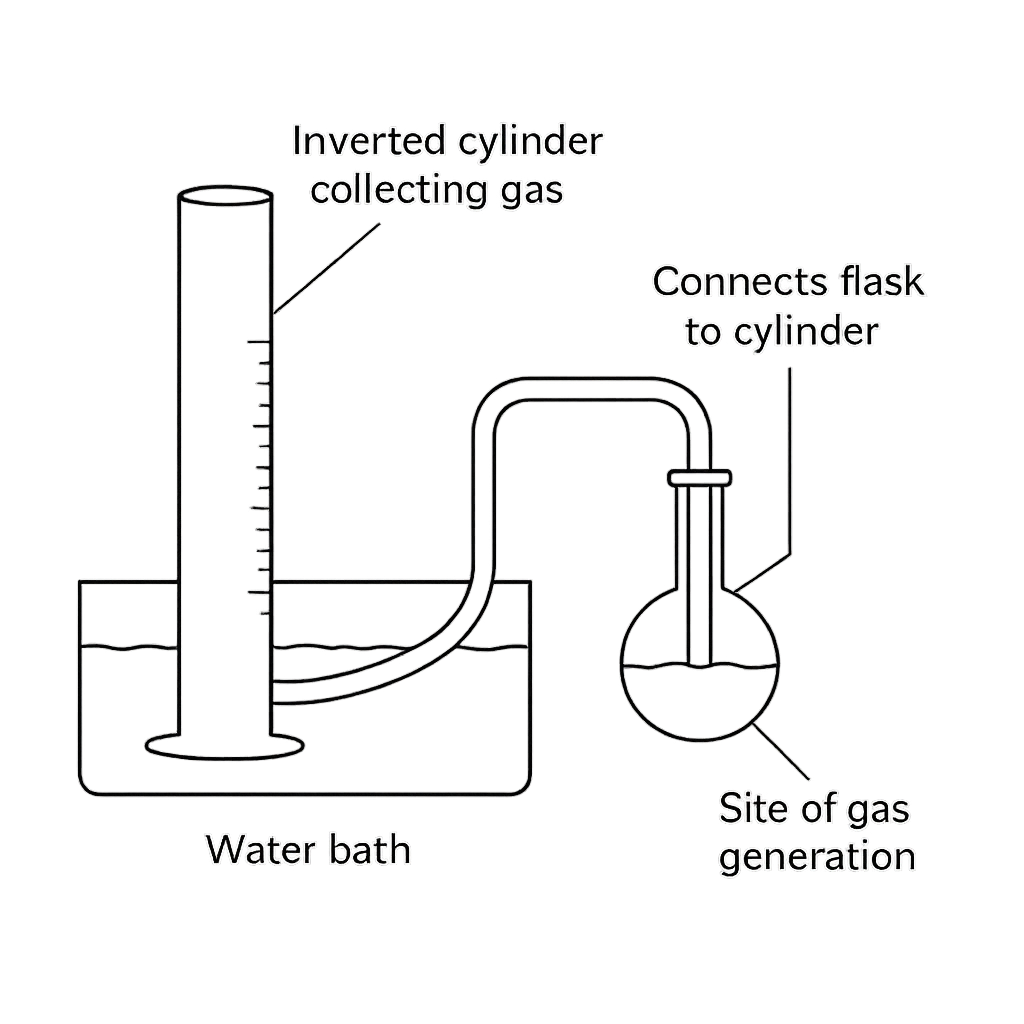
A gas‑evolution experiment is set up using the classic gas‑over‑water apparatus shown in the diagram. The graduated cylinder (inverted) reads a volume of 125 mL of gas collected at 25 °C. Atmospheric pressure is 760 mm Hg and the vapour pressure of water at 25 °C is 23.8 mm Hg. Calculate the number of moles of dry gas collected (to two significant figures).
A. 3.9×10⁻³ mol
B. 5.2×10⁻³ mol
Correct C. 4.9×10⁻³ mol
D. 4.5×10⁻³ mol

Correct Answer: C

Want to see the full step-by-step solution? Unlock AI Explanation & Analytics
Question 5 View Details
The solubility product of silver chloride at 25 °C is \(K_{sp}=1.8\times10^{-10}\). A solution is prepared by dissolving solid AgCl in 0.20 M NaCl.\n\n(a) Calculate the solubility of AgCl (in mol L⁻¹) in this solution.\n(b) If 0.50 g of solid AgCl is added to 250 mL of the same solution, will any solid remain undissolved? Justify your answer.
Correct A. Solubility = 9.0×10⁻¹⁰ mol L⁻¹; yes, solid will remain undissolved
B. Solubility = 1.3×10⁻⁵ mol L⁻¹; no, all solid will dissolve
C. Solubility = 9.0×10⁻⁸ mol L⁻¹; yes, solid will remain undissolved
D. Solubility = 9.0×10⁻¹⁰ mol L⁻¹; no, all solid will dissolve

Correct Answer: A

Want to see the full step-by-step solution? Unlock AI Explanation & Analytics
Question 6 View Details
A 14.6 g mixture of propane \(\ce{C3H8}\) and butane \(\ce{C4H10}\) is burnt completely in excess oxygen. The combustion produces 22.4 L of \(\ce{CO2}\) measured at STP. Given the molar masses \(M_{\text{C3H8}} = 44.1\ \text{g mol}^{-1}\) and \(M_{\text{C4H10}} = 58.1\ \text{g mol}^{-1}\), determine the mass of butane present in the mixture.
A. 6.5 g
Correct B. 8.3 g
C. 9.1 g
D. 7.2 g

Correct Answer: B

Want to see the full step-by-step solution? Unlock AI Explanation & Analytics
Question 7 View Details
At 30 °C the vapour pressures of n‑pentane (\(\ce{C5H12}\)) and isopentane (\(\ce{2‑methylbutane}\)) are 0.45 atm and 0.60 atm respectively. A liquid mixture of these two hydrocarbons exerts a total vapour pressure of 0.525 atm at the same temperature. Assuming the mixture behaves ideally, calculate the mole fraction of n‑pentane in the liquid phase.
Correct A. 0.50
B. 0.55
C. 0.60
D. 0.45

Correct Answer: A

Want to see the full step-by-step solution? Unlock AI Explanation & Analytics
Question 8 View Details
The vapour pressure of a liquid is 0.40 atm at 350 K and 0.80 atm at 380 K. Assuming the enthalpy of vapourisation remains constant over this temperature range, estimate the boiling point of the liquid at a pressure of 1.00 atm. (R = 8.314 J mol⁻¹ K⁻¹).
A. 405 K
B. 382 K
C. 418 K
Correct D. 391 K

Correct Answer: D

Want to see the full step-by-step solution? Unlock AI Explanation & Analytics
Question 9 View Details
In acidic solution the redox reaction \(\ce{MnO4^- + Fe^{2+} -> Mn^{2+} + Fe^{3+}}\) occurs. If 0.025 mol of \(\ce{MnO4^-}\) reacts completely with excess \(\ce{Fe^{2+}}\), calculate the volume of \(\ce{O2}\) (at STP) that could be liberated if the same total number of electrons were instead used to reduce \(\ce{O2}\) to water via \(\ce{O2 + 4 H+ + 4 e- -> 2 H2O}\).
A. 0.35 L
B. 1.05 L
Correct C. 0.70 L
D. 0.14 L

Correct Answer: C

Want to see the full step-by-step solution? Unlock AI Explanation & Analytics
Question 10 View Details
2.00 g of an unknown non‑volatile solid is dissolved in 100.0 g of benzene (\(K_b = 5.12\ \text{K kg mol}^{-1}\)). The boiling point of the solution is 80.5 °C, whereas pure benzene boils at 80.1 °C. Determine the molar mass of the solute.
Correct A. 256 g mol⁻¹
B. 320 g mol⁻¹
C. 210 g mol⁻¹
D. 180 g mol⁻¹

Correct Answer: A

Want to see the full step-by-step solution? Unlock AI Explanation & Analytics
Question 11 View Details
A 2.00 g sample of a solid mixture of NaCl and KCl contains 30.0\% Na by mass. Calculate the number of moles of KCl present in the sample. (Atomic masses: Na = 22.99 g mol\(^{-1}\), K = 39.10 g mol\(^{-1}\), Cl = 35.45 g mol\(^{-1}\).)
Correct A. 6.37e-3
B. 7.89e-3
C. 4.56e-3
D. 5.12e-3

Correct Answer: A

Want to see the full step-by-step solution? Unlock AI Explanation & Analytics
Question 12 View Details
A buffer solution contains 0.250 mol of acetic acid (CH\(_3\)COOH) and an unknown amount of sodium acetate. The pH of the buffer is 4.75. Given \(K_a = 1.8\times10^{-5}\) for acetic acid, calculate the mass of sodium acetate (NaCH\(_3\)COO) required to obtain this pH. (Molar mass NaCH\(_3\)COO = 82.03 g mol\(^{-1}\).)
A. 25.6
Correct B. 20.8
C. 15.3
D. 18.9

Correct Answer: B

Want to see the full step-by-step solution? Unlock AI Explanation & Analytics
Question 13 View Details
Five grams of magnesium metal react with excess hydrochloric acid according to \(\text{Mg} + 2\text{HCl} \rightarrow \text{MgCl}_2 + \text{H}_2\). The hydrogen gas is collected over water at 25\(^\circ\)C and a total pressure of 750 mmHg. The vapour pressure of water at this temperature is 23.8 mmHg. Determine the volume of dry \(\text{H}_2\) gas that would be measured at STP (0\(^\circ\)C, 1 atm).
A. 3.80
B. 4.20
Correct C. 4.60
D. 5.10

Correct Answer: C

Want to see the full step-by-step solution? Unlock AI Explanation & Analytics
Question 14 View Details
The solubility product of silver chloride at 25\(^\circ\)C is \(K_{sp}=1.8\times10^{-10}\). The enthalpy change for its dissolution is \(+15.0\) kJ mol\(^{-1}\). Estimate the value of \(K_{sp}\) at 35\(^\circ\)C. (Use \(R=8.314\) J mol\(^{-1}\) K\(^{-1}\).)
A. 2.8e-9
B. 3.0e-10
Correct C. 2.2e-10
D. 1.5e-10

Correct Answer: C

Want to see the full step-by-step solution? Unlock AI Explanation & Analytics
Question 15 View Details
A river with a flow rate of 2000 L s\(^{-1}\) receives a continuous discharge of wastewater that contains 0.050 mg L\(^{-1}\) of a pesticide. The pesticide undergoes first‑order degradation with a half‑life of 12 days. Assuming complete mixing at the point of discharge and that water travels 5 km downstream in 2 h, calculate the concentration of the pesticide 5 km downstream. Express your answer in µg L\(^{-1}\).
A. 50.0
B. 44.6
Correct C. 49.8
D. 99.5

Correct Answer: C

Want to see the full step-by-step solution? Unlock AI Explanation & Analytics
Question 16 View Details
A buffer solution is prepared by dissolving 0.500 mol of acetic acid ( \(K_a = 1.8 \times 10^{-5}\) ) and 0.300 mol of sodium acetate in 2.00 L of water. After the buffer is formed, 0.050 mol of HCl is added. Calculate the pH of the solution after the acid is added. Give your answer to two decimal places.
A. 5.20
B. 4.85
C. 4.10
Correct D. 4.40

Correct Answer: D

Want to see the full step-by-step solution? Unlock AI Explanation & Analytics
Question 17 View Details
A lake of volume \(5.0 \times 10^{6}\) L receives a continuous inflow of clean water at \(200\) L s\(^{-1}\) and has an equal outflow. The lake initially contains a dissolved pollutant at a concentration of \(10\) mg L\(^{-1}\). The pollutant undergoes first‑order decay with rate constant \(k = 0.001\) s\(^{-1}\). Assuming perfect mixing, determine the time required for the pollutant concentration to fall to \(2\) mg L\(^{-1}\). Give your answer in seconds to three significant figures.
A. 1.55e2
B. 1.20e3
Correct C. 1.55e3
D. 2.30e3

Correct Answer: C

Want to see the full step-by-step solution? Unlock AI Explanation & Analytics
Question 18 View Details
The solubility of silver chloride in pure water at \(25^{\circ}\)C is \(1.33 \times 10^{-5}\) mol L\(^{-1}\). When \(0.010\) mol L\(^{-1}\) sodium chloride is added to the solution, the solubility of AgCl decreases. Calculate the new solubility of AgCl in the sodium‑chloride solution. Express your answer in mol L\(^{-1}\) with two significant figures.
A. 3.0e-8
Correct B. 1.8e-8
C. 1.2e-8
D. 2.5e-8

Correct Answer: B

Want to see the full step-by-step solution? Unlock AI Explanation & Analytics
Question 19 View Details
The reaction \(2\,\text{Al} + 6\,\text{H}_2\text{O} \rightarrow 2\,\text{Al(OH)}_3 + 3\,\text{H}_2\) is carried out by mixing \(15.0\) g of aluminium with excess water. The hydrogen gas produced is collected at STP and its volume is measured as \(0.85\) L. Calculate the percent yield of hydrogen obtained in this experiment. Give your answer to one decimal place.
A. 3.1
B. 6.2
C. 5.8
Correct D. 4.6

Correct Answer: D

Want to see the full step-by-step solution? Unlock AI Explanation & Analytics
Question 20 View Details
Ethanoic acid reacts with ethanol in the presence of sulphuric acid according to the equilibrium \[\text{CH}_3\text{COOH} + \text{C}_2\text{H}_5\text{OH} \rightleftharpoons \text{CH}_3\text{COOC}_2\text{H}_5 + \text{H}_2\text{O}\] At \(25^{\circ}\)C the equilibrium constant \(K_c\) is \(4.0\). If initially \(0.20\) mol of ethanoic acid and \(0.30\) mol of ethanol are placed in a \(1.0\) L flask, calculate the equilibrium concentration of ethyl acetate. Give your answer in mol L\(^{-1}\) to three significant figures.
Correct A. 0.157
B. 0.183
C. 0.210
D. 0.124

Correct Answer: A

Want to see the full step-by-step solution? Unlock AI Explanation & Analytics
Question 21 View Details
A sample of 5.00 g of 2‑bromo‑2‑methylpropane (\(\mathrm{C_{4}H_{9}Br}\)) is reacted with excess aqueous NaOH. The substitution reaction produces tert‑butyl alcohol (\(\mathrm{C_{4}H_{10}O}\)), but 20 % of the substrate undergoes elimination to give isobutene. After work‑up, 1.80 g of tert‑butyl alcohol is isolated. Calculate the percentage yield of the alcohol.
A. 68 %
B. 75 %
Correct C. 83 %
D. 90 %

Correct Answer: C

Want to see the full step-by-step solution? Unlock AI Explanation & Analytics
Question 22 View Details
Two isomers of \(\mathrm{C_{4}H_{8}}\), namely 1‑butene (\(\mathrm{CH_{2}=CH‑CH_{2}‑CH_{3}}\)) and cyclobutane (a four‑membered ring of \(\mathrm{CH_{2}}\) groups), are combusted completely in oxygen according to the reaction \(\mathrm{C_{4}H_{8} + 6\,O_{2} \rightarrow 4\,CO_{2} + 4\,H_{2}O}\). Using the following average bond enthalpies (kJ·mol⁻¹): C-C 347, C=C 614, C-H 413, O=O 498, C=O 799, O-H 463, determine which isomer releases the greater amount of heat per gram of fuel.
A. cyclobutane
B. 2‑butene
C. isobutene
Correct D. 1‑butene

Correct Answer: D

Want to see the full step-by-step solution? Unlock AI Explanation & Analytics
Question 23 View Details
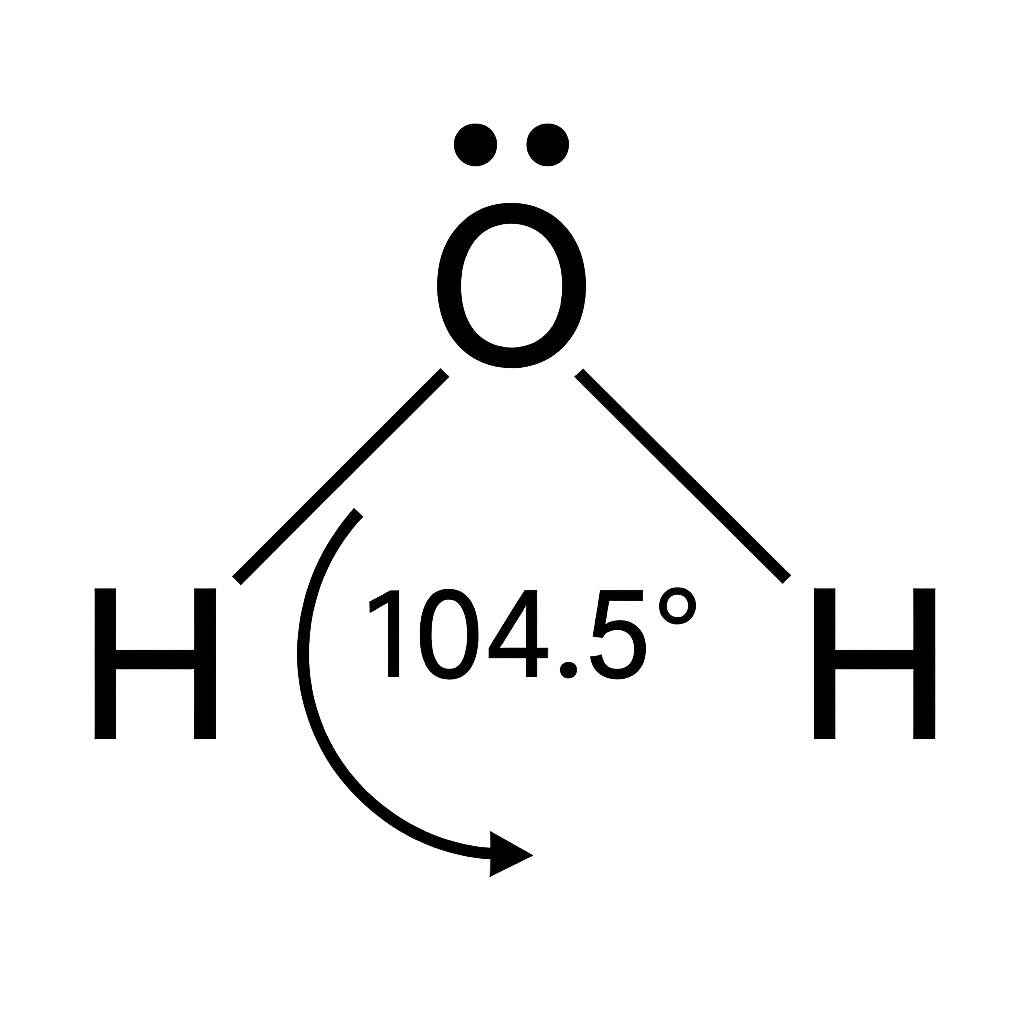
The diagram shows a water molecule. Identify the type of bond between the oxygen and hydrogen atoms, and state the molecular geometry around the oxygen atom.
A. Polar covalent bonds; tetrahedral geometry
B. Ionic bonds; trigonal planar geometry
C. Nonpolar covalent bonds; linear geometry
Correct D. Polar covalent bonds; bent (angular) geometry

Correct Answer: D

Want to see the full step-by-step solution? Unlock AI Explanation & Analytics
Question 24 View Details
A buffer solution is prepared by dissolving 0.20 mol of acetic acid (\(\mathrm{CH_{3}COOH}\), \(K_{a}=1.8\times10^{-5}\)) and 0.15 mol of sodium acetate (\(\mathrm{CH_{3}COONa}\)) in enough water to make 1.00 L of solution.\n(a) Calculate the initial pH of the buffer.\n(b) After adding 0.05 mol of HCl to the solution, calculate the new pH.
A. Initial pH ≈ 4.74; after HCl addition pH ≈ 4.50
B. Initial pH ≈ 4.30; after HCl addition pH ≈ 4.10
Correct C. Initial pH ≈ 4.62; after HCl addition pH ≈ 4.35
D. Initial pH ≈ 4.55; after HCl addition pH ≈ 4.20

Correct Answer: C

Want to see the full step-by-step solution? Unlock AI Explanation & Analytics
Question 25 View Details
Consider a galvanic cell constructed as Zn|Zn²⁺ (0.010 M) || Cu²⁺ (0.10 M) |Cu at 25 °C. Standard electrode potentials are \(E^{\circ}(\mathrm{Zn^{2+}/Zn}) = -0.76\,\text{V}\) and \(E^{\circ}(\mathrm{Cu^{2+}/Cu}) = +0.34\,\text{V}\).\n(a) Calculate the cell potential under the given conditions using the Nernst equation.\n(b) State which electrode functions as the anode and which as the cathode.
A. E_cell ≈ 0.96 V; anode = Zn electrode, cathode = Cu electrode
Correct B. E_cell ≈ 1.13 V; anode = Zn electrode, cathode = Cu electrode
C. E_cell ≈ 1.13 V; anode = Cu electrode, cathode = Zn electrode
D. E_cell ≈ 0.85 V; anode = Zn electrode, cathode = Cu electrode

Correct Answer: B

Want to see the full step-by-step solution? Unlock AI Explanation & Analytics

Master the Exam!

You've seen a preview, but there are thousands more questions plus AI tutor to break down complex solutions.

Unlock Full Access Available for Android & Windows
Help others prepare! Share this practice hub:
Chat with Support