gce model questions vol1 2020 biology | Essay

Prepare for your exams with gce model questions vol1 questions? Reviewing past/model questions is one of the most effective ways to guarantee a high score. This practice hub features authentic 2020 biology (Essay) questions designed to simulate the real exam environment.

Practice these randomly selected questions to test your readiness.
Question 1 View Details
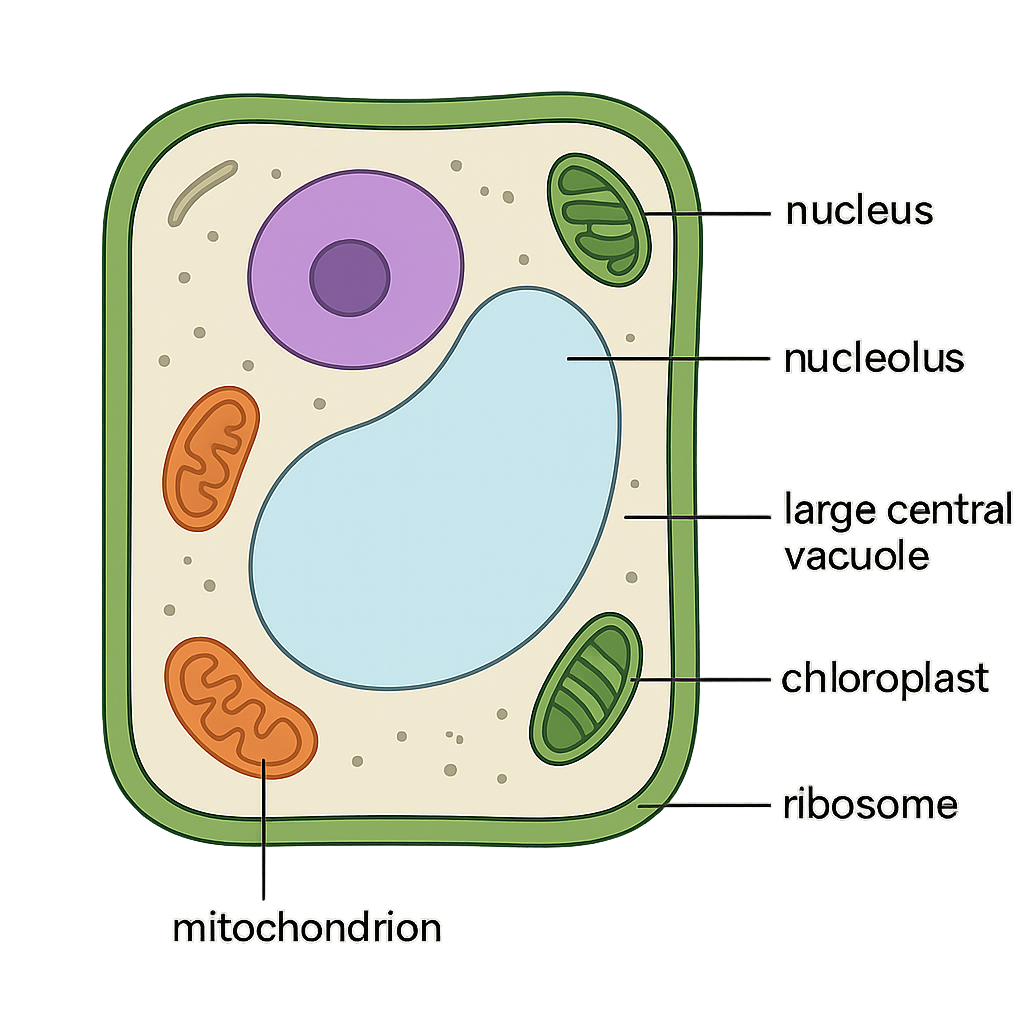
The diagram shows a typical plant cell with its major structures labelled.
Question Parts
(a)
Identify any three labelled organelles and state the principal function of each.
(b)
Explain how the structure of the cell wall enables it to perform its role in the plant cell.
(c)
Compare the plant cell shown with a typical animal cell, giving at least four structural differences and stating the functional significance of each difference.
Detailed Essay Solution & Marking Scheme Available

Get the step-by-step mathematical proofs, key points required by examiners, and a comprehensive breakdown from our AI Tutor.
Question 2 View Details
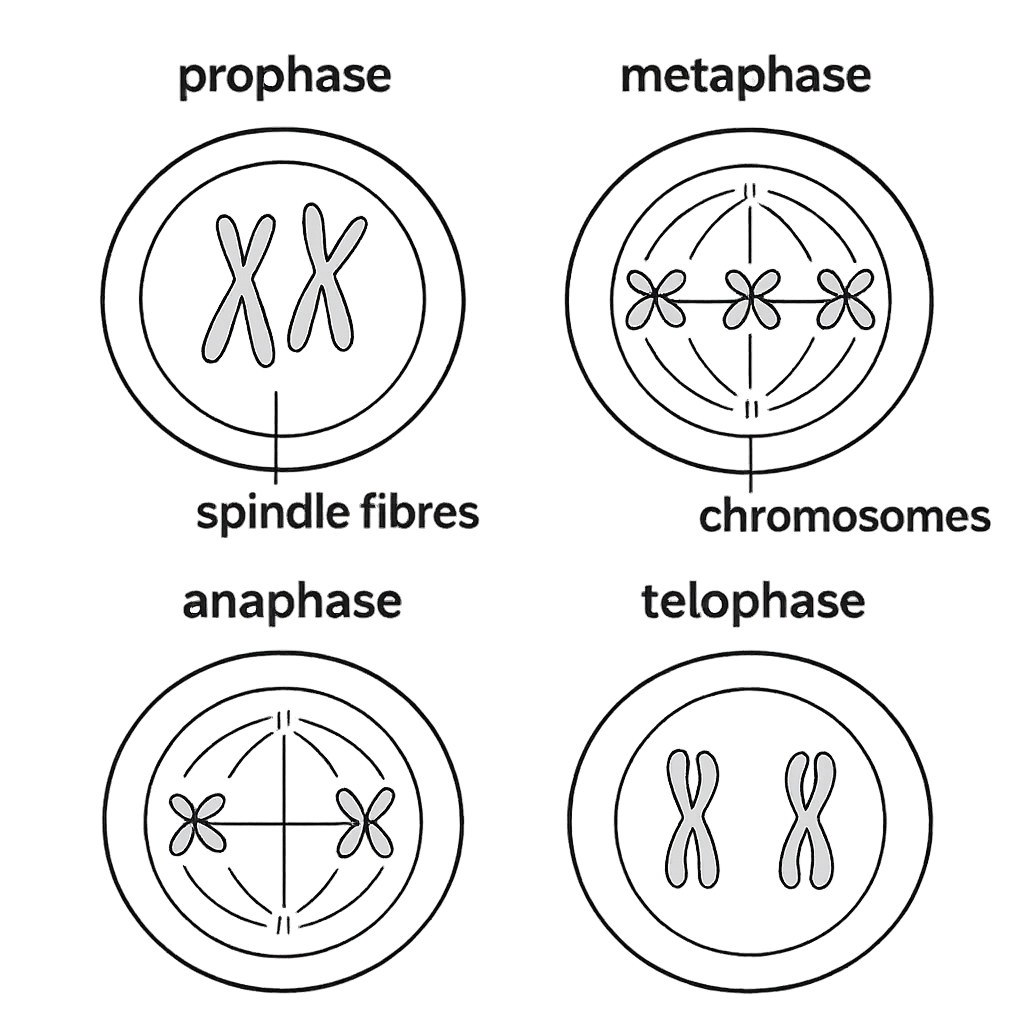
The labelled diagram depicts a eukaryotic cell undergoing mitosis.
Question Parts
(a)
State which stage of mitosis is illustrated in the diagram.
(b)
Describe the key events that occur during this stage.
(c)
Explain the significance of spindle fibres in ensuring accurate chromosome segregation.
(d)
Discuss two ways in which errors during mitosis can lead to disease in humans.
Detailed Essay Solution & Marking Scheme Available

Get the step-by-step mathematical proofs, key points required by examiners, and a comprehensive breakdown from our AI Tutor.
Question 3 View Details
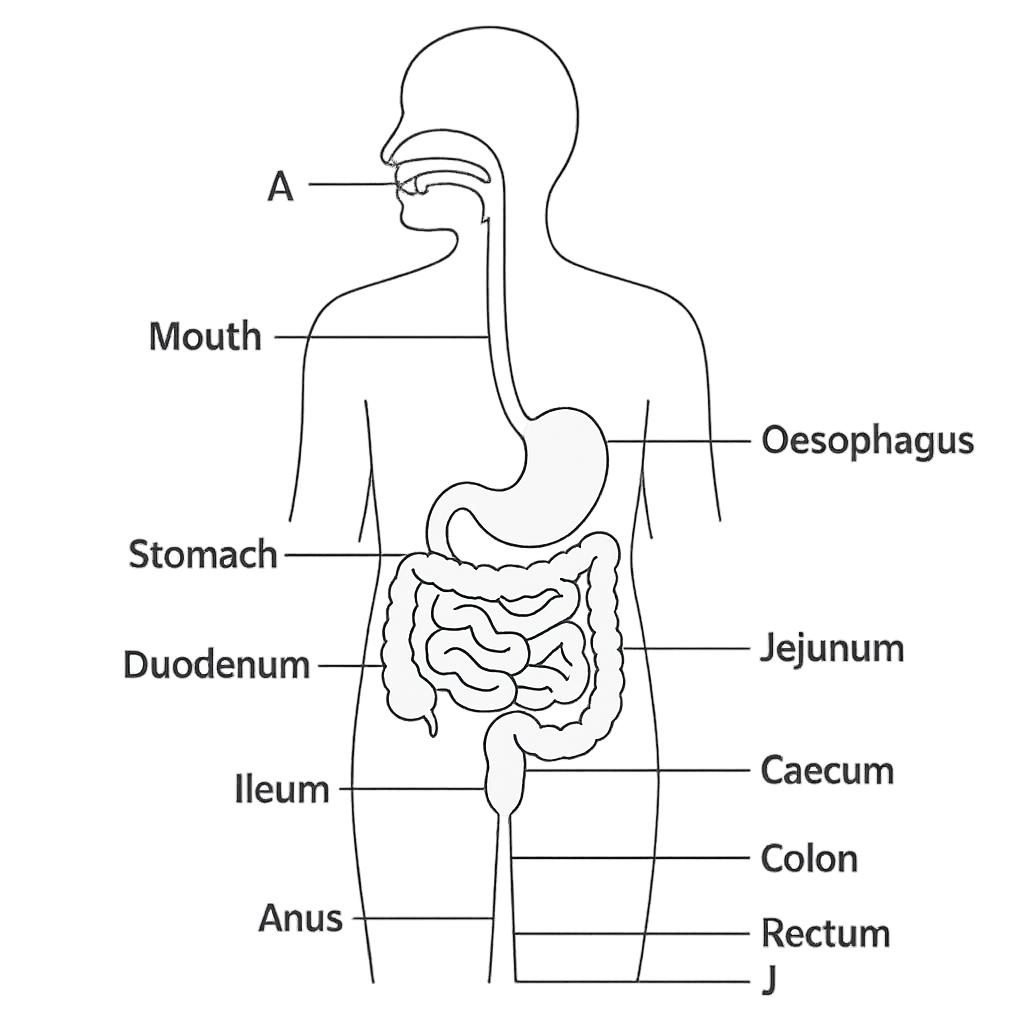
The labelled diagram shows the major parts of the human digestive system.
Question Parts
(a)
Describe the mechanical and chemical processes that occur in the mouth and stomach, and explain how they prepare food for absorption in the small intestine.
(b)
Identify, using the diagram, the region where most nutrient absorption occurs and discuss why its structure is especially suited to this function.
(c)
A dietitian advises a client to increase dietary fibre. Explain, with reference to the diagram, how higher fibre intake would affect the large intestine’s function and overall health.
(d)
The jejunum contains millions of villi that greatly increase its absorptive area.
() Calculate the approximate total surface area contributed by the villi, assuming each villus is a cylinder of length 0.5 mm and radius 0.05 mm, and there are about 10⁹ villi.
() Discuss how this large surface area benefits nutrient absorption.
Detailed Essay Solution & Marking Scheme Available

Get the step-by-step mathematical proofs, key points required by examiners, and a comprehensive breakdown from our AI Tutor.
Question 4 View Details
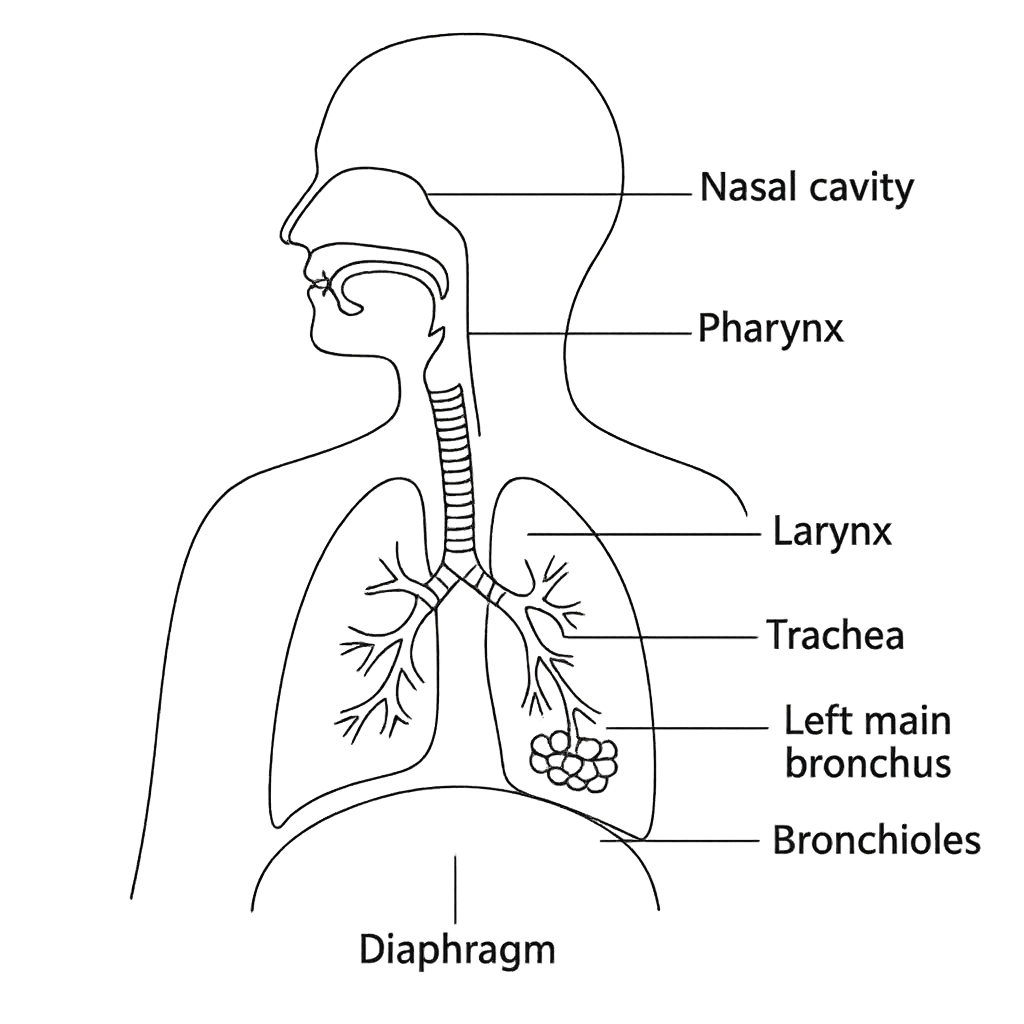
The diagram shows the human respiratory system with the parts labelled as follows: nasal cavity, pharynx, larynx, trachea, right main bronchus, left main bronchus, bronchioles, alveolar sacs and diaphragm.
Question Parts
(a)
Describe the complete pathway that a breath of air follows from the external environment to the alveoli, naming each structure it passes through.
(b)
Explain the mechanism of gas exchange at the alveolar‑capillary membrane, including the roles of partial pressure gradients and diffusion.
(c)
A patient suffers a blockage in the right main bronchus. Discuss the likely physiological consequences for ventilation and gas exchange, and suggest two clinical interventions that could restore airflow.
(d)
(i) Calculate the functional residual capacity (FRC) of a healthy adult whose total lung capacity (TLC) is 6.0 L and tidal volume (TV) is 0.5 L. (ii) If the same individual’s tidal volume falls to 0.3 L because of the bronchial blockage, assuming residual volume remains unchanged, determine the new FRC and comment on its clinical significance.
Detailed Essay Solution & Marking Scheme Available

Get the step-by-step mathematical proofs, key points required by examiners, and a comprehensive breakdown from our AI Tutor.

Question 5 View Details
A farmer in the northern region observes that his maize crop is wilting despite recent rainfall. He suspects that the plant's transport system is not functioning efficiently under the prevailing environmental conditions.
Question Parts
(a)
Explain the mechanisms by which water moves from the soil to the leaves in a typical vascular plant. In your answer, describe the roles of root pressure, capillary action, cohesion‑tension, and transpiration pull.
(b)
Identify three environmental factors that can reduce the efficiency of water transport in the farmer’s maize and suggest one practical management strategy for each factor to minimise wilting.
Detailed Essay Solution & Marking Scheme Available

Get the step-by-step mathematical proofs, key points required by examiners, and a comprehensive breakdown from our AI Tutor.

Question 6 View Details
A 55‑year‑old man has been diagnosed with hypertension. The physician explains that the kidneys play a central role in regulating blood pressure and prescribes a thiazide diuretic.
Question Parts
(a)
Describe the processes of glomerular filtration, tubular reabsorption and tubular secretion in the nephron, and explain how each contributes to the formation of urine.
(b)
Explain how the kidneys contribute to long‑term regulation of blood pressure, mentioning the renin‑angiotensin‑aldosterone system (RAAS).
(c)
Discuss the mechanism by which thiazide diuretics lower blood pressure, and state one important side‑effect that a clinician must monitor.
Detailed Essay Solution & Marking Scheme Available

Get the step-by-step mathematical proofs, key points required by examiners, and a comprehensive breakdown from our AI Tutor.

Question 7 View Details
Homeostasis is the maintenance of a stable internal environment despite external changes. Answer the following questions in detail.
Question Parts
(a)
Define negative feedback and illustrate the principle with a physiological example that is not temperature regulation.
(b)
Outline the neural and hormonal mechanisms that operate together to maintain core body temperature when a person is exposed to a cold environment.
(c)
Compare the strategies used by mammals and reptiles to maintain internal temperature, highlighting at least two advantages and two disadvantages of each strategy.
Detailed Essay Solution & Marking Scheme Available

Get the step-by-step mathematical proofs, key points required by examiners, and a comprehensive breakdown from our AI Tutor.

Question 8 View Details
Coordination enables the body to produce smooth, purposeful movements. Answer the following questions in detail.
Question Parts
(a)
Describe the structure of a simple spinal reflex arc and explain how it produces a rapid response to a painful stimulus.
(b)
Explain the role of the cerebellum in fine motor coordination, including how it integrates sensory information to modify ongoing movements.
(c)
A patient has suffered a lesion to the cerebellar vermis and shows impaired coordination. (i) Propose a simple experimental test that could be used in a clinical setting to assess this deficit. (ii) Predict the observations you would expect from the test.
() Propose a simple experimental test that could be used in a clinical setting to assess this deficit.
() Predict the observations you would expect from the test.
Detailed Essay Solution & Marking Scheme Available

Get the step-by-step mathematical proofs, key points required by examiners, and a comprehensive breakdown from our AI Tutor.

Question 9 View Details
A tropical plant species X can reproduce both sexually (by seed) and asexually (by vegetative off‑shoots). Over a 12‑month period the following observations were recorded: - Seeds produced each month (Jan–Dec): 120, 150, 200, 180, 160, 140, 130, 110, 100, 90, 80, 70. - Germination rate of the seeds = 60 %. - Survival rate of germinated seedlings to maturity = 40 %. - Vegetative off‑shoots produced each month (Jan–Dec): 30, 35, 40, 45, 50, 55, 60, 65, 70, 75, 80, 85. - Survival rate of off‑shoots to maturity = 80 %. - The initial adult population at the start of January was 200 mature individuals. Using the data above, answer the following: a) Determine the total number of new mature individuals that arise from sexual reproduction and from asexual reproduction during the 12‑month period. b) Calculate the net increase in the mature population after one year and give the final population size. c) Discuss two ecological advantages for species X in maintaining both reproductive modes. Then explain how a prolonged drought that sharply reduces seed production but does not affect off‑shoot formation might alter the relative contributions of the two modes to population growth.
Question Parts
(a)
Determine the total number of new mature individuals that arise from sexual reproduction and from asexual reproduction during the 12‑month period.
(b)
Calculate the net increase in the mature population after one year and give the final population size.
(c)
Discuss two ecological advantages for species X in maintaining both reproductive modes. Then explain how a prolonged drought that sharply reduces seed production but does not affect off‑shoot formation might alter the relative contributions of the two modes to population growth.
Detailed Essay Solution & Marking Scheme Available

Get the step-by-step mathematical proofs, key points required by examiners, and a comprehensive breakdown from our AI Tutor.

Question 10 View Details
In a certain species of fruit fly, two genes A and B are located on the same chromosome and are linked. The dominant alleles are A and B, the recessive alleles are a and b. The known recombination frequency between the loci is 12 %. A heterozygous individual of genotype AB/ab (cis configuration) is crossed with a homozygous recessive individual aa bb. Answer the following: a) List all possible gamete types produced by the heterozygote and give their expected frequencies. b) Using the gamete frequencies from (a), determine the phenotypic ratio expected among the progeny of the test cross. c) In an actual test cross, 200 offspring are obtained. 112 display the parental phenotypes (both dominant or both recessive) and 88 display recombinant phenotypes. Calculate the experimental recombination frequency and comment on what this indicates about the linkage of A and B. d) Briefly explain how crossing‑over during meiosis generates the recombinant gametes and why the experimentally observed recombination frequency may differ from the map distance of 12 %.
Question Parts
(a)
List all possible gamete types produced by the heterozygote and give their expected frequencies.
(b)
Using the gamete frequencies from (a), determine the phenotypic ratio expected among the progeny of the test cross.
Detailed Essay Solution & Marking Scheme Available

Get the step-by-step mathematical proofs, key points required by examiners, and a comprehensive breakdown from our AI Tutor.

Master the Exam!

You've seen a preview, but there are thousands more questions plus AI tutor to break down complex solutions.

Unlock Full Access Available for Android & Windows
Help others prepare! Share this practice hub:
Chat with Support