gce model questions vol1 2020 agricultural_science | Objective

Prepare for your exams with gce model questions vol1 questions? Reviewing past/model questions is one of the most effective ways to guarantee a high score. This practice hub features authentic 2020 agricultural_science (Objective) questions designed to simulate the real exam environment.

Practice these randomly selected questions to test your readiness.
Question 1 View Details
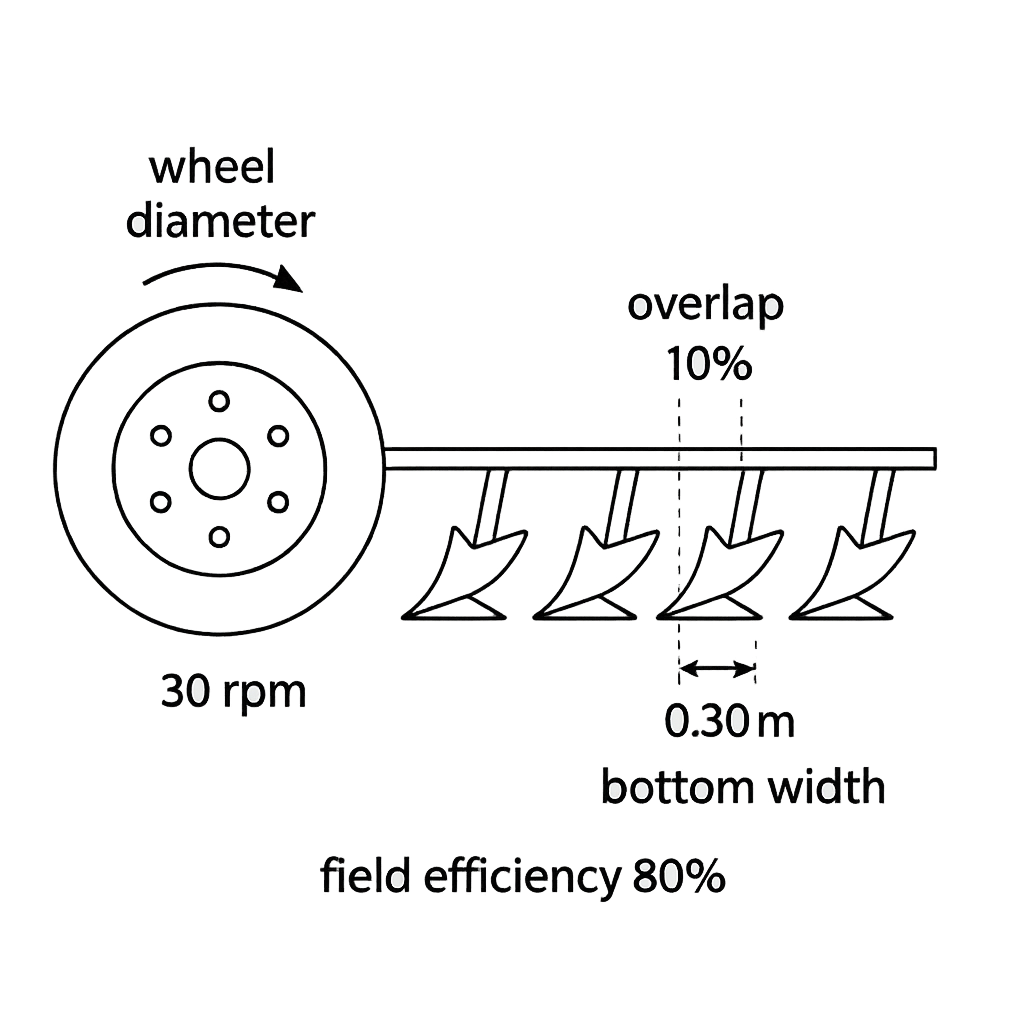
A tractor is shown in the diagram. The wheel diameter is \(0.80\) m and the wheel rotates at \(30\) rpm. The attached plough has four bottoms, each \(0.30\) m wide, but there is a \(10\%\) overlap between adjacent bottoms. The field efficiency is \(80\%\). Calculate the field capacity in hectares per hour.
A. 0.50 ha/h
B. 0.35 ha/h
C. 0.45 ha/h
Correct D. 0.40 ha/h

Correct Answer: D

Want to see the full step-by-step solution? Unlock AI Explanation & Analytics
Question 2 View Details
Two feeding regimes are used for broiler chickens over a 6‑week (42 day) rearing period.\nRegime A: each bird receives \(0.10\) kg feed per day at a cost of £\(0.30\) per kg, and the birds gain \(2.0\) kg live weight.\nRegime B: each bird receives \(0.12\) kg feed per day at a cost of £\(0.28\) per kg, and the birds gain \(2.2\) kg live weight.\nThe market price of live weight is £\(2.5\) per kg for both regimes. Calculate the net profit per bird for each regime and state which regime gives the higher profit and by how much.
A. Regime A gives higher profit by £0.10 per bird
B. Regime B gives higher profit by £0.20 per bird
Correct C. Regime B gives higher profit by £0.35 per bird
D. Regime A gives higher profit by £0.35 per bird

Correct Answer: C

Want to see the full step-by-step solution? Unlock AI Explanation & Analytics
Question 3 View Details
A goat farm starts with 30 does and 5 bucks. Each doe produces on average \(1.5\) kids per year. Kids survive to weaning at \(80\%\) in the first year and \(90\%\) in the second year. Adult goats suffer a \(5\%\) annual mortality rate. No culling is carried out. Estimate the total number of goats on the farm after two years.
A. 190 goats (approximately)
Correct B. 159 goats (approximately)
C. 175 goats (approximately)
D. 140 goats (approximately)

Correct Answer: B

Want to see the full step-by-step solution? Unlock AI Explanation & Analytics
Question 4 View Details
A water pump requires a mechanical power of \(15\) kW at \(1500\) rpm. It is driven by a belt from a tractor PTO that runs at \(540\) rpm. The belt drive has an efficiency of \(90\%\) and the gear reduction from PTO to pump is \(3:1\). The PTO itself operates at \(95\%\) efficiency and the tractor engine has a mechanical efficiency of \(85\)\%. Determine the minimum engine power (in kW) that the tractor must be capable of delivering.
A. 24.0 kW (approximately)
B. 22.5 kW (approximately)
Correct C. 20.6 kW (approximately)
D. 18.4 kW (approximately)

Correct Answer: C

Want to see the full step-by-step solution? Unlock AI Explanation & Analytics
Question 5 View Details
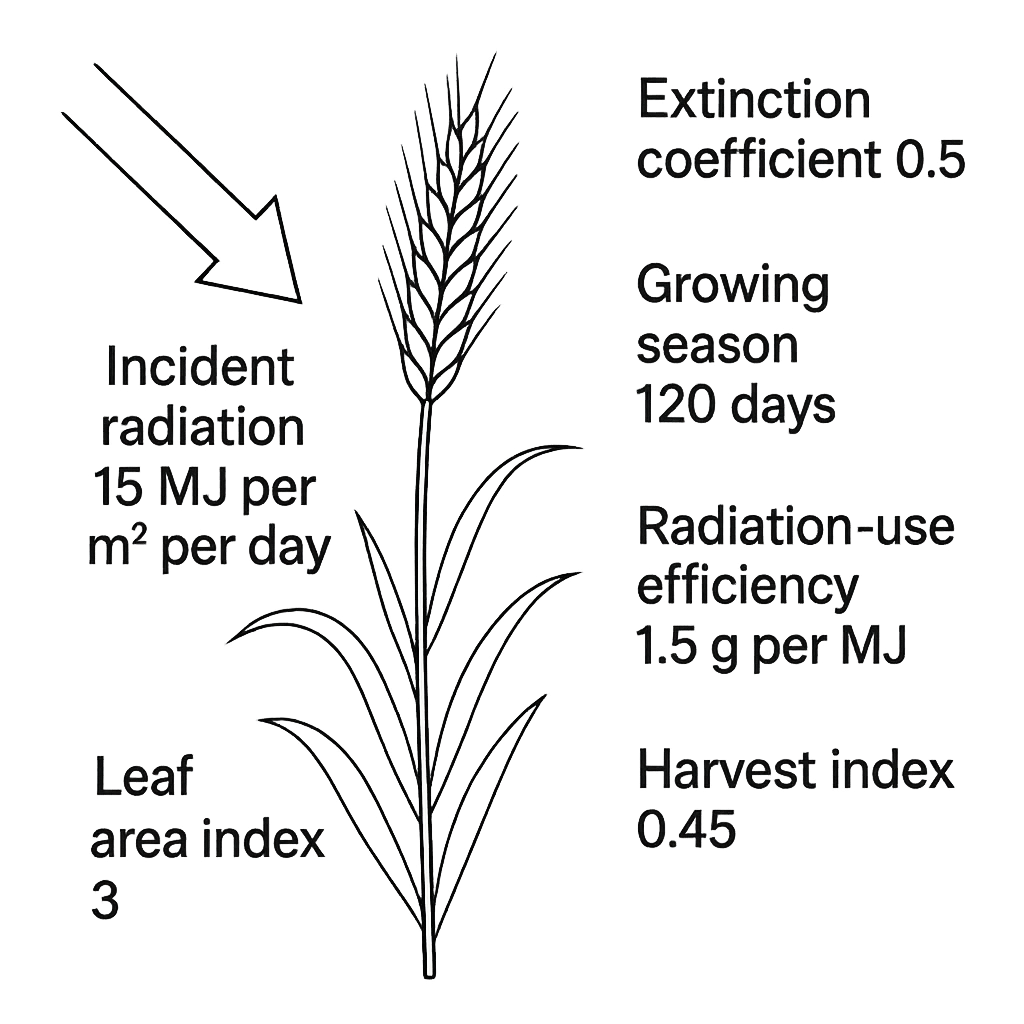
The diagram shows a wheat crop canopy with a leaf‑area index (LAI) of \(3\). The extinction coefficient for the canopy is \(k = 0.5\). Incident solar radiation is \(15\) MJ m⁻² day⁻¹ and the growing season lasts \(120\) days. The radiation‑use efficiency (RUE) of wheat is \(1.5\) g MJ⁻¹ and the harvest index is \(0.45\). Estimate the grain yield in tonnes per hectare.
Correct A. 9.4 t/ha (approximately)
B. 5.8 t/ha (approximately)
C. 7.2 t/ha (approximately)
D. 11.0 t/ha (approximately)

Correct Answer: A

Want to see the full step-by-step solution? Unlock AI Explanation & Analytics
Question 6 View Details
A farmer converts 2 ha of pasture to arable land. The pasture originally stores carbon at a rate of \(12\ \text{t C ha}^{-1}\). After conversion, the 2 ha now store carbon at \(8\ \text{t C ha}^{-1}\), while the remaining 3 ha of pasture retain the original rate. What is the total loss of carbon (in tonnes) due to the conversion?
A. 6
Correct B. 8
C. 10
D. 12

Correct Answer: B

Want to see the full step-by-step solution? Unlock AI Explanation & Analytics
Question 7 View Details
Two tree species are considered for a commercial forest. Species A reaches a merchantable volume of \(200\ \text{m}^3\) at age 30 years and then its volume declines by 2 % per year. Species B reaches \(180\ \text{m}^3\) at age 25 years and thereafter its volume remains constant. Timber sells for \$50 per m³ and the discount rate is 5 % per annum. Assuming the trees are harvested at the age that maximises the present value of the timber, which species provides the higher present value?
A. Species A
B. Both species
C. Neither species
Correct D. Species B

Correct Answer: D

Want to see the full step-by-step solution? Unlock AI Explanation & Analytics
Question 8 View Details
A wheat farmer faces the following cost and price functions (\(Q\) in tonnes): Fixed cost = \$12 000 per season; variable cost per tonne = \(150\; -\;0.02Q\); market price per tonne = \(300\; -\;0.1Q\). Determine the output level \(Q\) (to the nearest whole tonne) that maximises profit and state the corresponding maximum profit (to the nearest dollar).
A. 925 tonnes; $57,800
Correct B. 938 tonnes; $58,313
C. 930 tonnes; $56,900
D. 940 tonnes; $59,100

Correct Answer: B

Want to see the full step-by-step solution? Unlock AI Explanation & Analytics
Question 9 View Details
A soil sample contains 2 % organic matter and 20 % clay. The cation‑exchange capacity (CEC) contributed by organic matter is 0.5 cmolc kg⁻¹ per percent organic matter, and that contributed by clay is 0.2 cmolc kg⁻¹ per percent clay. Estimate the total CEC of the soil (in cmolc kg⁻¹).
A. 6.0
B. 4.6
C. 5.4
Correct D. 5.0

Correct Answer: D

Want to see the full step-by-step solution? Unlock AI Explanation & Analytics
Question 10 View Details
A farmer wishes to plant maize with a row spacing of 75 cm and an intra‑row spacing of 25 cm. The recommended seed rate for 100 % germination at this spacing is 25 kg ha⁻¹. If the seed germination rate is only 85 %, how many kilograms of seed per hectare should the farmer purchase to achieve the target spacing?
A. 24.5
B. 28.0
Correct C. 29.4
D. 30.0

Correct Answer: C

Want to see the full step-by-step solution? Unlock AI Explanation & Analytics
Question 11 View Details
On a cattle farm of 200 animals, a disease occurs at an incidence of \(5\%\) per year if no control is applied. A vaccine reduces the incidence by \(60\%\) and costs \(\text{₦}15\) per animal per year. An alternative biosecurity measure reduces the incidence by \(40\%\) and costs \(\text{₦}8\) per animal per year. Treatment of an infected animal costs \(\text{₦}200\). Assuming the incidence after control is applied uniformly across the herd, which control method gives the lower expected total cost per animal per year? State the method.
A. No control
B. Vaccine
C. Both methods
Correct D. Biosecurity measure

Correct Answer: D

Want to see the full step-by-step solution? Unlock AI Explanation & Analytics
Question 12 View Details
Feed A contains \(20\%\) protein and costs $0.30 per kg. Feed B contains \(35\%\) protein and costs $0.45 per kg. A goat herd requires exactly 120 kg of protein per day. At most 400 kg of Feed A can be purchased each day. Determine the least‑cost combination of Feed A and Feed B that meets the protein requirement, and give the total daily cost (to two decimal places).
A. Use Feed A and Feed B; total cost = $160.00 per day
Correct B. Use only Feed B; total cost = $154.29 per day
C. Use only Feed B; total cost = $150.00 per day
D. Use only Feed A; total cost = $120.00 per day

Correct Answer: B

Want to see the full step-by-step solution? Unlock AI Explanation & Analytics
Question 13 View Details
Which process in the nitrogen cycle converts ammonium (NH₄⁺) to nitrate (NO₃⁻) in aerobic soils? Provide the name of the process.
A. nitrogen fixation
Correct B. nitrification
C. denitrification
D. ammonification

Correct Answer: B

Want to see the full step-by-step solution? Unlock AI Explanation & Analytics
Question 14 View Details
Weight loss of mangoes during storage is described by \(R(T)=0.02\,e^{0.1T}\) % per day, where \(T\) is the storage temperature in °C (5 ≤ T ≤ 20). The daily probability of spoilage is \(S(T)=0.005\,(T-5)\). The economic loss is $0.10 per % weight loss per kg and $1 per kg of spoiled fruit. For a 1000 kg batch, the total expected daily loss is \(L(T)=100\,R(T)+1000\,S(T)\). Determine the temperature that minimises \(L(T)\) and compute the minimum loss (to two decimal places).
A. 15 °C; minimum loss = $6.20 per day
Correct B. 5 °C; minimum loss = $3.30 per day
C. 10 °C; minimum loss = $4.50 per day
D. 20 °C; minimum loss = $9.80 per day

Correct Answer: B

Want to see the full step-by-step solution? Unlock AI Explanation & Analytics
Question 15 View Details
Fish in a lake follow logistic growth \(\frac{dN}{dt}=rN\left(1-\frac{N}{K}\right)\) with intrinsic rate \(r=0.4\) yr\(^{-1}\) and carrying capacity \(K=20\,000\) fish.\n\n(a) Calculate the maximum sustainable yield (MSY) and the equilibrium population size at MSY.\n\n(b) If the fishery harvests 3000 fish per year, determine the equilibrium population size and state whether the harvest is sustainable.
Correct A. MSY = 2000 fish/yr, equilibrium at MSY = 10 000 fish; harvest of 3000 fish/yr gives no positive equilibrium - unsustainable
B. MSY = 1500 fish/yr, equilibrium at MSY = 10 000 fish; harvest of 3000 fish/yr gives no positive equilibrium - unsustainable
C. MSY = 2500 fish/yr, equilibrium at MSY = 12 000 fish; harvest of 3000 fish/yr gives a positive equilibrium - sustainable
D. MSY = 2000 fish/yr, equilibrium at MSY = 8 000 fish; harvest of 3000 fish/yr gives a positive equilibrium - sustainable

Correct Answer: A

Want to see the full step-by-step solution? Unlock AI Explanation & Analytics
Question 16 View Details
An inland fishery follows logistic growth with intrinsic rate (r = 0.5\ \text{yr}^{-1}\) and carrying capacity (K = 20\,000\) fish. The current constant annual harvest is (H_{0} = 2\,000\) fish. (a) Determine the equilibrium stock size \(N_{eq}\) under this harvest. (b) A management measure reduces the harvest by 20 % (so the new harvest is \(H_{1} = 0.8 H_{0}\)). Find the new equilibrium stock \(N'_{eq}\). (c) Is the new equilibrium at least 75 % of the carrying capacity? Answer "Yes" or "No".
A. 14 000 fish; 16 500 fish; No
Correct B. 14 472 fish; 16 000 fish; Yes
C. 14 800 fish; 15 500 fish; No
D. 13 800 fish; 15 200 fish; No

Correct Answer: B

Want to see the full step-by-step solution? Unlock AI Explanation & Analytics
Question 17 View Details
Disease severity on a wheat crop was recorded at four times: week 0 = 5 %, week 2 = 20 %, week 4 = 45 %, week 6 = 70 %. (a) Calculate the area under the disease progress curve (AUDPC) using the trapezoidal method. (b) If a fungicide reduces the severity at each observation by 30 % (i.e., multiplies each percentage by 0.7), compute the new AUDPC. (c) What is the percentage reduction in AUDPC caused by the fungicide? Give your answer to the nearest whole percent.
Correct A. 30 %
B. 40 %
C. 35 %
D. 25 %

Correct Answer: A

Want to see the full step-by-step solution? Unlock AI Explanation & Analytics
Question 18 View Details
A farm comprises three land types: 40 ha of forest that sequesters 2.5 t C ha\(^{-1}\) yr\(^{-1}\), 30 ha of grassland sequestering 1.2 t C ha\(^{-1}\) yr\(^{-1}\), and 20 ha of cultivated land sequestering 0.5 t C ha\(^{-1}\) yr\(^{-1}\). (a) Calculate the total carbon sequestered by the whole farm each year (in tonnes). (b) What percentage of the total sequestration is contributed by the forest? Give your answer to one decimal place.
A. 144 t; 68.0 %
Correct B. 146 t; 68.5 %
C. 146 t; 70.0 %
D. 150 t; 66.7 %

Correct Answer: B

Want to see the full step-by-step solution? Unlock AI Explanation & Analytics
Question 19 View Details
A tractor travels at a constant speed of 5 km h\(^{-1}\) in a field. Its wheels have a diameter of 1.2 m. (a) Determine the wheel revolutions per minute. (b) If the implement attached has a working width of 2.5 m and a field efficiency of 90 % (i.e., 10 % overlap loss), calculate the theoretical field capacity in hectares per hour. Give wheel rev to one decimal place and capacity to two decimal places.
Correct A. 22.1 rpm; 1.13 ha h^{-1}
B. 22.1 rpm; 1.00 ha h^{-1}
C. 24.0 rpm; 1.20 ha h^{-1}
D. 20.5 rpm; 1.05 ha h^{-1}

Correct Answer: A

Want to see the full step-by-step solution? Unlock AI Explanation & Analytics
Question 20 View Details
A farmer wishes to apply per hectare: 120 kg N, 60 kg P\(_2\)O\(_5\), and 40 kg K\(_2\)O. He has a blended fertilizer containing 20 % N, 10 % P\(_2\)O\(_5\), and 15 % K\(_2\)O (by weight). (a) How many kilograms of this fertilizer can be applied per hectare without exceeding the K\(_2\)O requirement? (b) Based on that amount, how much nitrogen will actually be supplied? Round the fertilizer amount to the nearest kilogram and the nitrogen supplied to one decimal place.
A. 260 kg ha^{-1}; 52.0 kg N ha^{-1}
Correct B. 267 kg ha^{-1}; 53.3 kg N ha^{-1}
C. 267 kg ha^{-1}; 53.4 kg N ha^{-1}
D. 268 kg ha^{-1}; 53.6 kg N ha^{-1}

Correct Answer: B

Want to see the full step-by-step solution? Unlock AI Explanation & Analytics
Question 21 View Details
A tractor is to pull a plough that requires a draft force of 12 kN on level ground. When moving up a 5 % slope, the required force increases by 10 % due to the grade. The tractor's drivetrain efficiency is 80 %. It will travel at a constant speed of \(5\ \text{km h}^{-1}\). Calculate the minimum engine power in kilowatts (kW) that must be developed to maintain this speed up the slope.
Correct A. 22.9 kW
B. 18.7 kW
C. 25.3 kW
D. 20.5 kW

Correct Answer: A

Want to see the full step-by-step solution? Unlock AI Explanation & Analytics
Question 22 View Details
A forest of 1000 ha is divided into 10 ha blocks arranged in a 10 × 10 grid. In any given year each block has an independent probability of 0.02 of becoming infected by a pest. If a block is infected, each of its orthogonal neighbouring blocks (sharing a side) has a 0.30 probability of becoming infected in the following year. Assuming infections persist once they occur and no control measures are applied, what is the expected number of blocks that will be infected after three years? Give your answer to one decimal place.
Correct A. 14.6
B. 12.3
C. 10.5
D. 16.8

Correct Answer: A

Want to see the full step-by-step solution? Unlock AI Explanation & Analytics
Question 23 View Details
An extension officer plans a training programme for 120 farmers. The fixed cost per session is ₦50 000 and the variable cost per farmer is ₦2 000. Each farmer is expected to increase his maize yield by 1.5 tonnes, and the market price of maize is ₦150 per kilogram. Adoption of the new practice follows the logistic model \(A = \frac{1}{1+e^{-k(x-x_{0})}}\) where \(x\) is the number of training days attended (maximum 3 days), \(k = 1.5\) and \(x_{0}=1.5\). On average each farmer attends 2 days. Assuming only the proportion \(A\) of farmers realise the yield increase, calculate the net economic benefit (total additional profit minus programme costs) in Nigerian Naira, rounding to the nearest thousand naira.
A. ₦17 500 000
Correct B. ₦18 043 000
C. ₦19 200 000
D. ₦15 800 000

Correct Answer: B

Want to see the full step-by-step solution? Unlock AI Explanation & Analytics
Question 24 View Details
A tractor engine runs at 2400 rpm. The power‑take‑off (PTO) must operate at 540 rpm. The transmission uses two gear stages in series. The first stage can be set to a reduction ratio of either 1.5 : 1, 2 : 1 or 2.5 : 1, and the second stage can be set to 2 : 1, 2.5 : 1 or 3 : 1. Choose a combination of the two stages that gives a PTO speed within ±2 % of the required 540 rpm, and state the resulting PTO speed (to the nearest rpm).
A. 527 rpm
Correct B. 533 rpm
C. 549 rpm
D. 540 rpm

Correct Answer: B

Want to see the full step-by-step solution? Unlock AI Explanation & Analytics
Question 25 View Details
A farmer intends to cultivate maize on 8 ha. Variable costs amount to ₦120 000 per hectare, while fixed overheads are ₦250 000. The expected market price is ₦80 per kilogram. To achieve a profit margin of at least 20 % on total revenue, what is the minimum average yield per hectare (in tonnes) that must be obtained? Give your answer to two decimal places.
Correct A. 2.36 tonnes/ha
B. 2.70 tonnes\/ha
C. 2.50 tonnes\/ha
D. 2.20 tonnes\/ha

Correct Answer: A

Want to see the full step-by-step solution? Unlock AI Explanation & Analytics

Master the Exam!

You've seen a preview, but there are thousands more questions plus AI tutor to break down complex solutions.

Unlock Full Access Available for Android & Windows
Help others prepare! Share this practice hub:
Chat with Support