gce model questions vol1 2019 biology | Objective

Prepare for your exams with gce model questions vol1 questions? Reviewing past/model questions is one of the most effective ways to guarantee a high score. This practice hub features authentic 2019 biology (Objective) questions designed to simulate the real exam environment.

Practice these randomly selected questions to test your readiness.

Question 1 View Details
An unknown photosynthetic eukaryote exhibits the following traits: (i) cells have cellulose cell walls, (ii) chloroplasts contain chlorophyll a and b, (iii) stores carbohydrate as starch, (iv) undergoes alternation of generations with a dominant sporophyte, (v) possesses vascular tissue with xylem containing tracheids, and (vi) reproduces via seeds. Using the standard plant taxonomic hierarchy, determine the most specific taxonomic rank (kingdom, division, class, order or family) that can be assigned with confidence to this organism.
A. Class Bryopsida
B. Class Magnoliopsida
C. Class Liliopsida
Correct D. Class Pinopsida

Correct Answer: D

Want to see the full step-by-step solution? Unlock AI Explanation & Analytics
Question 2 View Details
In a grassland ecosystem the measured gross primary productivity (GPP) is \(1500\ \text{g C m}^{-2}\text{ yr}^{-1}\). Autotrophic respiration consumes \(60\%\) of GPP. Herbivores eat \(30\%\) of the net primary production (NPP). The remaining organic matter is decomposed, and \(80\%\) of that remainder is returned to the atmosphere as CO\(_2\) by heterotrophic respiration. Calculate (a) the percentage of the original GPP that is transferred to herbivores and (b) the percentage of the original GPP that is ultimately released to the atmosphere as CO\(_2\) (including both autotrophic and heterotrophic respiration).
A. 10% to herbivores; 85.6% to atmosphere
B. 15% to herbivores; 78.0% to atmosphere
C. 12% to herbivores; 80.0% to atmosphere
Correct D. 12% to herbivores; 82.4% to atmosphere

Correct Answer: D

Want to see the full step-by-step solution? Unlock AI Explanation & Analytics
Question 3 View Details
A contagious disease has a basic reproduction number \(R_{0}=3.5\). A vaccine available for the disease is \(85\%\) effective at preventing infection.\n(a) What minimum proportion of the total population must be vaccinated to achieve herd immunity?\n(b) If only \(60\%\) of the population is willing to be vaccinated, calculate the effective reproduction number \(R_{e}\) after vaccination.
Correct A. 84% of the population must be vaccinated; with 60% coverage, Re ≈ 1.72
B. 78% of the population must be vaccinated; with 60% coverage, Re ≈ 2.10
C. 80% of the population must be vaccinated; with 60% coverage, Re ≈ 1.85
D. 90% of the population must be vaccinated; with 60% coverage, Re ≈ 1.55

Correct Answer: A

Want to see the full step-by-step solution? Unlock AI Explanation & Analytics
Question 4 View Details
In pea plants two linked genes are considered: gene \(A\) (tall \(A\) vs dwarf \(a\)) and gene \(B\) (purple flowers \(B\) vs white flowers \(b\)). The parental plant is heterozygous in cis configuration \(AB/ab\) and is test‑crossed with a homozygous recessive \(ab/ab\) plant. The recombination frequency between \(A\) and \(B\) is \(12\%\). Determine the expected phenotypic ratio among the progeny for the four possible phenotypes: tall‑purple, tall‑white, dwarf‑purple and dwarf‑white.
A. 25:25:0:0 (i.e., 50% tall‑purple, 50% dwarf‑white, 0% tall‑white, 0% dwarf‑purple)
Correct B. 22:22:3:3 (i.e., 44% tall‑purple, 44% dwarf‑white, 6% tall‑white, 6% dwarf‑purple)
C. 20:20:5:5 (i.e., 40% tall‑purple, 40% dwarf‑white, 10% tall‑white, 10% dwarf‑purple)
D. 24:24:2:2 (i.e., 48% tall‑purple, 48% dwarf‑white, 4% tall‑white, 4% dwarf‑purple)

Correct Answer: B

Want to see the full step-by-step solution? Unlock AI Explanation & Analytics
Question 5 View Details
A cell maintains an intracellular potassium concentration of \(150\ \text{mM}\) and an extracellular concentration of \(5\ \text{mM}\). The membrane potential is \(-70\ \text{mV}\) (inside negative).\n(a) Calculate the equilibrium potential for K\(^+\) at \(25^{\circ}\text{C}\) using the Nernst equation.\n(b) State whether K\(^+\) would tend to move into or out of the cell spontaneously.\n(c) The Na\(^+\)/K\(^+\)‑ATPase moves 3 Na\(^+\) out and 2 K\(^+\) in per molecule of ATP hydrolysed. Assuming the standard free energy change for ATP hydrolysis is \(-30.5\ \text{kJ mol}^{-1}\), compute the net free‑energy change per mole of ATP when the pump moves the two K\(^+\) ions against their electrochemical gradient. Indicate if the pump can operate spontaneously.
A. EK ≈ -60 mV; K⁺ tends to enter the cell; net ΔG per ATP ≈ -15 kJ·mol⁻¹ (pump operates spontaneously)
Correct B. EK ≈ -87 mV; K⁺ tends to leave the cell; net ΔG per ATP ≈ -27 kJ·mol⁻¹ (pump operates spontaneously)
C. EK ≈ -30 mV; K⁺ tends to leave the cell; net ΔG per ATP ≈ -27 kJ·mol⁻¹ (pump operates spontaneously)
D. EK ≈ -100 mV; K⁺ tends to leave the cell; net ΔG per ATP ≈ +5 kJ·mol⁻¹ (pump does not operate spontaneously)

Correct Answer: B

Want to see the full step-by-step solution? Unlock AI Explanation & Analytics
Question 6 View Details
In the regulation of blood glucose, pancreatic β‑cells secrete insulin at a rate \(R = a\,(G - G_{\text{thr}})\) when the blood glucose concentration \(G\) exceeds the threshold \(G_{\text{thr}} = 5\) mmol L⁻¹. Insulin increases glucose uptake by tissues at a rate \(U = b\,R\). At steady state the glucose production rate \(P\) equals the uptake \(U\). Given \(a = 1\) µU L⁻¹ min⁻¹ per mmol L⁻¹, \(b = 0.5\) mmol L⁻¹ per µU min⁻¹, \(P = 1\) mmol L⁻¹ min⁻¹ and the measured steady‑state glucose concentration is \(7\) mmol L⁻¹, a drug reduces the sensitivity \(a\) by 25 %. Assuming \(P\) remains unchanged, calculate the new steady‑state glucose concentration (to two decimal places).
A. 6.33 mmol/L
B. 8.00 mmol/L
Correct C. 7.67 mmol/L
D. 7.00 mmol/L

Correct Answer: C

Want to see the full step-by-step solution? Unlock AI Explanation & Analytics
Question 7 View Details
A muscle cell and a liver cell are both eukaryotic. Which organelle is expected to be present in higher numbers in the muscle cell, and what is the primary reason for this difference?
Correct A. Mitochondria; because muscle cells need large amounts of ATP for contraction
B. Lysosomes; because muscle cells require more degradation of cellular waste
C. Endoplasmic reticulum; because muscle cells need increased calcium storage
D. Ribosomes; because muscle cells synthesize more proteins for contraction

Correct Answer: A

Want to see the full step-by-step solution? Unlock AI Explanation & Analytics
Question 8 View Details
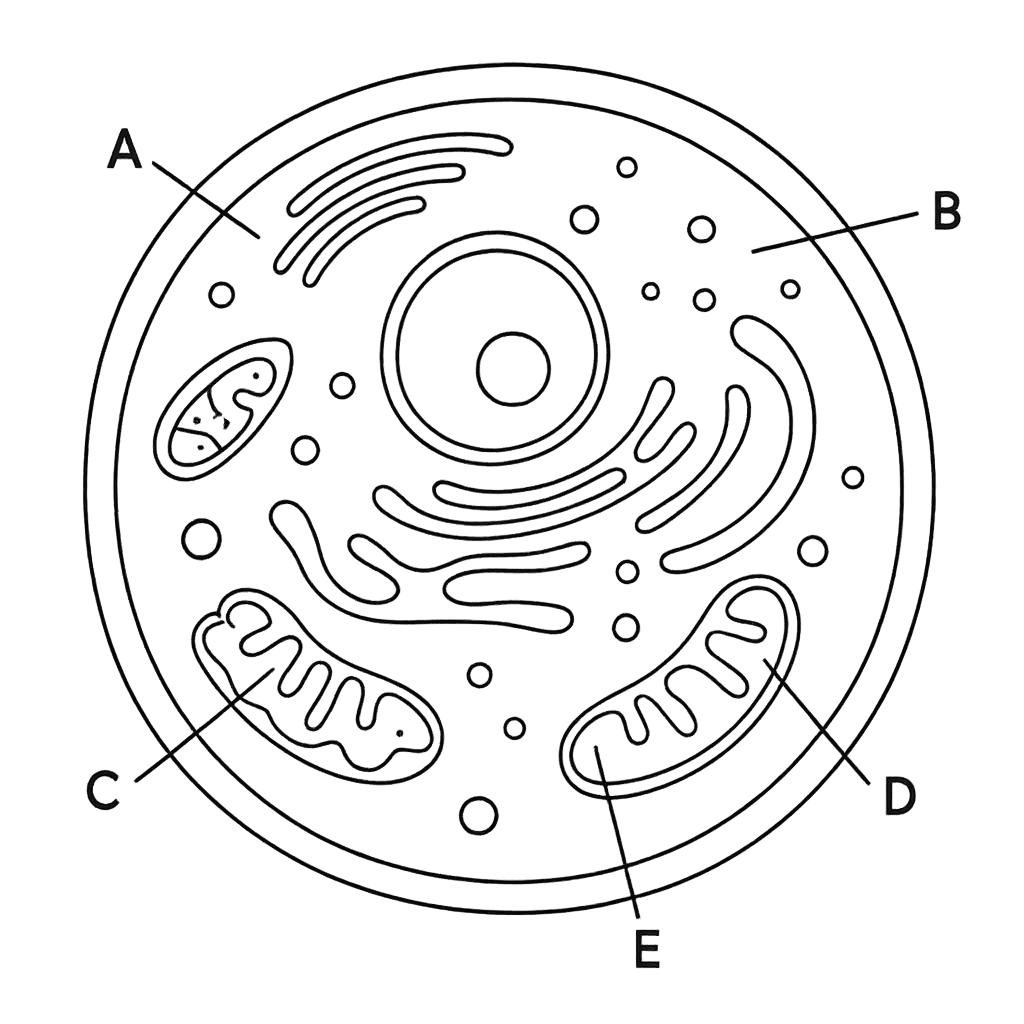
The diagram shows an animal cell with five labelled structures: A - Rough endoplasmic reticulum, B - Smooth endoplasmic reticulum, C - Golgi apparatus, D - Lysosome, E - Mitochondrion. Which labelled organelle is primarily responsible for detoxifying drugs, and which structural feature enables this function?
Correct A. B - Smooth endoplasmic reticulum; its lack of ribosomes (smooth surface) and presence of detoxifying enzymes
B. D - Lysosome; its hydrolytic enzymes and role in intracellular digestion
C. C - Golgi apparatus; its stacked cisternae and function in protein modification
D. A - Rough endoplasmic reticulum; its ribosome‑studded surface and role in protein synthesis

Correct Answer: A

Want to see the full step-by-step solution? Unlock AI Explanation & Analytics
Question 9 View Details
A diploid human somatic cell (2n = 46) is in the middle of mitosis. How many chromosomes and how many chromatids are present at the end of metaphase?
A. 23 chromosomes and 46 chromatids
B. 46 chromosomes and 46 chromatids
Correct C. 46 chromosomes and 92 chromatids
D. 92 chromosomes and 184 chromatids

Correct Answer: C

Want to see the full step-by-step solution? Unlock AI Explanation & Analytics
Question 10 View Details
In a mammal the glomerular filtration rate (GFR) is 120 mL min⁻¹. 65 % of the filtered water is reabsorbed in the proximal tubule, 15 % of the water remaining after the proximal tubule is reabsorbed in the loop of Henle, and 10 % of the water remaining after the loop is reabsorbed in the distal tubule. The fluid that reaches the collecting duct becomes urine unless further water is reabsorbed. (a) Calculate the urine flow rate (mL min⁻¹) before any influence of antidiuretic hormone (ADH). (b) If ADH acting on the collecting duct causes an additional 50 % of the water entering the duct to be reabsorbed, what is the new urine flow rate (mL min⁻¹)?
A. 21.6 mL/min; 10.8 mL/min after ADH
Correct B. 32.1 mL/min; 16.1 mL/min after ADH
C. 23.7 mL/min; 11.9 mL/min after ADH
D. 32.0 mL/min; 16.0 mL/min after ADH

Correct Answer: B

Want to see the full step-by-step solution? Unlock AI Explanation & Analytics
Question 11 View Details
A 30‑year‑old male weighing 70 kg and 175 cm tall has a basal metabolic rate (BMR) given by the Harris‑Benedict equation \( \text{BMR}=66+(13.7\times \text{weight})+(5\times \text{height})-(6.8\times \text{age}) \) (kcal day\(^{-1}\)). He is moderately active (activity factor 1.55) and wishes to lose 0.5 kg each week. Assuming that a loss of 1 kg of body fat requires a deficit of 7700 kcal, calculate (a) his target daily caloric intake, and (b) the number of grams of protein he should consume each day if 15 % of his calories are to come from protein (protein provides 4 kcal g\(^{-1}\)).
Correct A. 2080 kcal per day; 78 g protein
B. 1900 kcal per day; 70 g protein
C. 2150 kcal per day; 81 g protein
D. 2000 kcal per day; 75 g protein

Correct Answer: A

Want to see the full step-by-step solution? Unlock AI Explanation & Analytics
Question 12 View Details
An unknown eukaryotic organism exhibits the following characteristics: (i) cell wall composed of cellulose, (ii) chloroplasts containing thylakoid membranes, (iii) stores excess carbohydrate as starch, (iv) reproduces by releasing non‑motile spores, and (v) shows a distinct haploid-diploid life cycle but lacks true vascular tissue. Based on these traits, determine (a) its kingdom, (b) its division (phylum), and (c) its class. Then state which photosynthetic pigments are predominant in this organism.
A. Kingdom Fungi; Division Bryophyta; Class Bryopsida; pigments chlorophyll a and b
Correct B. Kingdom Plantae; Division Bryophyta; Class Bryopsida; pigments chlorophyll a and b
C. Kingdom Plantae; Division Bryophyta; Class Sphagnopsida; pigments chlorophyll a and b
D. Kingdom Plantae; Division Pteridophyta; Class Polypodiopsida; pigments chlorophyll a and b

Correct Answer: B

Want to see the full step-by-step solution? Unlock AI Explanation & Analytics
Question 13 View Details
Identify the cellular organelle that is the main site of ATP production through oxidative phosphorylation in eukaryotic cells.
A. Ribosome
Correct B. Mitochondrion
C. Nucleus
D. Chloroplast

Correct Answer: B

Want to see the full step-by-step solution? Unlock AI Explanation & Analytics
Question 14 View Details
Aerobic respiration of one molecule of glucose normally yields 32 ATP molecules (4 from substrate‑level phosphorylation, 10 NADH each giving 2.5 ATP and 2 FADH₂ each giving 1.5 ATP). A toxin partially inhibits Complex IV of the electron‑transport chain, reducing the efficiency of proton pumping by 30 %. Assuming the ATP yield from each NADH and each FADH₂ is reduced proportionally, calculate (a) the new total ATP yield from one glucose molecule, and (b) the percentage decrease in ATP production compared with the normal yield.
A. ≈22.4 ATP total; ≈30 % decrease
Correct B. ≈23.6 ATP total; ≈26 % decrease
C. ≈24.8 ATP total; ≈22 % decrease
D. ≈21.0 ATP total; ≈34 % decrease

Correct Answer: B

Want to see the full step-by-step solution? Unlock AI Explanation & Analytics
Question 15 View Details
In a simple spinal reflex, the sensory receptor is located 0.5 m from the spinal cord, and the motor effector is 0.6 m beyond the spinal cord. The afferent (sensory) neuron conducts impulses at 50 m s\(^{-1}\) and the efferent (motor) neuron at 60 m s\(^{-1}\). (a) Calculate the total neural transmission time from receptor to effector, ignoring synaptic delay. (b) If the synaptic delay at the integration centre is 0.5 ms, what is the total response time of the reflex?
A. Neural transmission 22 ms; total response time 22.5 ms
Correct B. Neural transmission 20 ms; total response time 20.5 ms
C. Neural transmission 15 ms; total response time 15.5 ms
D. Neural transmission 20 ms; total response time 20 ms

Correct Answer: B

Want to see the full step-by-step solution? Unlock AI Explanation & Analytics
Question 16 View Details
Desert mammals and reptiles show a relationship between body mass (M, in kg) and basal metabolic rate (BMR, in watts) that can be expressed as \( \text{BMR}=aM^{b} \). For a desert rodent (Species A) with \(M=0.05\) kg the measured BMR is 0.9 W, and for a desert lizard (Species B) with \(M=0.20\) kg the measured BMR is 2.5 W.\n\n(a) Determine the constants \(a\) and \(b\) that satisfy the data.\n(b) Using these constants, predict the BMR of a desert fox (Species C) that weighs 5 kg.\n(c) The fox's actual measured BMR is 30 W. Comment on whether this indicates an additional physiological adaptation.
A. Predicted BMR ≈ 27 W; the observed 30 W is lower, suggesting a reduced metabolic rate.
Correct B. Predicted BMR ≈ 27 W; the observed 30 W is higher, suggesting an extra physiological adaptation.
C. Predicted BMR ≈ 35 W; the observed 30 W is lower, indicating a possible metabolic efficiency.
D. Predicted BMR ≈ 22 W; the observed 30 W is higher, suggesting an extra physiological adaptation.

Correct Answer: B

Want to see the full step-by-step solution? Unlock AI Explanation & Analytics
Question 17 View Details
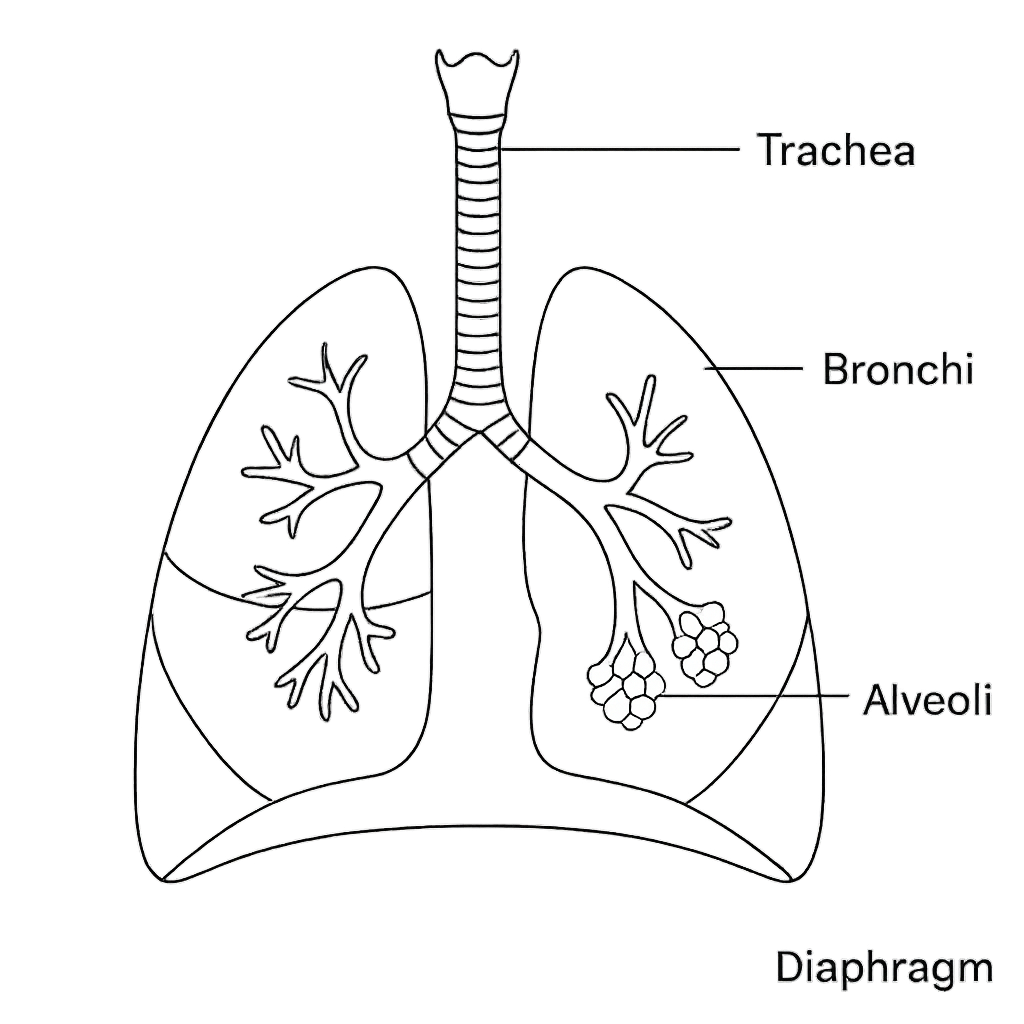
The diagram shows the main structures of the human respiratory system. The labelled alveoli (C) are spherical with an average radius of 0.10 mm. The total number of alveoli is \(4.8\times10^{8}\). Because each alveolus is highly folded, the effective internal surface area is three times the geometric surface area of a smooth sphere.\n\nCalculate the total internal surface area available for gas exchange in the lungs, expressing your answer in square metres (m\(^2\)).
A. ≈ 2.4×10² m² (about 240 m²)
B. ≈ 1.2×10² m² (about 120 m²)
C. ≈ 9.0×10¹ m² (about 90 m²)
Correct D. ≈ 1.8×10² m² (about 180 m²)

Correct Answer: D

Want to see the full step-by-step solution? Unlock AI Explanation & Analytics
Question 18 View Details
In a mammalian kidney, the renal plasma flow is 600 mL min\(^{-1}\) and the filtration fraction is 20 %.\n\n(a) Calculate the glomerular filtration rate (GFR) in mL min\(^{-1}\).\n(b) If 99 % of the filtered water is re‑absorbed and 85 % of the filtered sodium ions are re‑absorbed, determine (i) the volume of urine produced per hour and (ii) the amount of sodium excreted per hour, given that the plasma sodium concentration is 145 mmol L\(^{-1}\).
A. Urine volume ≈ 36 mL h⁻¹; Na⁺ excreted ≈ 7.9×10¹ mmol h⁻¹
B. Urine volume ≈ 360 mL h⁻¹; Na⁺ excreted ≈ 7.9×10² mmol h⁻¹
C. Urine volume ≈ 144 mL h⁻¹; Na⁺ excreted ≈ 3.1×10² mmol h⁻¹
Correct D. Urine volume ≈ 72 mL h⁻¹; Na⁺ excreted ≈ 1.6×10² mmol h⁻¹

Correct Answer: D

Want to see the full step-by-step solution? Unlock AI Explanation & Analytics
Question 19 View Details
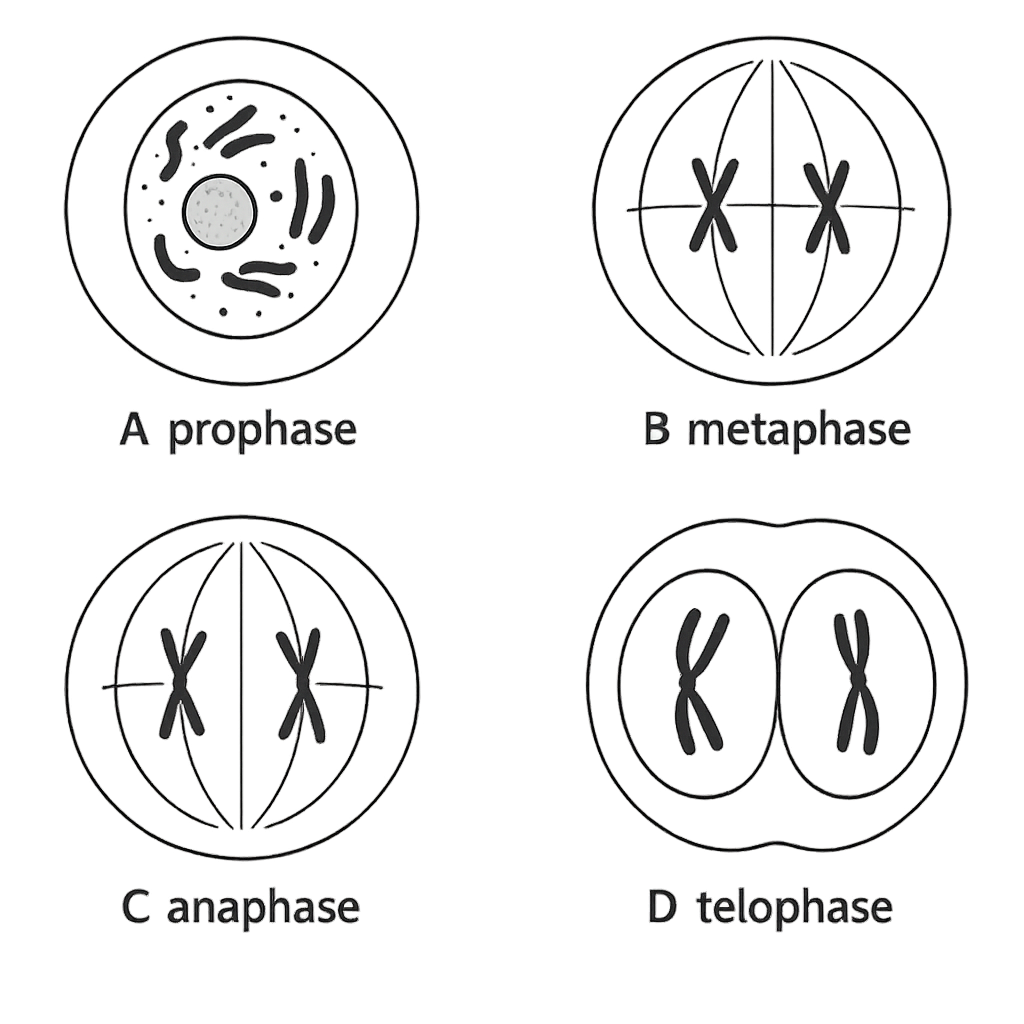
The labelled diagram depicts a stage of mitosis in a eukaryotic cell. In the shown stage, chromosomes are aligned along the centre of the cell, attached to spindle fibres at their kinetochores. Identify the stage.
A. Anaphase
Correct B. Metaphase
C. Telophase
D. Prophase

Correct Answer: B

Want to see the full step-by-step solution? Unlock AI Explanation & Analytics
Question 20 View Details
A bacterial culture starts with \(1.0\times10^{6}\) cells. Under optimal conditions the generation time is 30 min, so the population doubles every 30 min. After 5 h the culture is exposed to an antibiotic that increases the effective generation time to 90 min, but the cells continue to grow exponentially. Assuming no cell death, calculate the total number of cells present after 10 h from the start of the experiment.
A. ≈ 2.0×10¹⁰ cells
B. ≈ 1.0×10⁹ cells
C. ≈ 5.0×10⁹ cells
Correct D. ≈ 1.0×10¹⁰ cells

Correct Answer: D

Want to see the full step-by-step solution? Unlock AI Explanation & Analytics
Question 21 View Details
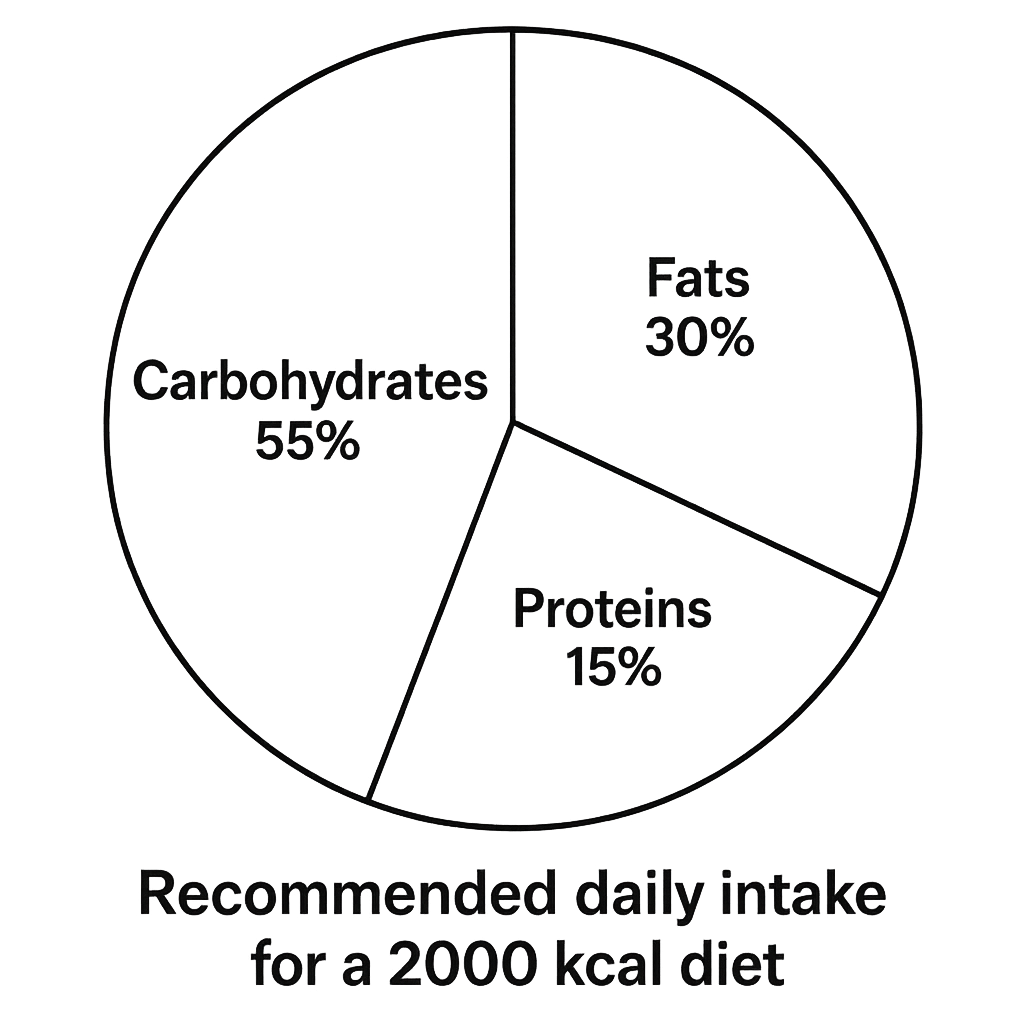
The labelled diagram shows a recommended daily macronutrient distribution for a 2000 kcal diet: Carbohydrates 55 %, Proteins 15 %, Fats 30 %. If a person increases their total energy intake to 2500 kcal, calculate the required grams of each macronutrient (use 4 kcal g⁻¹ for carbohydrates and proteins, 9 kcal g⁻¹ for fats). The person actually consumes 180 g carbohydrates, 70 g proteins and 80 g fats. Which macronutrient is the most limiting relative to the requirement? Provide the required grams (rounded to the nearest gram) and name the limiting nutrient.
A. Carbohydrates ≈ 300 g, Proteins ≈ 94 g, Fats ≈ 83 g; the limiting nutrient is protein.
B. Carbohydrates ≈ 344 g, Proteins ≈ 80 g, Fats ≈ 83 g; the limiting nutrient is fat.
Correct C. Carbohydrates ≈ 344 g, Proteins ≈ 94 g, Fats ≈ 83 g; the limiting nutrient is carbohydrate.
D. Carbohydrates ≈ 344 g, Proteins ≈ 94 g, Fats ≈ 70 g; the limiting nutrient is carbohydrate.

Correct Answer: C

Want to see the full step-by-step solution? Unlock AI Explanation & Analytics
Question 22 View Details
Two species share a homologous gene that is 1500 base pairs long. Sequencing shows a 12 % nucleotide difference between the species. The mutation rate for this gene is estimated at 2\times10^{-9} substitutions per site per year. Assuming the differences accumulated equally in both lineages, estimate the time (in millions of years) since the two species diverged.
A. 24 million years
B. 36 million years
C. 15 million years
Correct D. 30 million years

Correct Answer: D

Want to see the full step-by-step solution? Unlock AI Explanation & Analytics
Question 23 View Details
A simplified phylogenetic tree for four species is described as follows: from the root, branch to species D is 15 million years (My). The other branch from the root leads to a node that is 7 My from the root; from this node, branch to species C is 12 My (from the root) and a further node splits into species A and B, each 5 My from that node.\n\n(a) Which two species are most closely related?\n(b) What is the total evolutionary distance (in My) between species A and species C?
A. B and D; 22 million years
Correct B. A and B; 24 million years
C. A and C; 27 million years
D. C and D; 30 million years

Correct Answer: B

Want to see the full step-by-step solution? Unlock AI Explanation & Analytics
Question 24 View Details
In a human population the allele frequency of a recessive X‑linked disorder is q = 0.02. Assuming Hardy-Weinberg equilibrium and an equal sex ratio, calculate:\n(i) the proportion of affected males,\n(ii) the proportion of carrier females,\n(iii) the expected number of affected newborns in a sample of 10 000 births (rounded to the nearest whole number).
A. Affected males: 1 % (50); carrier females: 4.00 % (≈200); total affected newborns: 52
Correct B. Affected males: 2 % (100); carrier females: 3.92 % (≈196); total affected newborns: 102
C. Affected males: 2 % (100); carrier females: 3.92 % (≈196); total affected newborns: 150
D. Affected males: 2 % (100); carrier females: 4.00 % (≈200); total affected newborns: 120

Correct Answer: B

Want to see the full step-by-step solution? Unlock AI Explanation & Analytics
Question 25 View Details
In a beetle population two alleles determine colour: A (green) and a (brown). The initial frequency of allele A is p = 0.6. The relative fitnesses are w_{AA}=0.9, w_{Aa}=0.95 and w_{aa}=1.0 (brown is favoured). After one generation of selection, what is the new frequency of allele A (to three decimal places)?
A. 0.610
B. 0.530
Correct C. 0.587
D. 0.560

Correct Answer: C

Want to see the full step-by-step solution? Unlock AI Explanation & Analytics

Master the Exam!

You've seen a preview, but there are thousands more questions plus AI tutor to break down complex solutions.

Unlock Full Access Available for Android & Windows
Help others prepare! Share this practice hub:
Chat with Support