gce model questions vol1 2019 agricultural_science | Objective

Prepare for your exams with gce model questions vol1 questions? Reviewing past/model questions is one of the most effective ways to guarantee a high score. This practice hub features authentic 2019 agricultural_science (Objective) questions designed to simulate the real exam environment.

Practice these randomly selected questions to test your readiness.

Question 1 View Details
A 10‑ha forest is planted with a fast‑growing species. The initial annual volume growth is 2.5 m³ ha⁻¹ yr⁻¹ and declines by 5 % each successive year. After 5 years a thinning removes 20 % of the standing volume and reduces all subsequent annual growth rates by an additional 10 %. Assuming the declining growth pattern continues after thinning, calculate (a) the total standing timber volume after 12 years (in m³) and (b) the average annual increment over the 12‑year period (in m³ yr⁻¹).
A. 180.0 m³, 14.5 m³ per year
B. 202.7 m³, 16.9 m³ per year
C. 190.2 m³, 15.8 m³ per year
Correct D. 195.5 m³, 16.3 m³ per year

Correct Answer: D

Want to see the full step-by-step solution? Unlock AI Explanation & Analytics
Question 2 View Details
A tractor has a maximum engine power of 50 kW and a transmission efficiency of 85 %. It must pull a plough that requires a draw‑bar pull of 8 kN up a 5 % slope at a speed of 4 km h⁻¹. (a) Determine whether the tractor can maintain this speed, and (b) calculate the fuel consumption in kilograms per hour if the diesel fuel has an energy content of 42 MJ kg⁻¹ and the engine's thermal efficiency is 30 %.
A. Yes; 2.5 kg/h
B. Yes; 3.5 kg/h
Correct C. Yes; 3.0 kg/h
D. No; 3.0 kg/h

Correct Answer: C

Want to see the full step-by-step solution? Unlock AI Explanation & Analytics
Question 3 View Details
A loamy soil has a bulk density of 1.3 g cm⁻³ and a particle density of 2.65 g cm⁻³. (a) Compute the soil porosity, and (b) assuming field capacity is half the porosity, find the volumetric water content at field capacity (expressed as a decimal).
A. 0.45, 0.22
Correct B. 0.51, 0.26
C. 0.55, 0.28
D. 0.48, 0.24

Correct Answer: B

Want to see the full step-by-step solution? Unlock AI Explanation & Analytics
Question 4 View Details
A mixed‑crop farm has 20 ha of land. Crop A yields 3 t ha⁻¹ and sells for $200 t⁻¹, with a variable cost of $80 ha⁻¹. Crop B yields 2 t ha⁻¹ and sells for $300 t⁻¹, with a variable cost of $120 ha⁻¹. Fixed overheads are $10 000 per year. The farmer must allocate at least 30 % of the land to Crop B. Determine the minimum area (in ha) that must be devoted to Crop A for the farm to break even (total profit zero).
A. 8
Correct B. 10
C. 15
D. 12

Correct Answer: B

Want to see the full step-by-step solution? Unlock AI Explanation & Analytics
Question 5 View Details
A hand hoe has a handle length of 1.2 m. The farmer applies the effort at the handle end, at an angle of 30° to the handle (i.e., the angle between the force direction and the lever arm is 30°). The soil resistance acts at a point 0.2 m from the pivot and requires a vertical force component of 150 N to overcome. Calculate the magnitude of the effort force the farmer must apply (in newtons).
Correct A. 50
B. 75
C. 25
D. 29

Correct Answer: A

Want to see the full step-by-step solution? Unlock AI Explanation & Analytics
Question 6 View Details
Four fields each of 5 ha are affected by a fungal disease. The total infected area across the four fields is 30\% of the total area. Field\,1 has twice the incidence (percentage of area infected) of field\,3, field\,2's incidence is 10\% higher than that of field\,3, and field\,4's incidence is 5\% lower than field\,1. What is the disease incidence in field\,3 (to the nearest 0.1\%)?
A. 18.5
Correct B. 19.2
C. 21.5
D. 20.0

Correct Answer: B

Want to see the full step-by-step solution? Unlock AI Explanation & Analytics
Question 7 View Details
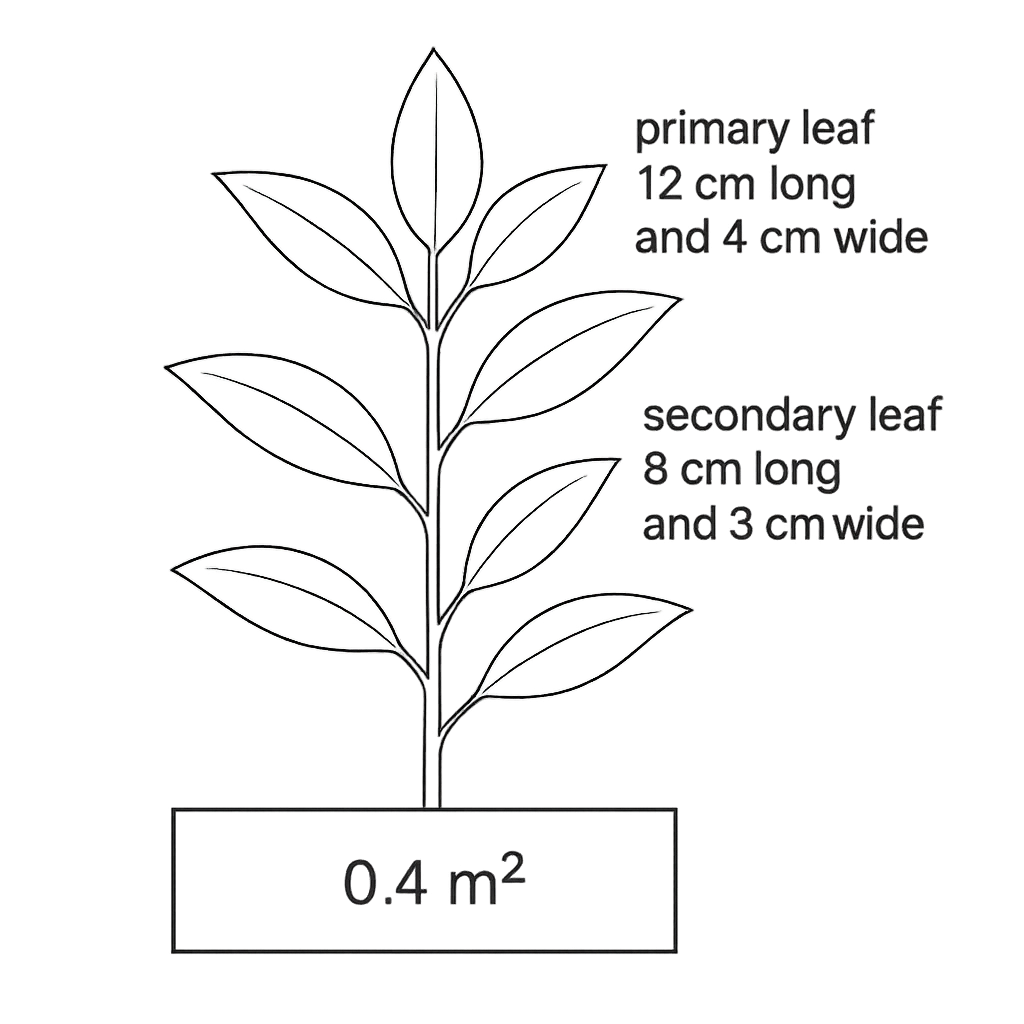
The diagram shows a plant with two types of leaves. Primary leaves are 12\,cm long and 4\,cm wide; secondary leaves are 8\,cm long and 3\,cm wide. The plant bears 5 primary leaves and 7 secondary leaves. The ground area occupied by the plant is 0.4\,m\(^2\). Calculate the leaf‑area index (LAI), defined as total leaf area (in m\(^2\)) divided by ground area, and give your answer to two decimal places.
A. 0.15
Correct B. 0.10
C. 0.08
D. 0.12

Correct Answer: B

Want to see the full step-by-step solution? Unlock AI Explanation & Analytics
Question 8 View Details
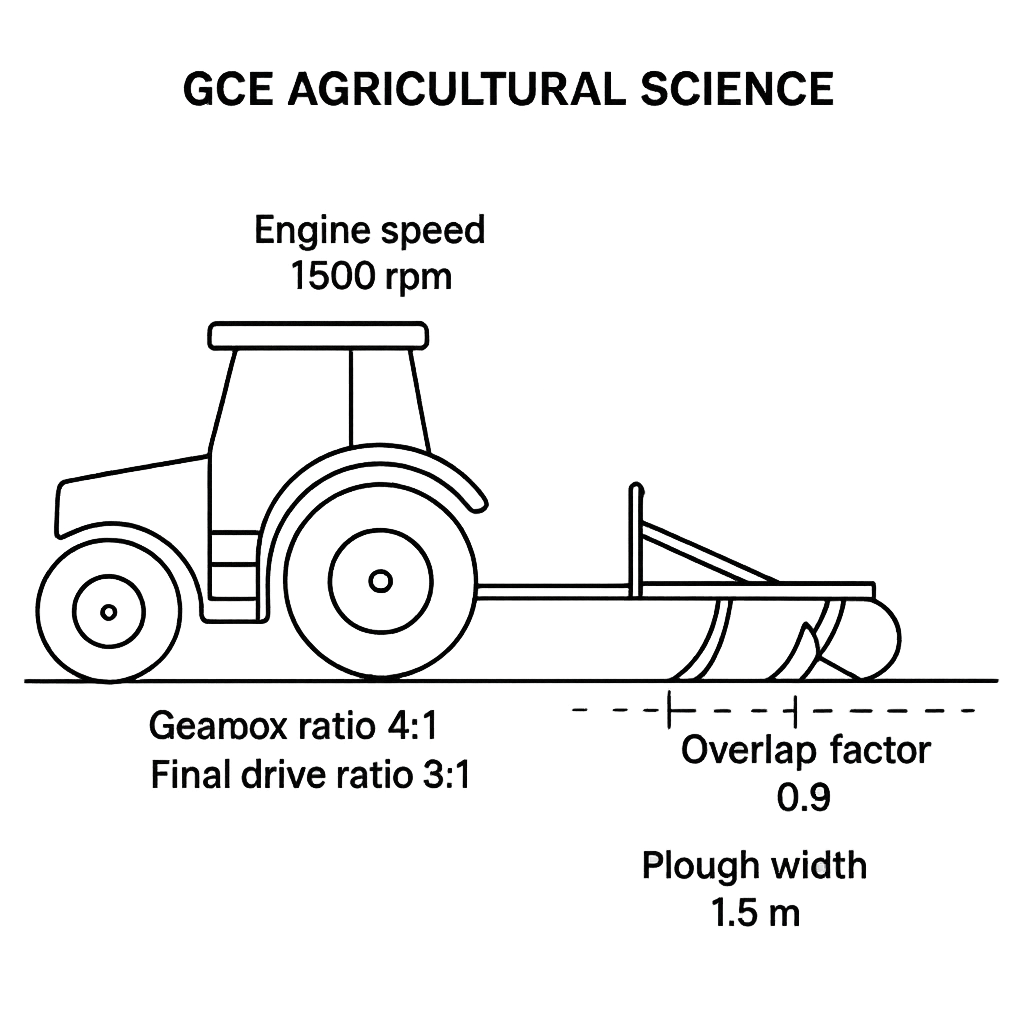
A tractor's engine runs at 1500\,rpm. The gearbox reduces the speed by a ratio of 4\,:\,1 and the final‑drive reduces it further by 3\,:\,1 before it reaches the wheels, which have a radius of 0.5\,m. The tractor pulls a plough 1.5\,m wide, but because of overlap only 90\% of the plough width is effective. Using the field‑capacity formula \(\text{Capacity (ha\,h}^{-1}\text{)} = \dfrac{\text{speed (km\,h}^{-1}\text{)} \times \text{effective width (m)}}{10}\), calculate the theoretical field capacity in hectares per hour, rounded to two decimal places.
A. 2.95
B. 4.10
Correct C. 3.18
D. 3.45

Correct Answer: C

Want to see the full step-by-step solution? Unlock AI Explanation & Analytics
Question 9 View Details
A soil test indicates that the available phosphorus in a field is 12\,mg\,kg\(^{-1}\). The target level is 30\,mg\,kg\(^{-1}\). The soil bulk density is 1.3\,g\,cm\(^{-3}\), the plough depth is 15\,cm and the field area is 2\,ha. A fertilizer containing 20\% P\(_2\)O\(_5\) (by weight) is to be applied. Given that P\(_2\)O\(_5\) is 43.66\% elemental phosphorus, calculate the amount of this fertilizer (in kilograms) required to raise the soil phosphorus to the target level. Give your answer to the nearest kilogram.
A. 950
B. 860
Correct C. 804
D. 720

Correct Answer: C

Want to see the full step-by-step solution? Unlock AI Explanation & Analytics
Question 10 View Details
An extension officer has a budget of \(\text{₦}150,000\) to promote a new crop variety. Three communication media are available:\n\n- Radio spot: cost \(\text{₦}5,000\), reaches 800 households per spot.\n- Community meeting: cost \(\text{₦}12,000\), reaches 250 households per meeting.\n- Leaflet batch (500 leaflets): cost \(\text{₦}3,000\), reaches 400 households per batch.\n\nAt least one of each media must be used. How many radio spots, community meetings, and leaflet batches should be purchased to maximise the total number of households reached without exceeding the budget? State the optimal numbers of each media and the total households reached.
A. Radio spots: 26, Community meetings: 1, Leaflet batches: 1 (total reach 21,450 households)
B. Radio spots: 24, Community meetings: 2, Leaflet batches: 1 (total reach 20,100 households)
Correct C. Radio spots: 27, Community meetings: 1, Leaflet batches: 1 (total reach 22,250 households)
D. Radio spots: 25, Community meetings: 1, Leaflet batches: 2 (total reach 21,050 households)

Correct Answer: C

Want to see the full step-by-step solution? Unlock AI Explanation & Analytics
Question 11 View Details
A mixed farm has 20 ha of land and 50 labour days available. Two crops are considered: - Crop X yields 3 t ha⁻¹ and sells at £200 t⁻¹; variable cost is £150 ha⁻¹. - Crop Y yields 2.5 t ha⁻¹ and sells at £250 t⁻¹; variable cost is £120 ha⁻¹. Each hectare of Crop X requires 2 labour days, each hectare of Crop Y requires 3 labour days. Fixed overheads are £2000. Determine the allocation of land (ha of Crop X and ha of Crop Y) that maximises profit. State the hectares of each crop to be planted.
Correct A. 10 ha of Crop X and 10 ha of Crop Y
B. 8 ha of Crop X and 12 ha of Crop Y
C. 12 ha of Crop X and 8 ha of Crop Y
D. 15 ha of Crop X and 5 ha of Crop Y

Correct Answer: A

Want to see the full step-by-step solution? Unlock AI Explanation & Analytics
Question 12 View Details
The diagram shows a seed‑drill set‑up. The metering disc has a diameter of 0.30 m and carries 12 equally spaced holes, of which 2 are blocked (shown shaded). The disc rotates at 120 rpm. The drill rows are spaced 0.25 m apart and the tractor moves forward at 5 km h⁻¹. Using the information in the diagram, calculate the seed‑rate in seeds per hectare that will be applied.
Correct A. 576,000 seeds per hectare
B. 480,000 seeds per hectare
C. 720,000 seeds per hectare
D. 540,000 seeds per hectare

Correct Answer: A

Want to see the full step-by-step solution? Unlock AI Explanation & Analytics
Question 13 View Details
A farmer intends to grow wheat on a 5 ha field. The recommended nitrogen (N) fertiliser rate is 120 kg ha⁻¹. A soil test shows the field already contains 30 kg ha⁻¹ of available N. The farmer can apply either urea (46 % N) costing £0.50 kg⁻¹ or ammonium nitrate (34 % N) costing £0.70 kg⁻¹. Regulations limit the total urea application to 100 kg ha⁻¹. Determine the quantities (kg) of urea and ammonium nitrate the farmer should apply to meet the required N level at minimum cost.
A. 978 kg urea and 0 kg ammonium nitrate
B. 500 kg urea and 600 kg ammonium nitrate
Correct C. 500 kg urea and 647 kg ammonium nitrate
D. 400 kg urea and 782 kg ammonium nitrate

Correct Answer: C

Want to see the full step-by-step solution? Unlock AI Explanation & Analytics
Question 14 View Details
A 3 ha maize field is surveyed and an average of 8 fall‑armyworm larvae are found per 10 m². The economic injury level (EIL) is 5 larvae per 10 m². The recommended pesticide is applied at 2.5 L ha⁻¹ and contains 0.8 % active ingredient (a.i.). Each litre of product contains 8 g a.i. and reduces the larval density by 1.5 larvae per 10 m² uniformly across the field. Assuming the farmer wants to bring the population just below the EIL, calculate the total volume of pesticide (in litres) that should be applied to the whole field.
Correct A. 6 L
B. 8 L
C. 12 L
D. 4 L

Correct Answer: A

Want to see the full step-by-step solution? Unlock AI Explanation & Analytics
Question 15 View Details
Name two ecosystem services that hedgerows provide in agricultural landscapes.
A. Recreational fishing and wildlife hunting (any two valid services)
B. Timber production and fuel extraction (any two valid services)
C. Urban recreation and flood control (any two valid services)
Correct D. Pollination and pest control (any two valid services)

Correct Answer: D

Want to see the full step-by-step solution? Unlock AI Explanation & Analytics
Question 16 View Details
A farmer harvests 10 tonnes of maize with an initial moisture content of 25 % (wet basis). He dries the maize in a dryer where the moisture content M (in %) decreases according to \( \frac{dM}{dt} = -0.5\,(M-14) \) where t is in days. After 3 days the maize is also subject to respiration loss of 2 % of its dry matter per day. Assuming the respiration loss acts on the dry matter present at the start of the drying period, what is the final weight of the maize (in tonnes) after the 3 days, correct to two decimal places?
Correct A. 8.45
B. 8.00
C. 9.12
D. 7.90

Correct Answer: A

Want to see the full step-by-step solution? Unlock AI Explanation & Analytics
Question 17 View Details
A predator consumes insects from two species in a fixed ratio of 3 : 2 (species A : species B). In a field there are initially 1 200 insects of species A and 800 insects of species B. If the predator eats a total of 150 insects, how many insects remain in the field after the predation?
A. 1700
B. 1500
Correct C. 1850
D. 1900

Correct Answer: C

Want to see the full step-by-step solution? Unlock AI Explanation & Analytics
Question 18 View Details
A pine plantation is managed by clear‑cutting the stand at a uniform rotation age T (years). Each tree yields 0.5 m³ of timber per year after the stand reaches age 5 years, so the total timber volume per hectare at harvest is \( V = 0.5\,(T-5) \) m³ (assume T > 5). The timber price at the time of harvest is \( P_T = 120\,(1.02)^{T} \) dollars per m³, reflecting a 2 % annual price increase. Harvesting costs are $30 per m³ and the planting cost is $200 per hectare, incurred at the start of each rotation. Using a discount rate of 5 % per annum and the Faustmann formula, determine the integer rotation age T (in whole years) that maximises the net present value per hectare. Give the optimal T.
A. 40
Correct B. 35
C. 45
D. 30

Correct Answer: B

Want to see the full step-by-step solution? Unlock AI Explanation & Analytics
Question 19 View Details
A pesticide is applied at a rate of 2.5 L ha⁻¹ per application to a 5‑ha field. The pesticide has a half‑life of 7 days, so after d days the remaining proportion is \((½)^{d/7}\). To keep the pest population below the economic threshold, the concentration must remain at least 30 % of the initial dose after each interval. The crop season lasts 60 days. Assuming applications are spaced equally and no other control measures are used, (a) what is the maximum allowable interval between applications (in days, to two decimal places), and (b) how many liters of pesticide are required for the whole season?
Correct A. 12.15 days, 62.5 L
B. 10.80 days, 58.0 L
C. 11.20 days, 60.0 L
D. 13.50 days, 65.0 L

Correct Answer: A

Want to see the full step-by-step solution? Unlock AI Explanation & Analytics
Question 20 View Details
A lake supports a fish population that follows the logistic growth model \( \frac{dN}{dt}= rN\left(1-\frac{N}{K}\right) \) with intrinsic growth rate \( r = 0.4 \) year⁻¹ and carrying capacity \( K = 800{,}000 \) fish. A constant annual harvest H (fish year⁻¹) is imposed. (a) Derive the expression for the maximum sustainable yield (MSY) and the corresponding equilibrium population, (b) calculate the numerical values of the MSY (in fish per year) and the equilibrium population at MSY.
Correct A. 80,000 fish per year; 400,000 fish
B. 60,000 fish per year; 300,000 fish
C. 100,000 fish per year; 500,000 fish
D. 80,000 fish per year; 300,000 fish

Correct Answer: A

Want to see the full step-by-step solution? Unlock AI Explanation & Analytics
Question 21 View Details
A farmer plans to raise 12 goats for 30 days. Each goat gains on average \(0.25\) kg per day. The feed conversion ratio (FCR) is \(5\) kg feed per \(1\) kg weight gain. Feed costs \(\text{₦}150\) per kg. (a) Determine the maximum total weight gain the herd can achieve in the 30‑day period. (b) Based on this maximum gain, calculate the total amount of feed required and the total feed cost. (c) Find the average daily feed cost per goat.
Correct A. Maximum total gain = 90 kg; total feed required = 450 kg; total feed cost = ₦67 500; average daily feed cost per goat = ₦187.5
B. Maximum total gain = 90 kg; total feed required = 500 kg; total feed cost = ₦75 000; average daily feed cost per goat = ₦208.33
C. Maximum total gain = 84 kg; total feed required = 420 kg; total feed cost = ₦63 000; average daily feed cost per goat = ₦180
D. Maximum total gain = 96 kg; total feed required = 480 kg; total feed cost = ₦72 000; average daily feed cost per goat = ₦200

Correct Answer: A

Want to see the full step-by-step solution? Unlock AI Explanation & Analytics
Question 22 View Details
A farmer produces maize. Fixed costs are \(\text{₦}200{,}000\) per season and the variable cost is \(\text{₦}30{,}000\) per tonne. Expected yield is 8 tonnes per season and the market price is \(\text{₦}45{,}000\) per tonne.\n(a) Calculate the break‑even yield (in tonnes).\n(b) The farmer can invest in a fertilizer that raises yield by 20 % but adds \(\text{₦}40{,}000\) to fixed costs and increases variable cost by \(\text{₦}5{,}000\) per tonne. Should the farmer adopt the fertilizer if the market price remains unchanged?\n(c) If after adoption the market price falls by 10 %, recalculate profit and state whether the fertilizer should now be adopted.
A. Adopt the fertilizer under both price scenarios.
Correct B. Do not adopt the fertilizer under either price scenario.
C. Adopt the fertilizer when the market price remains unchanged.
D. Adopt the fertilizer even after the market price falls by ten percent.

Correct Answer: B

Want to see the full step-by-step solution? Unlock AI Explanation & Analytics
Question 23 View Details
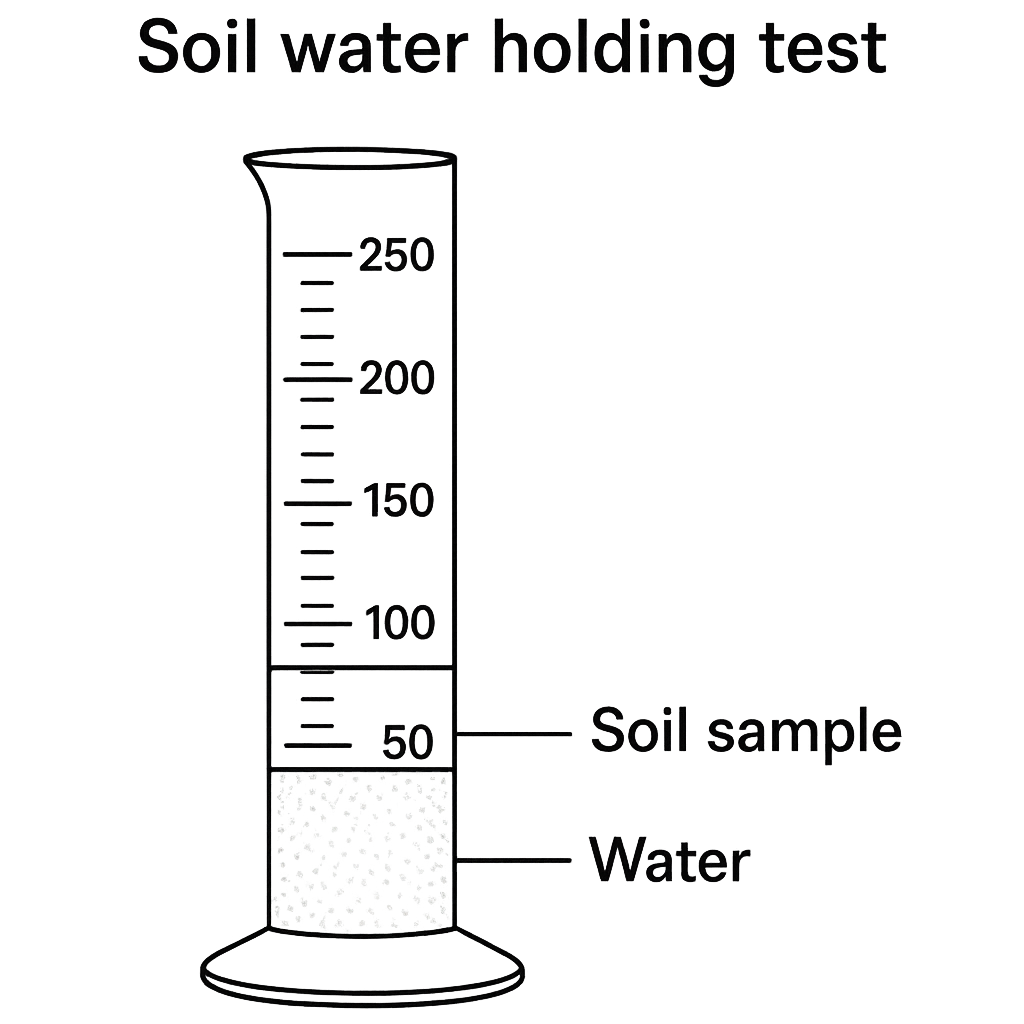
In the diagram of a soil water‑holding capacity test, a 250 mL graduated cylinder contains a 100 g air‑dry soil sample. Water is added until the cylinder reads 210 mL. The cylinder is then placed on a filter and allowed to drain until the water level stabilises at 190 mL. Calculate the field capacity (in mL water per g soil) of the soil.
A. 1.5 mL water per g soil
Correct B. 1.9 mL water per g soil
C. 2.1 mL water per g soil
D. 2.0 mL water per g soil

Correct Answer: B

Want to see the full step-by-step solution? Unlock AI Explanation & Analytics
Question 24 View Details
A farmer rotates wheat and a legume (soybean) over a 4‑year cycle. Wheat removes \(120\) kg N ha⁻¹ each season, while the legume adds \(80\) kg N ha⁻¹ through fixation. The farmer wants the soil N to never fall below \(150\) kg ha⁻¹. Starting soil N is \(200\) kg ha⁻¹. Determine the minimum number of legume years required in the 4‑year cycle to satisfy this condition, give one possible crop sequence, and compute the average annual change in soil N over the cycle.
A. At least 3 legume years (e.g., L‑W‑L‑L); average annual N decrease = -5 kg ha⁻¹
B. At least 4 legume years (e.g., L‑L‑L‑L); average annual N increase = 40 kg ha⁻¹
Correct C. At least 3 legume years (e.g., L‑L‑L‑W); average annual N increase = 30 kg ha⁻¹
D. At least 2 legume years (e.g., L‑L‑W‑W); average annual N increase = 10 kg ha⁻¹

Correct Answer: C

Want to see the full step-by-step solution? Unlock AI Explanation & Analytics
Question 25 View Details
In a poultry farm an outbreak of Newcastle disease shows the following weekly new case numbers: Week 1 = 5, Week 2 = 12, Week 3 = 28, Week 4 = 65. Assuming the disease follows the discrete exponential model \(C_{t+1}=R_{0}\,C_{t}\), where \(C_{t}\) is the number of cases in week \(t\):\n(a) Estimate the basic reproduction number \(R_{0}\) from the data.\n(b) If a vaccination programme reduces the effective reproduction number to \(R_{e}=0.8\,R_{0}\), how many weeks will it take for the number of cases to fall below 1, starting from the initial 5 cases?\n(c) Discuss one management strategy that could achieve the required reduction.
A. R₀ ≈ 2.10; with Re = 1.68 the cases will never fall below 1, so vaccination must reduce Re below 1 (e.g., achieve >40 % effective coverage).
B. R₀ ≈ 3.00; with Re = 2.40 the cases will never fall below 1, so vaccination must reduce Re below 1 (e.g., achieve >66 % effective coverage).
Correct C. R₀ ≈ 2.35; with Re = 1.88 the cases will never fall below 1, so vaccination must reduce Re below 1 (e.g., achieve >57 % effective coverage).
D. R₀ ≈ 1.90; with Re = 1.52 the cases will fall below 1 after about 4 weeks, so vaccination need not be higher.

Correct Answer: C

Want to see the full step-by-step solution? Unlock AI Explanation & Analytics

Master the Exam!

You've seen a preview, but there are thousands more questions plus AI tutor to break down complex solutions.

Unlock Full Access Available for Android & Windows
Help others prepare! Share this practice hub:
Chat with Support