gce model questions vol1 2018 mathematics | Essay

Prepare for your exams with gce model questions vol1 questions? Reviewing past/model questions is one of the most effective ways to guarantee a high score. This practice hub features authentic 2018 mathematics (Essay) questions designed to simulate the real exam environment.

Practice these randomly selected questions to test your readiness.

Question 1 View Details
A positive integer N satisfies the following conditions: - When divided by 7 it leaves a remainder of 3. - When divided by 9 it leaves a remainder of 5. - When divided by 11 it leaves a remainder of 7. Find the smallest such N and then determine how many zeros are at the end of N! (the factorial of N).
Question Parts
(a)
Find the smallest positive integer N that satisfies the three remainder conditions.
(b)
Using the value of N found in part (a), calculate the number of trailing zeros in N! .
Detailed Essay Solution & Marking Scheme Available

Get the step-by-step mathematical proofs, key points required by examiners, and a comprehensive breakdown from our AI Tutor.
Question 2 View Details
A retailer purchases a batch of a particular article at a certain cost price C (in pounds). The retailer first marks up the price by 20% on the cost price and then offers a discount of 15% on the marked‑up price. After these two operations the final selling price is £68. Answer the following:
Question Parts
(a)
Determine the original cost price C, expressed as a fraction in lowest terms.
(b)
Write the cost price C as a decimal correct to two decimal places.
(c)
Calculate the overall percentage profit made on the article relative to the original cost price.
Detailed Essay Solution & Marking Scheme Available

Get the step-by-step mathematical proofs, key points required by examiners, and a comprehensive breakdown from our AI Tutor.
Question 3 View Details
A researcher is analysing two positive quantities a and b that are expressed using indices and surds. The quantities satisfy a + b = 10 and a \times b = 12.
Question Parts
(a)
Show that a and b are the roots of a quadratic equation and find their exact values in simplest surd form.
(b)
If a can be written in the form 2^{x} where x is a real number, determine x in exact logarithmic form.
(c)
If b can be written as \sqrt{3^{y}} where y is an integer, determine the value of y.
Detailed Essay Solution & Marking Scheme Available

Get the step-by-step mathematical proofs, key points required by examiners, and a comprehensive breakdown from our AI Tutor.

Question 4 View Details
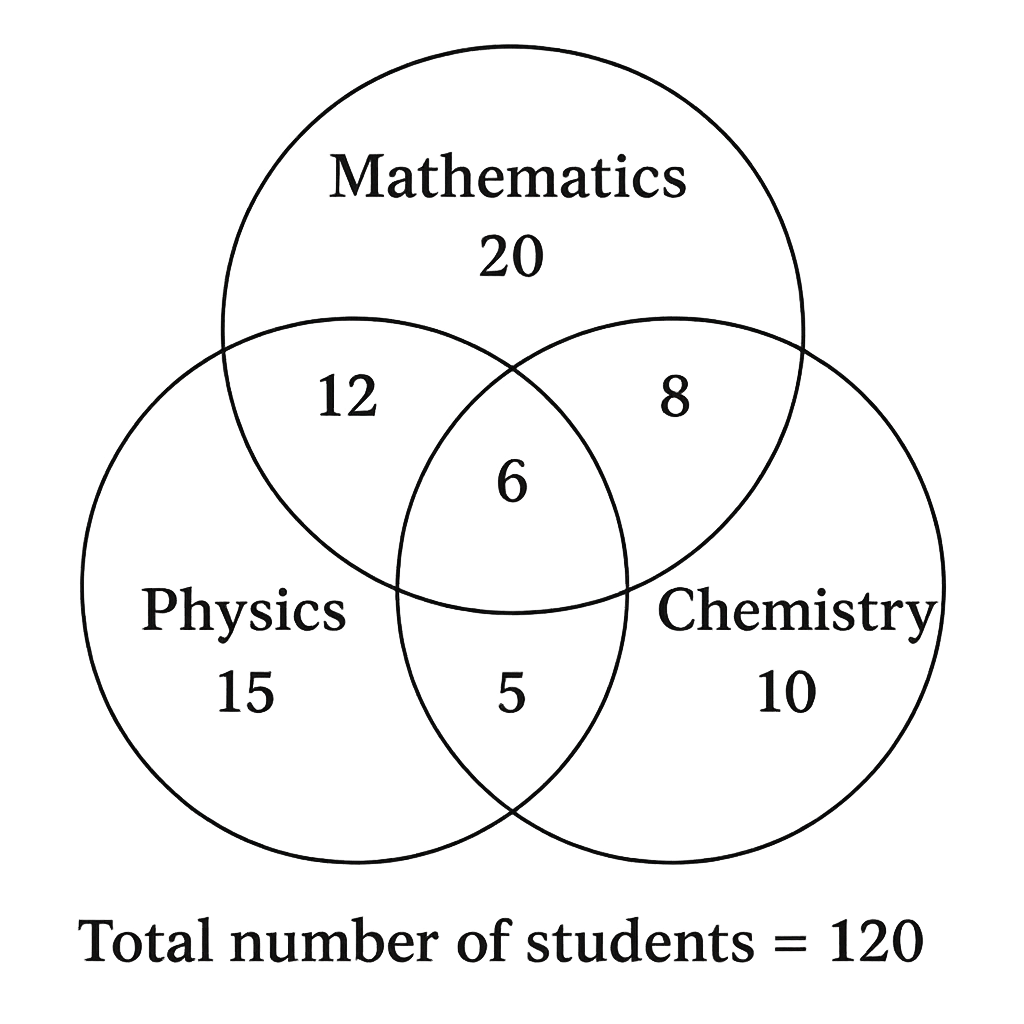
The Venn diagram below represents the numbers of students in a school who study three science subjects: Mathematics (M), Physics (P) and Chemistry (C). The total number of students surveyed is 120.
Question Parts
(a)
How many students study at least one of the three subjects?
(b)
How many students study none of the three subjects?
(c)
What is the probability that a randomly selected student studies exactly two of the subjects?
(d)
Given that a student studies Mathematics, what is the probability that the same student also studies Chemistry?
Detailed Essay Solution & Marking Scheme Available

Get the step-by-step mathematical proofs, key points required by examiners, and a comprehensive breakdown from our AI Tutor.

Question 5 View Details
Two integers a and b satisfy the conditions a + b = 7 and a² + b² = 37.
Question Parts
(a)
Determine the values of a and b.
(b)
Using your values, evaluate (a³ – b³) ÷ (a – b).
Detailed Essay Solution & Marking Scheme Available

Get the step-by-step mathematical proofs, key points required by examiners, and a comprehensive breakdown from our AI Tutor.

Question 6 View Details
A contractor charges a fixed fee of ₦2,000 plus ₦150 per square metre for tiling a floor. A client pays ₦9,500 for tiling a floor.
Question Parts
(a)
Determine the area of the floor that was tiled (in square metres).
(b)
If the contractor offers a 10 % discount on the variable charge per square metre for a second floor of the same area, while the fixed fee remains unchanged, calculate the total cost for tiling both floors.
Detailed Essay Solution & Marking Scheme Available

Get the step-by-step mathematical proofs, key points required by examiners, and a comprehensive breakdown from our AI Tutor.

Question 7 View Details
A rectangular garden has a length that is 3 m more than twice its width. The area of the garden is 135 m².
Question Parts
(a)
Form a quadratic equation in one variable that represents the dimensions of the garden.
(b)
Solve the quadratic equation obtained in part (a) to find the possible dimensions of the garden. State which solution is physically acceptable.
(c)
The garden is to be fenced with wire costing ₦250 per metre. Calculate the total cost of the fence.
(d)
If the garden is divided into two equal rectangular plots by a fence parallel to the shorter side, determine the additional length of fence required and the extra cost incurred.
Detailed Essay Solution & Marking Scheme Available

Get the step-by-step mathematical proofs, key points required by examiners, and a comprehensive breakdown from our AI Tutor.

Question 8 View Details
A company produces two types of widget, A and B. The profit per unit of A is ₦120 and per unit of B is ₦150. The weekly production capacity is limited to 800 units and the total weekly labour hours available are 540 h. Each unit of A requires 0.5 h of labour and each unit of B requires 0.75 h. The company wishes to achieve a profit of at least ₦78 000 each week.
Question Parts
(a)
Let x be the number of units of A produced and y the number of units of B produced. Write the system of inequalities that represents all the constraints, including non‑negativity.
(b)
Determine the coordinates of all vertices of the feasible region defined by the inequalities in part (a). (State the method used to obtain each vertex.)
Detailed Essay Solution & Marking Scheme Available

Get the step-by-step mathematical proofs, key points required by examiners, and a comprehensive breakdown from our AI Tutor.

Question 9 View Details
A sequence \(\{u_n\}\) is defined by \(u_1 = 2\) and for \(n \ge 1\) the recurrence relation \(u_{n+1}=3u_n+4\).
Question Parts
(a)
Find an explicit formula for \(u_n\) in terms of \(n\).
(b)
Using the formula obtained in part (a), calculate the sum \(S_5 = u_1+u_2+u_3+u_4+u_5\).
(c)
Determine the smallest integer \(n\) for which \(u_n > 500\).
Detailed Essay Solution & Marking Scheme Available

Get the step-by-step mathematical proofs, key points required by examiners, and a comprehensive breakdown from our AI Tutor.

Question 10 View Details
The rate \(R\) of a certain chemical reaction varies directly with the concentration \(C\) of reactant A and inversely with the square root of the absolute temperature \(T\) (in kelvin). The concentration \(C\) itself varies directly with the pressure \(P\) (in atmospheres) and inversely with the volume \(V\) (in litres) of the container.
Question Parts
(a)
Write the combined variation formula that relates \(R\), \(P\), \(V\) and \(T\). Then, using the data \(P=2\) atm, \(V=5\) L, \(T=300\) K and \(R=12\) units, determine the constant of proportionality \(K\).
Detailed Essay Solution & Marking Scheme Available

Get the step-by-step mathematical proofs, key points required by examiners, and a comprehensive breakdown from our AI Tutor.

Question 11 View Details
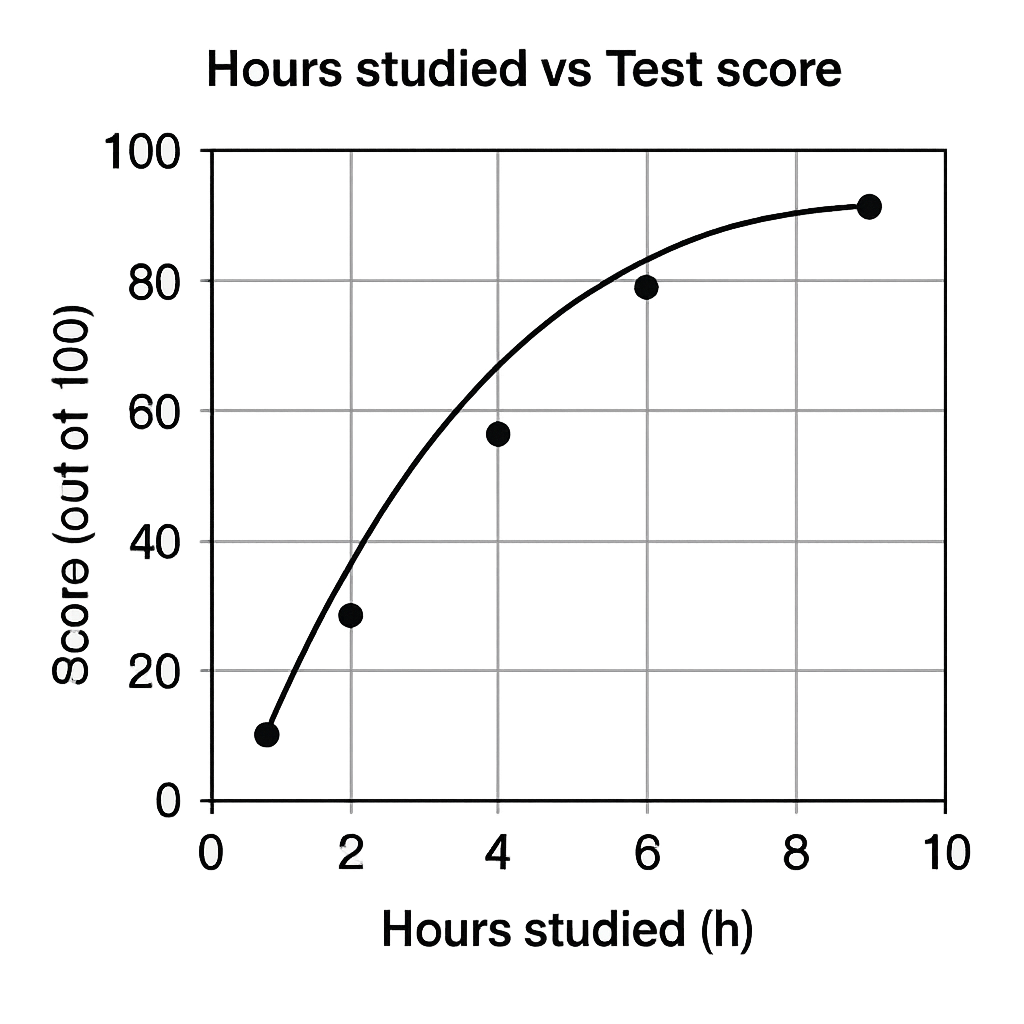
The graph below shows the relationship between the number of hours studied (h) and the score obtained (S) in a mathematics test for a group of students.
Question Parts
(a)
Assuming the data follow a quadratic model S = ah^2 + bh + c, determine the values of a, b and c that best fit the points (0,20), (4,68) and (8,88).
(b)
Using the quadratic model obtained in part (a), predict the score for a student who studies for 10 hours.
(c)
Find the marginal increase in score when the study time is increased from 4 to 6 hours, using the derivative of the quadratic model.
(d)
Comment on the suitability of a quadratic model for the given data, referring to the residuals at the plotted points.
Detailed Essay Solution & Marking Scheme Available

Get the step-by-step mathematical proofs, key points required by examiners, and a comprehensive breakdown from our AI Tutor.

Question 12 View Details
In the diagram, triangle ABC is shown. Side AB has length 12 cm and lies on the positive x‑axis of a Cartesian coordinate system with A at the origin O(0,0) and B at (12,0). The interior angles at A and B are 45° and 55° respectively. The triangle is placed as described.
Question Parts
(a)
Find the coordinates of point C. Give each coordinate correct to two decimal places.
(b)
Using the coordinates obtained in part (a), write the equation of line AC in the form y = mx + c, stating the values of m and c to two decimal places where required.
(c)
Calculate the area of triangle ABC in square centimetres, giving your answer correct to two decimal places.
(d)
Let D be the foot of the perpendicular from C to AB. Find the coordinates of D and the length CD, both correct to two decimal places.
Detailed Essay Solution & Marking Scheme Available

Get the step-by-step mathematical proofs, key points required by examiners, and a comprehensive breakdown from our AI Tutor.

Question 13 View Details
A quadratic equation is given by 3x^2 - kx + 12 = 0 where k is a constant.
Question Parts
(a)
Find the range of values of k for which the equation has two distinct real roots.
(b)
If one root is twice the other, determine the value of k and the roots.
Detailed Essay Solution & Marking Scheme Available

Get the step-by-step mathematical proofs, key points required by examiners, and a comprehensive breakdown from our AI Tutor.

Master the Exam!

You've seen a preview, but there are thousands more questions plus AI tutor to break down complex solutions.

Unlock Full Access Available for Android & Windows
Help others prepare! Share this practice hub:
Chat with Support