gce model questions vol1 2018 chemistry | Objective

Prepare for your exams with gce model questions vol1 questions? Reviewing past/model questions is one of the most effective ways to guarantee a high score. This practice hub features authentic 2018 chemistry (Objective) questions designed to simulate the real exam environment.

Practice these randomly selected questions to test your readiness.

Question 1 View Details
An ore sample weighing 100 g contains 80 g of metal oxide \(X_2O_3\) (molar mass 158 g mol\(^{-1}\)) and 5 g of impurity oxide \(Y_2O_3\) (molar mass 128 g mol\(^{-1}\)); the remaining 15 g is inert gangue. The oxides are reduced with excess carbon according to \[X_2O_3 + 3C \rightarrow 2X + 3CO\] \[2Y_2O_3 + 3C \rightarrow 4Y + 3CO\] where the atomic masses are \(M_X = 55\) g mol\(^{-1}\) and \(M_Y = 40\) g mol\(^{-1}\). After reduction the collected metal is 85 % \(X\) by mass and 15 % \(Y\) by mass. Calculate the mass of pure \(X\) obtained from the 100 g ore.
Correct A. 17.8 g
B. 15.6 g
C. 13.4 g
D. 20.1 g

Correct Answer: A

Want to see the full step-by-step solution? Unlock AI Explanation & Analytics
Question 2 View Details
Diatomic molecule AB has a bond length of 120 pm and an infrared absorption at \(1000\ \text{cm}^{-1}\). The atomic masses are \(M_A = 12\) u and \(M_B = 16\) u. Using the harmonic oscillator model, the force constant \(k\) is given by \[k = (2\pi c \tilde{\nu})^{2}\mu,\] where \(c = 2.998\times10^{10}\ \text{cm s}^{-1}\), \(\tilde{\nu}\) is the wavenumber, and \(\mu\) is the reduced mass in kilograms. (a) Calculate \(k\) for AB (express your answer in N m\(^{-1}\) to two significant figures). (b) A related molecule CD has a measured force constant of \(5.0\times10^{2}\ \text{N m}^{-1}\). Which molecule is expected to have the higher bond order, AB or CD? Justify your answer.
A. (a) \\(k \\approx 4.0\\times10^{2}\\ \\text{N m}^{-1}\\). (b) AB has the higher bond order because its lighter atoms lead to stronger bond.
B. (a) \\(k \\approx 3.5\\times10^{2}\\ \\text{N m}^{-1}\\). (b) AB has the higher bond order because its force constant is larger.
Correct C. (a) \(k \approx 4.0\times10^{2}\ \text{N m}^{-1}\). (b) CD has the higher bond order because its force constant is larger.
D. (a) \\(k \\approx 4.5\\times10^{2}\\ \\text{N m}^{-1}\\). (b) CD has the higher bond order because its force constant is larger, despite being similar.

Correct Answer: C

Want to see the full step-by-step solution? Unlock AI Explanation & Analytics
Question 3 View Details
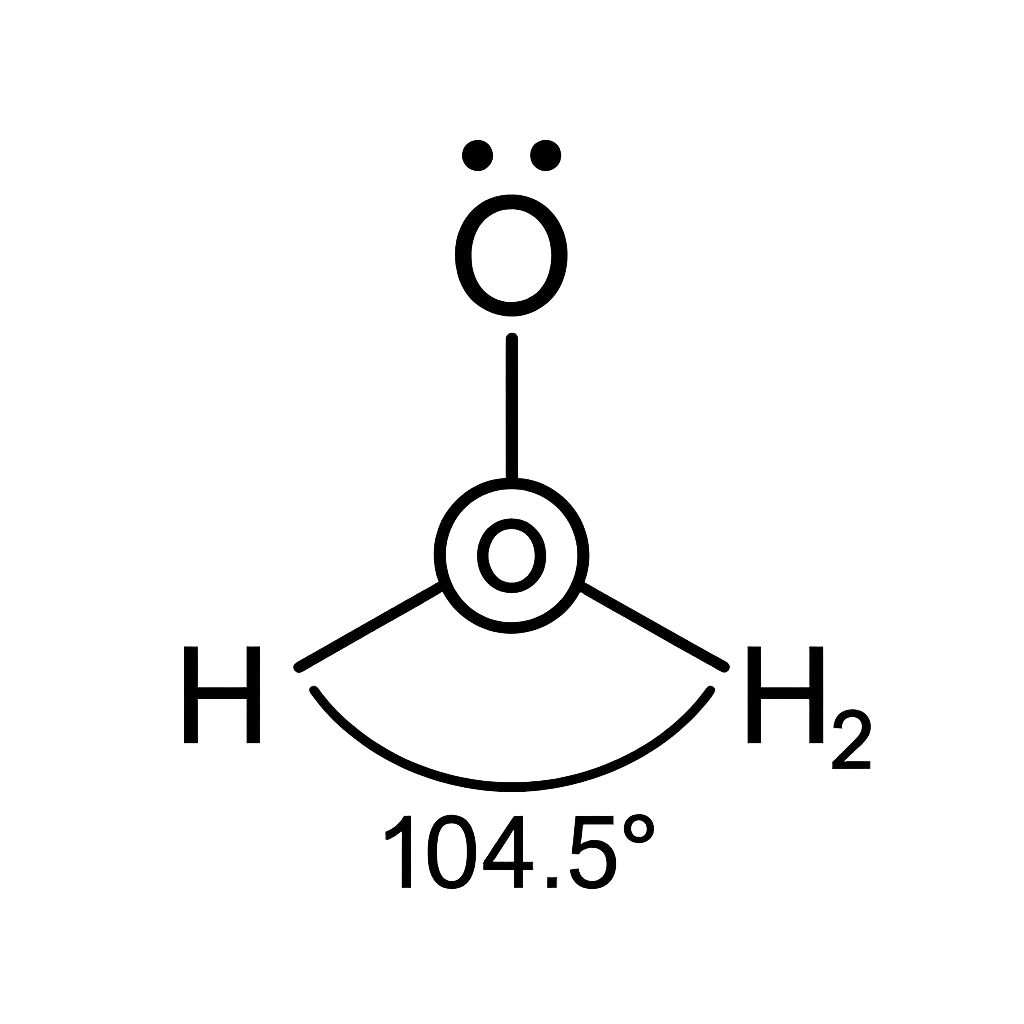
The diagram shows a water molecule. The oxygen atom is bonded to two hydrogen atoms at a bond angle of \(104.5^{\circ}\) and possesses two lone pairs.
Correct A. sp³ hybridisation; bent (angular) geometry
B. sp hybridisation; linear geometry
C. sp² hybridisation; trigonal planar geometry
D. sp³d hybridisation; tetrahedral geometry

Correct Answer: A

Want to see the full step-by-step solution? Unlock AI Explanation & Analytics
Question 4 View Details
Among the elements potassium (K), calcium (Ca) and scandium (Sc), which has the smallest atomic radius? Explain your answer using periodic trends.
A. Scandium (Sc) has the largest atomic radius.
B. Potassium (K) has the smallest atomic radius.
Correct C. Scandium (Sc) has the smallest atomic radius.
D. Calcium (Ca) has the smallest atomic radius.

Correct Answer: C

Want to see the full step-by-step solution? Unlock AI Explanation & Analytics
Question 5 View Details
Anisole (\(C_7H_8O\), \(M = 108\ \text{g mol}^{-1}\)) is nitrated with excess \(\mathrm{HNO_3/H_2SO_4}\). The methoxy group is an ortho/para‑directing, activating substituent. The reaction gives 70 % ortho‑nitroanisole and 30 % para‑nitroanisole by mass. Calculate the mass of para‑nitroanisole obtained when 10.0 g of anisole is used. (Molar mass of para‑nitroanisole = 153 g mol\(^{-1}\)).
A. 5.2 g
B. 2.5 g
C. 3.9 g
Correct D. 4.3 g

Correct Answer: D

Want to see the full step-by-step solution? Unlock AI Explanation & Analytics
Question 6 View Details
The reaction between potassium dichromate, iron(II) sulphate and sulphuric acid can be represented as \(\ce{K2Cr2O7 + FeSO4 + H2SO4 -> Cr2(SO4)3 + Fe2(SO4)3 + K2SO4 + H2O}\).\nBalance the equation and then calculate the mass of \(\ce{Fe2(SO4)3}\) that would be formed when \(2.00\) g of \(\ce{K2Cr2O7}\) are used, assuming 100 % yield.
A. 7.45 g
Correct B. 8.16 g
C. 9.23 g
D. 5.12 g

Correct Answer: B

Want to see the full step-by-step solution? Unlock AI Explanation & Analytics
Question 7 View Details
A galvanic cell is constructed with a copper electrode immersed in a \(0.010\) M \(\ce{Cu^{2+}}\) solution and an iron electrode immersed in a solution that contains \(0.10\) M \(\ce{Fe^{2+}}\) and an unknown concentration \(x\) of \(\ce{Fe^{3+}}\). The standard reduction potentials are \(E^{\circ}_{\ce{Cu^{2+}/Cu}} = +0.34\) V and \(E^{\circ}_{\ce{Fe^{3+}/Fe^{2+}}} = +0.77\) V. The measured cell emf at 25 °C is \(0.42\) V. Determine the concentration \(x\) of \(\ce{Fe^{3+}}\) in the solution.
A. 9.5×10⁻⁴ M
B. 1.2×10⁻² M
Correct C. 6.8×10⁻³ M
D. 4.2×10⁻³ M

Correct Answer: C

Want to see the full step-by-step solution? Unlock AI Explanation & Analytics
Question 8 View Details
A liquid has a vapor pressure of \(0.40\) atm at \(298\) K and \(1.20\) atm at \(318\) K. Assuming the enthalpy of vaporisation is constant over this temperature range, use the Clausius-Clapeyron equation to estimate its normal boiling point (the temperature at which the vapor pressure equals \(1.00\) atm).
A. 38 °C
B. 45 °C
Correct C. 42 °C
D. 50 °C

Correct Answer: C

Want to see the full step-by-step solution? Unlock AI Explanation & Analytics
Question 9 View Details
In an electrolytic cell containing \(\ce{CuSO4}\) solution, a copper anode and an inert cathode are used. A constant current of \(2.00\) A is passed for \(30.0\) min. Ten percent of the total current is consumed by the side reaction \(\ce{2H2O + 2e- -> H2 + 2OH-}\). Calculate the mass of copper deposited on the cathode.
A. 1.20 g
B. 0.96 g
Correct C. 1.07 g
D. 0.85 g

Correct Answer: C

Want to see the full step-by-step solution? Unlock AI Explanation & Analytics
Question 10 View Details
Solid zinc is placed in a 0.010 M solution of copper(II) nitrate that also contains 0.10 M ammonia. The reaction is \(\ce{Zn(s) + Cu^{2+}(aq) -> Zn^{2+}(aq) + Cu(s)}\). Standard reduction potentials are \(E^{\circ}_{\ce{Cu^{2+}/Cu}} = +0.34\) V and \(E^{\circ}_{\ce{Zn^{2+}/Zn}} = -0.76\) V. Ammonia complexes copper(II) according to \(\ce{Cu^{2+} + 4NH3 <=> [Cu(NH3)4]^{2+}}\) with a formation constant \(K_f = 1.0\times10^{13}\). Assuming the total copper(II) concentration remains 0.010 M, calculate the cell potential under these conditions at 25 °C (ignore activity coefficients).
Correct A. 0.774 V
B. 0.654 V
C. 0.834 V
D. 0.594 V

Correct Answer: A

Want to see the full step-by-step solution? Unlock AI Explanation & Analytics
Question 11 View Details
A 0.250 L solution contains 0.020 mol of acetic acid \(\text{CH}_3\text{COOH}\) (Ka = 1.8\times10^{-5}) and 0.015 mol of its sodium salt \(\text{CH}_3\text{COONa}\). After adding 0.005 mol of \(\text{HCl}\), what is the pH of the solution? Give your answer to two decimal places.
A. 4.85
Correct B. 4.35
C. 3.95
D. 5.15

Correct Answer: B

Want to see the full step-by-step solution? Unlock AI Explanation & Analytics
Question 12 View Details
The vapour pressure of liquid X at 350 K is 0.45 atm. Its enthalpy of vapourisation is 30 kJ·mol⁻¹. Estimate the vapour pressure at 380 K using the Clausius-Clapeyron equation (assume \(\Delta H_{vap}\) is constant). Give your answer in atm to two significant figures.
A. 0.85
Correct B. 1.0
C. 0.65
D. 1.2

Correct Answer: B

Want to see the full step-by-step solution? Unlock AI Explanation & Analytics
Question 13 View Details
The electron configuration \([\text{Ar}]\,4s^{2}\,3d^{10}\,4p^{2}\) corresponds to which element? State the element's name, its group number, period number and the two most common oxidation states of the element.
A. Silicon, group 14, period 3, oxidation states +2 and +4
B. Germanium, group 13, period 4, oxidation states +1 and +3
Correct C. Germanium, group 14, period 4, oxidation states +2 and +4
D. Tin, group 14, period 5, oxidation states +2 and +4

Correct Answer: C

Want to see the full step-by-step solution? Unlock AI Explanation & Analytics
Question 14 View Details
A 0.500 L solution contains 0.050 mol of benzoic acid \(\text{C}_6\text{H}_5\text{COOH}\) (Ka = 6.3\times10^{-5}) and 0.050 mol of p‑nitrobenzoic acid \(\text{p‑NO}_2\text{C}_6\text{H}_4\text{COOH}\) (Ka = 4.5\times10^{-4}). Assuming the acids do not interact, calculate the pH of the solution. Give your answer to two decimal places.
A. 2.45
Correct B. 2.15
C. 2.05
D. 1.95

Correct Answer: B

Want to see the full step-by-step solution? Unlock AI Explanation & Analytics
Question 15 View Details
A 5.00 L container at 298 K contains 0.250 mol of an ideal gas. The gas is first compressed isothermally until the pressure reaches 2.00 atm. Then the temperature is raised to 350 K while the volume is kept constant. What is the final pressure of the gas? Give your answer in atm to two decimal places.
Correct A. 2.35
B. 2.10
C. 2.80
D. 2.55

Correct Answer: A

Want to see the full step-by-step solution? Unlock AI Explanation & Analytics
Question 16 View Details
A hydrocarbon of unknown formula is completely combusted. The combustion of a sample produces 44.8 g of \( \mathrm{CO_2} \) and 18.0 g of \( \mathrm{H_2O} \). The molar mass of the hydrocarbon is 114 g·mol\(^{-1}\). Determine its molecular formula.
A. C8H14
B. C9H20
Correct C. C8H16
D. C7H14

Correct Answer: C

Want to see the full step-by-step solution? Unlock AI Explanation & Analytics
Question 17 View Details
A river at 25 °C contains dissolved oxygen (DO) measured at 10.0 mg L\(^{-1}\). The solubility of O\(_2\) at this temperature is given by Henry's constant \(k_H = 1.3\times10^{-3}\,\text{mol L}^{-1}\,\text{atm}^{-1}\) and the partial pressure of O\(_2\) in air is 0.21 atm. (a) State whether the water is supersaturated with respect to O\(_2\) and calculate the excess O\(_2\) concentration (mg L\(^{-1}\)). (b) If a degassing unit removes excess O\(_2\) at a rate of 0.5 mg L\(^{-1}\) min\(^{-1}\), how long (to one decimal place) will it take to bring the DO down to equilibrium?
Correct A. Excess O2 = 1.3 mg L⁻¹; time = 2.5 min
B. Excess O2 = 2.1 mg L⁻¹; time = 1.2 min
C. Excess O2 = 0.9 mg L⁻¹; time = 3.0 min
D. Excess O2 = 1.3 mg L⁻¹; time = 4.0 min

Correct Answer: A

Want to see the full step-by-step solution? Unlock AI Explanation & Analytics
Question 18 View Details
A solution at 78 °C contains 40.0 g of ethanol (\( \mathrm{C_2H_5OH} \), \(M = 46.07\) g mol\(^{-1}\)) and 60.0 g of water (\(M = 18.02\) g mol\(^{-1}\)). The vapour pressures of pure ethanol and pure water at this temperature are 0.40 atm and 0.30 atm respectively. Assuming the solution behaves ideally, calculate (a) the mole fraction of ethanol in the liquid, (b) the total vapour pressure above the solution, and (c) the mole fraction of ethanol in the vapour phase.
A. x_E = 0.215; P_total = 0.329 atm; y_E = 0.267
Correct B. x_E = 0.207; P_total = 0.321 atm; y_E = 0.258
C. x_E = 0.190; P_total = 0.312 atm; y_E = 0.240
D. x_E = 0.207; P_total = 0.300 atm; y_E = 0.230

Correct Answer: B

Want to see the full step-by-step solution? Unlock AI Explanation & Analytics
Question 19 View Details
Calcium carbonate (\( \mathrm{CaCO_3} \)) reacts with excess hydrochloric acid according to \( \mathrm{CaCO_3 + 2HCl \rightarrow CaCl_2 + CO_2 + H_2O}. \) A 5.0 g sample of \( \mathrm{CaCO_3} \) is completely reacted and the carbon dioxide produced is collected over water at 25 °C, 760 mm Hg total pressure. The vapour pressure of water at this temperature is 23.8 mm Hg and the volume of dry \( \mathrm{CO_2} \) collected is 1.20 L. Calculate the percentage yield of \( \mathrm{CO_2} \) based on the theoretical yield.
A. 85 %
B. 90 %
C. 100 %
Correct D. 95 %

Correct Answer: D

Want to see the full step-by-step solution? Unlock AI Explanation & Analytics
Question 20 View Details
Using the data below, apply a Born-Haber cycle to determine the enthalpy of sublimation of sodium metal, \( \Delta H_{\text{sub}}(\mathrm{Na}) \). Data (all per mole of substance unless stated): sublimation of solid chlorine, \( \Delta H_{\text{sub}}(\mathrm{Cl_2(s)}) = 58\) kJ mol\(^{-1}\); bond dissociation energy, \( D(\mathrm{Cl-Cl}) = 242\) kJ mol\(^{-1}\); ionisation energy of Na, \( IE(\mathrm{Na}) = 496\) kJ mol\(^{-1}\); electron affinity of chlorine, \( EA(\mathrm{Cl}) = -349\) kJ mol\(^{-1}\); lattice energy of NaCl, \( U_{\text{latt}}(\mathrm{NaCl}) = -787\) kJ mol\(^{-1}\); standard enthalpy of formation of NaCl(s), \( \Delta H_f^{\circ}(\mathrm{NaCl}) = -411\) kJ mol\(^{-1}\). Calculate \( \Delta H_{\text{sub}}(\mathrm{Na}) \) in kJ mol\(^{-1}\).
A. -41 kJ mol⁻¹
Correct B. 79 kJ mol⁻¹
C. 58 kJ mol⁻¹
D. 112 kJ mol⁻¹

Correct Answer: B

Want to see the full step-by-step solution? Unlock AI Explanation & Analytics
Question 21 View Details
A 5.00 g sample of cyclohexanol (\(\mathrm{C_6H_{12}O}\), M = 100.16 g mol\(^{-1}\)) is oxidised with potassium dichromate in acidic medium according to the equation \(3\,\mathrm{C_6H_{12}O} + \mathrm{K_2Cr_2O_7} + 4\,\mathrm{H_2SO_4} \rightarrow 3\,\mathrm{C_6H_{11}COOH} + \mathrm{Cr_2(SO_4)_3} + \mathrm{K_2SO_4} + 7\,\mathrm{H_2O}\). If 0.025 mol of \(\mathrm{K_2Cr_2O_7}\) is used and 4.20 g of cyclohexanecarboxylic acid (\(\mathrm{C_7H_{12}O_2}\), M = 128.17 g mol\(^{-1}\)) is isolated, calculate the percentage yield of the oxidation.
A. 58.3 %
B. 72.1 %
C. 81.5 %
Correct D. 65.7 %

Correct Answer: D

Want to see the full step-by-step solution? Unlock AI Explanation & Analytics
Question 22 View Details
A buffer is prepared by dissolving 0.20 mol of acetic acid (\(\mathrm{CH_3COOH}\), \(pK_a = 4.76\)) and 0.15 mol of sodium acetate (\(\mathrm{CH_3COONa}\)) in enough water to make 1.0 L of solution. Then 0.050 mol of hydrochloric acid (\(\mathrm{HCl}\)) is added. Assuming the volume change is negligible, calculate the pH of the resulting solution.
A. 5.03
Correct B. 4.36
C. 4.78
D. 4.12

Correct Answer: B

Want to see the full step-by-step solution? Unlock AI Explanation & Analytics
Question 23 View Details
For the molecule xenon difluoride (\(\mathrm{XeF_2}\)), determine (a) the steric number of xenon, (b) the hybridisation of the xenon atom, and (c) the molecular geometry, giving the bond angle between the two fluorine atoms.
A. Steric number = 5; hybridisation = sp³d; geometry = bent; F-Xe-F angle = 104.5°
Correct B. Steric number = 5; hybridisation = sp³d; geometry = linear; F-Xe-F angle = 180°
C. Steric number = 6; hybridisation = sp³d²; geometry = octahedral; F-Xe-F angle = 90°
D. Steric number = 4; hybridisation = sp³; geometry = trigonal planar; F-Xe-F angle = 120°

Correct Answer: B

Want to see the full step-by-step solution? Unlock AI Explanation & Analytics
Question 24 View Details
In a 1.0 L reaction vessel, 0.10 mol of ethanol (\(\mathrm{CH_3CH_2OH}\)) and 0.10 mol of 2‑propanol (\(\mathrm{(CH_3)_2CHOH}\)) are mixed with 0.20 mol of acetic acid (\(\mathrm{CH_3COOH}\)). Both alcohols undergo esterification with the acid to give ethyl acetate and isopropyl acetate respectively. Each esterification has an equilibrium constant \(K = 4.0\) at 25 °C. Assuming the two equilibria are independent but share the same pool of acetic acid, calculate the total amount (in moles) of ester formed at equilibrium.
A. 0.100 mol
B. 0.080 mol
Correct C. 0.069 mol
D. 0.050 mol

Correct Answer: C

Want to see the full step-by-step solution? Unlock AI Explanation & Analytics
Question 25 View Details
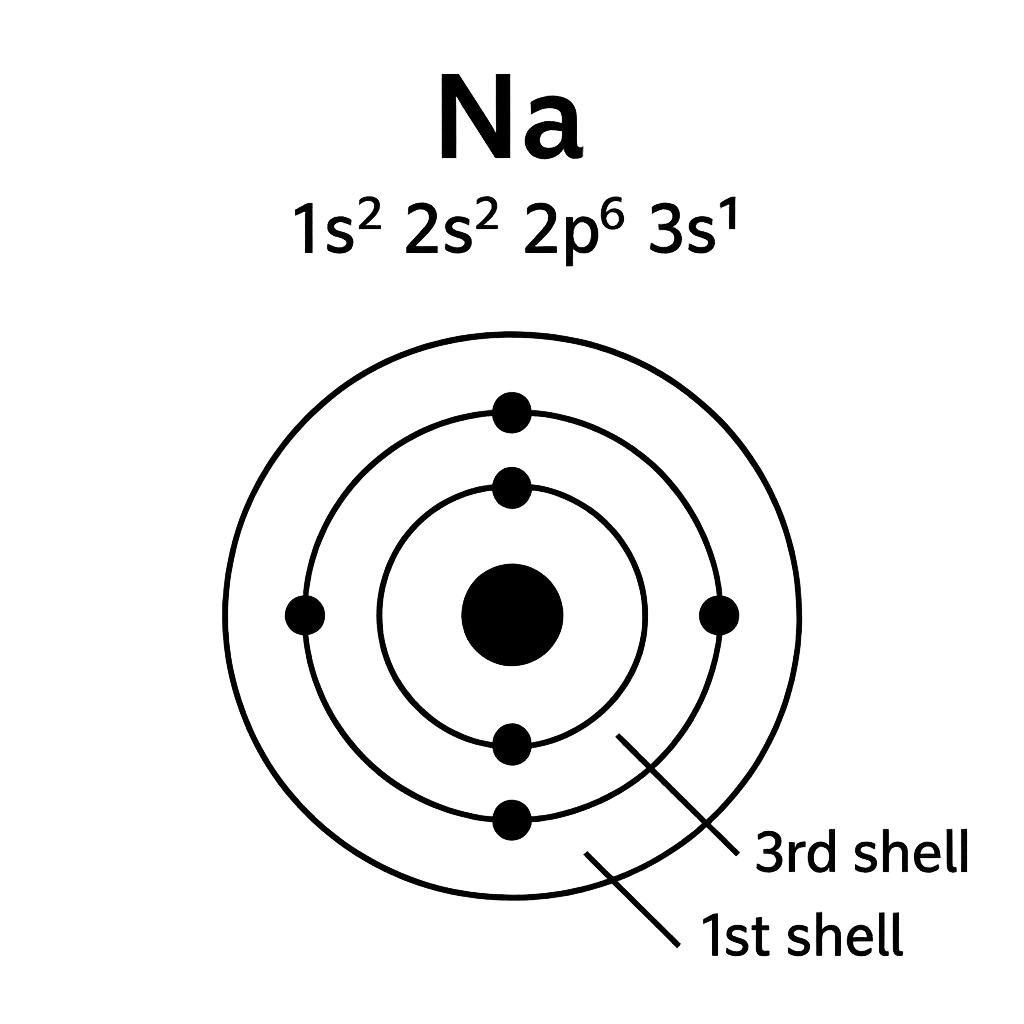
The diagram shows the Bohr model of a sodium atom (\(Z = 11\)). The first shell contains 2 electrons, the second shell contains 8 electrons, and the third shell contains 1 electron. Using the diagram, state (a) the number of electrons in the outermost shell and (b) the oxidation state of sodium in its common ionic form.
A. 2 electrons; oxidation state +2
B. 3 electrons; oxidation state +1
C. 1 electron; oxidation state 0
Correct D. 1 electron; oxidation state +1

Correct Answer: D

Want to see the full step-by-step solution? Unlock AI Explanation & Analytics

Master the Exam!

You've seen a preview, but there are thousands more questions plus AI tutor to break down complex solutions.

Unlock Full Access Available for Android & Windows
Help others prepare! Share this practice hub:
Chat with Support