gce model questions vol1 2018 biology | Objective

Prepare for your exams with gce model questions vol1 questions? Reviewing past/model questions is one of the most effective ways to guarantee a high score. This practice hub features authentic 2018 biology (Objective) questions designed to simulate the real exam environment.

Practice these randomly selected questions to test your readiness.

Question 1 View Details
At sea level the barometric pressure is 760 mm Hg. A climber ascends to a altitude where the barometric pressure is 640 mm Hg. The fraction of oxygen in dry air is 0.21 and the water vapour pressure in the alveoli is 47 mm Hg. Using the alveolar gas equation \(PAO_2 = F_{iO_2}(P_b - P_{H_2O}) - \frac{P_{aCO_2}}{R}\) with \(P_{aCO_2}=40\) mm Hg and respiratory quotient \(R=0.8\), calculate the alveolar partial pressure of oxygen \(PAO_2\) (in mm Hg).
A. 81.0 mm Hg (approximately)
B. 68.2 mm Hg (approximately)
Correct C. 74.5 mm Hg (approximately)
D. 95.3 mm Hg (approximately)

Correct Answer: C

Want to see the full step-by-step solution? Unlock AI Explanation & Analytics
Question 2 View Details
A motor neuron's axon is 0.5 m long. When the axon is myelinated an impulse travels at 80 m s\(^{-1}\); when it is demyelinated the speed falls to 20 m s\(^{-1}\). A simple reflex requires the impulse to travel from the spinal cord to the muscle and back along the same axon. Calculate (a) the total time taken for the reflex when the axon is myelinated and when it is demyelinated, (b) the difference in time between the two conditions, and (c) the percentage increase in time caused by demyelination.
A. The reflex takes 13 ms when myelinated and 52 ms when demyelinated; the demyelinated condition is 39 ms slower, a 300 % increase.
B. The reflex takes 14 ms when myelinated and 56 ms when demyelinated; the demyelinated condition is 42 ms slower, a 300 % increase.
C. The reflex takes 10 ms when myelinated and 40 ms when demyelinated; the demyelinated condition is 30 ms slower, a 300 % increase.
Correct D. The reflex takes 12.5 ms when myelinated and 50 ms when demyelinated; the demyelinated condition is 37.5 ms slower, a 300 % increase.

Correct Answer: D

Want to see the full step-by-step solution? Unlock AI Explanation & Analytics
Question 3 View Details
Blood flow through a small artery can be approximated by Poiseuille's law \(Q = \frac{\pi \Delta P r^{4}}{8 \eta L}\). The artery has a radius of 0.5 mm, length 10 cm and blood viscosity \( \eta = 3.5 \times 10^{-3}\) Pa·s. If the radius is reduced by 20 % due to vasoconstriction while the pressure gradient \(\Delta P\) and length remain unchanged, what is the percentage change in the flow rate \(Q\)?
Correct A. ≈ 59 % decrease in flow
B. ≈ 41 % decrease in flow
C. ≈ 80 % decrease in flow
D. ≈ 59 % increase in flow

Correct Answer: A

Want to see the full step-by-step solution? Unlock AI Explanation & Analytics
Question 4 View Details
During mitosis, at which stage do sister chromatids separate and move toward opposite poles of the cell?
A. Telophase
B. Metaphase
Correct C. Anaphase
D. Prophase

Correct Answer: C

Want to see the full step-by-step solution? Unlock AI Explanation & Analytics
Question 5 View Details
Two genes, A and B, are located on the same chromosome with a recombination frequency of 10 %. An individual heterozygous for both genes has the cis arrangement AB/ab. This individual is crossed with a homozygous recessive aabb individual. What proportion of the offspring are recombinant (i.e., have genotype Ab or aB)?
A. 20 % of the offspring are recombinant
B. 15 % of the offspring are recombinant
Correct C. 10 % of the offspring are recombinant
D. 5 % of the offspring are recombinant

Correct Answer: C

Want to see the full step-by-step solution? Unlock AI Explanation & Analytics
Question 6 View Details
In a terrestrial ecosystem, the primary producers generate (10\,000\) MJ of energy per year. Energy is transferred to primary consumers with an efficiency of \(10\%\), from primary to secondary consumers with an efficiency of \(15\%\), and from secondary to tertiary consumers with an efficiency of \(20\%\). If a particular tertiary predator species consumes \(5\%\) of the total secondary‑consumer biomass, calculate the amount of energy (in MJ) available to that predator each year.
A. 12.5 MJ
B. 0.75 MJ
Correct C. 7.5 MJ
D. 75 MJ

Correct Answer: C

Want to see the full step-by-step solution? Unlock AI Explanation & Analytics
Question 7 View Details
A simple reflex arc involves a sensory neuron 0.8 m long conducting at 60 m s\(^{-1}\), an interneuron 0.2 m long conducting at 30 m s\(^{-1}\), and a motor neuron 0.5 m long conducting at 50 m s\(^{-1}\). Each synapse in the pathway introduces a delay of 0.5 ms. After the reflex, the foot moves forward at 2 m s\(^{-1}\) for 0.1 s and then returns to its original position at the same speed. Determine the total time, in milliseconds, from the moment the stimulus is applied until the foot is back at its starting point.
Correct A. 231 ms
B. 241 ms
C. 221 ms
D. 200 ms

Correct Answer: A

Want to see the full step-by-step solution? Unlock AI Explanation & Analytics
Question 8 View Details
A cylindrical blood‑vessel segment is 0.5 cm long and has an initial radius of 0.02 cm. The blood viscosity is \(3.5\times10^{-3}\) Pa·s and the volumetric flow rate is \(5\times10^{-6}\) m\(^3\) s\(^{-1}\). If vasoconstriction reduces the radius by 20 % while the flow rate remains unchanged, calculate the new pressure drop across the segment (in pascals) using Poiseuille's law.
A. 5.1×10^5 Pa
B. 4.2×10^5 Pa
Correct C. 3.4×10^5 Pa
D. 2.8×10^5 Pa

Correct Answer: C

Want to see the full step-by-step solution? Unlock AI Explanation & Analytics
Question 9 View Details
During mitosis, at which stage do the sister chromatids separate and move toward opposite poles of the cell?
A. Metaphase
B. Prophase
C. Telophase
Correct D. Anaphase

Correct Answer: D

Want to see the full step-by-step solution? Unlock AI Explanation & Analytics
Question 10 View Details
A newly isolated microbe is observed under the microscope to be unicellular, lacks a membrane‑bound nucleus, possesses a cell wall composed of peptidoglycan, reproduces by binary fission, and its metabolism is strictly aerobic. According to the three‑domain system, to which domain and kingdom does this organism belong?
A. Domain Eukarya; Kingdom Protista
Correct B. Domain Bacteria; Kingdom Monera
C. Domain Archaea; Kingdom Archaebacteria
D. Domain Bacteria; Kingdom Protista

Correct Answer: B

Want to see the full step-by-step solution? Unlock AI Explanation & Analytics
Question 11 View Details
Fossil evidence shows that Species A had an average molar length of \(12\) mm \(5\) million years ago, while the modern form has a length of \(18\) mm. Species B's fossil, dated \(2\) million years ago, had a molar length of \(15\) mm and the modern form measures \(21\) mm. Assuming linear change over time, which lineage has the greater evolutionary rate, and what is that rate in mm per million years for the faster lineage?
A. 2.5 mm Myr⁻¹
B. 4.0 mm Myr⁻¹
Correct C. 3.0 mm Myr⁻¹
D. 3.5 mm Myr⁻¹

Correct Answer: C

Want to see the full step-by-step solution? Unlock AI Explanation & Analytics
Question 12 View Details
The total duration of the plant cell cycle is \(24\) h, divided into G1 = \(8\) h, S = \(6\) h, G2 = \(4\) h and M = \(2\) h. In an asynchronous culture, what proportion of cells are expected to be in S phase at any instant?
A. 20 %
Correct B. 25 %
C. 33 %
D. 30 %

Correct Answer: B

Want to see the full step-by-step solution? Unlock AI Explanation & Analytics
Question 13 View Details
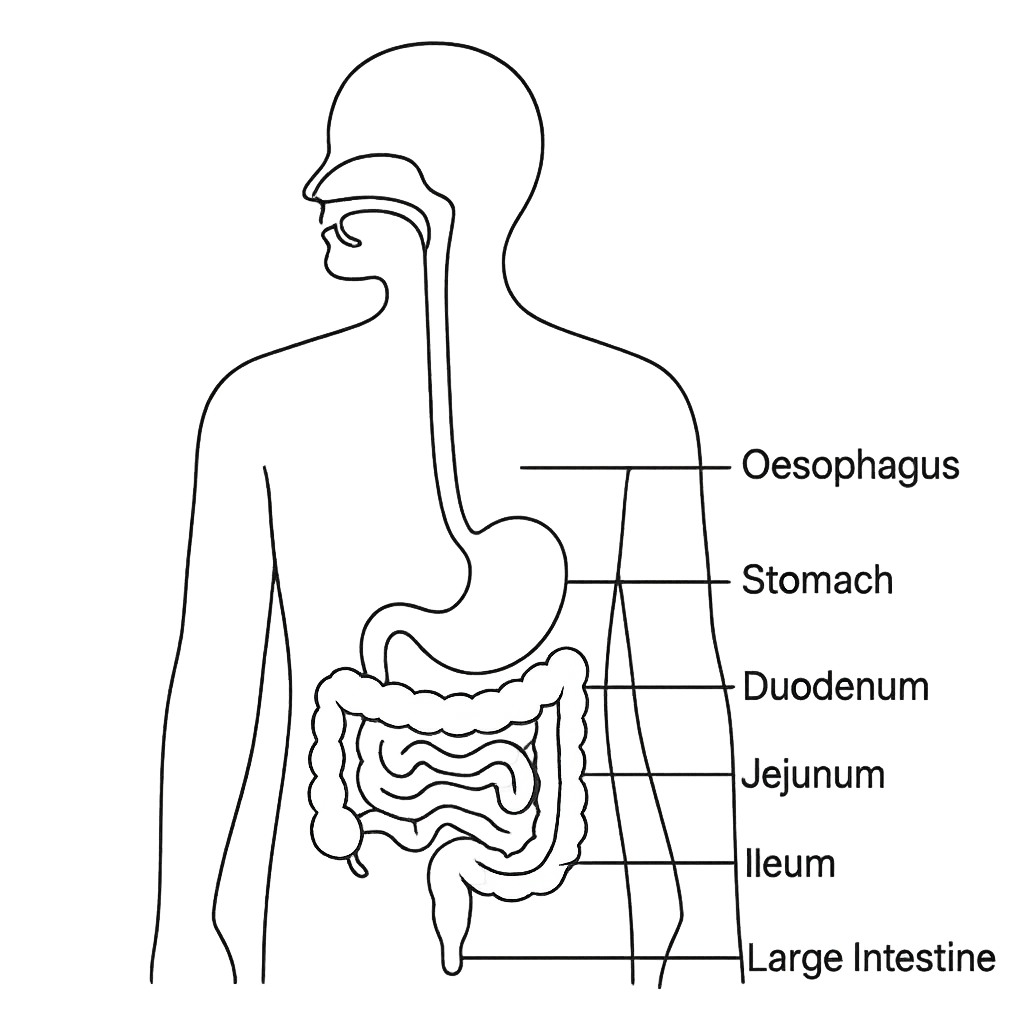
A carbohydrate‑rich meal is ingested. Using the diagram of the human digestive system, identify the region where the majority of carbohydrate digestion occurs, and calculate the percentage of the total length of the small intestine that this region represents, given that the duodenum is \(25\) cm long, the jejunum \(250\) cm and the ileum \(300\) cm.
A. Ileum; 52.2 %
B. Duodenum; 4.3 %
C. Jejunum; 50 %
Correct D. Jejunum; 43.5 %

Correct Answer: D

Want to see the full step-by-step solution? Unlock AI Explanation & Analytics
Question 14 View Details
In a renal clearance test, the plasma concentration of inulin is \(0.10\) g L\(^{-1}\) and the urine concentration is \(12.0\) g L\(^{-1}\). The urine flow rate is \(1.0\) mL min\(^{-1}\). Calculate the glomerular filtration rate (GFR) in mL min\(^{-1}\) using the clearance formula, and state whether it is within the normal adult range (≈125 mL min\(^{-1}\)).
Correct A. 120 mL min⁻¹ (slightly below normal)
B. 115 mL min⁻¹ (slightly below normal)
C. 130 mL min⁻¹ (above normal)
D. 125 mL min⁻¹ (within normal range)

Correct Answer: A

Want to see the full step-by-step solution? Unlock AI Explanation & Analytics
Question 15 View Details
In a dioecious plant population, 60 % of individuals are female and 40 % are male. Among the males, genotype frequencies at a locus are: 25 % homozygous recessive (rr), 50 % heterozygous (Rr) and 25 % homozygous dominant (RR). Each female is pollinated by a randomly chosen male. Assuming Mendelian segregation, what is the probability that a randomly selected seed carries the recessive allele \(r\) from its father?
Correct A. 0.50 (50 %)
B. 0.40 (40 %)
C. 0.25 (25 %)
D. 0.75 (75 %)

Correct Answer: A

Want to see the full step-by-step solution? Unlock AI Explanation & Analytics
Question 16 View Details
A population of a diploid organism has an effective size \(N_{e}=500\). The initial heterozygosity at a neutral locus is \(H_{0}=0.8\). Assuming no mutation, heterozygosity after \(t\) generations follows \(H_{t}=H_{0}\left(1-\frac{1}{2N_{e}}\right)^{t}\). After how many generations will heterozygosity fall below \(0.5\)?
A. 350 generations
B. 400 generations
C. 600 generations
Correct D. 471 generations

Correct Answer: D

Want to see the full step-by-step solution? Unlock AI Explanation & Analytics
Question 17 View Details
During moderate exercise a subject consumes oxygen at a rate of \(1.2\) L min\(^{-1}\). The measured respiratory quotient (RQ) is \(0.85\). Each litre of \(O_{2}\) yields \(20.1\) kJ of metabolic energy. Calculate (a) the total energy expended (in kJ) during a 45‑minute session, (b) the volume of \(CO_{2}\) produced (in litres), and (c) the proportion of the energy derived from carbohydrate versus fat, assuming carbohydrate has \(RQ=1.0\) and fat has \(RQ=0.7\).
A. Energy ≈1000 kJ; CO₂ ≈44.0 L; 55 % carbohydrate, 45 % fat
B. Energy ≈950 kJ; CO₂ ≈42.0 L; 60 % carbohydrate, 40 % fat
C. Energy ≈1150 kJ; CO₂ ≈48.5 L; 40 % carbohydrate, 60 % fat
Correct D. Energy ≈1085 kJ; CO₂ ≈45.9 L; 50 % carbohydrate, 50 % fat

Correct Answer: D

Want to see the full step-by-step solution? Unlock AI Explanation & Analytics
Question 18 View Details
A 30‑year‑old female weighs \(65\) kg and is \(165\) cm tall. Her basal metabolic rate (BMR) is estimated by the Harris‑Benedict equation \(\text{BMR}=655+(9.6\times\text{weight})+(1.8\times\text{height})-(4.7\times\text{age})\) (kcal). She has a moderate activity factor of \(1.55\). She wishes to obtain 15 % of her total energy intake from protein, and each gram of protein provides \(17\) kJ. How many grams of protein should she consume each day? (Round to the nearest gram.)
A. 70 g protein per day
Correct B. 82 g protein per day
C. 78 g protein per day
D. 85 g protein per day

Correct Answer: B

Want to see the full step-by-step solution? Unlock AI Explanation & Analytics
Question 19 View Details
A population of a herbivorous mammal in a closed reserve follows the logistic growth model \(\frac{dN}{dt}=rN\left(1-\frac{N}{K}\right)\). Field observations give a per‑capita growth rate of \(0.06\) month\(^{-1}\) when \(N=200\) and \(0.02\) month\(^{-1}\) when \(N=800\).\n(a) Determine the intrinsic rate of increase \(r\) and the carrying capacity \(K\).\n(b) If a constant harvest of 30 individuals per month is introduced, find the equilibrium population size(s).\n(c) State whether this harvest level is sustainable.
A. One feasible equilibrium at 600 individuals; harvest is not sustainable
Correct B. No feasible equilibrium; harvest is not sustainable
C. One feasible equilibrium at 500 individuals; harvest is sustainable
D. Two equilibria at 300 and 900 individuals; harvest is sustainable

Correct Answer: B

Want to see the full step-by-step solution? Unlock AI Explanation & Analytics
Question 20 View Details
In a mammalian species the average litter size is 6 and the probability that a newborn is male is 0.48. Females reach sexual maturity at 1 year and reproduce once per year for 4 years, after which they die. Starting from a single breeding pair and assuming no mortality other than senescence, estimate the expected total number of individuals in the population after 3 years.
Correct A. Approximately 39 individuals
B. Approximately 45 individuals
C. Approximately 52 individuals
D. Approximately 34 individuals

Correct Answer: A

Want to see the full step-by-step solution? Unlock AI Explanation & Analytics
Question 21 View Details
Two desert plants are compared for water‑use efficiency (WUE). Plant C is a cactus that uses CAM photosynthesis; its net photosynthetic rate is \(5 \;\mu\text{mol CO}_2\,\text{m}^{-2}\,\text{s}^{-1}\) and its stomatal conductance is \(0.05 \;\text{mol H}_2\text{O}\,\text{m}^{-2}\,\text{s}^{-1}\). Plant S is a shrub that uses the C\(_3\) pathway; its net photosynthetic rate is \(12 \;\mu\text{mol CO}_2\,\text{m}^{-2}\,\text{s}^{-1}\) and its stomatal conductance is \(0.15 \;\text{mol H}_2\text{O}\,\text{m}^{-2}\,\text{s}^{-1}\). Both plants experience the same ambient temperature of \(35^{\circ}\text{C}\) and relative humidity of \(30\%\). The saturation vapour pressure (kPa) at temperature \(T\) (°C) can be approximated by \(e_s = 0.6108\,\exp\!\left(\dfrac{17.27T}{T+237.3}\right)\). Transpiration rate \(E\) (mol m\(^{-2}\) s\(^{-1}\)) is given by \(E = g_s \times \text{VPD}\), where VPD = \(e_s - e_a\) and \(e_a = \text{RH}\times e_s/100\). Calculate the WUE for each plant (\(\text{WUE}=A/E\)) and state which plant has the higher WUE.
A. The cactus (Plant C) has the higher WUE (≈3.2×10⁻⁵ mol CO₂ mol⁻¹ H₂O) compared with the shrub.
Correct B. The cactus (Plant C) has the higher WUE (≈2.5×10⁻⁵ mol CO₂ mol⁻¹ H₂O) compared with the shrub.
C. The shrub (Plant S) has the higher WUE (≈2.5×10⁻⁵ mol CO₂ mol⁻¹ H₂O) compared with the cactus.
D. The shrub (Plant S) has the higher WUE (≈1.8×10⁻⁵ mol CO₂ mol⁻¹ H₂O) compared with the cactus.

Correct Answer: B

Want to see the full step-by-step solution? Unlock AI Explanation & Analytics
Question 22 View Details
In a batch culture, the initial bacterial count is \(N_0 = 1.0 \times 10^{3}\) cells. After 6 h, the population under Condition A reaches \(N_A = 8.0 \times 10^{5}\) cells, whereas under Condition B it reaches \(N_B = 2.0 \times 10^{5}\) cells. Assuming exponential growth, the number of generations \(g\) in time \(t\) satisfies \(N = N_0 \times 2^{t/g}\). Determine the generation time (in hours) for each condition and indicate which condition supports faster bacterial growth.
Correct A. Condition A: generation time ≈ 0.62 h; Condition B: generation time ≈ 0.79 h. Condition A grows faster.
B. Condition A: generation time ≈ 0.75 h; Condition B: generation time ≈ 0.62 h. Condition B grows faster.
C. Condition A: generation time ≈ 0.62 h; Condition B: generation time ≈ 0.79 h. Both conditions grow at the same rate.
D. Condition A: generation time ≈ 0.55 h; Condition B: generation time ≈ 0.90 h. Condition A grows faster.

Correct Answer: A

Want to see the full step-by-step solution? Unlock AI Explanation & Analytics
Question 23 View Details
A mixed bacterial population contains \(1.0 \times 10^{8}\) cells. Among them, \(5.0 \times 10^{5}\) are donor cells that carry a plasmid conferring antibiotic resistance. Conjugation occurs when a donor contacts a recipient; the probability of successful plasmid transfer per donor‑recipient contact is \(5 \times 10^{-7}\) per hour. Each donor makes one random contact per hour. Simultaneously, free plasmid DNA is present at a concentration of \(10\) ng ml\(^{-1}\) (≈\(1.5 \times 10^{10}\) copies ml\(^{-1}\)). The probability that a recipient cell takes up a DNA copy per hour is \(2 \times 10^{-8}\). Over a period of 4 h, calculate the expected number of newly resistant cells produced by (i) conjugation and (ii) transformation, and state which mechanism is likely to generate more resistant cells.
A. Conjugation ≈ 0 new resistant cells; Transformation ≈ 10 new resistant cells. Transformation yields more resistant cells.
B. Conjugation ≈ 1 new resistant cell; Transformation ≈ 4 new resistant cells. Conjugation yields more resistant cells.
Correct C. Conjugation ≈ 1 new resistant cell; Transformation ≈ 8 new resistant cells. Transformation yields more resistant cells.
D. Conjugation ≈ 2 new resistant cells; Transformation ≈ 5 new resistant cells. Conjugation yields more resistant cells.

Correct Answer: C

Want to see the full step-by-step solution? Unlock AI Explanation & Analytics
Question 24 View Details
In a case‑control study of lung disease, 2000 participants were classified by smoking status and disease outcome as follows: - Smokers: 800 individuals, 120 developed lung disease. - Non‑smokers: 1200 individuals, 30 developed lung disease. (a) Calculate the relative risk (RR) of lung disease for smokers compared with non‑smokers. (b) Determine the attributable risk percent (AR%) among smokers. (c) Compute the population attributable fraction (PAF) for the whole study population. Present your answers to two decimal places where appropriate.
A. RR = 4.50; AR% = 77.78 %; PAF = 55.56 %.
Correct B. RR = 6.00; AR% = 83.33 %; PAF = 66.67 %.
C. RR = 5.00; AR% = 80.00 %; PAF = 60.00 %.
D. RR = 6.00; AR% = 75.00 %; PAF = 70.00 %.

Correct Answer: B

Want to see the full step-by-step solution? Unlock AI Explanation & Analytics
Question 25 View Details
The following five terrestrial plants are described by their key characteristics: 1. Moss - non‑vascular, reproduces via spores, lacks true leaves. 2. Fern - vascular, reproduces via spores, has true leaves (fronds). 3. Pine - vascular, seed plant, gymnosperm, needle‑like leaves, no flowers. 4. Rose - vascular, seed plant, angiosperm, broad leaves, produces flowers. 5. Liverwort - non‑vascular, thallus body, reproduces via spores, lacks true leaves. Construct a dichotomous key that separates these five plants using the traits above, and then use your key to identify the plant that is vascular, reproduces via spores, and possesses true leaves.
A. Pine (item 3).
B. Rose (item 4).
C. Moss (item 1).
Correct D. Fern (item 2).

Correct Answer: D

Want to see the full step-by-step solution? Unlock AI Explanation & Analytics

Master the Exam!

You've seen a preview, but there are thousands more questions plus AI tutor to break down complex solutions.

Unlock Full Access Available for Android & Windows
Help others prepare! Share this practice hub:
Chat with Support