gce model questions vol1 2018 agricultural_science | Essay

Prepare for your exams with gce model questions vol1 questions? Reviewing past/model questions is one of the most effective ways to guarantee a high score. This practice hub features authentic 2018 agricultural_science (Essay) questions designed to simulate the real exam environment.

Practice these randomly selected questions to test your readiness.

Question 1 View Details
Discuss how ecological principles can be applied to achieve sustainable crop production in a typical Nigerian farm.
Question Parts
(a)
Explain the concepts of biodiversity and ecological succession and how they influence soil fertility and pest regulation.
(b)
Identify two major ecological problems that arise from intensive monoculture and propose one agronomic practice for each problem that restores ecological balance.
(c)
Using the example of a mixed‑cropping system, illustrate how resource use efficiency (e.g., water, nutrients) can be improved compared with a single‑crop system.
Detailed Essay Solution & Marking Scheme Available

Get the step-by-step mathematical proofs, key points required by examiners, and a comprehensive breakdown from our AI Tutor.
Question 2 View Details
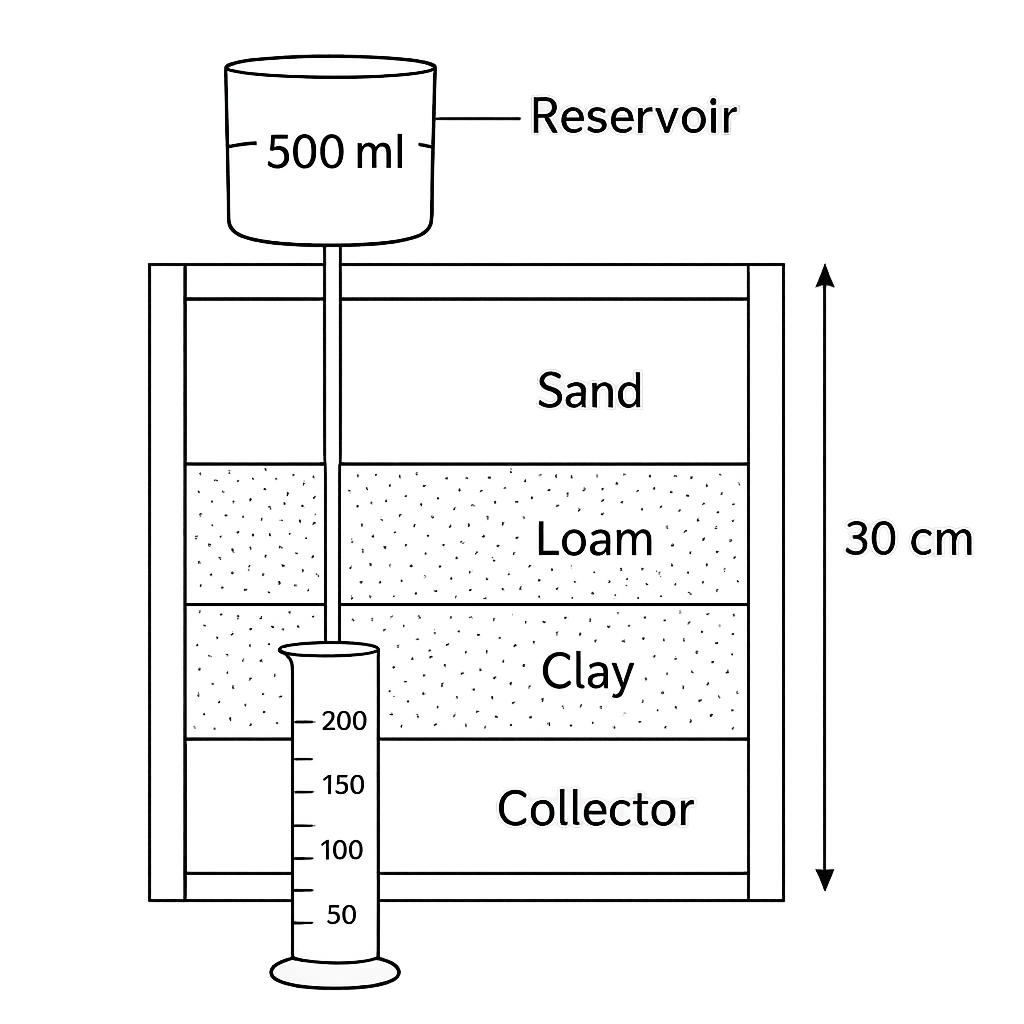
The diagram shows a simple soil‑percolation apparatus used to compare infiltration rates of three common soil textures found in Nigerian farms.
Question Parts
(a)
Identify the three soil layers shown in the apparatus and state the typical infiltration rate (mm h⁻¹) for each layer as given in the accompanying table.
(b)
Calculate the time (in minutes) required for a 100 mm depth of water to percolate completely through each individual layer.
(c)
If 5 % organic matter is incorporated uniformly into the clay layer, its infiltration rate increases by 20 %. Re‑calculate the percolation time for the clay layer under this amendment.
(d)
Based on the results, recommend one management practice for each soil type that would enhance water infiltration on a farm scale.
Detailed Essay Solution & Marking Scheme Available

Get the step-by-step mathematical proofs, key points required by examiners, and a comprehensive breakdown from our AI Tutor.

Question 3 View Details
A soil test of a field intended for maize production gave the following results: pH 5.5, organic matter 2 %, available phosphorus 12 mg kg⁻¹ and potassium 150 mg kg⁻¹. The recommended fertiliser rates for maize are 120 kg N ha⁻¹, 60 kg P₂O₅ ha⁻¹ and 80 kg K₂O ha⁻¹. A commercial NPK fertiliser containing 15 % N, 15 % P₂O₅ and 15 % K₂O is to be used.
Question Parts
(a)
Convert the recommended P₂O₅ and K₂O rates to the equivalent elemental phosphorus (P) and potassium (K) required per hectare.
(b)
Determine the amount of the 15‑15‑15 fertiliser that must be applied per hectare to meet the nitrogen requirement, and state whether the phosphorus and potassium requirements are also satisfied by this amount.
Detailed Essay Solution & Marking Scheme Available

Get the step-by-step mathematical proofs, key points required by examiners, and a comprehensive breakdown from our AI Tutor.

Question 4 View Details
A farmer plans a three‑year crop rotation consisting of maize, soybean (a legume) and a fallow period on a total area of 12 ha. The rotation must contain at least 30 % legume to supply nitrogen biologically. Expected yields are 4 t ha⁻¹ for maize and 2.5 t ha⁻¹ for soybean; fallow produces no crop.
Question Parts
(a)
Allocate the land area to each of the three years so that the legume proportion requirement is satisfied.
(b)
Calculate the total expected production (in tonnes) from the three‑year rotation based on the allocation in part (a).
Detailed Essay Solution & Marking Scheme Available

Get the step-by-step mathematical proofs, key points required by examiners, and a comprehensive breakdown from our AI Tutor.

Question 5 View Details
A farmer has 2 hectares of land and intends to practice a three‑year crop rotation as follows: Year 1 – maize Year 2 – cowpea (a legume) Year 3 – wheat. Average grain yields are expected to be 5 t ha⁻¹ for maize, 2 t ha⁻¹ for cowpea and 4 t ha⁻¹ for wheat. Nitrogen (N) removal with the harvested grain is 25 kg N t⁻¹ for maize and 20 kg N t⁻¹ for wheat. Cowpea fixes 30 kg N ha⁻¹ into the soil during Year 2. The farmer applies synthetic N fertilizer at 120 kg ha⁻¹ in Year 1 and 100 kg ha⁻¹ in Year 3; no fertilizer is applied in Year 2.
Question Parts
(a)
Calculate the total amount of nitrogen removed from the soil by the harvested grain over the three‑year rotation (express the answer in kilograms of N for the whole 2‑ha farm).
(b)
Determine the net change in the soil nitrogen stock after the three years, taking into account fertilizer applications and the nitrogen fixed by the cowpea.
(c)
Discuss two agronomic benefits of including a leguminous crop such as cowpea in the rotation.
Detailed Essay Solution & Marking Scheme Available

Get the step-by-step mathematical proofs, key points required by examiners, and a comprehensive breakdown from our AI Tutor.

Question 6 View Details
A smallholder dairy farmer keeps 20 lactating cows. Each cow averages 15 L of milk per day and has a live weight of 450 kg. The cows are fed a total mixed ration (TMR) that consists of 60 % maize silage (dry matter, DM = 35 %) and 40 % concentrate (DM = 90 %). The TMR is offered at 2.5 % of the cow’s body weight on a dry‑matter basis. The concentrate costs ₦150 kg⁻¹ and the maize silage costs ₦30 kg⁻¹.
Question Parts
(a)
Determine the daily amount (in kilograms, as‑fed) of maize silage and concentrate that each cow receives.
(b)
Calculate the daily feed cost for one cow.
Detailed Essay Solution & Marking Scheme Available

Get the step-by-step mathematical proofs, key points required by examiners, and a comprehensive breakdown from our AI Tutor.

Question 7 View Details
A farmer in northern Nigeria observes damage to his maize crop. The symptoms include small, circular, dead patches on leaves and the presence of a small, brown, soft‑bodied insect on the undersides of leaves. The farmer cultivates 2 hectares of maize with an expected yield of 5 tonnes per hectare. Market price of maize is ₦200 per kilogram. Field inspection shows that about 15 % of the leaf area of the crop is affected by the pest. Assume that for each 1 % of leaf area damaged, the yield is reduced by 0.5 % of the potential yield.
Question Parts
(a)
Identify the pest responsible for the described damage.
(b)
Outline the main stages of the pest’s life cycle that are relevant to control measures.
(c)
Calculate the monetary loss the farmer is likely to incur because of the pest damage.
(d)
Recommend an integrated pest management (IPM) strategy for this pest, explaining why each component is appropriate.
Detailed Essay Solution & Marking Scheme Available

Get the step-by-step mathematical proofs, key points required by examiners, and a comprehensive breakdown from our AI Tutor.

Question 8 View Details
A farmer growing tomatoes in a greenhouse observes wilting, yellowing of lower leaves and a brown discoloration of vascular tissue in several plants. Laboratory analysis confirms the presence of Fusarium oxysporum f. sp. lycopersici. The following disease severity observations were recorded over a 10‑week period (severity expressed as the percentage of plants showing typical wilt symptoms): | Week (t) | Severity (Y) % | |----------|----------------| | 0 | 0 | | 2 | 20 | | 4 | 45 | | 6 | 70 | | 8 | 85 | |10 | 90 | Assume the intervals between observations are equal (2 weeks). The Area Under the Disease Progress Curve (AUDPC) is calculated using the formula: AUDPC = Σ [(Yi + Yi+1)/2] × (ti+1 – ti). For disease pressure classification, use the following thresholds: AUDPC < 100 – low, 100 ≤ AUDPC ≤ 200 – moderate, AUDPC > 200 – high.
Question Parts
(a)
State the name of the disease and the causal pathogen.
(b)
Calculate the AUDPC for the disease using the data provided.
(c)
Classify the disease pressure based on the AUDPC value and justify your classification.
(d)
Propose a comprehensive disease management plan for this situation, covering cultural, chemical, and genetic control measures, and explain the rationale for each.
Detailed Essay Solution & Marking Scheme Available

Get the step-by-step mathematical proofs, key points required by examiners, and a comprehensive breakdown from our AI Tutor.

Question 9 View Details
A commercial broiler farm with a flock of 2,000 birds has recently experienced an outbreak of disease. The affected birds show sudden onset of respiratory distress, swollen wattles, and a high mortality rate within 48 hours. Mortality has reached about 30 % of the flock. The farmer reports that the birds were vaccinated against Newcastle disease but not against any other disease. No recent changes in feed or housing have been noted.
Question Parts
(a)
Identify the most likely disease causing the outbreak and justify your choice based on the clinical signs and vaccination history.
(b)
Explain the pathogenesis of the identified disease in poultry, describing how the organism enters the host, spreads, and produces the observed clinical signs.
(c)
Propose an integrated control strategy for this outbreak, covering immediate, medium‑term and long‑term measures.
(d)
Estimate the direct monetary loss from the mortality reported and discuss two non‑monetary impacts of the outbreak on the farm.
Detailed Essay Solution & Marking Scheme Available

Get the step-by-step mathematical proofs, key points required by examiners, and a comprehensive breakdown from our AI Tutor.

Question 10 View Details
A smallholder intends to start a mixed crop‑livestock enterprise on a 10‑hectare farm. The objectives are to produce enough food for the household, generate cash income, and provide feed for a modest herd of cattle. The farmer has access to a reliable market for maize, beans and live cattle. The following average yields and prices are assumed: - Maize: 2.5 t ha⁻¹ at ₦30,000 per tonne. - Beans: 1.0 t ha⁻¹ at ₦45,000 per tonne. - Pasture (dry matter): 5 t ha⁻¹. Each tonne of dry matter can sustain 0.2 cattle per year. Each mature cattle generates a gross annual income of ₦200,000 (milk, meat and sales). Variable production costs are estimated at: - Maize: ₦50,000 ha⁻¹ - Beans: ₦40,000 ha⁻¹ - Pasture: ₦30,000 ha⁻¹ The farmer wishes to allocate the land among the three enterprises to meet the household’s food needs (minimum 4 t of maize and 0.8 t of beans per year) and keep a herd of at least three cattle. Using the data above, answer the following:
Question Parts
(a)
Propose a realistic allocation of the 10 ha among maize, beans and pasture that satisfies the minimum food and livestock requirements. Explain the reasoning behind the allocation.
(b)
Calculate the expected gross income from each enterprise (maize, beans and cattle) based on the allocation proposed in part (a).
Detailed Essay Solution & Marking Scheme Available

Get the step-by-step mathematical proofs, key points required by examiners, and a comprehensive breakdown from our AI Tutor.

Master the Exam!

You've seen a preview, but there are thousands more questions plus AI tutor to break down complex solutions.

Unlock Full Access Available for Android & Windows
Help others prepare! Share this practice hub:
Chat with Support