gce model questions vol1 2017 agricultural_science | Essay

Prepare for your exams with gce model questions vol1 questions? Reviewing past/model questions is one of the most effective ways to guarantee a high score. This practice hub features authentic 2017 agricultural_science (Essay) questions designed to simulate the real exam environment.

Practice these randomly selected questions to test your readiness.

Question 1 View Details
A mixed‑farming system is being introduced on a 10‑hectare farm in the savanna zone of Nigeria. The farmer plans to grow maize, cowpea and raise goats. The farm includes a small pond, a hedgerow of native trees and a compost heap.
Question Parts
(a)
Explain how rotating maize with cowpea can improve soil fertility, referring specifically to the role of nitrogen fixation.
(b)
Discuss two ecological benefits of retaining the hedgerow of native trees within the farm system.
(c)
The farmer wishes to estimate the water requirement for the maize crop during the growing season. Average evapotranspiration is 5 mm day⁻¹ for 120 days. The pond supplies 60 % of the water while rainfall supplies the remaining 40 %. Six hectares are allocated to maize. Calculate the total volume of water (in cubic metres) that must be drawn from the pond.
Detailed Essay Solution & Marking Scheme Available

Get the step-by-step mathematical proofs, key points required by examiners, and a comprehensive breakdown from our AI Tutor.
Question 2 View Details
A soil scientist sets up a laboratory experiment to investigate how varying percentages of compost added to a loamy soil affect the rate of water infiltration. The apparatus consists of a vertical transparent column 30 cm high divided into three equal sections, each packed with 2 kg of soil mixed with different compost rates: 5 %, 10 % and 15 % by weight. Water is poured into the top of the column at a constant rate of 100 ml min⁻¹. The outflow from the bottom is collected in a graduated cylinder and the time taken for 500 ml to be collected from each section is recorded.
Question Parts
(a)
Using the diagram, describe how the experimental setup ensures that the infiltration rate measured for each compost level is independent of the others.
(b)
The recorded times for 500 ml outflow are: 5 % compost – 8 min, 10 % compost – 6 min, 15 % compost – 4 min. Calculate the infiltration rate (in ml min⁻¹) for each compost level and comment on the trend.
(c)
If the farmer wishes to achieve an infiltration rate of at least 120 ml min⁻¹, estimate the minimum compost percentage (among the tested levels) that meets this target and discuss any practical considerations for field application.
Detailed Essay Solution & Marking Scheme Available

Get the step-by-step mathematical proofs, key points required by examiners, and a comprehensive breakdown from our AI Tutor.

Question 3 View Details
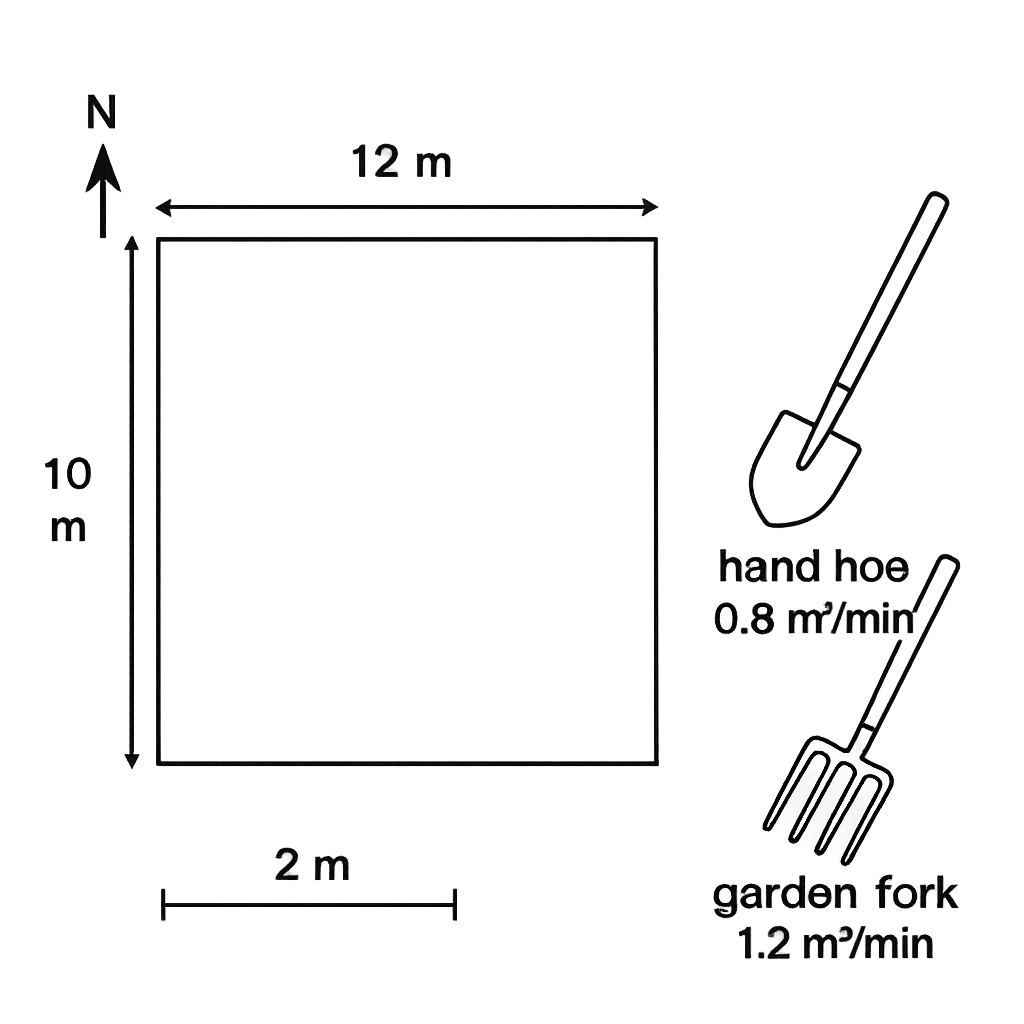
A small vegetable garden is laid out as a rectangular plot measuring 12 m in length and 10 m in width. The farmer intends to prepare the soil using two hand tools shown in the illustration: a hand hoe and a garden fork. The illustration also indicates the area that each tool can effectively work on per minute when used correctly.
Question Parts
(a)
State which of the two tools is more suitable for breaking up compacted soil and justify your choice with reference to the tool’s design and function.
(b)
Outline the correct sequence of actions the farmer should follow when using the selected tool to prepare the entire plot efficiently.
(c)
If manual digging with a spade can treat 0.5 m² per minute, while the selected tool can treat 1.2 m² per minute, calculate the time saved (in minutes) when preparing the whole plot with the selected tool instead of the spade. Show all steps of your calculation.
Detailed Essay Solution & Marking Scheme Available

Get the step-by-step mathematical proofs, key points required by examiners, and a comprehensive breakdown from our AI Tutor.

Question 4 View Details
A small farm uses a compact tractor to pull a single‑bottom disc plough across a field. The illustration shows the tractor, the power‑take‑off (PTO) shaft, the disc plough, and the field dimensions. The tractor travels at a constant speed of 5 km h, the effective working width of the disc plough is 1.5 m, and a field efficiency of 80 % is assumed for turning and overlap.
Question Parts
(a)
Identify the three main components of the power transmission system between the tractor and the plough as shown in the illustration.
(b)
Explain how the tractor’s engine power is transferred to the rotating disc of the plough and why maintaining the correct PTO speed is important.
(c)
Calculate the theoretical field capacity of the tractor‑plough combination in hectares per hour (ha h⁻¹). Show the formula used and each step of the calculation.
(d)
Discuss two advantages of using a tractor‑driven disc plough over manual tillage for a small farm.
Detailed Essay Solution & Marking Scheme Available

Get the step-by-step mathematical proofs, key points required by examiners, and a comprehensive breakdown from our AI Tutor.

Question 5 View Details
A farmer in the Sudan savanna region intends to establish a 2‑ha field for the production of maize (Zea mays) and cowpea (Vigna unguiculata) in a mixed cropping system.
Question Parts
(a)
Explain two agronomic advantages of intercropping maize with cowpea in this environment.
(b)
The recommended seed rate for maize is 25 kg ha⁻¹ and for cowpea 80 kg ha⁻¹. The farmer plans to allocate 60 % of the land to maize and the remaining 40 % to cowpea. Calculate the total quantity of seed (in kg) the farmer must purchase.
(c)
The soil test shows available phosphorus of 12 mg kg⁻¹, which is below the critical level of 20 mg kg⁻¹ for maize. The recommended phosphorus fertilizer application is 30 kg P₂O₅ per ha for the maize portion only. Assuming the fertilizer contains 44 % P₂O₅, determine the mass of fertilizer (in kg) required for the maize area.
(d)
Discuss how the residual nitrogen fixed by cowpea can affect the subsequent sole maize crop, and suggest one management practice to maximise this benefit.
Detailed Essay Solution & Marking Scheme Available

Get the step-by-step mathematical proofs, key points required by examiners, and a comprehensive breakdown from our AI Tutor.

Question 6 View Details
A smallholder in the Guinea savanna keeps a herd of 25 lactating West African Dwarf (WAD) goats. The average daily milk yield per goat is 1.2 L and the average lactation length is 210 days.
Question Parts
(a)
Calculate the total annual milk production (in litres) from the herd.
(b)
The farmer wishes to formulate a concentrate feed that supplies 12 MJ of metabolizable energy (ME) per kg of feed. Each goat requires 2.5 MJ of ME per day from concentrate (the remainder is met by roughage). Determine the total amount of concentrate (in kg) needed for the whole herd over the lactation period.
(c)
If the concentrate costs ₦150 per kg and the farmer sells milk at ₦120 per litre, compute the gross margin (in ₦) from milk sales after deducting the concentrate cost only (ignore other costs).
(d)
Identify two major health challenges commonly affecting lactating WAD goats in this zone and suggest one preventive measure for each.
Detailed Essay Solution & Marking Scheme Available

Get the step-by-step mathematical proofs, key points required by examiners, and a comprehensive breakdown from our AI Tutor.

Question 7 View Details
A farmer has a 2.5 ha maize field that has shown symptoms of leaf rolling, yellowing and the presence of small, white, waxy insects on the undersides of leaves. The farmer suspects a pest problem and wishes to adopt an Integrated Pest Management (IPM) approach.
Question Parts
(a)
Identify the pest most likely responsible for the described symptoms and outline its life cycle, highlighting the stage that causes the most damage to maize.
(b)
Propose an IPM programme for this field, including:
(c)
If the farmer decides to use the recommended insecticide at the dosage of 0.5 L per ha, calculate the total volume of insecticide solution required for the whole field and the amount of active ingredient (in grams) that will be applied.
Detailed Essay Solution & Marking Scheme Available

Get the step-by-step mathematical proofs, key points required by examiners, and a comprehensive breakdown from our AI Tutor.

Question 8 View Details
During the rainy season, a 1‑ha tomato farm in the savanna zone showed irregularly shaped, water‑soaked lesions on lower leaves, later developing into brown, sunken spots on fruits. The farmer recorded the following disease incidence data from five equal 0.2‑ha plots:
Question Parts
(a)
Identify the disease and the causal organism. Describe the disease cycle, emphasizing the role of environmental conditions in its spread.
(b)
Based on the incidence data below, calculate the overall disease incidence for the farm and estimate the potential economic loss, assuming: - Average marketable yield without disease = 30 t ha⁻¹ - Each 1 % increase in disease incidence reduces yield by 0.15 t. - Market price of tomatoes = ₦120 000 t⁻¹. Incidence data (percentage of plants showing symptoms): Plot 1 – 12 %, Plot 2 – 18 %, Plot 3 – 9 %, Plot 4 – 15 %, Plot 5 – 6 %. Then, recommend a comprehensive disease‑management strategy integrating cultural, chemical, and resistant‑variety measures.
Detailed Essay Solution & Marking Scheme Available

Get the step-by-step mathematical proofs, key points required by examiners, and a comprehensive breakdown from our AI Tutor.

Question 9 View Details
A farmer keeps a herd of 40 cattle. Over a period of two weeks, the following observations were recorded: - Sudden onset of high fever (40.5°C) in 12 animals. - Profuse watery nasal discharge and ulceration of the oral mucosa in the same 12 animals. - Rapid death of 6 animals within 48 hours of the first signs. - The remaining 6 clinically affected animals recovered after receiving an injectable antibiotic. The average market value of a mature cattle is ₦250,000 and the cost of the injectable antibiotic regimen per animal is ₦30,000. Using the information above, answer the following:
Question Parts
(a)
Identify the most probable disease affecting the herd and justify your choice with reference to the clinical signs.
(b)
Explain the aetiology of the disease identified in (a) and describe its principal mode of transmission on a farm.
(c)
Propose a comprehensive control programme for the herd, including at least four distinct measures. Justify why each measure is essential.
(d)
Estimate the total economic loss to the farmer resulting from the outbreak, assuming the 6 dead animals are not replaced and the 12 affected animals received the antibiotic regimen described. Show all calculations.
Detailed Essay Solution & Marking Scheme Available

Get the step-by-step mathematical proofs, key points required by examiners, and a comprehensive breakdown from our AI Tutor.

Question 10 View Details
A mixed farm operates on 5 hectares of land. The farmer allocates 3 ha to maize production and the remaining 2 ha to pasture for a goat herd. The following data are available: - Expected maize yield: 3.5 tonnes per hectare. - Market price of maize: ₦45,000 per tonne. - Variable cost of maize production: ₦20,000 per hectare (seed, fertilizer, labour). - Goat herd: 20 goats, each expected to gain 15 kg live weight per year. - Market price of goat meat: ₦500 per kg. - Variable cost of goat feeding: ₦10,000 per goat per year. - Annual labour cost (all farm activities): ₦150,000. - Fixed overheads (land rent, machinery depreciation, administration): ₦200,000 per year. Using this information, answer the following:
Question Parts
(a)
Calculate the gross income from maize and from goat production separately, then state the total gross income for the farm.
(b)
Determine the total variable costs and the overall total cost (variable + fixed) for the farm.
(c)
Calculate the net profit for the year and determine the break‑even area of maize (in hectares) required if the goat numbers remain unchanged. Show all steps and round the break‑even area to two decimal places.
Detailed Essay Solution & Marking Scheme Available

Get the step-by-step mathematical proofs, key points required by examiners, and a comprehensive breakdown from our AI Tutor.

Master the Exam!

You've seen a preview, but there are thousands more questions plus AI tutor to break down complex solutions.

Unlock Full Access Available for Android & Windows
Help others prepare! Share this practice hub:
Chat with Support