bece model questions vol1 2025 mathematics | Essay

Prepare for your exams with bece model questions vol1 questions? Reviewing past/model questions is one of the most effective ways to guarantee a high score. This practice hub features authentic 2025 mathematics (Essay) questions designed to simulate the real exam environment.

Practice these randomly selected questions to test your readiness.

Question 1 View Details
The integer 3,482,715 is written in standard form.
Question Parts
(a)
Write the number in expanded form.
(b)
Round the number to the nearest ten‑thousand.
(c)
Find the sum of the digits of the number.
(d)
When the number is divided by 9, what is the remainder?
Detailed Essay Solution & Marking Scheme Available

Get the step-by-step mathematical proofs, key points required by examiners, and a comprehensive breakdown from our AI Tutor.
Question 2 View Details
A secondary school plans to purchase notebooks. The total amount allocated for the purchase is ₦12,960. The number of notebooks to be bought is a perfect‑square whole number greater than 100 but less than 200, and the cost of each notebook is a whole‑number of naira.
Question Parts
(a)
Determine the number of notebooks the school will buy and the cost of each notebook.
(b)
If the school decides to increase the order by at least 15 % to accommodate a larger class, (i) how many additional whole notebooks must be purchased, and (ii) what will be the new total cost?
() Number of additional notebooks required.
() New total cost after the increase.
Detailed Essay Solution & Marking Scheme Available

Get the step-by-step mathematical proofs, key points required by examiners, and a comprehensive breakdown from our AI Tutor.

Question 3 View Details
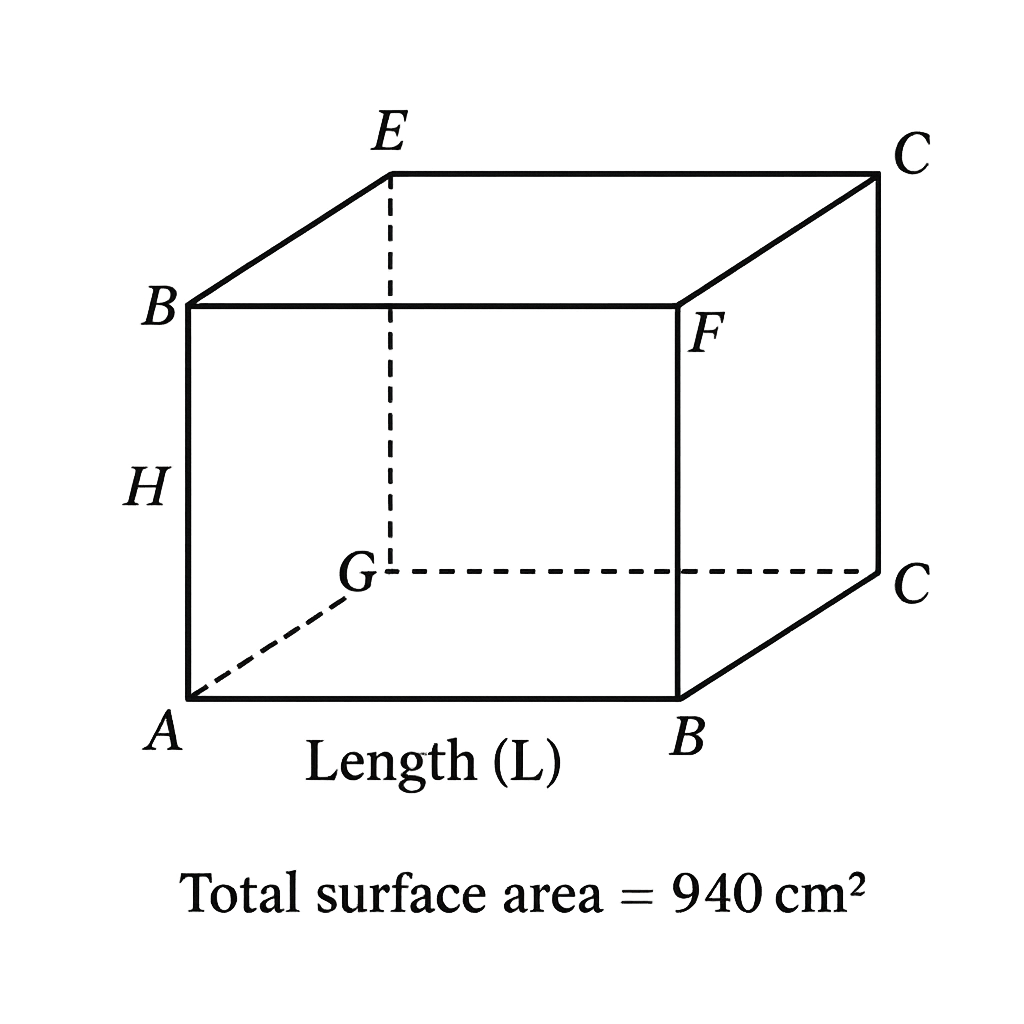
The diagram shows a right rectangular prism ABCD‑EFGH. Edges AB, BC and AE represent the length (L), width (W) and height (H) respectively. The ratio of the length to the width to the height is 3:4:5 and the total surface area of the prism is 940 cm².
Question Parts
(a)
State the ratio of the length : width : height of the prism.
(b)
Using the given surface area, determine the actual dimensions (L, W, H) in centimetres. Express each dimension in simplest radical form.
(c)
Calculate the length of the space diagonal of the prism. Give your answer in simplest radical form.
(d)
Find the ratio of the volume of the prism to its total surface area. Express the ratio in its simplest integer form a : b where a and b have no common factor.
Detailed Essay Solution & Marking Scheme Available

Get the step-by-step mathematical proofs, key points required by examiners, and a comprehensive breakdown from our AI Tutor.

Question 4 View Details
A secondary school has a total annual budget of ₦250,000. The budget is to be divided as follows: 12.5 % for sports, 18.75 % for arts, and the remainder for academic supplies. The amount allocated to academic supplies is then shared equally among three departments.
Question Parts
(a)
Calculate the amount (in naira) allocated to academic supplies.
(b)
State the amount each of the three departments receives from the academic supplies allocation, giving your answer to two decimal places.
(c)
The school decides to increase the sports allocation by 0.75 % of the total budget and to decrease the arts allocation by the same absolute amount. Determine the new percentages for sports and arts, and state the new amount (in naira) that remains for academic supplies after this adjustment.
Detailed Essay Solution & Marking Scheme Available

Get the step-by-step mathematical proofs, key points required by examiners, and a comprehensive breakdown from our AI Tutor.

Question 5 View Details
A secondary school is organising a field trip. The total amount allocated for the trip is ₦540,000. The cost per student consists of three components: transport, entry fee and meals. Transport costs are 40 % of the total cost per student, the entry fee is a fixed ₦1,500 per student and the remaining amount is spent on meals. The school wishes to take as many students as possible while ensuring that the total cost per student does not exceed ₦12,000. Furthermore, the school decides to give a 10 % discount on the entry fee for each student who brings a reusable water bottle. If 30 % of the students bring bottles, what is the new average cost per student? Answer the following: (a) Determine the maximum number of students that can attend the trip and the corresponding total cost per student. (b) Calculate the amount spent on transport, entry fee and meals per student for the situation in part (a). (c) Using the discount information, find the new average total cost per student.
Question Parts
(a)
Determine the maximum number of students that can attend the trip and the corresponding total cost per student.
(b)
Calculate the amount spent on transport, entry fee and meals per student for the situation in part (a).
(c)
Using the discount information, find the new average total cost per student.
Detailed Essay Solution & Marking Scheme Available

Get the step-by-step mathematical proofs, key points required by examiners, and a comprehensive breakdown from our AI Tutor.

Question 6 View Details
A rectangular garden measures 24 m in length and 18 m in width. The garden will be planted with roses and lilies. The area allocated to roses is in the ratio 3 : 5 of the area allocated to lilies. The cost of planting roses is ₦250 per square metre and lilies ₦180 per square metre. In addition, a fertilizer that covers the whole garden costs ₦12,000. Answer the following: (a) Determine the area (in square metres) to be planted with roses and with lilies. (b) Calculate the total cost of planting the two flower types together with the fertilizer. (c) If the gardener decides to increase the area for roses by 20 % while keeping the total garden area unchanged (the lily area is reduced accordingly), what will be the new total planting cost (excluding fertilizer)?
Question Parts
(a)
Determine the area (in square metres) to be planted with roses and with lilies.
(b)
Calculate the total cost of planting the two flower types together with the fertilizer.
(c)
If the gardener decides to increase the area for roses by 20 % while keeping the total garden area unchanged (the lily area is reduced accordingly), what will be the new total planting cost (excluding fertilizer)?
Detailed Essay Solution & Marking Scheme Available

Get the step-by-step mathematical proofs, key points required by examiners, and a comprehensive breakdown from our AI Tutor.

Question 7 View Details
A water tank in a school can hold 12,000 litres. Two electric pumps, Pump A and Pump B, are used to fill the tank. Pump A can fill the tank alone in 8 hours, while Pump B can fill it alone in 12 hours. Both pumps are switched on together, but after 3 hours Pump B develops a fault and stops working. The electricity cost is ₦15 per kilowatt‑hour, and Pump A consumes 0.75 kW while operating, whereas Pump B consumes 0.5 kW while operating.
Question Parts
(a)
Determine the total time required to fill the tank completely.
(b)
Calculate the total electricity cost incurred in filling the tank.
(c)
If the school wants to reduce the total cost by 20 % without changing the pumps, suggest one practical change and justify how it achieves the reduction.
Detailed Essay Solution & Marking Scheme Available

Get the step-by-step mathematical proofs, key points required by examiners, and a comprehensive breakdown from our AI Tutor.

Question 8 View Details
The power consumption P (in kilowatts) of a LED lighting tube of length L metres is modelled by the quadratic relation P(L)=0.02L²+0.3L. The school intends to install tubes of length 2.05 m but only has the exact power value for a 2.00 m tube, which is P(2.00)=0.68 kW.
Question Parts
(a)
Using linear approximation at L = 2.00 m, estimate the power consumption of a 2.05 m tube.
(b)
Compute the exact power consumption for a 2.05 m tube using the given formula.
Detailed Essay Solution & Marking Scheme Available

Get the step-by-step mathematical proofs, key points required by examiners, and a comprehensive breakdown from our AI Tutor.

Question 9 View Details
Consider the equation \(\dfrac{2^{x}\, 3^{2y}}{6^{z}} = 12^{k}\), where \(x, y, z, k\) are positive integers. It is also given that \(x + y = 10\) and \(z = y - 2\).
Question Parts
(a)
Rewrite the left‑hand side of the equation in the form \(2^{A}\,3^{B}\).
(b)
Using the result from part (a) and the given relations, determine the values of \(x, y, z\) and \(k\).
Detailed Essay Solution & Marking Scheme Available

Get the step-by-step mathematical proofs, key points required by examiners, and a comprehensive breakdown from our AI Tutor.

Question 10 View Details
Let \(f(x) = ax^{3}+bx^{2}+cx+d\) be a cubic polynomial with integer coefficients.
Question Parts
(a)
It is known that \(f(1)=10\), \(f(2)=20\) and that \((x-3)\) is a factor of \(f(x)-5x\). Determine the values of \(a, b, c\) and \(d\).
(b)
Show that \(f(x)\) can be expressed in the form \((x-3)g(x)+5x\) and determine the quadratic polynomial \(g(x)\).
Detailed Essay Solution & Marking Scheme Available

Get the step-by-step mathematical proofs, key points required by examiners, and a comprehensive breakdown from our AI Tutor.

Master the Exam!

You've seen a preview, but there are thousands more questions plus AI tutor to break down complex solutions.

Unlock Full Access Available for Android & Windows
Help others prepare! Share this practice hub:
Chat with Support