bece model questions vol1 2024 mathematics | Essay

Prepare for your exams with bece model questions vol1 questions? Reviewing past/model questions is one of the most effective ways to guarantee a high score. This practice hub features authentic 2024 mathematics (Essay) questions designed to simulate the real exam environment.

Practice these randomly selected questions to test your readiness.

Question 1 View Details
A five‑digit integer N satisfies the following conditions: (i) Its digits, when written in base 10, are in strictly increasing order from left to right. (ii) When N is expressed in base 5 the representation is 2431₅. (iii) The sum of the base‑10 digits of N equals the product of its first and last digits. Determine the value of N in base 10.
Question Parts
(a)
Convert 2431₅ to its decimal (base 10) equivalent.
(b)
Check whether the digits of 366 are in strictly increasing order. If they are not, explain why the given conditions cannot be satisfied.
(c)
If the examiner intended the number of digits to be five after conversion, propose a corrected base‑5 representation that would meet the three conditions and give the corresponding decimal number.
Detailed Essay Solution & Marking Scheme Available

Get the step-by-step mathematical proofs, key points required by examiners, and a comprehensive breakdown from our AI Tutor.
Question 2 View Details
A school has exactly 144 students who are to be divided into equal teams for the annual sports day. The organiser requires that: (i) the number of teams must be a divisor of 144; (ii) the number of teams must also be a multiple of 6; (iii) the size of each team (students per team) should be as large as possible while still satisfying (i) and (ii). Determine: (a) the number of teams, (b) the number of students in each team, (c) the greatest common divisor (GCD) of the two numbers found in (a) and (b), and (d) give a brief justification why this arrangement gives the maximum possible team size.
Question Parts
(a)
Find the number of teams that satisfies conditions (i) and (ii).
(b)
Calculate the number of students per team based on the answer to part (a).
(c)
Find the greatest common divisor (GCD) of the numbers obtained in (a) and (b).
(d)
Explain briefly why the arrangement found in (a) and (b) gives the maximum possible number of students per team.
Detailed Essay Solution & Marking Scheme Available

Get the step-by-step mathematical proofs, key points required by examiners, and a comprehensive breakdown from our AI Tutor.

Question 3 View Details
A school canteen sells three types of snack packs. The number of packs of type A sold in a week is \(\frac{2}{5}\) of the total packs sold. The number of packs of type B sold is \(\frac{3}{8}\) of the remaining packs after type A sales. The rest are type C packs.
Question Parts
(a)
If the total number of snack packs sold in the week is 240, calculate the number of packs of each type.
(b)
The profit per pack is \(\₦120\) for type A, \(\₦150\) for type B and \(\₦200\) for type C. Determine the total profit earned from the snack sales.
(c)
The canteen wants to increase the total profit by 25 % next week while keeping the same proportion of sales among the three types. Find the minimum total number of packs that must be sold next week to achieve this target profit.
Detailed Essay Solution & Marking Scheme Available

Get the step-by-step mathematical proofs, key points required by examiners, and a comprehensive breakdown from our AI Tutor.

Question 4 View Details
A farmer measures the yield of three adjacent fields of maize. The yields per hectare are 2.35 tonnes, 3.12 tonnes and 4.07 tonnes respectively. The areas of the fields are in the ratio 5 : 7 : 8 and the total combined area of the three fields is 100 hectares.
Question Parts
(a)
Calculate the total yield (in tonnes) from the three fields combined.
Detailed Essay Solution & Marking Scheme Available

Get the step-by-step mathematical proofs, key points required by examiners, and a comprehensive breakdown from our AI Tutor.

Question 5 View Details
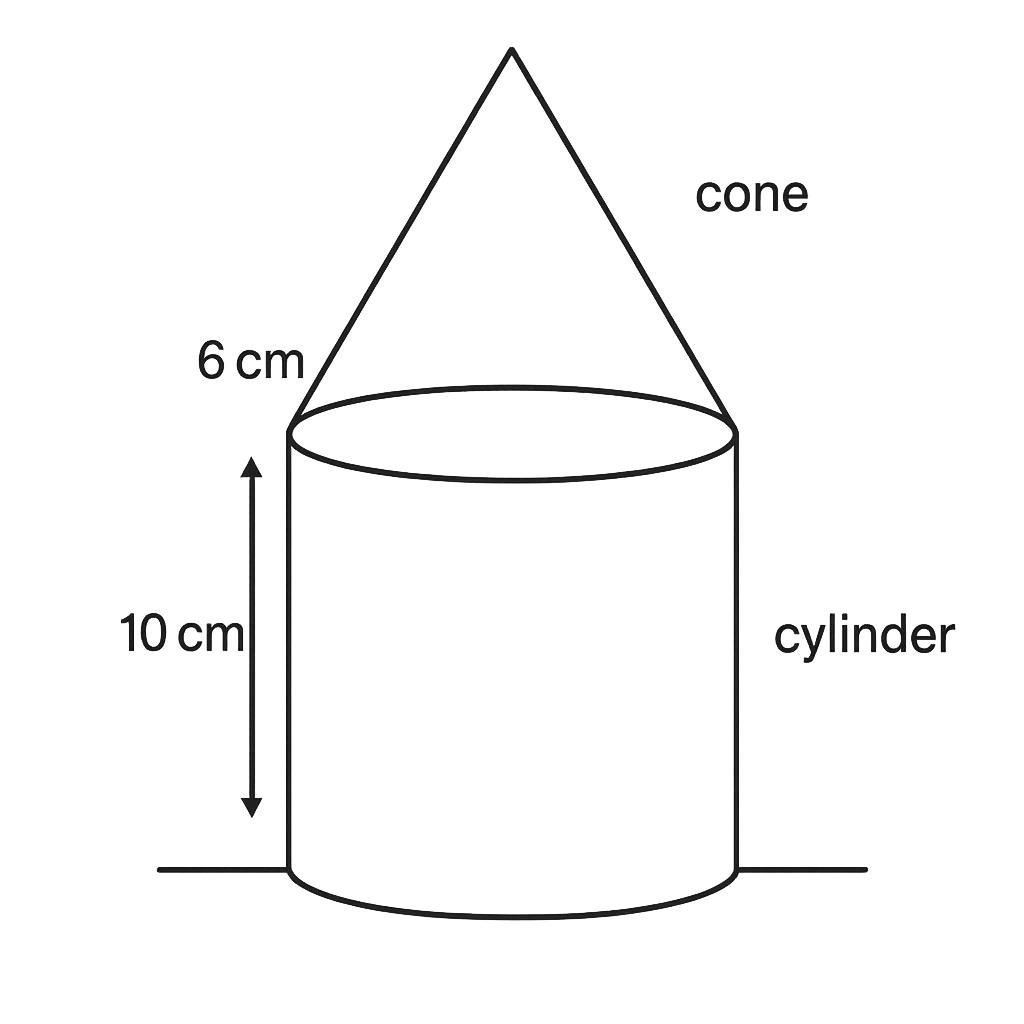
The diagram shows a solid formed by a right circular cylinder of radius 6 cm and height 10 cm, with a right circular cone of height 8 cm placed on top of the cylinder (the cone and cylinder share the same circular base). The solid rests on a flat surface, so the bottom base of the cylinder is not exposed.
Question Parts
(a)
Determine the total exposed surface area of the solid (do not include the bottom base of the cylinder that rests on the floor). Give your answer in terms of \(\pi\) and also as a decimal to one decimal place (cm²).
(b)
Find the total volume of the solid. Express your answer in terms of \(\pi\) and also as a decimal to one decimal place (cm³).
(c)
The exposed surfaces of the solid are to be painted at a cost of ₦45 per cm². Calculate the total cost of painting. Give the answer in naira to the nearest naira.
(d)
If the solid is filled completely with water, and water costs ₦0.12 per cm³, determine the total cost of filling the solid. Give the answer in naira to the nearest naira.
Detailed Essay Solution & Marking Scheme Available

Get the step-by-step mathematical proofs, key points required by examiners, and a comprehensive breakdown from our AI Tutor.

Question 6 View Details
A traditional Nigerian soup recipe calls for water, stockfish and meat in the volume ratio 5 : 3 : 2. The cook has 12 L of water available and wishes to use all of it. Answer the following:
Question Parts
(a)
Determine the volumes of stockfish and meat required to keep the original ratio.
(b)
If the cook increases the amount of meat by 25 % while keeping the original ratio of water : stockfish : meat, how many additional litres of water must be added?
Detailed Essay Solution & Marking Scheme Available

Get the step-by-step mathematical proofs, key points required by examiners, and a comprehensive breakdown from our AI Tutor.

Question 7 View Details
A water tank can be filled by two electric pumps, Pump A and Pump B. Pump A can fill the tank in 6 hours when it works alone. When both pumps operate together, the tank is filled in 4 hours. After 2 hours of combined operation, Pump A breaks down and Pump B continues alone until the tank is full.
Question Parts
(a)
Determine the rate of Pump B in tanks per hour and state how long Pump B would take to fill the tank by itself.
(b)
Calculate the total time required to fill the tank when both pumps work together from the start.
(c)
Using the situation described, find the additional time required after the breakdown for Pump B to finish filling the tank.
Detailed Essay Solution & Marking Scheme Available

Get the step-by-step mathematical proofs, key points required by examiners, and a comprehensive breakdown from our AI Tutor.

Question 8 View Details
A circular field has a radius of 47 metres. For a quick estimate, a farmer rounds the radius to the nearest ten metres and uses π ≈ 3.14 to compute the area.
Question Parts
(a)
Using the rounded radius (50 m) and π ≈ 3.14, calculate the estimated area of the field. Give your answer to the nearest hundred square metres.
(b)
Calculate the exact area using the true radius 47 m and π ≈ 3.1416. Give the result to the nearest square metre.
(c)
Determine the percentage error of the estimate obtained in part (a) relative to the exact area found in part (b).
(d)
Improve the estimate by using π ≈ 22/7 and the actual radius 47 m. Compute this improved area (nearest square metre) and the new percentage error. Comment on which method gives a more accurate approximation.
Detailed Essay Solution & Marking Scheme Available

Get the step-by-step mathematical proofs, key points required by examiners, and a comprehensive breakdown from our AI Tutor.

Question 9 View Details
Consider the expression involving indices: \[ \frac{2^{x}\,\cdot\,3^{2x}}{6^{\,x-1}} = 54 \] Answer the following questions.
Question Parts
(a)
Using the laws of indices, rewrite the left‑hand side in the form \(2^{m}\,\cdot\,3^{n}\). State the values of \(m\) and \(n\).
(b)
Hence solve for the integer value of \(x\) that satisfies the equation.
(c)
Define \(y = 2^{x}\,\cdot\,3^{x}\). Using the value of \(x\) found, compute \(y\).
Detailed Essay Solution & Marking Scheme Available

Get the step-by-step mathematical proofs, key points required by examiners, and a comprehensive breakdown from our AI Tutor.

Question 10 View Details
The cubic polynomial \(P(x)=x^{3}-a x^{2}+b x-30\) is known to be exactly divisible by the quadratic \(Q(x)=x^{2}-5x+6\). Answer the questions below.
Question Parts
(a)
Determine the values of the constants \(a\) and \(b\).
(b)
Write the complete factorisation of \(P(x)\) using the values of \(a\) and \(b\) found.
(c)
Let \(p\) and \(q\) be the roots of the quadratic \(Q(x)\). Compute \(p^{3}+q^{3}\).
Detailed Essay Solution & Marking Scheme Available

Get the step-by-step mathematical proofs, key points required by examiners, and a comprehensive breakdown from our AI Tutor.

Master the Exam!

You've seen a preview, but there are thousands more questions plus AI tutor to break down complex solutions.

Unlock Full Access Available for Android & Windows
Help others prepare! Share this practice hub:
Chat with Support