WAEC 2025 Physics | Practical

Prepare for your exams with WAEC questions? Reviewing past/model questions is one of the most effective ways to guarantee a high score. This practice hub features authentic 2025 Physics (Practical) questions designed to simulate the real exam environment.

Practice these randomly selected questions to test your readiness.
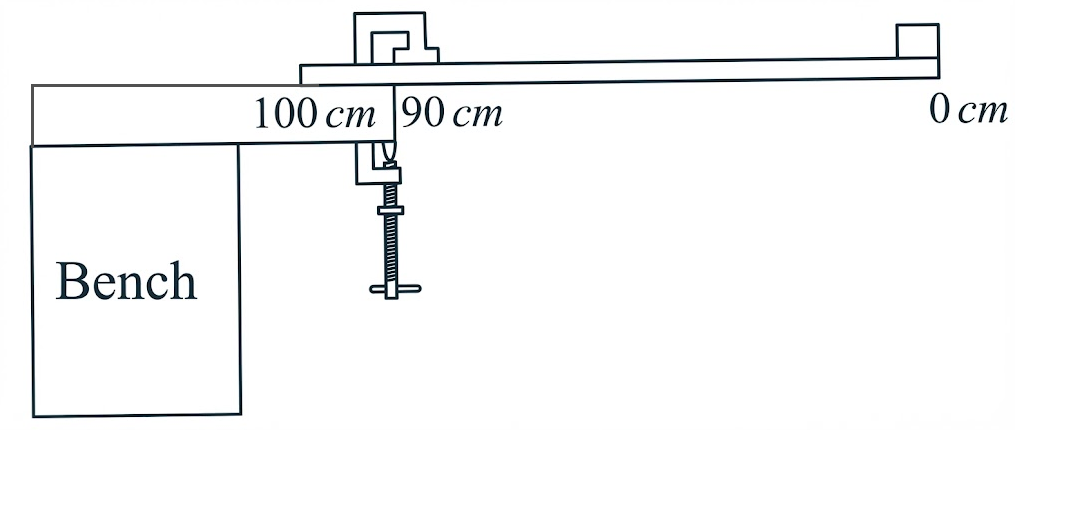
Question 1 View Details
You are provided with a G clamp, metre rule, masses, sellotape and stopwatch. Study the diagram above.
Question Parts
(a)
Carry out the following instructions: (i) Clamp the metre rule firmly to the workbench such that 90 cm of its length is projected outward. (ii) Use some sellotape to attach a mass M = 150 g at the free end of the metre rule. (iii) Depress the loaded end of the metre rule and determine the time, t for 10 complete vertical oscillations. (iv) Determine the period T, of one complete oscillation. (v) Evaluate Log T and Log M. (vi) Repeat the procedure for four other values of M = 200 g, 250 g, 300 g, and 350 g. (vii) Tabulate the results. (viii) Plot a graph with log T on the vertical axis and log M on the horizontal axis. (ix) Determine the slope, s, of the graph. (x) If a mass, M0 = 280 g is placed at the free end of the rule, determine the time t0 for 10 complete vertical oscillations of the cantilever from the graph. (xi) State two precautions taken to ensure accurate results.
(b)
(i) A loaded test tube floats vertically in a liquid. If it is depressed slightly and released, how do the quantities below vary as the test tube moves towards the equilibrium position: I. speed of the test tube II. restoring force in the test tube? (ii) A catapult of elastic constant 160 Nm^-1 is stretched by 10 cm and it is used to propel a stone of mass 40 g. Calculate the speed with which it is propelled.
Detailed Essay Solution & Marking Scheme Available

Get the step-by-step mathematical proofs, key points required by examiners, and a comprehensive breakdown from our AI Tutor.
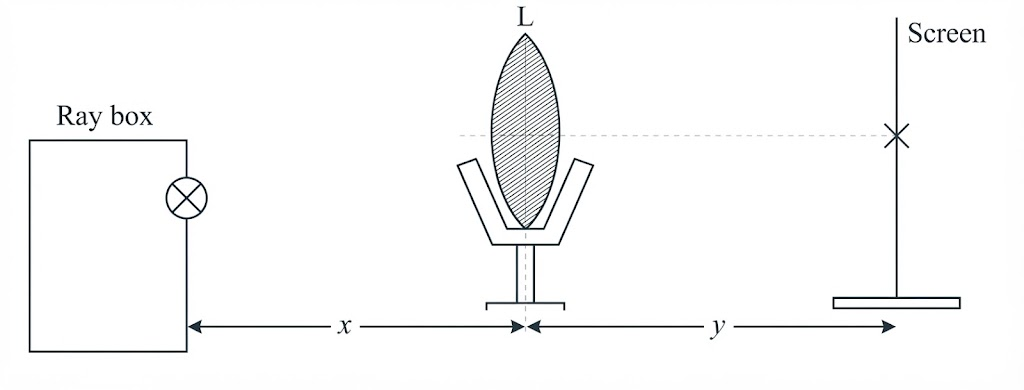
Question 2 View Details
Question Parts
(a)
You are provided with a ray box, a converging lens L, a lens holder, a meter rule, a screen and other necessary apparatus in holder, and move it towards or away from the screen until (i) Place the lens L in its holder, and move it towards or away from the screen until a clear image of a distant object is formed on the screen. (ii) Determine the approximate focal length of the lens. (iii) Set up the apparatus as shown in the diagram. (iv) With \( x=70 \mathrm{~cm} \), adjust the position of the screen until a clear image of the illuminated object is formed on the screen. (v) Measure and record the distance \( y \). (vi) Evaluate \( K=\frac{x}{y} \). (vii) Repeat the procedure with \( x=60.0 \mathrm{~cm}, 50.0 \mathrm{~cm}, 45.0 \mathrm{~cm} \) and 40.0 cm and in each record \( y \) and evaluate \( K=\frac{x}{y} \). (viii) Tabulate the results. (ix) Plot a graph of \( x \) on the vertical axis and \( K \) on the horizontal axis starting both axes from the origin \( (0,0) \). (x) Determine the slope, \( s \) of the graph and the intercept, \( c \) on the vertical axis. (xi) Using the graph, determine the value of \( y \) when \( x=48.0 \mathrm{~cm} \). (xii) State two precautions taken to ensure correct results.
(b)
(i) Explain the term conjugate foci of a converging lens. (ii) A converging lens of focal length 20 cm produces a virtual image 3 times the size of the object. Calculate the image distance.
Detailed Essay Solution & Marking Scheme Available

Get the step-by-step mathematical proofs, key points required by examiners, and a comprehensive breakdown from our AI Tutor.
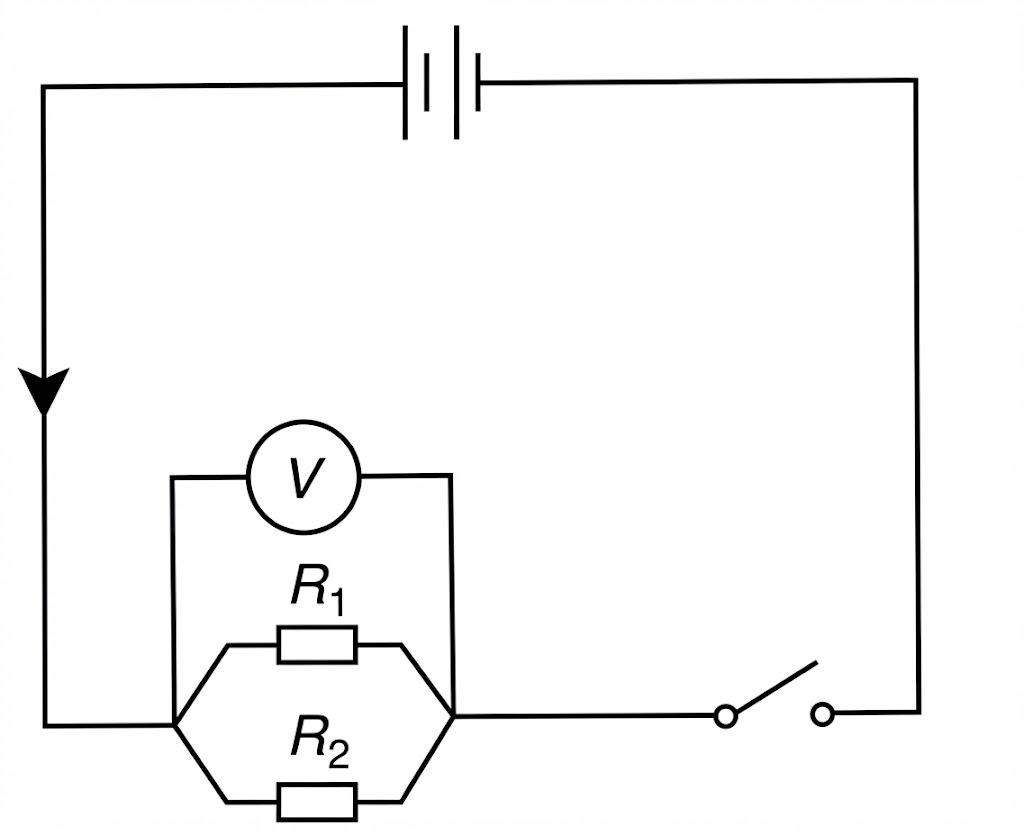
Question 3 View Details
Question Parts
(a)
(i) Connect the circuit as shown above leaving the key open. (ii) Close the key and adjust the meostat until the ammeter reads \( \mathrm{I}=0.20 \mathrm{~A} \). (iii) Record the corresponding voltmeter reading \( V \) (iv) Evaluate Log V and Log I. (v) Repeat the experiment for \( \mathrm{I}=0.30 \mathrm{A}, 0.40 \mathrm{A}, 0.50 \mathrm{A} \) and \( 0.60 \mathrm{A} \) for each case, record V, Log V and Log I. (vi) Tabulate the results. (vii) Plot a graph with Log V on the vertical axis and Log I on the horizontal axis starting both axes from the origin. (viii) Determine the slope, \( s \), of the graph. (ix) Determine the intercept, \( c \) on the Log I axis. (x) Calculate the value of R, in the equation \( \log R_{T}=c \) (xi) State two precautions taken to obtain accurate results.
(b)
(i) Define the term volt. (ii) A battery has an emf of 120 V and an internal resistance of \( 0.5 \Omega \). If a \( 2 \Omega \)
Detailed Essay Solution & Marking Scheme Available

Get the step-by-step mathematical proofs, key points required by examiners, and a comprehensive breakdown from our AI Tutor.

Master the Exam!

You've seen a preview, but there are thousands more questions plus AI tutor to break down complex solutions.

Unlock Full Access Available for Android & Windows
Help others prepare! Share this practice hub:
Chat with Support