WAEC 2022 Chemistry | Essay

Prepare for your exams with WAEC questions? Reviewing past/model questions is one of the most effective ways to guarantee a high score. This practice hub features authentic 2022 Chemistry (Essay) questions designed to simulate the real exam environment.

Practice these randomly selected questions to test your readiness.

Question 1 View Details
Question Parts
(a(i))
Define an acid according to the Lewis concept.
(a(ii))
Give one example of a Lewis acid.
(b)
Explain salting out in soap preparation.
(c)
State the reagent and condition necessary for the following conversion: \[ \mathrm{H}-\mathrm{C} \equiv \mathrm{C}-\mathrm{H} \rightarrow \mathrm{Ag}-\mathrm{C} \equiv \mathrm{C}-\mathrm{Ag} \]
(d)
What is the percentage abundance of an isotope?
(e(i))
Why does the element with atomic number 18 not have an oxide?
(e(ii))
Explain why chlorine (I) oxide has a low melting point.
(f)
Describe a test to distinguish between concentrated \( \mathrm{HNO}_{3} \) and concentrated \( \mathrm{H}_{2} \mathrm{SO}_{4} \).
(g)
State two differences between an electrochemical cell and an electrolytic cell.
(h)
How does the trend in ionization energy affect the reactivity of group 1 elements?
(i)
Define the term molecular formula.
(j(i))
State which of the gases \( \mathrm{H}_{2} \) and \( \mathrm{NH}_{3} \) would deviate more from ideal behaviour.
(j(ii))
Give reasons for the answer stated in 1(j)(i).
Detailed Essay Solution & Marking Scheme Available

Get the step-by-step mathematical proofs, key points required by examiners, and a comprehensive breakdown from our AI Tutor.
Question 2 View Details
Question Parts
(a(i))
Define the first ionization energy of an element.
(a(ii))
Consider the following table and use it to answer the question that follows; \( \begin{array}{|l|c|c|c|c|c|c|c|c|}\hline \text{Element} & \text{Li} & \text{Be} & \text{B} & \text{C} & \text{N} & \text{O} & \text{F} & \text{Ne} \\\\ \hline \text{Atomic No.} & 3 & 4 & 5 & 6 & 7 & 8 & 9 & 10 \\ \hline 1^{\text{st}}\\ I.E / \text{kJ mol}^{-1} & 520 & 900 & 801 & 1086 & 1402 & 1314 & 1681 & 2081 \\ \hline \end{array} \)Explain briefly why the first ionization energy of B is less than that of Be despite the fact that the atomic number of B is greater than that of Be.
(b)
When Titanium chloride was electrolysed by passing \( 0.12 A \) current through the solution for 500 seconds, 0.015 g of titanium was deposited. What is the charge on the titanium ion? \[ [\mathrm{IF}=96500 \mathrm{C}, \mathrm{Ti}=48.0] \]
(c(i))
Aluminium can be obtained by the application of electrolysis. State the electrolyte which yields aluminium on electrolysis.
(c(ii))
Name two major factors which would favour the siting of an aluminium smelter in a country.
(d(i))
Define the term paramagnetism.
(d(ii)(1))
Consider the following ions: \[ 24^{\mathrm{Cr}^{2+}}, 24^{\mathrm{Cr}^{6+}} \] Deduce the number of unpaired electrons in each of the ions.
(d(ii)(II))
State which of the ions will have a greater power of paramagnetism.
(d(iii))
Give a reason for the answer stated in 2d(ii)(II).
Detailed Essay Solution & Marking Scheme Available

Get the step-by-step mathematical proofs, key points required by examiners, and a comprehensive breakdown from our AI Tutor.

Question 3 View Details
Question Parts
(a(i))
Define the term Avogadro's number.
(a(ii))
If \( 2.30 g \) of an oxide of nitrogen, \( x \), contains \( 3.01 \times 10^{22} \) molecules, calculate the molar mass of \( x \).
(a(iii))
Deduce the formula of \( x \). \[ \left[\mathrm{N}_{ ext{A}}=6.02 \times 10^{23}, \mathrm{~N}=14.0, \mathrm{O}=16.0\right] \]
(b(i))
Describe briefly what happens when each of the following substances are added to water: (I) \( \mathrm{CCl}_{4} \); (II) \( \mathrm{SiCl}_{4} \)
(b(ii))
Explain briefly why the reactions in 3b(i) and 3b(i) (II) are different.
(c(i))
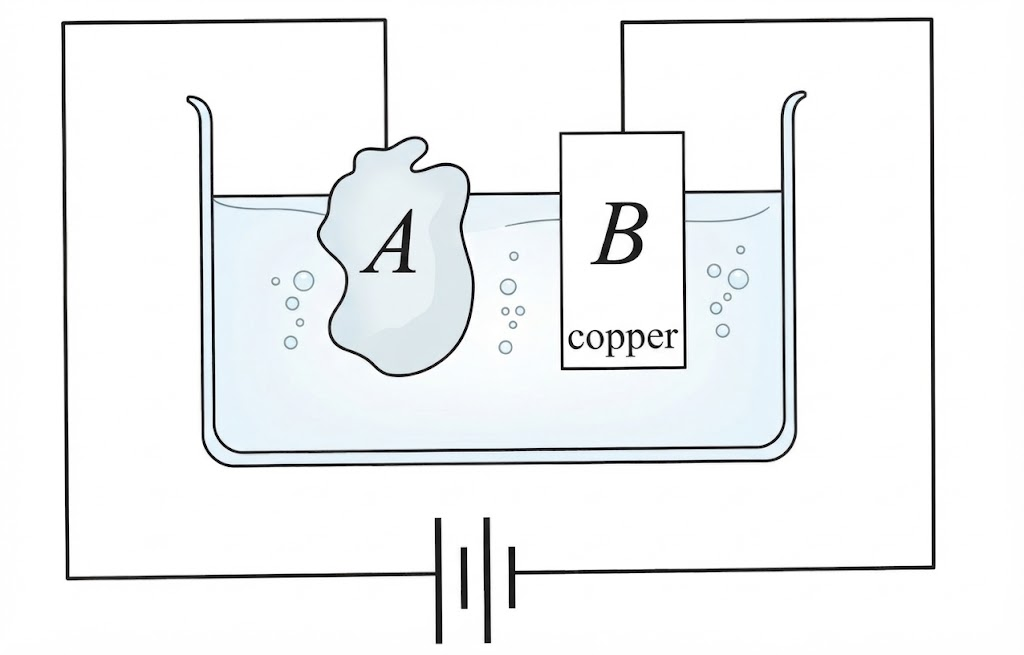
Study the diagram below and answer the questions that follow. (i) What is the set-up used for?
(c(ii))
Mention two compounds that could be used as electrolytes in the cell.
(c(iii))
Write a half-cell equation for the reaction at the anode.
(c(iv))
Calculate the electrochemical equivalent of copper if the cathode gained mass of 3.2 g when 50 amperes of current was passed for 3 minutes 13 seconds.
Detailed Essay Solution & Marking Scheme Available

Get the step-by-step mathematical proofs, key points required by examiners, and a comprehensive breakdown from our AI Tutor.

Question 4 View Details
Question Parts
(a(i))
State two conditions used in the Haber process.
(a(ii))
Explain briefly the effect of increasing the pressure on the rate of reaction in the Haber process.
(b(i))
A mixture of nitrogen (IV) oxide and oxygen is bubbled into warm water to produce trioxonitrate (V) oxide, write a balanced chemical equation for the reaction.
(b(ii))
Using a balanced chemical equation only, explain what would happen if nitrogen (IV) oxide is bubbled into warm water.
(b(iii))
Compare the gases evolved when trioxonitrate (V) acid decomposes under each of the following properties: (I) pH; (II) Solubility in water, (III) Reaction with carbon (II) oxide.
(c(i))
Name two oxides of sulphur.
(c(ii))
Write a balanced equation for the reaction between each of the named oxides in 4c(i) and water.
(d)
Name one calcium compound: (i) used to dry ammonia gas; (ii) used in the manufacture of cement; (iii) that causes hardness in water; (iv) referred to as plaster of paris.
Detailed Essay Solution & Marking Scheme Available

Get the step-by-step mathematical proofs, key points required by examiners, and a comprehensive breakdown from our AI Tutor.

Question 5 View Details
Question Parts
(a(i))
Describe the observation that would be made when: (i) sulphur is heated from room temperature till 119°C; (ii) \( 50 \% \) trioxonitrate (V) acid acts on copper tunings.
(b(i))
State two gaseous pollutants that can be generated by burning coal.
(b(ii))
What gas is responsible for most of the explosions in coal mines?
(b(iii))
The mining of coal leads to environmental pollution. State two environmental effects of the mining activity.
(b(iv))
Explain briefly why coal burns more easily when it is in pieces than in lump form.
(b(v))
Name the non-volatile residue after the destructive distillation of coal.
(c(i))
Describe a chemical test for water.
(c(ii)(i))
State the effect of: (i) boiling a temporary hard water; (II) adding sodium trioxocarbonate (IV) crystals to permanent hard water.
(c(iii))
Write an equation for the process in 5c(ii)(I).
(d)
With the aid of a labelled diagram, describe briefly the laboratory preparation of oxygen gas.
Detailed Essay Solution & Marking Scheme Available

Get the step-by-step mathematical proofs, key points required by examiners, and a comprehensive breakdown from our AI Tutor.

Master the Exam!

You've seen a preview, but there are thousands more questions plus AI tutor to break down complex solutions.

Unlock Full Access Available for Android & Windows
Help others prepare! Share this practice hub:
Chat with Support