UTME 2020 Biology | Objective

Practice these randomly selected questions to test your readiness.

Question 1
The lumbar vertebra when compared with a thoracic vertebra has a
A. longer neural spine
B. wider neural canal
C. thicker centrum
D. shorter transverse process.
Question 2
Fatigue of leg muscles may occur after riding many kilometers on a bicycle because of
A. insufficient glucose
B. excess carbon dioxide
C. excess protein
D. insufficient oxygen.
Question 3
Adaptive radiation is illustrated in
A. modified insect mouthparts.
B. dentition in mammals.
C. wings in birds and bats.
D. appendages in insects.
Question 4
According to Darwin, the driving force behind evolutionary change is
A. natural selection
B. genetic drift
C. mutation
D. gene flow
Question 5
The correct sequence of tissues in the anatomy of a young dicotyledonous stem from the inside to the outside is
A. pith, phloem, cambium, xylem, parenchyma, collenchyma and epidermis
B. xylem, phloem, cambium, cortex, endodermis, collenchyma and epidermis
C. pith, xylem, cambium, phloem, collenchyma, parenchyma and epidermis
D. phloem, xylem, cambium, cortex, endodermis, collenchyma and epidermis.
Question 6
Which of the following instruments is used for determining turbidity of water?
A. Thermometer
B. Secchi disc
C. Rain gauge
D. Hygrometer
Question 7
In a tropical rain forest, non-epiphytic ferns and allies occur as
A. middle storey species
B. upper storey species
C. shade-loving species
D. emergent species.
Question 8
Viruses are regarded as non-living because they
A. can neither reproduce asexually nor sexually
B. cannot survive in their respective environments
C. do not possess characteristics that can be transmitted from one generation to the next
D. can neither respire nor excrete.
Question 9
The water cycle is maintained mainly by
A. evaporation of water in the environment
B. evaporation and condensation of water in the environment
C. condensation of water in the environment
D. transpiration and respiration in plants.
Question 10
\( 6\text{CO}_2 + 6\text{H}_2\text{O} \xrightarrow[\text{Chlorophyll}]{\text{Sunlight}} \text{C}_6\text{H}_{12}\text{O}_6 + 6\text{O}_2 \uparrow \) The process represented by the above equation is
A. proteinsynthesis
B. respiration
C. photosynthesis
D. transpiration
Question 11
A boy who is fond of swimming in a pond finds himself passing urine with traces of blood. He is likely to have contracted
A. schistosomiasis
B. onchocerciasis
C. poliomyelitis
D. salmonellosis
Question 12
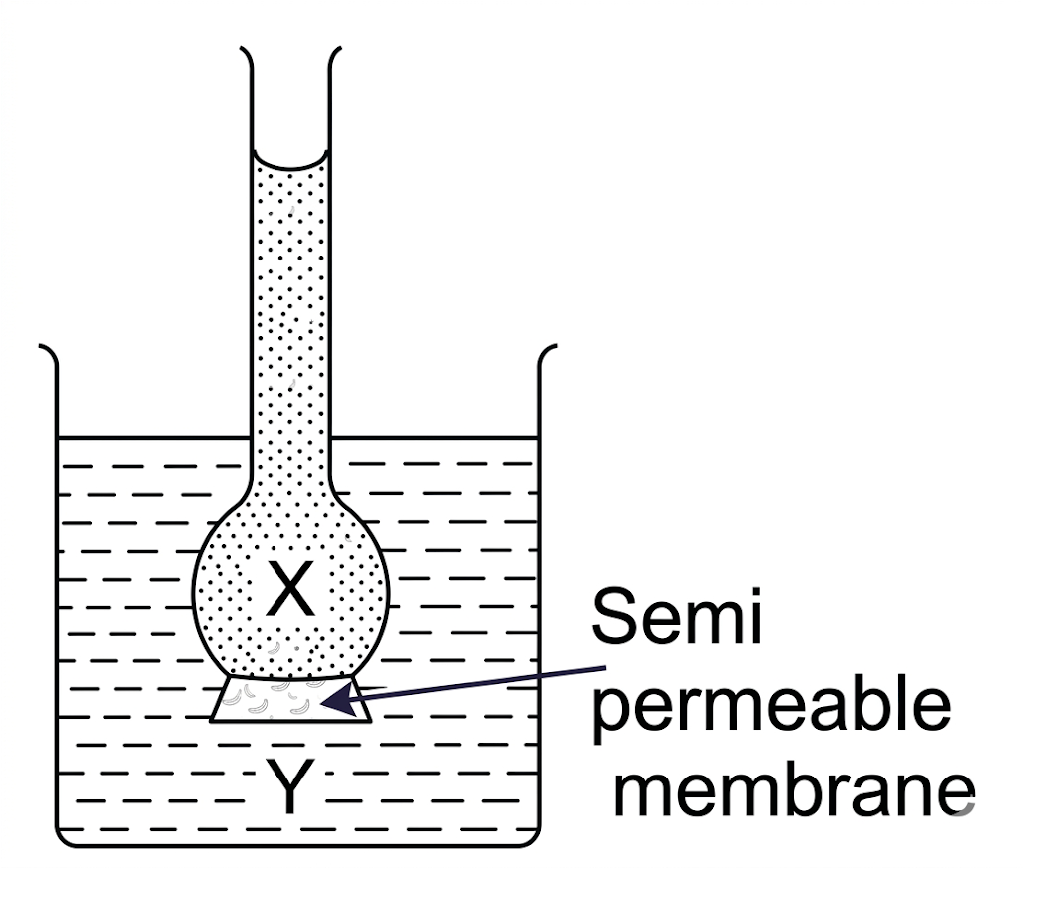
What would happen if solution Y is more concentrated than solution X in the figure above?
A. The level of X would rise, Y would fall
B. The level of X would rise, Y would rise
C. The levels of X and Y would stay the same
D. The level of Y would rise, X would fall
Question 13
One adaptation of reptiles to water loss is the presence of
A. keratinous scales
B. claws on limbs
C. long tails
D. long sticky tongues
Question 14
The vacuole of a plant cell is
A. a large empty space
B. smaller than that of an animal cell
C. filled with air
D. surrounded by a membrane
Question 15
The process of deamination is essential for the
A. digestion of protein
B. secretion of bile
C. formation of urea
D. formation of antibody

Master the Exam!

You've seen a preview, but there are thousands more questions plus AI tutor to break down complex solutions.

Unlock Full Access Available for Android & Windows
Help others prepare! Share this practice hub: